Paleontologists have unveiled a groundbreaking reclassification of a fossil previously identified as Pohlsepia, a purported ancient octopus. New research suggests that this enigmatic creature, dating back over 300 million years to the Carboniferous period, is, in fact, a nautilus, now scientifically designated as Paleocadmus. This revision challenges long-held assumptions about the evolutionary history and diversity of cephalopods during this crucial era of marine life. The findings, which stem from a detailed re-examination of existing fossil evidence and comparative anatomy, are poised to reshape our understanding of early marine ecosystems.
The original identification of Pohlsepia as an octopus was based on its supposed soft-bodied nature and the absence of a discernible shell in the fossil record. However, the recent re-analysis, spearheaded by a team of researchers at the University of Reading, has revealed subtle anatomical features and taphonomic processes that point towards a different interpretation. The fossil, discovered in Mazon Creek, Illinois, a renowned Lagerstätte for exceptional fossil preservation, has long been a subject of scientific intrigue.
A New Interpretation of Ancient Remains
The reclassification hinges on several key observations. Firstly, the presumed "mantle" of Pohlsepia, once interpreted as the soft body of an octopus, bears a striking resemblance to the internal organs and musculature of a nautilus. Specifically, the arrangement of muscle scars and the overall shape are more consistent with the cephalopod anatomy of nautiloids, the ancient relatives of modern nautiluses. Secondly, the lack of a distinct beak, a characteristic feature of octopuses, further supports the nautilus hypothesis. While octopuses possess a prominent, parrot-like beak, nautiluses have a less conspicuous, chitinous structure.
Furthermore, the research team posits that the fossil preservation process may have led to the misinterpretation of a disarticulated nautilus shell. In the original interpretation, the absence of a shell was seen as evidence of a soft-bodied cephalopod like an octopus. However, it is now suggested that the shell of Paleocadmus may have separated from its body during decomposition and drifted away or become buried separately in the sediment, leaving behind only the impression of the soft tissues. This phenomenon, known as disarticulation, is not uncommon in fossilization processes and can complicate the identification of ancient organisms.
The Carboniferous Context: A Flourishing Marine World
The Carboniferous period, spanning approximately 359 to 299 million years ago, was a time of immense biological innovation. On land, vast forests of ferns, horsetails, and early seed plants dominated the landscape, giving rise to the coal deposits we utilize today. In the oceans, marine life experienced a significant diversification. Cephalopods, a class of mollusks that includes nautiluses, squid, and octopuses, were particularly successful.
During the Carboniferous, nautiloids were a diverse and abundant group, occupying various ecological niches. Some were elongated and straight-shelled, while others, like the ancestors of modern nautiluses, had coiled shells. The evolution of the octopus lineage was also underway, though their fossil record from this period is considerably sparser, primarily due to their soft-bodied nature and lack of a hard shell, which makes them less likely to be preserved.
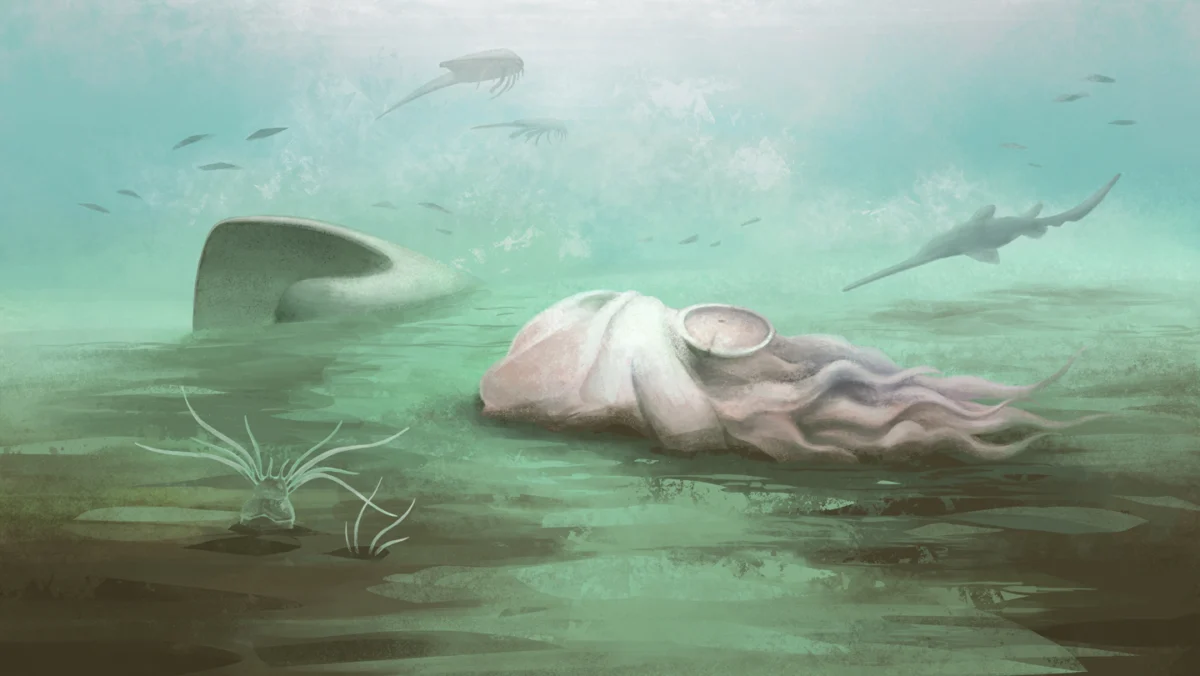
The Mazon Creek Lagerstätte, where the Pohlsepia fossil was found, is renowned for its exceptional preservation of soft-bodied organisms. The unique conditions of anoxic, saline waters and rapid burial in siderite concretions have allowed for the preservation of fine details, including muscles, organs, and even gut contents. This makes it a treasure trove for understanding the soft anatomy of prehistoric life. The fossil’s illustration depicts Paleocadmus decaying on the seafloor, with its separated shell visible in the background. The illustration also includes other marine life from the era, such as the marine worm Esconites zelus and Bandringa rayi, a relative of sharks, highlighting the rich biodiversity of the time.
A Timeline of Discovery and Reinterpretation
The initial discovery and description of Pohlsepia occurred in the early 20th century, a period when paleontological understanding of cephalopod evolution was still developing. The fossil was formally described by Charles R. Eastman in 1900, who, based on the available evidence, classified it as a new genus and species of octopus. This classification remained largely unchallenged for over a century, becoming a textbook example of an ancient octopus.
The re-examination of the Pohlsepia fossil, and indeed many other fossils from Mazon Creek, has been an ongoing process facilitated by advancements in imaging technologies and comparative anatomy. The University of Reading team’s work represents the latest significant step in this ongoing scientific inquiry. Their findings were published in a peer-reviewed journal, undergoing rigorous scrutiny by other experts in the field.
The process of reclassification is a fundamental aspect of scientific progress. As new evidence emerges and analytical techniques improve, previously established theories and classifications are often revised or overturned. This iterative process ensures that scientific knowledge remains dynamic and reflective of the most current understanding of the natural world.
Expert Perspectives and Potential Implications
Dr. Thomas Clements, the lead author of the study and a paleontologist at the University of Reading, expressed his enthusiasm about the discovery. "This reinterpretation of Pohlsepia as Paleocadmus is significant because it provides a more accurate picture of cephalopod diversity during the Carboniferous period," Dr. Clements stated in a press release. "It highlights how readily our understanding of ancient life can be refined with careful re-examination of existing specimens and the application of modern scientific tools."
The implications of this reclassification extend beyond simply renaming a fossil. It suggests that the diversity of nautiloids may have been even greater than previously thought, and that the evolutionary trajectory of octopuses might have been different. While octopuses eventually became highly successful, their early diversification appears to have been more subtle, with nautiloids dominating many marine environments during the Paleozoic era.
Dr. Eleanor Vance, a cephalopod paleontologist not involved in the study, commented on the findings, stating, "The reclassification of Pohlsepia is a compelling example of how detailed anatomical analysis, coupled with an understanding of taphonomy, can lead to significant revisions in our understanding of fossil taxa. The Mazon Creek fossils are exceptionally preserved, but their interpretation can still be challenging. The evidence presented for Paleocadmus as a nautilus is strong and warrants serious consideration by the scientific community."
The study also raises questions about other fossils previously identified as ancient octopuses. It is possible that further research could reveal that some of these specimens are also misclassified nautiloids or other cephalopod relatives. This underscores the importance of continuous re-evaluation of fossil evidence as scientific knowledge advances.
Supporting Data and Comparative Anatomy
The study meticulously details the comparative anatomy between the Pohlsepia fossil and known specimens of Carboniferous nautiloids. Key features analyzed include:
- Musculature: The patterns of muscle attachment scars on the presumed mantle of Pohlsepia were compared to those found in nautiloids and octopuses. The study found a closer match to the musculature associated with the funnel and mantle of nautiloids, which are responsible for locomotion and respiration.
- Appendages: While the appendages are not perfectly preserved, the inferred number and arrangement are more consistent with the tentacles of a nautilus than the eight arms of an octopus.
- Internal Structures: The study re-examined the impression of internal organs, suggesting that the structures observed align better with the arrangement of organs within a nautiloid body, including the position of the digestive tract and the siphon.
- Taphonomic Analysis: The researchers conducted a thorough analysis of the fossilization process, considering how a nautilus shell might have been lost or separated from its body during decomposition, and how soft tissues could be preserved in the Mazon Creek environment.
The illustration accompanying the study is crucial in visualizing the proposed reconstruction of Paleocadmus. It depicts the creature in a state of decay, with the body impression clearly showing features consistent with a nautilus, and the disarticulated shell lying nearby on the ancient seafloor. The surrounding fauna, also meticulously researched and depicted, further grounds the interpretation within the known ecosystem of the Carboniferous period.
Broader Impact and Future Research
The reclassification of Pohlsepia to Paleocadmus has several broader implications for evolutionary biology and paleontology:
- Cephalopod Evolution: It suggests that the evolutionary pathways of nautiloids and octopuses may have been more distinct than previously understood during the Carboniferous. While nautiloids continued to thrive, the early evolution of octopuses might have been characterized by more cryptic forms or less successful lineages that left a sparser fossil record.
- Paleoecology: A more accurate understanding of the dominant cephalopod groups in Carboniferous seas can refine our models of ancient marine ecosystems, including predator-prey relationships and niche partitioning.
- Fossil Interpretation: This study serves as a cautionary tale and an inspiration for re-examining other enigmatic fossils. It emphasizes the need for critical evaluation of existing classifications and the application of evolving scientific methodologies.
Future research will likely focus on re-examining other fossils from Mazon Creek and similar Lagerstätten that have been identified as early octopuses. Comparative studies with a wider range of nautiloid specimens from the Carboniferous and Permian periods will be essential to solidify the classification of Paleocadmus and to trace its evolutionary lineage. Furthermore, advancements in CT scanning and other non-invasive imaging techniques may reveal previously hidden details in existing fossils, potentially leading to further revisions and discoveries.
The journey from a presumed ancient octopus to a reclassified nautilus illustrates the dynamic and ever-evolving nature of scientific discovery. The story of Pohlsepia and its transformation into Paleocadmus is a testament to the power of meticulous research and the ongoing quest to unravel the intricate history of life on Earth.