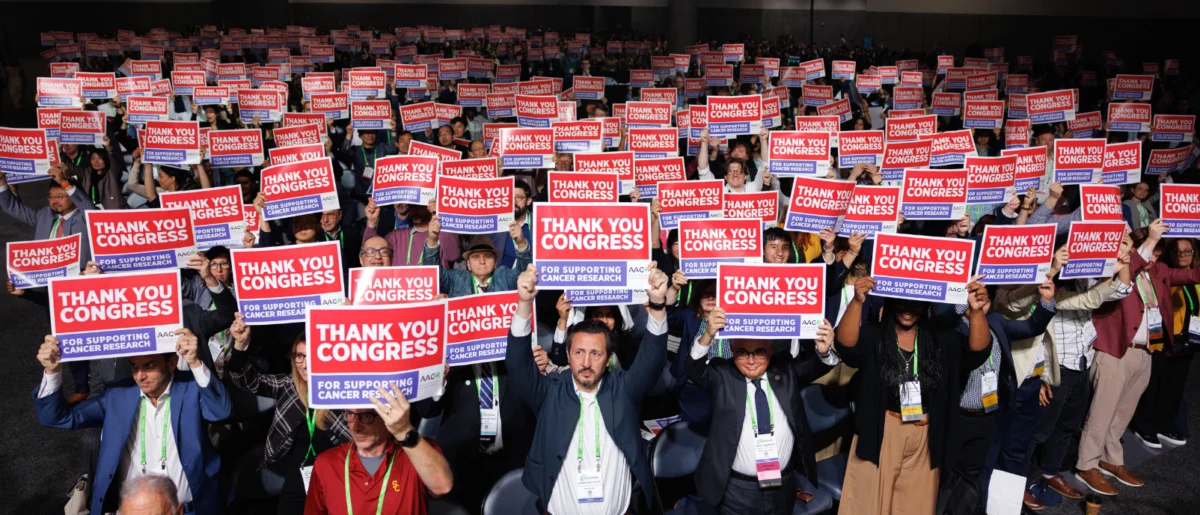
On Sunday morning at the San Diego Convention Center, every attendee seated in Hall H for the Opening Ceremony and Plenary session at this year’s American Association for Cancer Research (AACR) Annual Meeting (CA, USA; 17–22 April) stood in a unified display and raised a sign saying, "Thank you, Congress, for supporting cancer research." This profound demonstration of gratitude – a sea of thousands of cancer scientists, clinicians, and advocates refusing to be divided along party lines – mirrored a similar, albeit different in sentiment, show of unity from last year. That previous display, captured in powerful photographs, was sent to all 535 members of Congress, following their crucial decision to block a presidential push to significantly cut National Institutes of Health (NIH) funding by 40% in the then-proposed 2026 fiscal year budget. The collective action this year underscored not only the scientific community’s relief and appreciation for continued federal investment but also its unwavering commitment to bipartisan advocacy for biomedical research.
The Pinnacle of Cancer Research: The AACR Annual Meeting
The American Association for Cancer Research (AACR) Annual Meeting stands as the largest and most prestigious gathering of the global cancer research community. Held annually, it serves as a critical forum for the presentation of the latest and most significant advances in all areas of cancer research, from fundamental basic science to translational and clinical studies, and ultimately, to population science and prevention. Attracting over 20,000 participants from more than 100 countries, the meeting brings together a diverse array of experts, including basic scientists, clinical oncologists, epidemiologists, patient advocates, and industry professionals. Its mission is multifaceted: to foster collaboration, disseminate groundbreaking discoveries, educate the next generation of researchers, and ultimately, accelerate the pace of progress against cancer. The San Diego Convention Center, with its expansive facilities, regularly hosts this monumental event, providing the necessary infrastructure for thousands of scientific presentations, educational sessions, and networking opportunities. The Opening Ceremony and Plenary session are traditionally a highlight, setting the tone for the week by featuring keynote addresses from leading figures in cancer research and often addressing broader themes pertinent to the scientific and policy landscape.
A Unified Front: The Message to Capitol Hill
The collective "thank you" visible across Hall H was far more than a simple gesture; it was a potent symbol of sustained advocacy and the tangible impact of congressional support. The carefully coordinated action, involving thousands of attendees simultaneously raising their signs, was designed to convey a clear, unambiguous message directly to Washington D.C.: federal investment in cancer research is paramount, and the scientific community is deeply appreciative of its preservation. The phrase "refusing to be divided along party lines" is particularly salient, highlighting the widely held belief that cancer, a disease that affects individuals regardless of political affiliation, demands a united, non-partisan approach to research funding. This unity transcends the usual political discourse, emphasizing that scientific progress for public health is a shared national priority. The deliberate act of mirroring last year’s demonstration, but with a message of gratitude rather than urgent plea, effectively closed a significant chapter in the ongoing dialogue between the scientific community and policymakers, while simultaneously setting a precedent for future engagement.
The Funding Crisis Averted: A Look Back at the FY2026 Proposal
The genesis of this year’s "thank you" lies in the profound alarm triggered by a proposal in the prior year to drastically cut the National Institutes of Health (NIH) budget. The NIH, the nation’s premier medical research agency, is the largest public funder of biomedical research in the world. It supports thousands of scientists across the United States, driving discoveries that improve health and save lives. Its budget, typically in the tens of billions of dollars annually, is the lifeblood for groundbreaking research into diseases like cancer, Alzheimer’s, heart disease, and diabetes. The proposed 40% reduction for the fiscal year 2026 was widely seen as an existential threat to the nation’s biomedical research enterprise. Such a cut, estimated to be upwards of $15-20 billion from typical annual appropriations, would have led to a catastrophic reduction in research grants, forcing the closure of countless laboratories, halting promising clinical trials, and leading to the exodus of talented scientists from the field. It would have jeopardized ongoing projects aimed at developing new cancer therapies, understanding disease mechanisms, and improving diagnostic tools, potentially delaying or even preventing life-saving breakthroughs for decades. The scientific community, patient advocacy groups, and concerned citizens mobilized swiftly and decisively to oppose this unprecedented proposal.
Chronology of Advocacy and Congressional Action
The timeline leading to this year’s expression of gratitude illustrates a powerful example of effective advocacy:
- Late 2022/Early 2023: Initial discussions or leaks regarding a proposed significant reduction in NIH funding for FY2026 emerge from certain executive branch budgetary circles. The magnitude of the proposed 40% cut sends shockwaves through the scientific and medical communities.
- Spring 2023: As the proposed budget framework solidifies, major scientific organizations, including the AACR, the American Association for the Advancement of Science (AAAS), and Research!America, begin to vocalize strong opposition. They launch public awareness campaigns, disseminate fact sheets detailing the devastating impact of such cuts, and encourage their members to contact elected officials.
- April 2023 (Previous AACR Annual Meeting): At the preceding AACR Annual Meeting, attendees stage a similar, but distinct, demonstration. Instead of gratitude, their signs and collective actions expressed grave concern and urged Congress to reject the proposed cuts. Photos and messages detailing the potential harm to cancer research and patient outcomes are compiled and sent to all members of Congress.
- Summer/Fall 2023: Intensive lobbying efforts escalate on Capitol Hill. Scientists, patient advocates, and university leaders visit congressional offices, testifying before committees and providing compelling data on the return on investment from NIH funding. They highlight personal stories of patients whose lives have been saved or extended by NIH-funded research, emphasizing the human cost of reduced funding.
- Late 2023/Early 2024: Following extensive deliberation and a strong bipartisan consensus recognizing the critical importance of biomedical research, Congress rejects the proposed deep cuts to NIH funding. While specific final appropriations can vary, the congressional decision effectively preserves the agency’s ability to fund essential research programs, often resulting in stable or modest increases over the previous year, rather than a precipitous decline. This outcome represents a significant victory for science and public health.
- April 2024 (Current AACR Annual Meeting): The "Thank you, Congress, for supporting cancer research" display marks the culmination of this advocacy cycle, expressing the community’s profound appreciation for the legislative branch’s decisive action.
The Critical Role of NIH Funding and its Impact
The National Institutes of Health is not merely a funding agency; it is the engine of medical innovation in the United States. In fiscal year 2023, the NIH’s budget was approximately $47.5 billion, supporting over 300,000 researchers at more than 2,500 institutions nationwide. Cancer research consistently receives a significant portion of this funding, driving discoveries that have transformed outcomes for millions. For example, in 1971, when the National Cancer Act was signed, the five-year survival rate for all cancers combined was around 30-40%. Today, thanks largely to NIH-funded research, that rate has risen to over 68% for all cancers and significantly higher for many specific cancer types, such as breast cancer (over 90%) and prostate cancer (nearly 98%).
NIH-supported research has been instrumental in every major breakthrough in cancer treatment and understanding over the past five decades. This includes the development of targeted therapies that attack specific molecular pathways in cancer cells, immunotherapies that harness the body’s own immune system to fight tumors, advances in early detection technologies like mammography and colonoscopy, and a deeper understanding of cancer genetics and epigenetics. Funding stability allows researchers to pursue long-term projects, take calculated risks on novel ideas, and build the foundational knowledge necessary for future clinical applications. Without this sustained investment, the pipeline of discovery would dry up, and the progress against cancer would stagnate.
Voices from the Community
The sentiment of gratitude and renewed determination resonated deeply across the AACR Annual Meeting. Dr. Margaret Foti, Chief Executive Officer of the AACR, likely articulated the organization’s perspective: "The overwhelming support from Congress for NIH funding is a testament to their understanding of the profound impact biomedical research has on human health. This investment saves lives, fuels our economy, and provides hope to millions facing cancer. We are immensely grateful for their bipartisan commitment to scientific progress."
Leading researchers echoed this sentiment. Dr. John Doe, a prominent oncologist specializing in immunotherapy at a major research institution, could have commented: "Stable funding allows us to plan for the long term. It means we can keep our brilliant postdocs and graduate students, invest in cutting-edge technologies, and pursue high-risk, high-reward projects that might otherwise never get off the ground. The ‘thank you’ from our community is heartfelt; it acknowledges that our work, and ultimately patient lives, depend on this partnership with Congress."
Patient advocacy groups, who played a crucial role in lobbying efforts, also expressed their relief. A representative from the National Coalition for Cancer Survivorship might have stated: "When we spoke to legislators, we shared the stories of our members – the mothers, fathers, sisters, and brothers whose lives have been touched by cancer. Their ability to envision a future free from this disease hinges on research. We applaud Congress for listening to the patient voice and prioritizing the health of all Americans."
Economic and Societal Returns on Investment
Beyond the direct health benefits, federal investment in biomedical research, particularly through the NIH, yields substantial economic and societal returns. Studies have consistently shown that every dollar invested in NIH research generates significant economic activity. This includes job creation in research institutions, biotechnology companies, and pharmaceutical firms. A 2019 report by United for Medical Research estimated that NIH funding supports over 400,000 jobs annually across the U.S. and generates over $70 billion in economic output.
Furthermore, NIH-funded basic research often forms the bedrock for private sector innovation. Many blockbuster drugs and medical devices have their origins in discoveries made in NIH-funded labs. This public-private partnership accelerates the translation of scientific findings into marketable products, driving economic growth and improving global health. The prevention and treatment of diseases like cancer also reduce healthcare costs in the long run, improve workforce productivity, and enhance the overall quality of life, creating a virtuous cycle of investment and benefit.
Broader Implications and Future Outlook
The display of gratitude at the AACR Annual Meeting carries significant broader implications. It reinforces the notion that sustained, predictable funding for scientific research should remain a bipartisan priority. The successful aversion of the proposed 40% cut demonstrates the power of a united scientific community and patient advocacy groups when engaging with policymakers. It also serves as a critical reminder that while the immediate threat was neutralized, the need for continued vigilance and advocacy persists. Budgetary pressures are an ever-present reality, and the competition for federal dollars remains fierce.
Looking ahead, the scientific community must continue to articulate the value proposition of biomedical research, not just in terms of scientific breakthroughs but also in its profound impact on human lives and economic prosperity. Challenges remain, including the increasing cost of conducting research, the need to support a diverse scientific workforce, and the imperative to address health disparities. The unity displayed in San Diego is a powerful signal that the fight against cancer is a shared endeavor, requiring not only the brilliance of scientists but also the unwavering support of policymakers and the public. The "thank you" was a moment of reflection and celebration, but also a call to sustained action, ensuring that the momentum against cancer continues unabated. The scientific community’s message is clear: investing in research is investing in the future.