

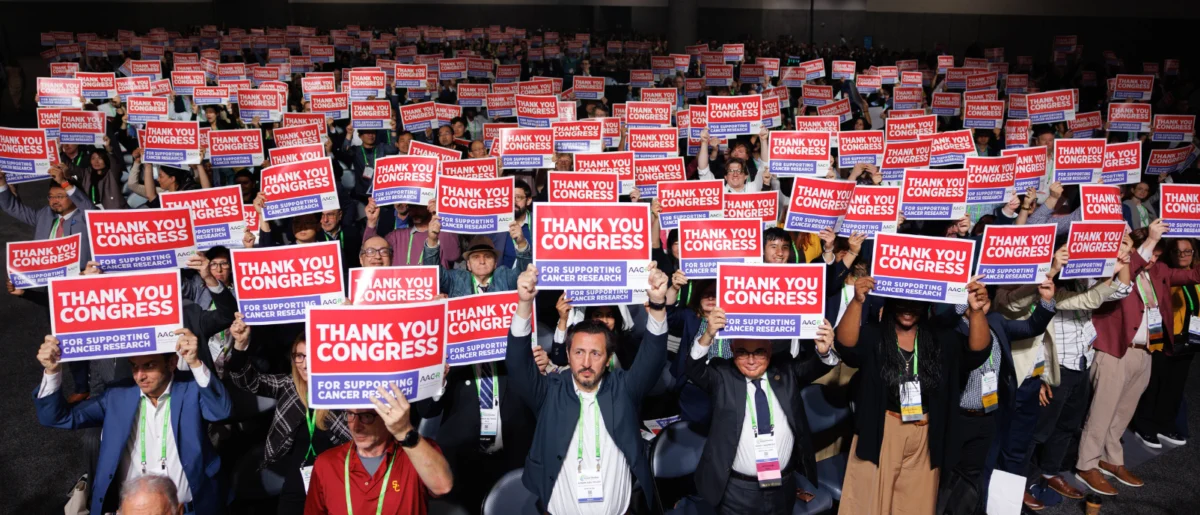
On Sunday morning, at the bustling San Diego Convention Center, a powerful demonstration of unity and gratitude unfolded as attendees of the American Association for Cancer Research (AACR) Annual Meeting (CA, USA; 17–22 April) gathered for the Opening Ceremony and Plenary session. Every scientist, clinician, and advocate seated in Hall H rose in unison, raising signs that unequivocally stated, "Thank you, Congress, for supporting cancer research." This striking display, a profound visual of the cancer research community transcending political divides, mirrored a similar event from the previous year, underscoring a persistent message to policymakers about the indispensable role of federal investment in biomedical science. The collective message, a potent reminder of the scientific community’s advocacy, was meticulously documented and subsequently delivered to all 535 members of Congress, following their decisive action in the preceding fiscal year to block a Presidential proposal that sought to cut National Institutes of Health (NIH) funding by a staggering 40% for the 2026 fiscal year.
The annual AACR meeting, a cornerstone event in the global oncology calendar, brings together an unparalleled assembly of more than 20,000 cancer researchers, physician-scientists, healthcare professionals, survivors, and patient advocates from across the globe. It serves not only as a crucial platform for disseminating the latest scientific breakthroughs, fostering collaborations, and shaping the future of cancer care but also as a vital forum for collective advocacy. The synchronized act of appreciation and affirmation for congressional support highlights the deep concern within the scientific community regarding the stability and predictability of federal funding, particularly for the NIH, which stands as the largest public funder of biomedical research worldwide.
A Chronology of Advocacy and Funding Debates
The roots of this year’s demonstration can be traced back to a critical juncture in federal budget negotiations, a recurring theme in Washington D.C. The proposition to slash NIH funding by 40% for fiscal year 2026, put forth by the executive branch, sent shockwaves through the scientific, medical, and patient advocacy communities. Such a drastic reduction would have represented an unprecedented blow to the nation’s biomedical research enterprise, threatening to dismantle decades of progress in understanding and combating diseases, particularly cancer.
April 2023 (Previous AACR Annual Meeting): The initial demonstration of solidarity and advocacy took place. Scientists at the AACR Annual Meeting collectively voiced their apprehension and made a public appeal for sustained NIH funding. This event was meticulously documented, with photographs and messages sent to every member of Congress, effectively communicating the potential devastating impact of proposed budget cuts on the future of health research and patient care.
Late 2024 / Early 2025 (Budget Proposal Cycle): The presidential administration’s budget proposal for fiscal year 2026 was released, including the controversial 40% reduction for the NIH. This proposal ignited immediate and widespread condemnation from scientific organizations, universities, patient groups, and a bipartisan coalition of lawmakers who recognized the critical role of NIH funding.
Congressional Response and Intervention: In a significant show of bipartisan support for medical research, members of both the House and Senate moved to reject the proposed cuts. Through legislative action and sustained advocacy, Congress ultimately ensured that NIH funding was maintained, or in some instances, even modestly increased, defying the executive branch’s proposal. This congressional intervention was a direct acknowledgment of the powerful advocacy efforts from the scientific community and the understanding among many lawmakers that investing in health research is a long-term investment in national health, economic prosperity, and global scientific leadership.
April 202X (Current AACR Annual Meeting): The demonstration witnessed this Sunday in San Diego serves as both a "thank you" to Congress for their past intervention and a renewed call for vigilance and continued support. It underscores the ongoing nature of budget debates and the necessity for the scientific community to remain actively engaged in advocating for policies that prioritize health research. The repeat performance ensures that the message of gratitude and continued need for support resonates with policymakers as future budget cycles approach.
The Indispensable Role of NIH Funding in Cancer Research
The National Institutes of Health, with its annual budget currently hovering around $47.5 billion (for FY2024, subject to change in future fiscal years), is the primary engine driving biomedical discovery in the United States. Its funding supports thousands of research grants across universities, medical schools, and research institutions nationwide, fostering a robust ecosystem of innovation. For cancer research specifically, NIH funding is the lifeblood that sustains basic scientific inquiry, translational research, clinical trials, and population health studies.
Over the past decades, sustained federal investment through the NIH has led to monumental breakthroughs in cancer prevention, diagnosis, and treatment. These include:
- Immunotherapy: The development of checkpoint inhibitors, which harness the body’s own immune system to fight cancer, a revolutionary approach that has transformed outcomes for melanoma, lung cancer, and several other malignancies. This field, largely nurtured by NIH grants, represents one of the most significant advancements in oncology.
- Targeted Therapies: The identification of specific genetic mutations or protein targets in cancer cells, leading to the development of drugs that precisely attack these vulnerabilities while sparing healthy cells. Examples include Gleevec for chronic myeloid leukemia and Herceptin for HER2-positive breast cancer, both products of extensive NIH-supported basic research.
- Genomic Sequencing and Precision Medicine: NIH initiatives like The Cancer Genome Atlas (TCGA) have cataloged the genetic landscapes of numerous cancers, paving the way for precision oncology, where treatments are tailored to an individual’s unique tumor profile.
- Early Detection and Prevention: Advances in screening technologies, such as improved mammography, colonoscopy, and HPV vaccines, have significantly reduced cancer incidence and mortality for several common cancers.
- Improved Survival Rates: Overall cancer death rates have steadily declined in the U.S. since the 1990s, a testament to the cumulative impact of research-driven advancements. From 1991 to 2020, the cancer death rate in the U.S. fell by 33%, translating to an estimated 3.8 million fewer cancer deaths. This progress is directly attributable to the continuous, multi-faceted research endeavors largely funded by the NIH.
A 40% cut, as proposed, would not merely slow progress; it would effectively cripple the research enterprise. It would lead to the immediate cessation of countless ongoing studies, the layoff of thousands of scientists, technicians, and support staff, and a devastating loss of institutional knowledge. It would deter promising young scientists from entering the field, creating a "brain drain" that would take decades to recover from.
Statements and Reactions from Related Parties
While no direct quotes from specific congressional members were provided in the original snippet, the congressional action to block the cuts speaks volumes. It can be logically inferred that:
AACR Leadership: Dr. Lisa M. Coussens, PhD, FAACR, President of the AACR (or a similar figure in the organization), would likely reiterate the organization’s steadfast commitment to advocating for robust, sustained, and predictable federal funding for cancer research. A statement might emphasize: "The unified display at our Annual Meeting is a powerful affirmation of our community’s belief in the transformative power of science. We are profoundly grateful to Congress for recognizing the immense value of NIH funding and for safeguarding our nation’s biomedical research enterprise against drastic cuts. Cancer does not discriminate, and neither should our investment in finding cures. This is not a partisan issue; it is a human issue."
Congressional Supporters of NIH Funding: Bipartisan lawmakers, particularly those on appropriations committees, have consistently championed NIH funding. Their inferred statements would likely highlight: "Investing in the NIH is investing in the health and economic future of our nation. The breakthroughs funded by these critical dollars not only save lives but also spur innovation, create jobs, and maintain America’s leadership in biomedical science. We stand with the scientific community and patient advocates in ensuring that our researchers have the resources they need to continue their life-saving work."
Patient Advocacy Groups: Organizations representing cancer patients and survivors would likely express deep relief and continued urgency. A representative might state: "Every dollar invested in cancer research represents hope for millions of patients and their families. The proposed cuts were terrifying, threatening to snatch away the promise of new treatments and cures. We are incredibly thankful to Congress for listening to the voices of the patient community and for understanding that research funding is not a luxury, but a necessity for progress against this devastating disease."
Broader Impact and Implications
The repeated demonstration at the AACR Annual Meeting and the ongoing advocacy efforts carry significant broader implications for public health, scientific innovation, and national policy:
Sustaining the Research Pipeline: Consistent and adequate funding is crucial for maintaining a healthy research pipeline, from fundamental discovery to clinical application. Interruptions or drastic cuts can lead to a loss of momentum, making it harder to attract and retain top talent, and slowing the pace at which new therapies reach patients. The scientific community’s unified voice reinforces the need for long-term, strategic investment rather than sporadic, politically motivated budget fluctuations.
Global Competitiveness: The United States has historically been at the forefront of biomedical research and innovation. This leadership position is directly tied to the strength of its federal funding mechanisms, primarily the NIH. Undermining this funding could erode America’s scientific preeminence, leading to a shift in talent and discovery to other nations that prioritize scientific investment.
Economic Returns: Investment in biomedical research is not merely a public expenditure; it is a powerful economic engine. NIH-funded research supports millions of jobs, stimulates growth in the biotechnology and pharmaceutical industries, and leads to the creation of new companies and technologies. Studies have shown that every dollar invested in NIH research generates significant economic returns, far outweighing the initial investment. A 40% cut would have had dire economic consequences, beyond the immediate health impacts.
Public Trust and Engagement: The public demonstration by thousands of scientists also serves to enhance public understanding and trust in the scientific process. By openly advocating for funding and expressing gratitude for congressional support, researchers reinforce the transparent and beneficial nature of their work, encouraging broader public engagement and support for science policy.
Future Policy Landscape: The success of the scientific community’s advocacy in blocking the proposed 40% cut sets an important precedent. It signals to future administrations and legislative bodies that such drastic measures against biomedical research will face strong, unified opposition. However, the recurring nature of the demonstration highlights that the fight for sustained funding is perennial. As the nation grapples with complex fiscal challenges, the scientific and patient communities must remain vigilant and articulate the profound value of their work. The message from San Diego is clear: investing in cancer research is an investment in human life, in progress, and in the future well-being of society. The scientific community stands ready to continue its partnership with Congress to ensure that this vital investment endures.


















Leave a Reply