

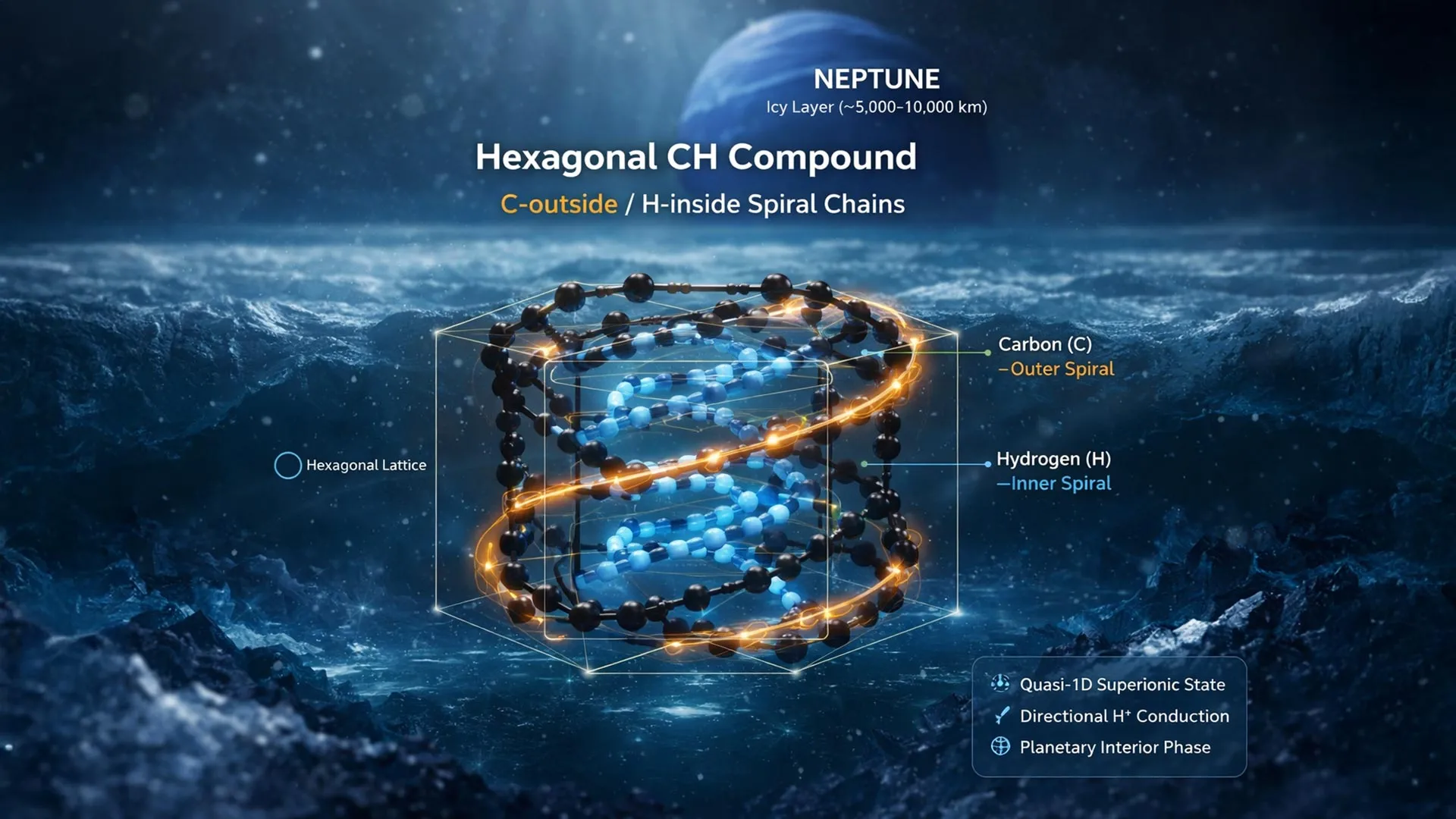
The deep interiors of the solar system’s ice giants, Uranus and Neptune, may harbor a previously unknown form of matter that challenges conventional understanding of chemical bonding and planetary physics. According to a groundbreaking study led by Carnegie Institution for Science researchers Cong Liu and Ronald Cohen, carbon hydride—a compound consisting of carbon and hydrogen—transitions into an exotic "quasi-one-dimensional superionic state" under the staggering pressures and temperatures found thousands of miles beneath the visible cloud tops of these distant worlds. Published in the journal Nature Communications, the findings provide a new lens through which scientists can view the internal dynamics of ice giants and thousands of similar exoplanets throughout the galaxy.
The discovery suggests that the internal layers of Uranus and Neptune are far more complex than a simple mixture of "hot ices." By utilizing advanced high-performance computing and machine-learning-enhanced quantum simulations, Liu and Cohen have demonstrated that at pressures reaching millions of times that of Earth’s atmosphere, carbon and hydrogen atoms organize themselves into a structure that is simultaneously solid and liquid. This phase of matter, characterized by hydrogen atoms flowing through a rigid carbon framework along spiral-like pathways, could be the key to solving long-standing mysteries regarding planetary magnetic fields and heat transport.
The Mystery of the Ice Giant Interiors
For decades, Uranus and Neptune have remained the least understood major planets in our solar system. Unlike the gas giants Jupiter and Saturn, which are composed primarily of hydrogen and helium, the ice giants are believed to be dominated by heavier elements, specifically oxygen, carbon, and nitrogen. In the planetary science community, these are often referred to as "ices," even though they exist in a highly compressed, fluid-like state due to internal heat.
The density profiles of these planets, gathered primarily from the Voyager 2 flybys in the 1980s and subsequent ground-based observations, indicate a layered structure. Beneath a relatively thin outer atmosphere lies a massive, thick mantle composed of water, methane, and ammonia. Beneath that mantle sits a solid rocky core. However, the exact physical state of the materials within the mantle has remained a subject of intense theoretical debate.
Standard models of planetary evolution assume that these layers act as a fluid dynamo, generating the planets’ magnetic fields. Yet, the magnetic fields of Uranus and Neptune are notoriously "wonky"—they are not aligned with the planets’ centers and are tilted at extreme angles. Scientists have long suspected that the behavior of matter at these depths must be radically different from anything observed in a terrestrial laboratory to account for such anomalies.
Chronology of the Discovery: From Voyager to AI
The path to this discovery began with the realization that traditional laboratory experiments are often unable to replicate the conditions of planetary interiors. While diamond anvil cells can reach high pressures, maintaining the simultaneous high temperatures and measuring the precise movement of atoms within a sample remains a monumental challenge.
In the early 2000s, theoretical physicists began predicting "superionic" phases of water, where oxygen atoms form a crystal lattice while hydrogen ions move freely like a liquid. This was experimentally confirmed in 2018, providing a template for how other compounds might behave. Following the confirmation of superionic water, researchers turned their attention to methane (CH4), a major constituent of ice giants.
Recognizing that methane likely decomposes under extreme pressure into various carbon-hydrogen (CH) compounds, Liu and Cohen initiated a multi-year project to simulate the behavior of carbon hydride. They leveraged the evolution of Density Functional Theory (DFT) combined with modern machine learning algorithms. This approach allowed them to simulate the interactions of thousands of atoms with quantum-mechanical accuracy, a feat that would have been computationally impossible just a decade ago. Their study represents the culmination of this technological leap, identifying a specific phase of carbon hydride that exists only in the extreme "Goldilocks zone" of pressure and temperature found inside Uranus and Neptune.
Supporting Data: Simulating the Extreme
To uncover this new state of matter, the Carnegie team modeled conditions ranging from 500 to 3,000 gigapascals (GPa). For context, 1 GPa is roughly 10,000 times the atmospheric pressure at sea level on Earth. The upper limit of their simulation—3,000 GPa—represents nearly 30 million times Earth’s atmospheric pressure.
The simulated temperatures were equally extreme, ranging from 4,000 to 6,000 Kelvin (approximately 6,740 to 10,340 degrees Fahrenheit). Under these conditions, the simulations revealed that carbon hydride does not remain a simple molecular gas or a standard solid. Instead, it enters a "spiral" superionic state.
The data showed that carbon atoms arrange themselves into a stable, ordered hexagonal framework. This framework provides the structural "skeleton" of the material. Within this skeleton, the hydrogen atoms do not sit still, nor do they move randomly in all directions. Instead, the hydrogen atoms move preferentially along well-defined, helical pathways. This "quasi-one-dimensional" movement is what distinguishes this state from other superionic materials where atomic diffusion is typically three-dimensional.
Official Responses and Scientific Context
The implications of this discovery have resonated across the planetary science community. Lead researcher Ronald Cohen emphasized the uniqueness of the atomic movement observed in their models. "This newly predicted carbon-hydrogen phase is particularly striking because the atomic motion is not fully three-dimensional," Cohen explained. "Instead, hydrogen moves preferentially along well-defined helical pathways embedded within an ordered carbon structure."
This directional movement is a critical finding because it suggests that the material is anisotropic—meaning its physical properties, such as electrical and thermal conductivity, vary depending on the direction. Cong Liu added that despite the prevalence of these elements, we are only beginning to scratch the surface of their potential configurations. "Carbon and hydrogen are among the most abundant elements in planetary materials, yet their combined behavior at giant-planet conditions remains far from fully understood," Liu noted.
While external peer reviewers and independent astrophysicists have noted that these findings are theoretical, they emphasize that such simulations are currently the most reliable way to "visit" the centers of ice giants. The consensus among researchers is that this study provides a necessary roadmap for future experimentalists attempting to synthesize these materials in high-energy laser facilities, such as the National Ignition Facility (NIF) in the United States.
Broader Impact: Magnetic Fields and Exoplanets
The discovery of a quasi-one-dimensional superionic state has profound implications for how we understand planetary magnetic fields. On Earth, the magnetic field is generated by the movement of liquid iron in the outer core (the dynamo). In Uranus and Neptune, the magnetic fields are believed to be generated within the "icy" mantles.
If carbon hydride exists in this superionic state, the highly mobile hydrogen ions would be capable of carrying an electric current. Because the hydrogen moves along specific spiral paths, the resulting electrical conductivity would be highly directional. This could explain the complex, non-dipolar, and offset magnetic fields observed by Voyager 2. It suggests that the "engine" driving these magnetic fields is not a uniform churning liquid, but a structured, exotic layer with unique flow properties.
Furthermore, the research has significant applications in the study of exoplanets. As of 2024, astronomers have confirmed the existence of over 5,600 exoplanets, with thousands more candidates awaiting verification. A large percentage of these are "Sub-Neptunes" or "Super-Earths"—planets with sizes and compositions likely similar to Uranus and Neptune. Understanding the phase diagram of carbon-hydrogen compounds allows scientists to create more accurate models of these distant worlds’ interiors, helping to determine their cooling rates, atmospheric compositions, and potential habitability.
Future Outlook in Materials Science
Beyond the stars, the work of Liu and Cohen may have terrestrial applications in the field of materials science. The ability of a material to allow ions to move through a solid lattice is the fundamental principle behind battery technology and fuel cells. While the pressures required for this specific carbon-hydrogen state are too high for commercial use on Earth, the discovery of "quasi-one-dimensional" transport provides a new theoretical framework.
Engineers may look to replicate this directional ion flow in other materials at lower pressures, potentially leading to the development of new superconductors or high-efficiency electrolytes. The study proves that even the simplest elements—carbon and hydrogen—can exhibit remarkably complex and organized behaviors when pushed to their limits.
As NASA and the European Space Agency (ESA) begin preliminary planning for a dedicated Uranus Orbiter and Probe (UOP) mission—a top priority identified in the most recent Planetary Science Decadal Survey—the findings from the Carnegie team will be instrumental. When a probe eventually descends into the atmosphere of an ice giant, it will be looking for the chemical signatures and gravitational data that could confirm the presence of this "spiral" matter, finally turning a computer simulation into a confirmed piece of the cosmic puzzle.

















Leave a Reply