

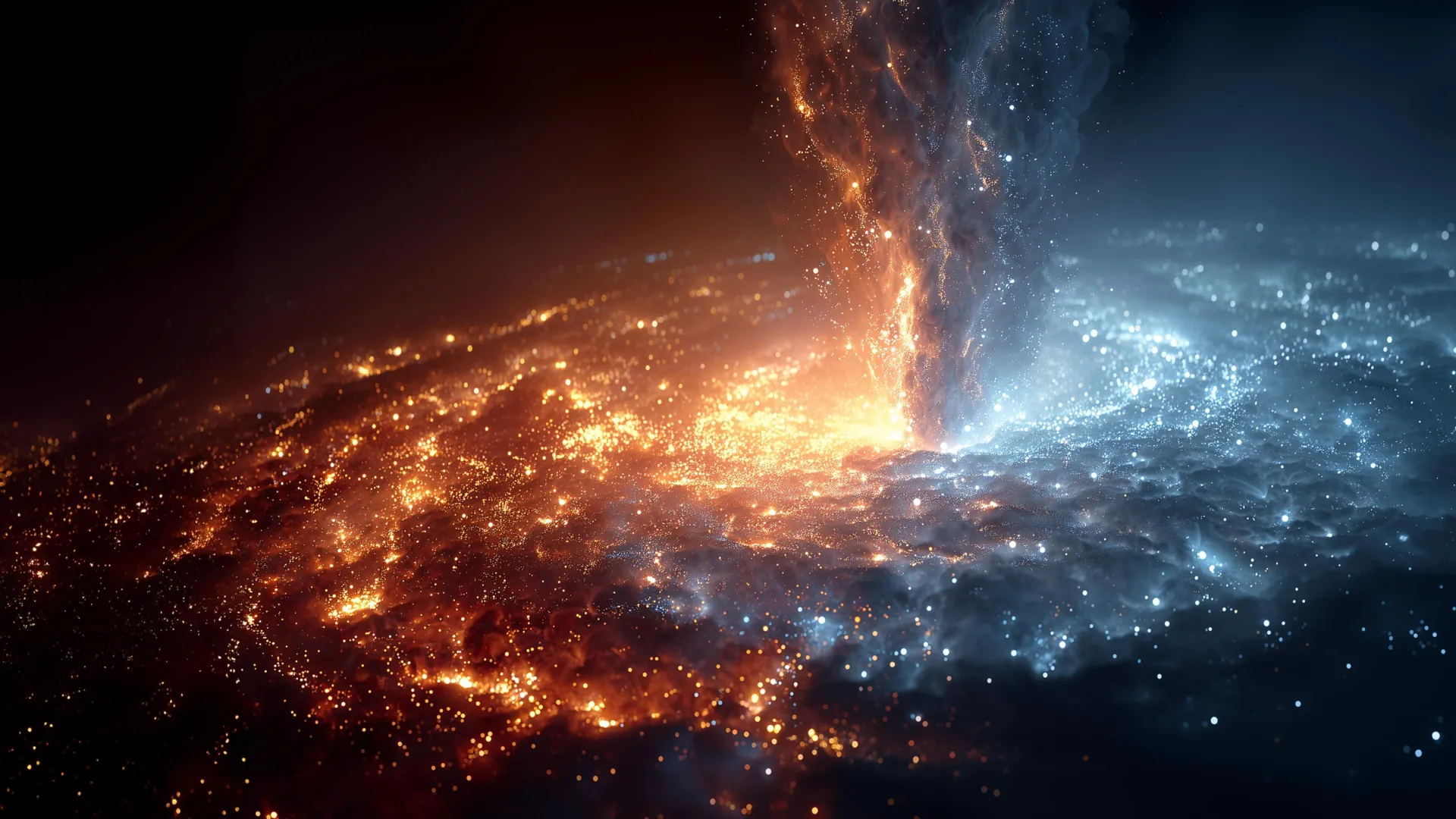
The search for dark matter, the invisible substance believed to constitute approximately 85% of the matter in the universe, has long been characterized by a frustrating paradox: while its gravitational influence is undeniable on a cosmic scale, its particle nature remains elusive. However, a groundbreaking study recently published in the Journal of Cosmology and Astroparticle Physics (JCAP) suggests that the key to unlocking this mystery may lie in an "environmental dependence" that has previously been overlooked. The research, titled "dSph-obic dark matter," proposes a sophisticated two-component model that explains why a mysterious gamma-ray glow exists at the center of the Milky Way but remains absent in neighboring dwarf galaxies.
This theoretical breakthrough addresses one of the most persistent tensions in modern astrophysics. For over a decade, scientists have observed an "excess" of gamma radiation emanating from the heart of our galaxy. While many researchers have pointed to dark matter annihilation as the source, the lack of a corresponding signal from dark-matter-rich dwarf galaxies has cast doubt on that conclusion. The new study, authored by Asher Berlin, Joshua Foster, Dan Hooper, and Gordan Krnjaic, suggests that dark matter is not a monolith but a complex system of interacting particles whose behavior changes based on their local concentration.
The History of the Galactic Center Excess
The story of this discovery begins in 2009, when physicists Dan Hooper and Lisa Goodenough first analyzed data from NASA’s Fermi Gamma-ray Space Telescope. They identified an unusual surplus of high-energy photons—gamma rays—coming from a roughly spherical region surrounding the Milky Way’s galactic center. This phenomenon, now widely known as the Galactic Center Excess (GCE), matched the predicted signature of Weakly Interacting Massive Particles (WIMPs) colliding and annihilating one another in the dense inner reaches of the galaxy.
In these theoretical models, when two dark matter particles meet, they destroy each other, releasing a burst of energy in the form of gamma rays. For years, the GCE was considered the "smoking gun" for dark matter detection. However, as the years passed, the scientific community became divided. Critics argued that the signal could instead be produced by a large population of rapidly spinning neutron stars, known as millisecond pulsars, which are too faint to be detected individually but whose collective radiation could mimic the dark matter signal.
To resolve this debate, astronomers turned their sights toward dwarf spheroidal galaxies (dSphs). These small satellite galaxies orbiting the Milky Way are considered the most "dark matter-dominated" objects in the known universe. Because they contain very few stars and almost no gas or dust, they lack the "astrophysical noise" found in the Galactic Center. If dark matter annihilation were responsible for the glow in the Milky Way, a similar, cleaner signal should have been detected in these dwarf galaxies. Yet, despite years of intensive observation, no such signal has been found.
The Conflict Between Galaxy Types
The absence of gamma rays from dwarf galaxies created a significant hurdle for the dark matter hypothesis. Under the standard "S-wave" annihilation model—where the probability of two particles annihilating is constant regardless of their relative speed—the ratio of dark matter in the Milky Way to that in dwarf galaxies should have resulted in a clear detection in the latter.
Another alternative, the "P-wave" model, suggests that the annihilation rate depends on the velocity of the particles. Because dark matter moves faster in the massive Milky Way than in small dwarf galaxies, this model would predict a stronger signal in our galaxy. However, the velocity differences are not extreme enough to fully explain the total silence from the dwarf systems while maintaining the brightness of the Galactic Center.
"Right now there seems to be an excess of photons coming from an approximately spherical region surrounding the disk of the Milky Way," says Gordan Krnjaic, a theoretical physicist at the Fermi National Accelerator Laboratory (Fermilab) and a co-author of the study. Krnjaic notes that while the Fermi Gamma-ray Space Telescope has provided invaluable data, the lack of consistency across different galactic environments has led to a theoretical impasse.
A Two-Component Solution: The "Lock and Key" Mechanism
The research team led by Berlin, Foster, Hooper, and Krnjaic proposes a departure from the "single-particle" paradigm. Their model suggests that dark matter consists of two distinct species of particles, which we might call Particle A and Particle B. For annihilation to occur and produce gamma rays, an A particle must encounter a B particle.
This "two-component" framework introduces a new variable: the relative abundance of each particle type. In this scenario, the total density of dark matter is not the only factor; the ratio between the two species is equally critical.
"What we’re trying to point out in this paper is that you could have a different kind of environmental dependence, even if the annihilation probability is constant," Krnjaic explains. "Dark matter could straightforwardly be two different particles, and the two different particles need to find each other in order to annihilate."
In a large, complex system like the Milky Way, the two types of dark matter may be well-mixed in roughly equal proportions (a 50/50 split). This balance maximizes the chances of an A particle finding a B particle, resulting in the robust gamma-ray signal observed by the Fermi telescope. However, in the isolated and much smaller environments of dwarf galaxies, the distribution may be skewed. Due to the way these galaxies formed or the way dark matter was "captured" or "frozen out" in the early universe, one species might significantly outnumber the other.
If a dwarf galaxy is 90% Particle A and only 10% Particle B, the rate of annihilation drops precipitously because the A particles rarely encounter their necessary partners. This "dSph-obic" (dwarf spheroidal-phobic) nature of the dark matter signal allows the Milky Way’s excess to be real without requiring a matching signal from its smaller neighbors.
Technical Analysis and Supporting Data
The study utilizes a combination of astrophysical observations and thermal relic calculations to support this theory. In particle physics, the "thermal relic" concept suggests that the amount of dark matter in the universe today was determined by the rate at which particles annihilated in the hot, dense early universe.
The researchers demonstrated that a two-component model could naturally produce the observed density of dark matter while allowing for the specific asymmetries needed to explain the GCE. They analyzed data from the Fermi-LAT (Large Area Telescope) and compared it against the known dark matter density profiles of the 15 most studied dwarf spheroidal galaxies, including Draco, Sculptor, and Ursa Minor.
According to the paper, the mathematical framework for this model involves a "chemical potential" or an initial asymmetry in the dark matter sector, similar to the asymmetry between matter and antimatter in the visible universe. If the early universe produced slightly more of one dark matter component than the other, this imbalance would be magnified in smaller, low-density structures like dwarf galaxies, while larger structures would maintain a more representative sample of the cosmic average.
Broader Implications for Modern Physics
The implications of this study extend far beyond explaining a single telescope observation. If dark matter is indeed multi-component, it suggests the existence of a "Dark Sector"—a complex ecosystem of particles and forces that mirrors the complexity of the Standard Model of particle physics. Just as the visible world is not made of a single type of atom, the invisible world may have its own periodic table and chemistry.
This model also provides a lifeline for the dark matter interpretation of the GCE. In recent years, the pulsar hypothesis had gained significant traction, with some studies suggesting that the "graininess" of the gamma-ray signal pointed toward point sources like neutron stars rather than a smooth dark matter cloud. However, newer statistical analyses have challenged those findings, and the two-component dark matter model provides a robust theoretical alternative that fits the data without the need for tens of thousands of undiscovered pulsars.
Furthermore, this research changes the strategy for future dark matter searches. If annihilation depends on particle ratios, scientists may need to re-evaluate how they interpret data from direct detection experiments—underground labs looking for dark matter bumping into atomic nuclei—and collider experiments like the Large Hadron Collider (LHC).
Future Observations and Verification
The next decade will be crucial for testing the validity of the "dSph-obic" model. Several upcoming missions and upgrades are expected to provide the high-resolution data needed to confirm or refute these findings:
- The Cherenkov Telescope Array (CTA): This next-generation ground-based gamma-ray observatory will have much higher sensitivity than the Fermi telescope. It will be able to probe the Galactic Center with unprecedented clarity and look for subtle variations in the energy spectrum that would distinguish dark matter from pulsars.
- Extended Dwarf Galaxy Surveys: As more "ultra-faint" dwarf galaxies are discovered by telescopes like the Vera C. Rubin Observatory, scientists will have a larger sample size to test the two-component theory. If some dwarf galaxies show a faint signal while others remain silent, it would strongly support the idea of varying particle ratios.
- Indirect Detection Refinement: Improved models of the Milky Way’s gas and stellar distribution will help subtract the "background" radiation more accurately, leaving a clearer picture of the purported dark matter signal.
While the "dSph-obic" dark matter model is currently a theoretical framework, it represents a shift in how physicists approach the dark matter problem. It moves away from the search for a single, universal particle and toward a more nuanced understanding of a hidden sector that may be just as diverse as the world we can see.
The paper, now available in JCAP, serves as a reminder that in the vastness of the cosmos, the absence of evidence is not always evidence of absence. Sometimes, the silence of the stars tells a story just as profound as their light. As Asher Berlin, Joshua Foster, Dan Hooper, and Gordan Krnjaic have demonstrated, the missing signals in dwarf galaxies may not be a failure of our theories, but a clue to the true, complex nature of the most mysterious substance in the universe.

















Leave a Reply