

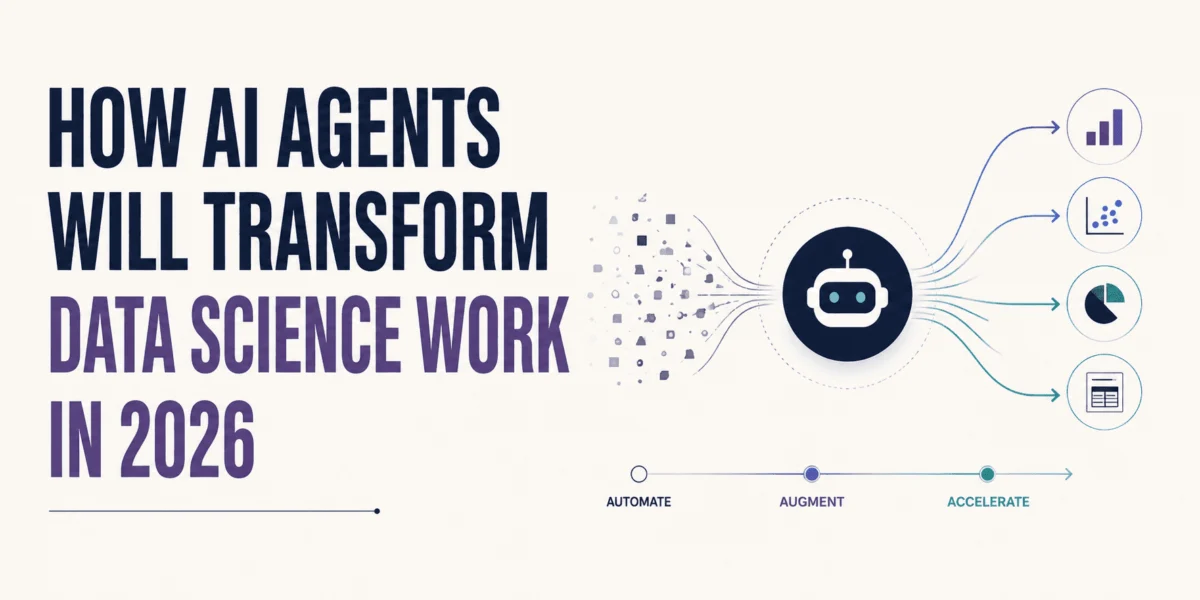
The dynamic realm of data science, already characterized by rapid technological advancements, is on the precipice of another profound transformation. By 2026, the integration of AI agents is projected to fundamentally reshape the daily workflows and strategic priorities of data professionals, shifting the paradigm from manual execution to strategic oversight and collaborative innovation. This evolution is not merely an incremental improvement but a foundational change poised to augment human capabilities, address persistent industry challenges, and unlock unprecedented efficiencies across organizations globally.
The Evolving Landscape of Data Science
For newcomers entering the data science field, the sheer volume of knowledge required can be overwhelming. Mastery of programming languages like Python, proficiency in cloud computing platforms, and a deep understanding of ever-evolving machine learning models represent a significant barrier to entry. Even seasoned professionals contend with the constant pressure to stay current with emerging tools and methodologies. Historically, a substantial portion of a data scientist’s time—often cited in industry reports as upwards of 60-80%—is dedicated to data preparation tasks such as cleaning, transforming, and validating data. This laborious "data wrangling" phase, while crucial, diverts valuable human capital from higher-level analytical and strategic work. The advent of AI agents aims to directly address this inefficiency, promising to offload these time-consuming, repetitive tasks and allow human experts to focus on complex problem-solving and business-critical insights.
Defining the AI Agent: Beyond Traditional AI Tools
To fully grasp the impending shift, it is essential to distinguish AI agents from conventional AI tools. A standard artificial intelligence tool, such as a large language model (LLM) like GPT-4, functions primarily as a sophisticated, passive knowledge base. Users input queries, and the LLM generates responses, code snippets, or textual content based on its training data. It reacts to prompts but does not typically initiate actions or autonomously pursue objectives without continuous human intervention.
In contrast, an AI agent is an autonomous system endowed with the ability to understand high-level objectives, break them down into actionable steps, execute those steps using various tools (including LLMs, code interpreters, and external APIs), monitor its progress, adapt to new information, and report back on its findings. An AI agent possesses a ‘memory’ of past interactions and decisions, allowing it to maintain context and refine its approach over time. For a data scientist, this means an agent can be given an objective like "improve the accuracy of the customer churn prediction model" and then independently embark on a multi-step process: accessing data repositories, proposing and testing different feature engineering techniques, experimenting with various machine learning algorithms, evaluating model performance metrics, and ultimately presenting a refined model with detailed documentation of its methodology. This proactive, goal-oriented autonomy fundamentally differentiates agents from their more passive predecessors.
Historical Context and the Rise of Agentic Workflows
The journey towards agentic workflows in data science can be traced through several key technological milestones. The early 2000s saw the widespread adoption of tools that automated rudimentary tasks, such as spreadsheet software that revolutionized accounting by automating calculations, allowing financial professionals to focus on strategic analysis rather than manual arithmetic. Similarly, the rise of powerful statistical software packages and integrated development environments (IDEs) streamlined data analysis and programming.
More recently, the late 2010s and early 2020s witnessed the proliferation of Automated Machine Learning (AutoML) platforms. These tools provided a significant leap by automating parts of the machine learning pipeline, such as model selection, hyperparameter tuning, and even some feature engineering. While highly effective for specific tasks, AutoML platforms typically required human input to define the problem, prepare the data, and interpret the results.
The year 2023 marked the mainstream emergence of generative AI, particularly large language models, demonstrating unprecedented capabilities in generating human-like text. This was followed by 2024, which saw a rapid expansion of generative AI into code generation, enabling developers and data scientists to quickly produce code snippets, debug errors, and automate routine coding tasks. Building upon these foundational advancements, 2026 is poised to be the year of the "agentic workflow." This represents the logical progression where the intelligence and generative capabilities of LLMs are combined with planning, execution, and monitoring components to create truly autonomous, goal-driven systems.
The Shifting Role of the Data Scientist: From Doer to Director
A central question arising from the proliferation of AI agents is whether they will displace human data scientists. Industry consensus, echoed by leading tech companies and academic researchers, firmly asserts the opposite. Instead of replacement, AI agents are expected to elevate the human role, making data scientists more valuable and impactful than ever before. This echoes historical patterns where technology has consistently augmented, rather than obsoleted, skilled labor.
The data scientist’s role will evolve from primarily executing technical tasks to becoming a director of AI-powered processes. This transformation means a significant reduction in time spent on:
- Data Wrangling and Cleaning: AI agents will autonomously handle data ingestion from disparate sources, identify and correct inconsistencies, manage missing values, and transform data into formats suitable for analysis, all while meticulously documenting each step.
- Exploratory Data Analysis (EDA): Agents can generate comprehensive statistical summaries, visualize key relationships, and flag anomalies, providing data scientists with immediate, actionable insights to guide their strategic decisions.
- Feature Engineering: Leveraging their understanding of various algorithms and domain context, agents can propose, create, and test hundreds or thousands of new features from raw data, identifying the most predictive ones.
- Model Selection and Training: Agents will automate the process of selecting appropriate machine learning algorithms, configuring hyperparameters, training models, and conducting cross-validation, significantly accelerating the iterative development cycle.
- Performance Monitoring and Retraining: Post-deployment, agents can continuously monitor model performance, detect data drift or concept drift, and autonomously trigger retraining processes to maintain accuracy and relevance.
Consequently, the human data scientist will dedicate more time to:
- Problem Definition and Strategy: Translating complex business challenges into quantifiable data science problems.
- Ethical Oversight and Bias Mitigation: Ensuring AI agents operate within ethical guidelines, identifying and correcting potential biases in data or model outputs.
- Contextual Interpretation: Providing domain-specific knowledge that AI agents, despite their capabilities, still lack.
- Result Evaluation and Storytelling: Critically assessing agent-generated insights, validating findings, and effectively communicating complex results to non-technical stakeholders.
- Innovation and Experimentation: Exploring novel approaches, designing entirely new solutions, and pushing the boundaries of what’s possible with data.
New Skill Sets for the AI-Augmented Era
The skills required for success in data science by 2026 will undoubtedly shift. While foundational knowledge in statistics, linear algebra, and machine learning principles remains crucial, the emphasis will move towards skills that leverage human cognitive strengths in collaboration with AI. These include:
- Prompt Engineering and Agent Orchestration: The ability to craft clear, unambiguous objectives and instructions for AI agents, and to effectively manage multiple agents working on different aspects of a project.
- Critical Thinking and Validation: Developing a robust capacity to scrutinize agent-generated outputs, identify potential errors or misinterpretations, and validate findings against domain knowledge and business context.
- Ethical AI and Governance: A deep understanding of the ethical implications of AI, including bias, fairness, transparency, and data privacy, to ensure responsible deployment of AI agents.
- Interdisciplinary Communication: The capacity to bridge the gap between technical AI capabilities and business needs, communicating complex analytical insights in an accessible manner to drive strategic decisions.
- Strategic Problem Solving: Focusing on the "why" and "what if" rather than just the "how," leveraging AI agents as tools to explore broader solution spaces.
Industry Adoption and Market Projections
The adoption of AI agents is not a distant future but an ongoing trajectory. Major technology companies like Google, Microsoft, and OpenAI are heavily investing in developing agentic frameworks and tools. Early enterprise adopters are already piloting these systems to automate routine tasks, streamline data pipelines, and accelerate research and development cycles.
Market analysts project significant growth in the AI agent sector, both as standalone platforms and as integrated features within existing data science ecosystems. A report by Gartner, for instance, predicts that by 2026, over 80% of enterprises will have utilized generative AI APIs or deployed generative AI-enabled applications in production environments, a substantial portion of which will likely incorporate agentic capabilities. The global AI market, generally, is expected to grow from an estimated $200 billion in 2023 to well over $1 trillion by the early 2030s, with AI agents forming a crucial component of this expansion. Businesses are increasingly recognizing that the competitive edge will belong to those who can most effectively leverage human-AI partnerships to extract value from their data.
Challenges and Considerations
Despite the immense promise, the widespread adoption of AI agents in data science is not without challenges. Key concerns include:
- Data Governance and Security: Ensuring that AI agents handle sensitive data securely and in compliance with stringent regulatory frameworks like GDPR and HIPAA.
- Bias and Fairness: The inherent biases present in training data can be perpetuated or even amplified by AI agents if not carefully monitored and mitigated by human oversight.
- Interpretability and Explainability: While agents can generate results, understanding why they made certain decisions can be complex, necessitating robust tools for explanation and transparency.
- Infrastructure and Cost: Deploying and maintaining sophisticated AI agents requires substantial computational resources and expertise, posing a barrier for some organizations.
- Human Adaptation: The shift in job roles requires significant reskilling and upskilling initiatives for the existing data science workforce.
Addressing these challenges will require collaborative efforts from technology providers, regulatory bodies, and educational institutions, alongside a proactive approach from businesses integrating these tools.
Conclusion: The Dawn of Human-Machine Synergy
The year 2026 will not witness the replacement of data scientists by AI. Instead, it will usher in an era of profound human-machine synergy, where AI agents become indispensable partners, handling the technical heavy lifting and iterative tasks, thereby liberating human creativity and strategic thinking. This collaborative model will empower data scientists to tackle more complex, high-impact problems, innovate faster, and drive unprecedented value for their organizations.
As the field evolves, aspiring and current data scientists must cultivate not only technical proficiency but also a new set of meta-skills focused on directing, evaluating, and ethically guiding AI agents. The future of data science is not a dichotomy of human versus machine, but a powerful integration of both, working in concert to unlock insights and shape the future. Embracing this partnership will be the hallmark of successful data professionals and organizations in the coming years.












Leave a Reply