The pursuit of clean, limitless energy through nuclear fusion and the understanding of the most violent phenomena in the universe have long shared a common hurdle: the inability to observe the transition of solid matter into plasma in real-time. This barrier has been significantly lowered following a groundbreaking experiment conducted by researchers at the Helmholtz-Zentrum Dresden-Rossendorf (HZDR). In a study recently published in the journal Nature Communications, an international team of scientists detailed how they successfully captured the ionization process of matter with unprecedented temporal and spatial resolution. By utilizing the unique capabilities of the European XFEL in Schenefeld, Germany, the team has provided a literal frame-by-frame account of how atoms are stripped of their electrons to form a superheated plasma, a process that occurs within trillionths of a second.
The implications of this research extend far beyond the laboratory. In the immediate term, it offers a vital diagnostic tool for the development of laser-driven fusion, a technology that seeks to replicate the power of the sun on Earth. By understanding the precise mechanics of how high-intensity light interacts with matter, physicists can better design the fuel targets and laser configurations necessary to achieve a self-sustaining fusion reaction. Furthermore, the experiment recreates conditions that are typically only found in the depths of space, such as the environments surrounding neutron stars or within the catastrophic bursts of gamma rays, providing an earthly window into the most extreme physics of the cosmos.
The Technological Vanguard: Integrating Two Master Lasers
The success of the HZDR experiment rested on the integration of two of the world’s most sophisticated laser systems at the High Energy Density (HED) instrument’s Helmholtz International Beamline for Extreme Fields (HiBEF) experimental station. The first is the European X-ray Free-Electron Laser (EuXFEL), a facility that spans 3.4 kilometers and generates X-ray flashes of such intensity and brevity that they can resolve atomic structures. The second is the ReLaX (Radiation-Electron-Laser-X-ray) high-intensity optical laser.
To appreciate the scale of this achievement, one must consider the temporal resolution involved. The researchers utilized laser pulses with durations of a mere 25 to 30 femtoseconds. A femtosecond is one-quadrillionth of a second. To put this in perspective, a femtosecond is to a second what a second is to roughly 32 million years. By employing pulses of this brevity, the team could "freeze" the motion of electrons and the formation of ions, effectively creating a high-speed camera for the subatomic world.
Dr. Lingen Huang, the head of experimentation in HZDR’s Division of High-Energy Density, emphasized that these conditions are unique to the HED-HiBEF station. "These are exactly the conditions provided by the two lasers," Huang noted, explaining that the synchronization of an X-ray laser with a high-intensity optical laser allows for a "pump-probe" configuration. In this setup, the optical laser (the pump) triggers the transformation of the matter, while the X-ray laser (the probe) captures the state of the material at specific, delayed intervals.
The Experimental Architecture: From Copper Wire to Cosmic Plasma
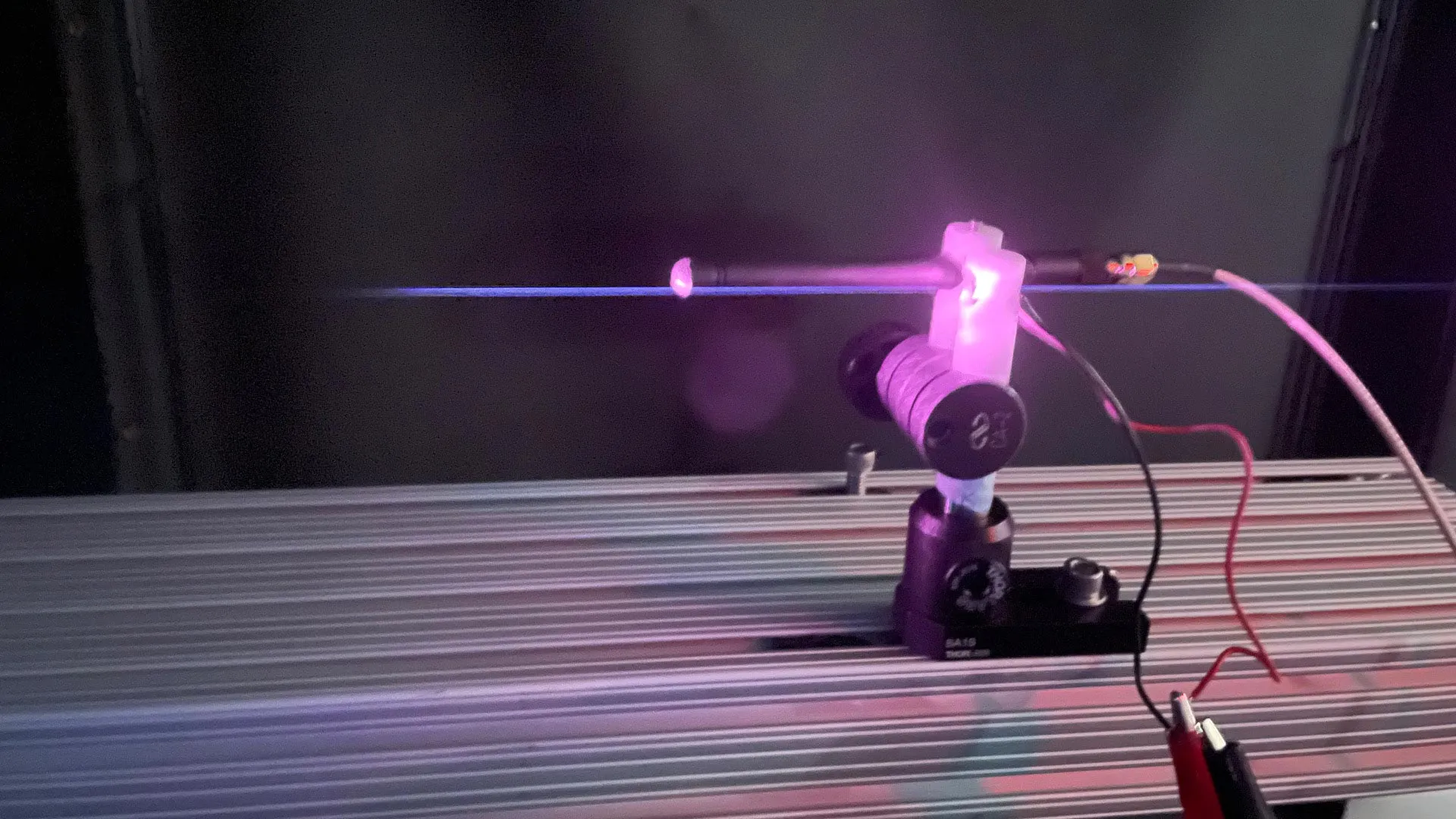
The target of this intense energy was a copper wire of microscopic proportions—measuring approximately 10 micrometers in diameter, or about one-seventh the thickness of a human hair. Despite its small size, the wire was subjected to a physical assault of staggering proportions. The optical laser delivered a burst of light that reached an intensity of 250 trillion megawatts per square centimeter.
When this concentrated energy struck the copper wire, the material did not simply melt or boil; it underwent a phase transition so violent that it instantly vaporized into a plasma. In this state, the thermal energy is so high that electrons are ripped away from their parent nuclei, creating a soup of positively charged ions and free-floating electrons. The temperature of this plasma reached several million degrees Celsius within a fraction of a picosecond (a trillionth of a second).
This level of energy density is rarely seen on our planet outside of specialized research facilities. It mimics the conditions found in the magnetospheres of neutron stars, where magnetic fields and radiation pressures are so intense that they reshape the fundamental behavior of matter. By recreating these "cosmic" conditions in the controlled environment of the European XFEL, the HZDR team has allowed scientists to study high-energy density physics without leaving the laboratory.
The Physics of Resonant Absorption and Ion Tracking
The core challenge of the experiment was not just creating the plasma, but measuring it. The researchers focused their attention on a specific state of the copper atom: the Cu²²⁺ ion. This is a copper atom that has been stripped of 22 of its 29 electrons. To track these specific ions, the team tuned the European XFEL’s X-ray pulses to a photon energy of 8.2 kiloelectronvolts (keV).
This specific energy level was chosen to trigger a process known as resonant absorption. When an X-ray photon with exactly 8.2 keV of energy hits a Cu²²⁺ ion, it is absorbed, causing an internal electronic transition. Shortly thereafter, the ion relaxes and emits its own distinctive X-ray radiation. By measuring the intensity of this stimulated emission, the researchers could calculate the exact density of Cu²²⁺ ions present in the plasma at any given moment.
"In our pump-probe experiment, we exactly measure the temporal development of this stimulated X-ray emission," Dr. Huang explained. This data allowed the team to construct a precise timeline of the plasma’s birth, peak, and eventual decay.
A Chronology of Destruction: The 10-Picosecond Window
The data collected by the HZDR team reveals a highly dynamic and structured sequence of events that unfolds over a window of just 10 picoseconds. The chronology of the ionization process can be broken down into three distinct phases:
- The Ignition Phase (0 to 1 Picosecond): Immediately upon the impact of the ReLaX laser pulse, the copper wire begins to vaporize. Initial ionization occurs as the outermost electrons are stripped away. However, the Cu²²⁺ ions do not appear instantly; they require a buildup of energy within the system.
- The Peak Ionization Phase (1 to 2.5 Picoseconds): The number of highly charged Cu²²⁺ ions rises sharply as a wave of high-energy electrons moves through the vaporized material. The concentration of these ions reaches its maximum at approximately 2.5 picoseconds after the initial laser strike. At this point, the plasma is at its most "active" and energetic state.
- The Recombination and Decay Phase (2.5 to 10 Picoseconds): As the plasma expands and begins to cool, the free electrons lose their kinetic energy. They are eventually recaptured by the copper nuclei in a process called recombination. By the 10-picosecond mark, the highly charged Cu²²⁺ ions have largely disappeared, and the plasma begins to return to a lower ionization state.
Prof. Tom Cowan, the former director of the Institute of Radiation Physics at HZDR, noted the historical significance of this observation. "No one has ever looked at this type of ionization so precisely before," he stated. The ability to distinguish between the various stages of ionization in such a narrow timeframe represents a major leap in experimental physics.
The Role of Secondary Electron Waves
One of the most significant findings of the study involves the mechanism that drives the ionization. While the primary laser pulse is responsible for the initial energy injection, it is the secondary "waves" of electrons that do much of the work in creating highly charged ions.
Computer simulations conducted alongside the physical experiment helped the researchers visualize this process. The initial laser strike strips a relatively small number of electrons, but it imbues them with immense energy. These "hot" electrons then surge through the surrounding copper atoms like a shockwave. "They are so energy-rich that they spread out like a wave and knock ever more electrons out of neighboring copper atoms," Prof. Cowan explained.
This cascading effect is what leads to the rapid rise in Cu²²⁺ ions. Understanding this "wave" behavior is crucial for researchers, as it explains how energy is distributed throughout a target during laser-matter interactions. In the context of fusion research, managing this energy distribution is the difference between a successful compression of fuel and a failed experiment.
Strategic Implications for Laser Fusion and Clean Energy
The long-term goal of much of the work performed at the HED-HiBEF station is the realization of inertial confinement fusion (ICF). In this process, powerful lasers are used to compress a small pellet of hydrogen isotopes until the nuclei fuse, releasing massive amounts of energy. A major challenge in ICF is the "instability" of the plasma—if the plasma does not heat and expand uniformly, the fusion process fails.
Dr. Ulf Zastrau, who oversees the HED-HIBEF experimental station at the European XFEL, believes these findings are a cornerstone for future energy research. "This experiment demonstrates how powerful our lasers are and paves the way for future laser fusion facilities," Zastrau said. He noted that because laser fusion relies on the same principles of laser-heated plasmas and electron waves observed in the copper wire experiment, these results provide a direct roadmap for improving reactor design.
By comparing the experimental results with theoretical models, the team can now refine the software used to simulate fusion reactions. Accurate simulations are the primary tool scientists use to design the multi-billion-dollar fusion facilities of the future, such as those being planned in the United States and Europe. "Thanks to our new concrete findings, we can now focus on continuing to refine our simulations of these processes," Zastrau added.
Conclusion and Future Outlook
The HZDR experiment marks a shift in plasma physics from theoretical modeling to direct, high-precision observation. By successfully mapping the life cycle of a highly ionized plasma in trillionths of a second, the researchers have provided the scientific community with a new set of benchmarks for high-energy density physics.
As the European XFEL continues to increase its pulse frequency and the HiBEF station integrates even more powerful diagnostic tools, the resolution of these "molecular movies" will only improve. Future experiments may look at different materials—such as those more closely resembling fusion fuel—or explore how magnetic fields can be used to confine and stabilize the plasma for longer durations.
For now, the ability to see the invisible—to watch as solid matter dissolves into a state of cosmic fire—represents a triumph of engineering and physics. The data harvested from a tiny copper wire in Schenefeld may one day be the key that unlocks the door to a new era of clean, sustainable energy for the planet.