

The pursuit of understanding the fundamental nature of matter has led physicists to the precipice of a new era in quantum mechanics, marked by the successful integration of time crystals with external physical systems. Researchers at Aalto University’s Department of Applied Physics have announced a breakthrough in which they successfully converted a time crystal into an optomechanical system, a feat previously thought to be nearly impossible due to the delicate nature of quantum states. This milestone, led by Academy Research Fellow Jere Mäkinen, represents a significant leap toward utilizing these exotic phases of matter in practical technologies, including quantum computing memory and ultra-precise sensing arrays.
The study, published in the journal Nature Communications, details how the research team manipulated magnons—quasiparticles representing collective excitations of electron spins—within a superfluid environment to create a stable time crystal that could interact with a mechanical oscillator. By bridging the gap between the isolated quantum environment of the time crystal and a tangible external system, the researchers have demonstrated that these "perpetual motion" systems can be controlled and tuned, opening doors to a new class of hybrid quantum devices.
The Genesis of Time Crystals: From Theory to Laboratory Reality
To understand the magnitude of the Aalto University achievement, one must look back to 2012, when Nobel Prize-winning physicist Frank Wilczek first hypothesized the existence of time crystals. In classical physics, a crystal like diamond or quartz is defined by its spatial symmetry breaking; its atoms are arranged in a repeating pattern in three-dimensional space. Wilczek proposed that a similar phenomenon could occur in the dimension of time. He envisioned a system that could break time-translation symmetry, resulting in a structure that repeats its motion periodically even in its lowest energy state, or ground state.
For years, the concept was met with skepticism, as critics argued it mirrored the impossible dream of a perpetual motion machine. However, the laws of thermodynamics are not violated by time crystals because they do not perform work or emit energy in a way that depletes the system; rather, they exist in a constant state of change that requires no external input to maintain. In 2016, the scientific community moved from theory to evidence when two independent teams—one at the University of Maryland and another at Harvard University—successfully created time crystals using trapped ions and nitrogen-vacancy centers in diamonds, respectively.
While those early experiments proved that time crystals could exist, they remained largely isolated curiosities. The primary challenge facing physicists was the "observer effect" or decoherence. In the quantum world, the act of connecting a system to an external environment typically disrupts the quantum state, causing it to collapse. For a time crystal, which relies on a precise, undisturbed rhythm, any interaction with an external system was expected to halt its motion.
Technical Execution: Helium-3 and the Role of Magnons
The Aalto University team approached this challenge by utilizing the unique properties of Helium-3, a rare isotope of helium that, when cooled to within a few millikelvins of absolute zero, becomes a superfluid. A superfluid is a state of matter that behaves like a fluid with zero viscosity, allowing it to flow without losing kinetic energy. This environment provides the near-perfect isolation required to sustain quantum phenomena over long durations.
To create the time crystal, the researchers used radio waves to inject magnons into the Helium-3 superfluid. Magnons are not elementary particles like electrons; they are quasiparticles that emerge from the collective behavior of a group of particles. In this context, they represent the "spin" of the atoms moving in a coordinated wave. Once the external radio wave source was deactivated, the magnons did not dissipate into chaos. Instead, they spontaneously organized into a coherent, repeating pattern—a time crystal.
"Perpetual motion is possible in the quantum realm so long as it is not disturbed by external energy input, such as by observing it," explains Jere Mäkinen. "That is why a time crystal had never before been connected to any external system. But we did just that and showed, also for the first time, that you can adjust the crystal’s properties using this method."
The Breakthrough: Integration with a Mechanical Oscillator
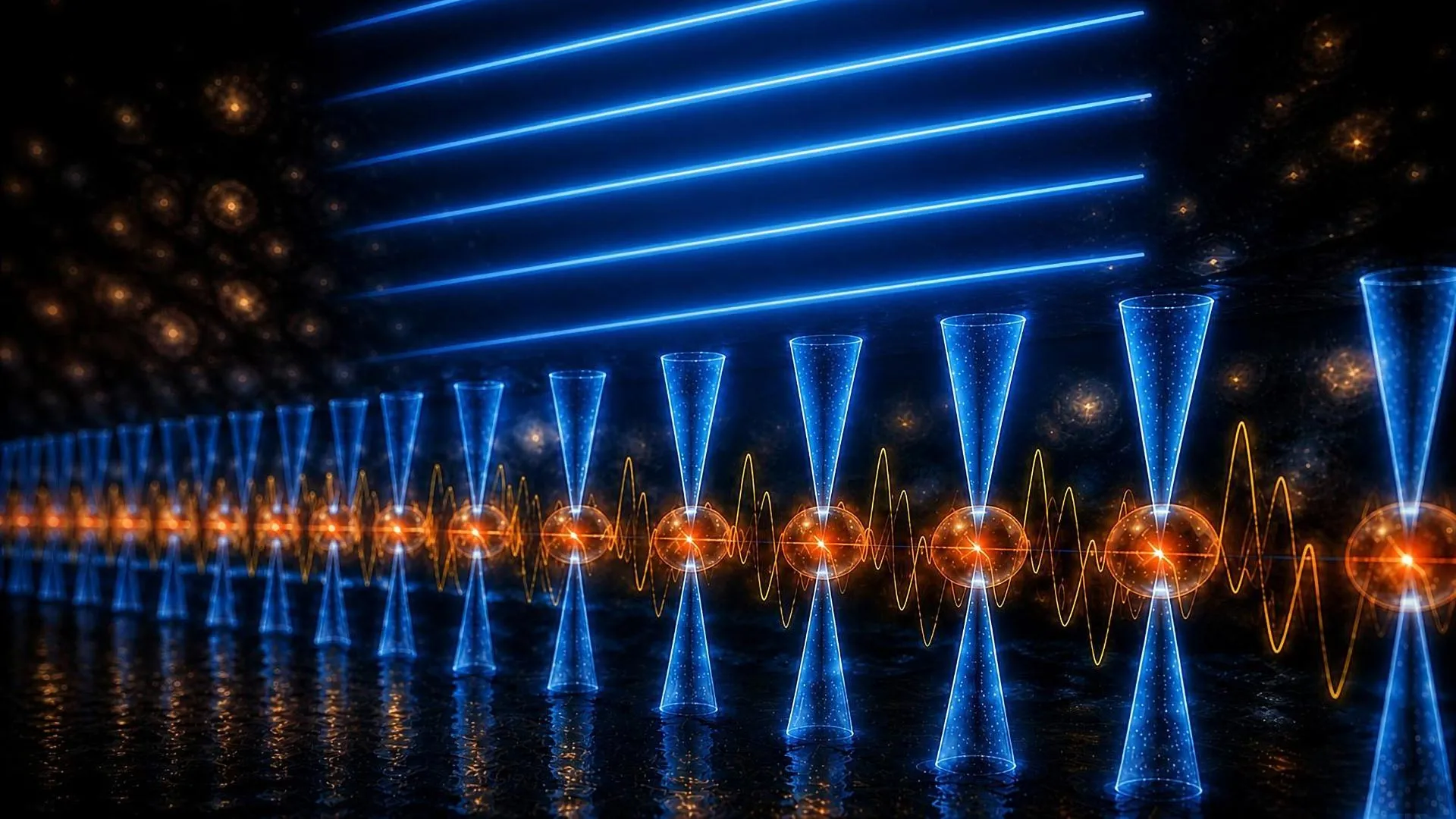
The crux of the experiment involved placing a mechanical oscillator in close proximity to the time crystal. As the time crystal exhibited its periodic motion, it began to interact with the oscillator. The team observed that the frequency and amplitude of the mechanical oscillator could influence the time crystal, and vice versa. This interaction is technically described as an optomechanical coupling, though in this case, the "optics" are replaced by the quantum oscillations of the time crystal.
The researchers discovered that the time crystal’s motion was incredibly resilient. It persisted for up to 108 cycles, lasting several minutes. In the context of quantum physics, where states often decohere in microseconds or milliseconds, a duration of several minutes is an eternity. This longevity is what makes time crystals such attractive candidates for future technological applications.
During the observation period, the team found that the changes in the time crystal’s frequency were perfectly analogous to optomechanical phenomena seen in traditional physics. This includes the same physical principles utilized by the Laser Interferometer Gravitational-Wave Observatory (LIGO) in the United States to detect ripples in spacetime. By establishing this analogy, the Aalto team has provided a roadmap for how time crystals can be used as high-sensitivity transducers.
Comparative Data and Experimental Context
The success of the Aalto experiment can be measured by comparing its results to previous attempts at stabilizing quantum systems. Most qubits—the basic units of quantum information—require constant error correction and have very short "coherence times." The time crystal in Helium-3, however, showed a natural resistance to environmental noise.
| Feature | Standard Superconducting Qubit | Aalto Time Crystal System |
|---|---|---|
| Medium | Silicon/Superconducting circuits | Helium-3 Superfluid |
| Typical Coherence Time | Microseconds to Milliseconds | Several Minutes (108 cycles) |
| Stability Mechanism | External Error Correction | Spontaneous Self-Organization |
| Temperature | ~10-20 Millikelvin | ~1-2 Millikelvin |
| External Interaction | Direct Electrical Coupling | Optomechanical Coupling |
The data indicates that the time crystal’s frequency could be shifted by adjusting the mechanical oscillator’s properties. This "tunability" is the missing link that moves time crystals from the realm of theoretical physics into the realm of engineering. If a system cannot be tuned or adjusted, it cannot be used to process information or act as a sensor.
Implications for Quantum Computing and Future Sensing
The long-term implications of this research are twofold: the advancement of quantum memory and the creation of next-generation sensors.
In the field of quantum computing, one of the greatest hurdles is the storage of information. Because quantum states are so fragile, building a "hard drive" for a quantum computer is immensely difficult. Time crystals, with their inherent stability and long life cycles, could serve as the foundation for quantum memory systems. They could potentially store quantum information for periods orders of magnitude longer than current technologies allow, significantly reducing the overhead required for error correction.
Furthermore, the sensitivity of the time crystal to its environment—once properly coupled—makes it an ideal candidate for frequency combs. Frequency combs are tools used to measure different colors (frequencies) of light with extreme precision. In a quantum context, a time crystal-based frequency comb could serve as an ultra-stable frequency reference for atomic clocks or GPS systems, potentially improving their accuracy by several factors.
"The best-case scenario is that time crystals could power the memory systems of quantum computers to significantly improve them," Mäkinen noted. "They could also be used as frequency combs which are employed in extremely high-sensitivity measurement devices as frequency references."
Chronology of Modern Time Crystal Development
The journey to the Aalto University breakthrough follows a decade of rapid theoretical and experimental progress:
- 2012: Frank Wilczek proposes the time crystal concept, suggesting that time-translation symmetry can be broken.
- 2015: Physicists refine the theory, suggesting that time crystals cannot exist in thermal equilibrium but can exist in "floquet" systems (driven systems).
- 2016: Experimentalists at Maryland and Harvard create the first discrete time crystals using ions and diamonds.
- 2019-2020: Researchers begin exploring time crystals in different states of matter, including superfluids and Bose-Einstein condensates.
- 2021: Google, in collaboration with several universities, uses its Sycamore quantum processor to create a time crystal, demonstrating the phase on a programmable platform.
- 2024: The Aalto University team successfully links a time crystal to an external mechanical system, demonstrating the first optomechanical coupling of its kind.
Infrastructure and Collaborative Efforts
The research was conducted at the Low Temperature Laboratory, which is part of OtaNano, Finland’s national research infrastructure for micro-, nano-, and quantum technologies. The facility is world-renowned for its ability to reach temperatures closer to absolute zero than almost anywhere else on Earth. The experiment also relied heavily on computational resources from the Aalto Science-IT project, which provided the modeling necessary to understand the complex interactions between the magnons and the mechanical oscillator.
While the current experiment requires extreme cryogenic cooling—a limitation for widespread consumer use—the principles established by the Aalto team provide a blueprint for other researchers. The goal now is to determine if similar coupling can be achieved at higher temperatures or using different materials that are easier to integrate into existing semiconductor fabrication processes.
A Fact-Based Analysis of the Path Forward
The successful coupling of a time crystal to a mechanical system marks the transition of time crystals from a "closed" quantum system to an "open" one. In physics, an open system is one that can exchange energy or information with its surroundings. This transition is essential for any practical technology.
However, challenges remain. The reliance on Helium-3 is a bottleneck, as the isotope is both rare and expensive, primarily sourced from the decay of tritium used in nuclear weapons stockpiles. Future research will likely focus on replicating these results in more accessible media, such as solid-state crystals or engineered metamaterials.
Despite these hurdles, the Aalto University study confirms that the "perpetual" motion of the quantum realm is not just a theoretical curiosity but a functional tool. By proving that we can "touch" a time crystal without destroying it, Mäkinen and his team have effectively bridged the gap between one of the most abstract concepts in physics and the future of high-performance computing and measurement. The ability to control the "rhythm of the quantum world" may soon become a cornerstone of 21st-century technology.









Leave a Reply