The human experience is inextricably linked to the sense of smell, a biological mechanism that allows us to navigate environments, enjoy the complexities of gastronomy, and forge deep-seated emotional memories. Yet, for decades, the internal logic of how the nose organizes its vast array of sensors has remained one of the most significant enigmas in sensory biology. While the maps for vision, hearing, and touch were decoded long ago, the olfactory system appeared to be a chaotic landscape of randomly distributed neurons. This long-standing mystery has finally been addressed by a team of neurobiologists at Harvard Medical School, who have published the first detailed map of smell receptors, revealing a highly organized biological architecture that challenges previous scientific assumptions.
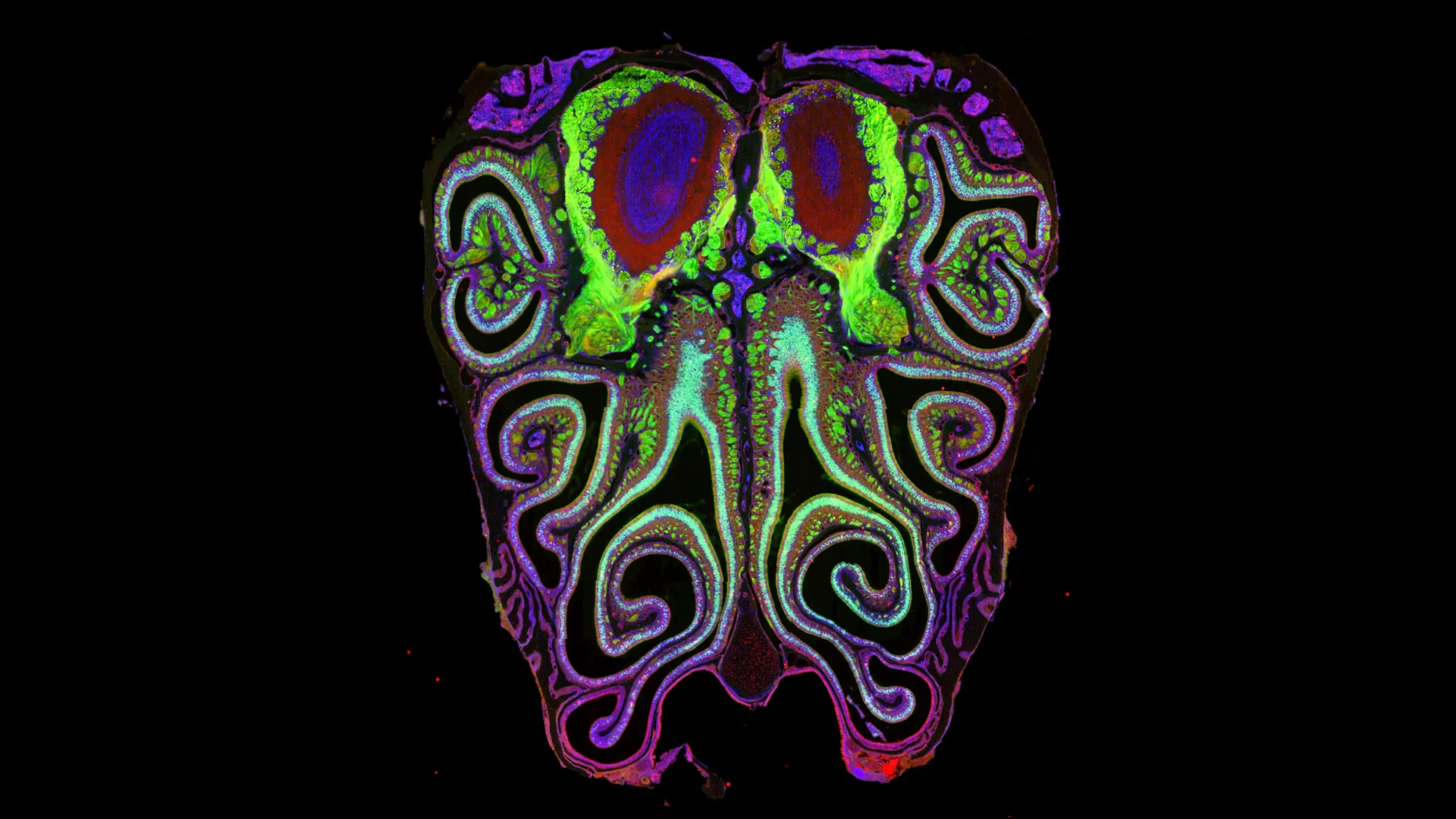
Sandeep Robert Datta, a professor of neurobiology in the Blavatnik Institute at Harvard Medical School and the senior author of the study, describes the sense of smell as "super-mysterious" in comparison to other sensory modalities. The research, published in the journal Cell, provides a conceptual shift in our understanding of how the brain processes chemical information. By analyzing the nasal tissues of mice, which serve as a primary model for mammalian olfaction, Datta and his colleagues discovered that the olfactory system is not a random collection of sensors but a precisely structured grid organized into horizontal bands or "stripes."
The Historical Challenge of Mapping Olfaction
To understand the significance of this discovery, one must look back at the history of olfactory research. The modern era of smell science began in 1991, when researchers Richard Axel and Linda Buck identified the family of genes responsible for odorant receptors—a discovery that later earned them the Nobel Prize in Physiology or Medicine in 2004. They discovered that the mammalian genome contains hundreds, and in some species over a thousand, different types of smell receptors.
Despite this breakthrough, the spatial organization of these receptors remained elusive. In vision, the retina is organized such that adjacent points in the visual field correspond to adjacent points in the brain’s visual cortex. Similarly, in touch, the "somatosensory map" ensures that neurons representing the hand are located near those representing the arm. Olfaction, however, appeared to be the exception to this rule of topographic mapping. For thirty years, the prevailing theory was that neurons expressing a particular receptor were scattered randomly across broad zones of the nose.
The sheer complexity of the system contributed to this lack of clarity. A mouse possesses approximately 20 million olfactory neurons, each expressing just one of more than 1,000 different receptor types. To put this in perspective, human color vision is governed by only three types of photoreceptors in the eye. The computational challenge of tracking 1,000 different variables across millions of cells required technological advancements that were not available to previous generations of scientists.
A New Map Built on Massive Data Scales
The breakthrough achieved by Datta’s team was made possible by the integration of two cutting-edge technologies: single-cell sequencing and spatial transcriptomics. Single-cell sequencing allows researchers to identify which specific genes are active in an individual cell, while spatial transcriptomics provides a "coordinate system" that pinpoints exactly where that cell is located within a tissue.
The scale of the study was unprecedented. The researchers analyzed approximately 5.5 million neurons across more than 300 mice. "This is now arguably the most sequenced neural tissue ever," Datta noted, emphasizing that such a massive data set was a prerequisite for identifying patterns that were previously invisible to the human eye or less powerful computational tools.
The resulting map revealed a stunning level of order. Instead of being randomly scattered, neurons carrying the same receptor types were found to be grouped into tight, overlapping horizontal stripes. These stripes run from the top of the nasal cavity to the bottom. This organized arrangement was remarkably consistent across every mouse studied, suggesting that the "smell map" is a fundamental and genetically encoded feature of the mammalian olfactory system.
The Role of Retinoic Acid in Biological Patterning
After identifying the map, the researchers sought to understand the biological instructions that tell a neuron where to go and which receptor to express. Their investigation led them to retinoic acid, a derivative of Vitamin A known to play a critical role in embryonic development and tissue growth.
The team discovered a gradient of retinoic acid within the nose—high concentrations in certain areas and low concentrations in others. This gradient acts as a chemical "GPS" for developing neurons. Depending on a neuron’s position relative to the retinoic acid levels, specific genes are turned on or off, determining which of the 1,000 receptors the neuron will eventually display.
To prove this connection, the researchers experimentally manipulated the levels of retinoic acid in the nasal cavity. They found that by altering the gradient, they could shift the entire receptor map upward or downward. This demonstrated that the organization of the nose is not accidental but is a direct result of a precise developmental program. "We show that development can achieve this feat of organizing a thousand different smell receptors into an incredibly precise map that’s consistent across animals," Datta said.
Bridging the Gap Between the Nose and the Brain
One of the most significant findings of the study is that the spatial map in the nose aligns perfectly with the map in the olfactory bulb—the part of the brain that first receives and processes scent information. In the olfactory bulb, information is organized into "glomeruli," which are small spherical structures where neurons from the nose terminate.
For years, scientists wondered how neurons from the nose "knew" where to plug into the brain. The discovery of the horizontal stripes in the nose provides the missing link. Because the neurons are already organized into a map at the source (the nose), they can more easily project their axons to the corresponding map in the brain. This alignment ensures that the "logic" of a scent is preserved as the signal travels from the external environment into the internal neural circuits of the animal.
This finding was corroborated by a parallel study led by Catherine Dulac, the Xander University Professor at Harvard, which was published in the same issue of Cell. The convergence of results from two independent labs provides a high degree of scientific confidence in the existence and function of this olfactory map.
Implications for Clinical Medicine and Anosmia
While the primary goal of the research was to advance fundamental neurobiology, the implications for human health are profound. Disorders of the sense of smell, collectively known as anosmia or hyposmia, affect millions of people worldwide. While often dismissed as a minor inconvenience, the loss of smell can have devastating effects on safety (the inability to detect gas leaks or spoiled food), nutrition (the loss of flavor), and mental health (a strong link exists between anosmia and depression).
The COVID-19 pandemic brought international attention to the importance of olfaction, as millions of patients experienced temporary or permanent loss of smell. Despite the prevalence of these conditions, clinical treatments remain limited. "We cannot fix smell without understanding how it works on a basic level," Datta explained.
The discovery of the receptor map and the role of retinoic acid provides a potential blueprint for regenerative medicine. If scientists can understand how the nose organizes itself during development, they may be able to use stem cell therapies to regrow olfactory tissue in patients with nerve damage. Furthermore, the map could inform the development of brain-computer interfaces designed to bypass damaged nasal tissues and deliver scent information directly to the brain.
Future Directions and Research Trajectory
The Harvard team is now looking toward the next frontier: determining whether this same organizational structure exists in humans. While mice rely more heavily on their sense of smell for survival than humans do, the basic biological principles of the mammalian olfactory system are often highly conserved across species.
The researchers also want to investigate why the receptors are arranged in this specific order. Does the "stripe" for a floral scent sit next to the "stripe" for a musky scent for a functional reason? Does this organization help the brain distinguish between similar chemical structures?
"Smell has a really profound and pervasive effect on human health, so restoring it is not just for pleasure and safety but also for psychological well-being," Datta said. "Without understanding this map, we’re doomed to fail in developing new treatments."
The research was a collaborative effort involving several institutions and was supported by the National Institutes of Health, the Yang Tan Collective at Harvard, and the National Science Foundation. As scientists continue to peel back the layers of the "mysterious" sense of smell, this map will serve as the essential guide for all future exploration into how we perceive the chemical world around us.