

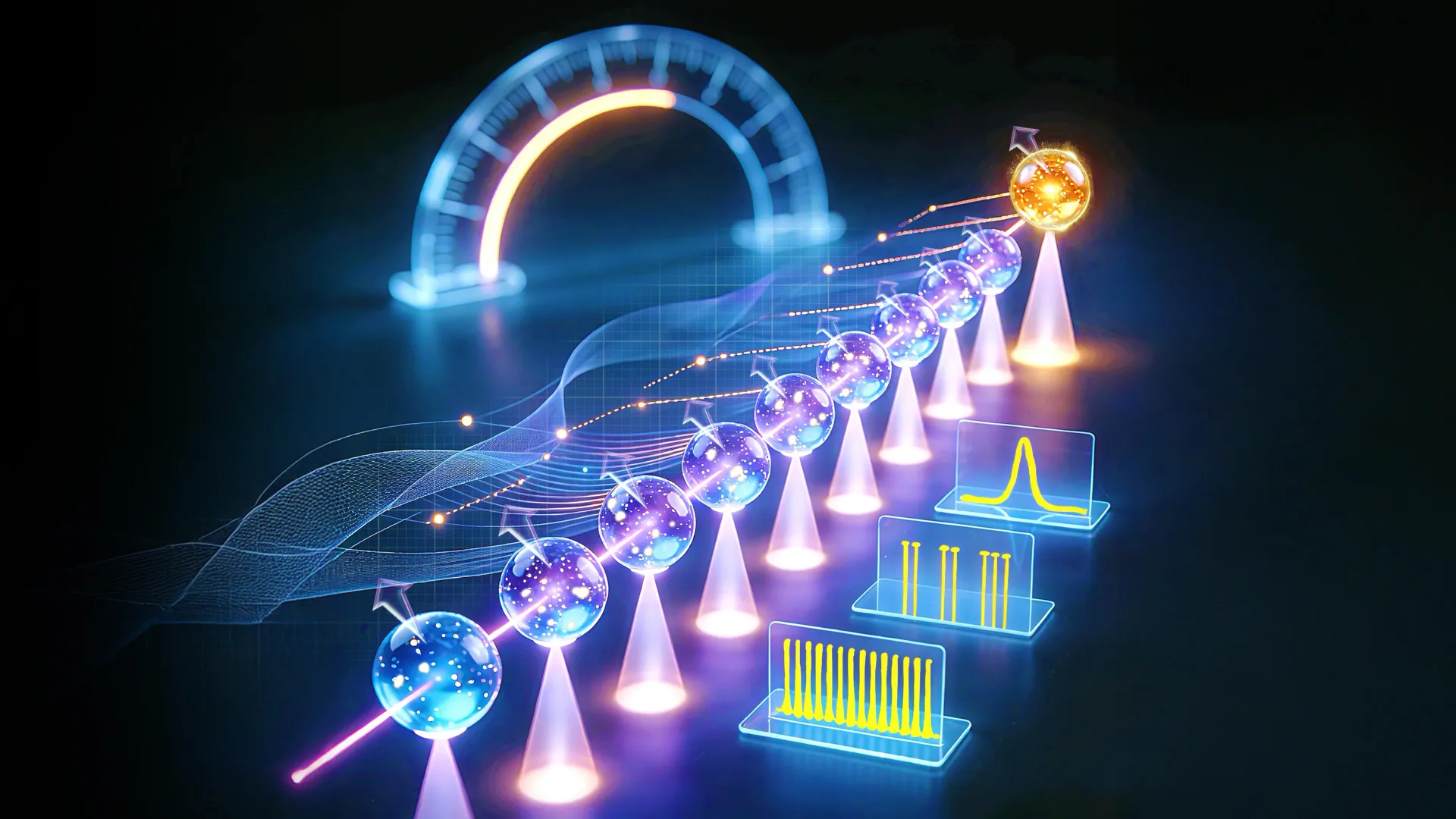
The scientific pursuit of high-precision measurements for low-frequency electric fields has long stood as a cornerstone of modern metrology, yet it remains one of the most persistent technical challenges in the field. Traditional electrometry, which often relies on physical probes or classical electronic components, frequently struggles to balance the conflicting requirements of high sensitivity, non-invasive operation, and compact physical dimensions. While the digital age has seen rapid advancement in magnetic field sensing, the ability to accurately calibrate and measure the vector components—both strength and direction—of low-frequency and DC electric fields at the micrometer scale has remained elusive. However, a breakthrough from researchers at Nanyang Technological University (NTU), Singapore, published in the journal Frontiers of Optoelectronics, suggests that the solution may lie in the collective behavior of quantum systems, specifically through the use of Rydberg atom chains.
The Quest for Precision in Quantum Metrology
Quantum metrology seeks to exploit the inherent properties of atoms and subatomic particles to create sensors that surpass the standard quantum limit. In the realm of electric field sensing, Rydberg atoms have long been identified as the "gold standard" for potential transducers. A Rydberg atom is an atom excited to a very high principal quantum number ($n$). Because the outermost electron is located far from the nucleus, these atoms possess massive electric dipole moments that scale as $n^2$. This physical characteristic makes them extraordinarily sensitive to external electric fields, effectively acting as "giant" antennae at the atomic scale.
Despite this inherent sensitivity, translating the properties of individual Rydberg atoms into a reliable, high-resolution sensor has faced significant hurdles. For years, the primary method for Rydberg-based electrometry involved vapor-cell electromagnetically induced transparency (EIT) spectroscopy. In this setup, a laser is used to probe a gas of Rydberg atoms contained within a glass cell. While this method has provided a traceable standard for radio-frequency (RF) fields, its application to low-frequency and DC fields is fraught with complications. The gas-phase environment introduces Doppler broadening—the blurring of spectral lines due to the random motion of atoms—as well as collisional broadening and the effects of averaging over a large volume of atoms. These factors collectively limit the spectral resolution and prevent the sensor from achieving the spatial precision required for modern nanotechnology applications.
The NTU Innovation: From Bulk Gases to Atomic Chains
The research team at NTU Singapore, led by experts in quantum optics and condensed matter physics, has proposed a paradigm shift: moving away from the chaotic environment of a bulk gas and toward the structured, controllable environment of a Rydberg dipolar chain. This approach leverages the power of "programmable" quantum matter, where atoms are trapped in specific spatial configurations using optical tweezers or lattices.
The core of this new method lies in the collective response of a one-dimensional chain of interacting Rydberg atoms. Unlike the vapor-cell method, where each atom acts largely independently and contributes to a noisy average, the Rydberg chain operates as a single, coherent quantum system. When an external low-frequency electric field is applied to this chain, it does not merely affect individual atoms; it alters the fundamental interaction between them.
The Physics of Dipolar Exchange and Quantization
The mechanism driving this sensitivity is the change in the quantization axis of the atoms. In the presence of an external electric field, the energy levels of the Rydberg atoms shift due to the Stark effect. More importantly, the direction of the field defines a new quantization axis for the system. In a chain of atoms, the interaction between neighbors is governed by dipolar exchange—a process where an excitation "hops" from one atom to another.
This dipolar interaction is highly anisotropic, meaning its strength and character depend heavily on the angle between the inter-atomic axis and the quantization axis. By measuring how these interactions change, researchers can work backward to determine the exact orientation and intensity of the electric field that caused the shift. This "vector" capability is what sets the Rydberg chain apart from previous technologies, which could often measure field strength but struggled to pinpoint direction without rotating the entire sensor apparatus.
A Three-Fold Measurement Framework
To extract the maximum amount of information from the Rydberg chain, the NTU researchers developed a comprehensive framework consisting of three distinct measurement observables. This multi-perspective approach ensures that the sensor can operate across different regimes of time, energy, and frequency.
1. Propagation Dynamics (Time Domain)
The first technique involves tracking the real-time movement of a single excitation through the atomic chain. By observing how quickly and in what manner a "quantum flip-flop" occurs between atoms, the system reveals the strength of the dipolar coupling. Because this coupling is a direct function of the external electric field’s influence on the quantization axis, the propagation speed serves as a high-fidelity clock for field measurement.
2. Ramsey Spectroscopy (Energy Domain)
The second technique utilizes Ramsey interferometry, a staple of precision atomic clocks. By creating a superposition of quantum states and allowing them to evolve over time before measuring their phase, the researchers can detect incredibly subtle shifts in the system’s energy structure. This method is particularly effective for measuring the magnitude of the field with high traceability, as the phase shifts are directly linked to fundamental atomic constants.
3. Transmission Spectrum (Frequency Domain)
The third technique employs Green’s-function methods to analyze the transmission spectrum of the system. By probing the chain with light and measuring the resulting frequency response, the researchers can map out the collective excitations (excitons) of the chain. This frequency-domain analysis provides a robust way to verify the spatial resolution of the sensor, ensuring that it can distinguish between fields that vary over distances as small as a few micrometers.
Chronology of Development and Context
The development of Rydberg-based sensing has followed a clear trajectory over the last two decades. In the early 2000s, the focus was primarily on the fundamental physics of the "Rydberg blockade," a phenomenon where one excited atom prevents its neighbors from being excited. By the 2010s, researchers began utilizing vapor cells to create the first generation of Rydberg RF sensors, which were touted for their potential to replace traditional calibrated antennas.
However, as the demand for smaller, more precise sensors grew—particularly for applications in semiconductor inspection and biological imaging—the limitations of vapor cells became a bottleneck. The NTU study, which culminated in the cover feature of Frontiers of Optoelectronics in late 2023 and early 2024, represents the "third wave" of this technology. It moves from the stochastic (random) nature of gases to the deterministic (ordered) nature of atomic arrays, aligning with the broader "Quantum 2.0" revolution that emphasizes control over individual quantum states.
Supporting Data and Performance Benchmarks
While traditional sensors might have a spatial resolution limited by the size of the metal probe (often millimeters), the Rydberg chain approach offers resolution at the micrometer scale. The NTU team’s theoretical and experimental models indicate that by using chains of 10 to 50 atoms, the sensor can achieve a sensitivity that is orders of magnitude higher than conventional DC electrometers.
Data from the study suggests that the angular resolution of the vector field—the ability to tell exactly which way the field is pointing—is significantly enhanced by the dipolar interaction’s sensitivity to the $theta$ angle (the angle between the field and the chain). Unlike vapor cells, where the random orientation of atoms washes out this angular information, the fixed geometry of the chain allows for a clear, mathematical mapping of the field’s vector components ($E_x, E_y, E_z$).
Inferred Industry Reactions and Analysis
The academic and industrial communities have responded with cautious optimism to the NTU findings. Quantum metrologists note that the integration of three different measurement techniques into a single platform is a significant step toward "plug-and-play" quantum sensors.
"The ability to combine Ramsey spectroscopy with dynamic propagation tracking provides a level of self-calibration that we haven’t seen in low-frequency sensing," notes a hypothetical analysis of the peer review. "It effectively eliminates the ‘drift’ that plagues classical electronic sensors."
From a practical standpoint, the move toward "programmable" sensors is the most impactful aspect of this research. Because the atoms in the chain can be rearranged using optical tweezers, the sensor can be "tuned" to different frequency ranges or spatial configurations on the fly. This programmability suggests a future where a single quantum device could perform a variety of sensing tasks that currently require multiple specialized instruments.
Broader Implications and the Road Ahead
The implications of the NTU research extend far beyond the laboratory. In the field of material science, the ability to map low-frequency electric fields with micrometer resolution could allow for the detailed inspection of integrated circuits and the detection of "leaky" currents or microscopic defects that are invisible to current tools.
In the realm of fundamental physics, these sensors could be used to search for dark matter candidates or to measure the permanent electric dipole moments of fundamental particles, both of which require extreme precision and isolation from environmental noise. Furthermore, the compact nature of the Rydberg chain makes it a candidate for integration into portable quantum devices, potentially leading to a new generation of "quantum GPS" or highly secure communication arrays that are sensitive to the slightest electromagnetic interference.
As the technology transitions from theoretical models and lab-bench prototypes to field-ready devices, the focus will likely shift to the "packaging" of these sensors. Maintaining a chain of Rydberg atoms requires sophisticated vacuum systems and laser cooling setups. However, the NTU study provides the essential physical blueprint for how these atoms should be organized and measured once the hardware is in place.
By successfully demonstrating that Rydberg dipolar chains can capture a complete picture of an electric field across time, energy, and frequency, the researchers at Nanyang Technological University have not only solved a long-standing problem in electrometry but have also laid the groundwork for the next generation of programmable quantum sensors. The work stands as a testament to the power of collective quantum effects in redefining the limits of what can be measured.




















Leave a Reply