

The global healthcare industry stands as a significant contributor to the planet’s carbon footprint, accounting for an estimated 4.4% of total global emissions annually. Within this vast sector, the pharmaceutical and biotechnology industries play a substantial role, with approximately 71% of healthcare’s emissions stemming from its intricate supply chain. This translates to an estimated 3.12% of total global emissions attributable to the pharmaceutical and biotech supply chain alone, underscoring the profound environmental impact of drug discovery, development, and delivery.
Medicines themselves are a major component of this footprint, contributing between 20% and 55% of healthcare’s overall carbon impact. This considerable share arises from a complex interplay of factors, including corporate operational emissions, the energy-intensive production of Active Pharmaceutical Ingredients (APIs), and the manufacturing processes that transform raw materials into life-saving medications. The scale of the challenge is further illuminated by the resource-intensive nature of pharmaceutical manufacturing, which frequently generates between 25 and 100 kilograms of chemical waste for every single kilogram of active drug produced. A substantial portion of this waste, typically 80% to 90%, is comprised of solvents, which are the primary drivers of Process Mass Intensity (PMI). The median PMI in the pharmaceutical sector ranges from 168 to 308, a figure significantly higher than in many other chemical industries, highlighting the inherent inefficiency in current production methodologies.
Beyond carbon emissions, the environmental footprint of pharmaceuticals extends to the widespread release of pharmaceutical residues into natural ecosystems. These residues enter the environment through multiple pathways: patient excretion following drug administration, emissions from manufacturing plants during production, and the improper disposal of unused or expired medicines. While current exposure levels of these residues in drinking water are generally considered to pose a low direct risk to human health, there are growing concerns about the long-term ecological effects on aquatic life and broader ecosystems. A particularly alarming aspect is the potential for antibiotic residues in manufacturing effluents to promote the development of antibiotic resistance, fostering "superbugs" that pose a severe threat to global public health.
The Paradox of Progress: Ambitious Targets Amidst Rising Emissions
In response to mounting pressure from regulators, investors, and the public, numerous pharmaceutical companies have voluntarily committed to ambitious sustainability goals and initiatives. Major industry players such as AstraZeneca, Johnson & Johnson, and Novartis have publicly declared targets to achieve carbon neutrality, predominantly aiming for the 2040s. Sanofi, demonstrating a more accelerated timeline, has set a goal to be carbon neutral by 2030. These commitments reflect an increasing awareness within the sector of its environmental responsibilities and the imperative to align with global climate objectives, particularly the 1.5-degree Celsius trajectory outlined in the Paris Agreement.
Data from the My Green Lab 2025 Carbon Impact Report indicates a positive trend in corporate alignment with these critical climate targets. The report observed a significant surge in sector alignment with 1.5-degree Celsius trajectories, climbing from 30% in 2024 to 52% in 2025. This suggests a growing number of companies are integrating more stringent climate considerations into their long-term strategic planning and operational frameworks.
Individual companies have reported tangible progress in various environmental metrics. AstraZeneca, for instance, reported in its 2025 Sustainability Data Annex that it is on track to achieve a remarkable 98% reduction in operational emissions by 2026. Furthermore, the company reported a 23% reduction in water use and a 13% decrease in waste production in 2025, compared to its baselines. Sanofi, as of 2024, has reported a 47% reduction in emissions compared to its 2019 baseline, positioning it favorably to meet its 2030 carbon neutrality target. The company is also striving for 100% of its manufacturing sites to implement comprehensive monitoring and management plans to control pharmaceuticals in the environment, addressing the critical issue of chemical residues.
Despite these commendable individual efforts and the increasing number of companies setting ambitious targets, the overarching trend reveals a troubling paradox: the pharmaceutical industry’s absolute emissions continue to climb. This escalating trajectory is often driven by the rapid scale-up of production required to meet increasing global demand for medicines, which frequently outpaces the gains made through sustainability initiatives. Novo Nordisk, a prominent pharmaceutical company, reported a 19% increase in total emissions between 2024 and 2025. This increase was attributed to the acquisition of new production sites and a corresponding surge in energy consumption, illustrating the direct correlation between business expansion and environmental impact without sufficient mitigating measures.
Moreover, while some companies manage to reduce their direct operational emissions (Scopes 1 and 2), their indirect emissions, particularly Scope 3, often show a worrying rise. AstraZeneca, despite its reported success in reducing operational emissions, saw its absolute Scope 3 emissions grow by 24% from its 2019 baseline. Similarly, Eli Lilly’s Scope 3 emissions experienced a substantial increase, rising from approximately 2.99 million metric tons in 2021 to 5.14 million metric tons in 2023. This highlights a fundamental challenge in the industry’s decarbonization journey.
The Scope 3 Conundrum: A Hidden Emissions Epidemic
The overall emissions from the healthcare industry have been on a continuous upward trend. The 2022 My Green Lab report starkly revealed that the total carbon output of public companies in the sector increased by 15%, from 197 million tCO2e (tonnes of carbon dioxide equivalent) in 2020 to 227 million in 2021. The following year, the sector’s carbon impact continued its ascent, rising from 3.9% of global emissions in 2021 to 5% in 2022. The most recent report further underscores this trajectory, indicating a 2% increase in absolute emissions from 2023 to 2024. This consistent growth in absolute emissions, even as individual companies report reductions in specific areas, suggests a systemic issue deeply embedded within the industry’s operational model and supply chain complexities.
To understand this challenge, it is crucial to differentiate between the industry’s carbon output categories as defined by the GHG Protocol:
- Scope 1 emissions: These are direct emissions from sources owned or controlled by the company, such as emissions from manufacturing facilities, company vehicles, and chemical reactions.
- Scope 2 emissions: These are indirect emissions from the generation of purchased energy, such as electricity, heating, and cooling consumed by the company.
- Scope 3 emissions: These encompass all other indirect emissions that occur in a company’s value chain, both upstream and downstream. They are typically the largest and most challenging category to measure and manage.
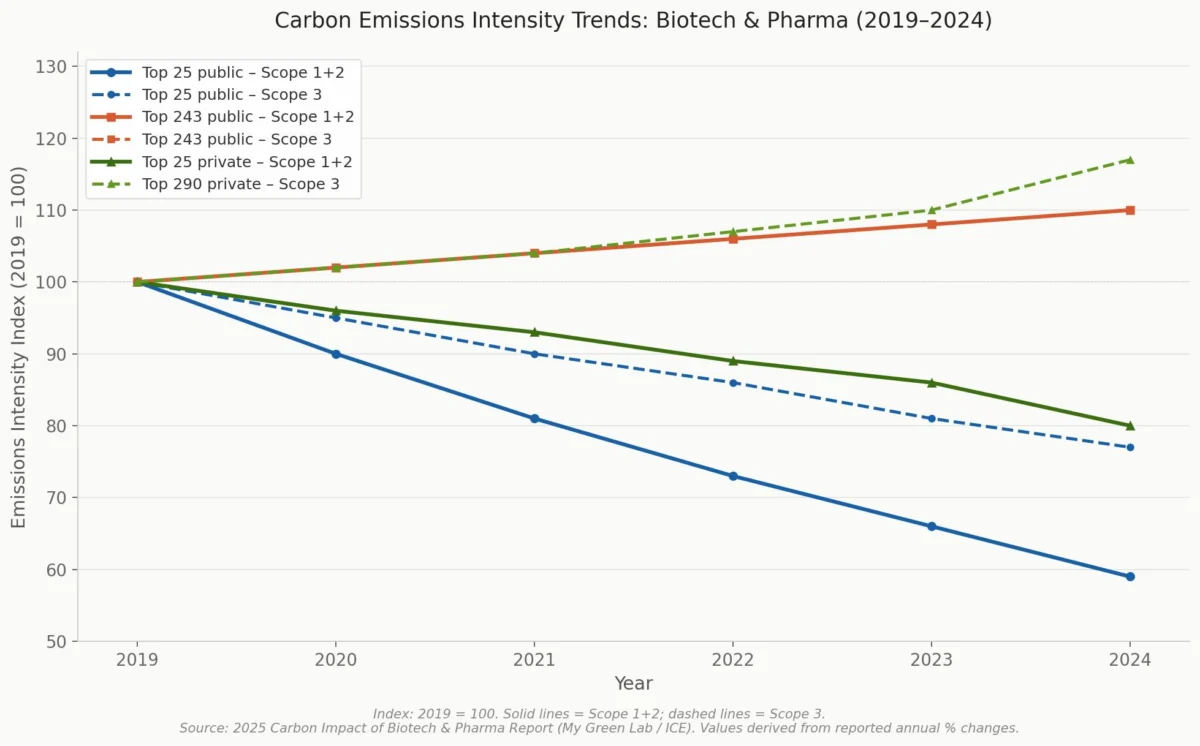
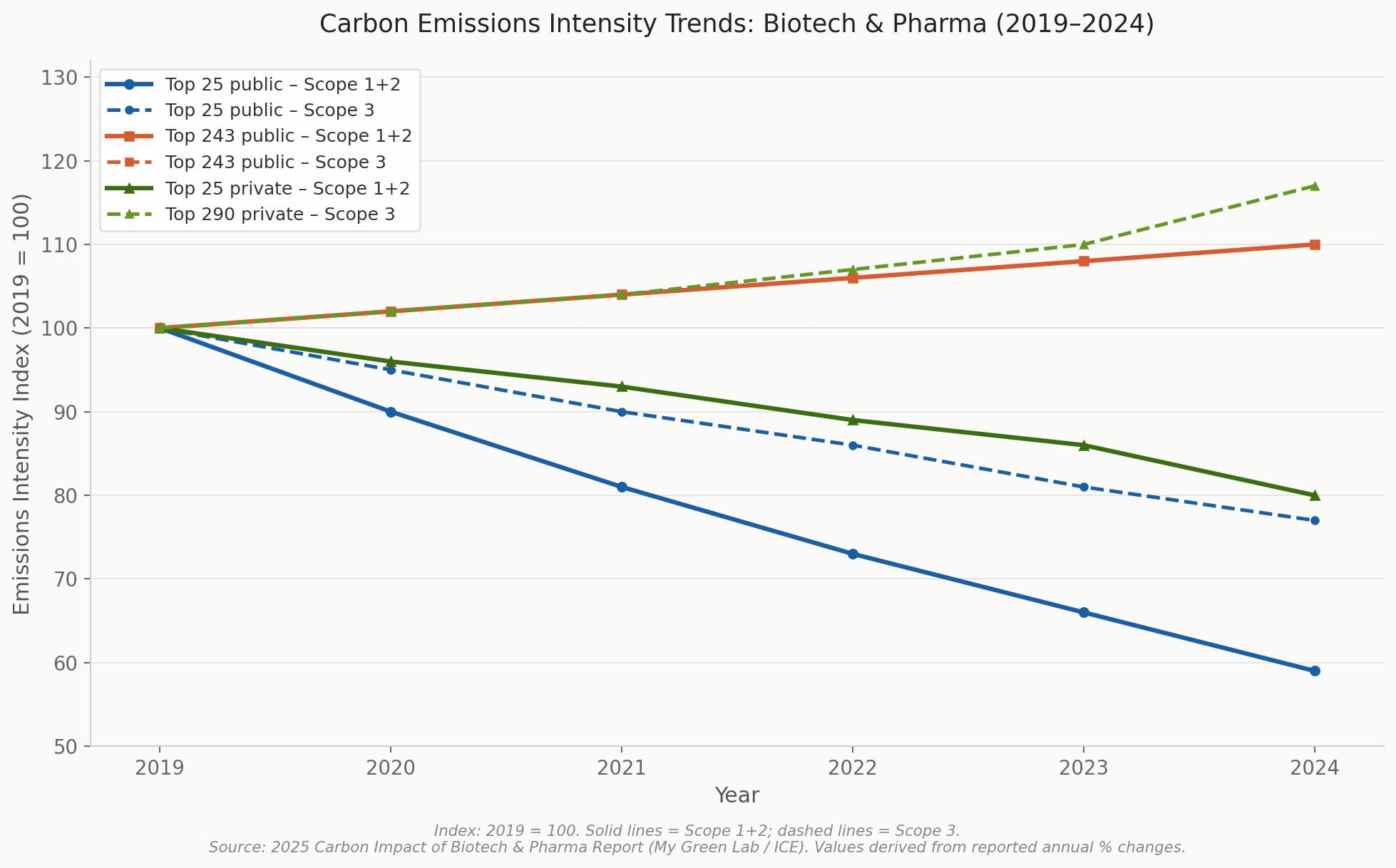
While many of the top 25 public pharmaceutical companies have made commendable strides in reducing their Scope 1 and 2 emissions through investments in renewable energy, energy efficiency, and cleaner operations, the overall carbon intensity of the industry is still rising. This increase is primarily attributed to two factors: the burgeoning contribution of smaller and private firms that may not yet have robust sustainability programs, and the pervasive challenge of Scope 3 emissions. Critically, Scope 3 emissions represent an overwhelming 82% of the industry’s total carbon footprint, making them the most significant leverage point for comprehensive decarbonization.
Scope 3 emissions in the pharmaceutical sector are vast and varied, encompassing:
- Purchased goods and services: This includes emissions from the synthesis of Active Pharmaceutical Ingredients (APIs), excipients, packaging materials, and other raw materials. For pharmaceutical companies, emissions from API synthesis, raw material sourcing, and outsourced manufacturing often constitute the largest single source of carbon emissions within this category.
- Capital goods: Emissions associated with the extraction, production, and transportation of materials used for constructing and maintaining facilities, laboratories, and equipment.
- Upstream and downstream transportation and distribution: Emissions from the logistics of moving raw materials to manufacturing sites, and finished products to distribution centers, hospitals, and pharmacies, including air, sea, road, and rail freight.
- Waste generated in operations: Emissions from the disposal and treatment of operational waste.
- Use of sold products: Emissions associated with the energy consumption of medical devices or the environmental impact of drug residues after patient use.
- End-of-life treatment of sold products: Emissions from the disposal or recycling of pharmaceutical products and packaging after consumption.
The inherent difficulty in managing Scope 3 emissions lies in their occurrence outside the direct operational control of pharmaceutical companies. These emissions are embedded within a sprawling global network of suppliers, contractors, logistics providers, and end-users. Effectively addressing this complex web requires unprecedented levels of collaboration, transparency, and strategic influence across the entire value chain.
Strategies for a Sustainable Future: Addressing Scope 3 and Beyond
To make a substantial and lasting dent in the industry’s emissions, pharmaceutical companies must adopt comprehensive and innovative strategies, particularly focusing on the Scope 3 challenge. These strategies include:
- Supplier Engagement and Incentivization: Companies can leverage their purchasing power to require or incentivize suppliers to adopt their own sustainability targets, transition to renewable energy sources, and improve their environmental performance. This could involve offering preferential contracts, providing technical support, or collaborating on green chemistry initiatives. Robust supplier auditing and reporting mechanisms are also crucial.
- Green Chemistry and Sustainable Manufacturing: Investing in and implementing green chemistry principles is paramount. This involves designing chemical products and processes that reduce or eliminate the use and generation of hazardous substances. Innovations in catalysis, solvent reduction, atom economy, and continuous manufacturing can significantly lower waste generation and energy consumption during API production and formulation.
- Optimized Logistics and Transportation: Shifting from air freight, which is highly carbon-intensive, to lower-emission modes of transport like sea or road freight for less time-sensitive shipments can yield significant reductions. Optimizing delivery routes, consolidating shipments, and investing in electric or hydrogen-powered vehicle fleets for last-mile delivery are also vital steps.
- Renewable Energy Integration Across the Value Chain: Encouraging and supporting suppliers to transition to 100% renewable electricity is a powerful lever. This can be achieved through long-term power purchase agreements, investment in on-site renewables, or purchasing high-quality renewable energy certificates.
- Circular Economy Principles: Embracing circular economy models can reduce waste and resource consumption. This includes designing products for recyclability, developing take-back programs for unused medicines and packaging, and exploring bio-based or recycled content for packaging materials.
- Responsible Management of Pharmaceuticals in the Environment (PiE): Beyond reducing manufacturing emissions, companies must actively engage in initiatives to minimize environmental contamination from drug residues. This includes developing more biodegradable drug formulations, investing in advanced wastewater treatment technologies at manufacturing sites, and supporting public awareness campaigns for proper drug disposal.
- Data Transparency and Collaboration: Improving the accuracy and granularity of Scope 3 emissions data is essential for effective management. This requires greater transparency across the supply chain and collaborative efforts with industry consortia, NGOs, and academic institutions to develop standardized methodologies and shared platforms for data exchange.
The pharmaceutical industry’s dual mission of improving human health and safeguarding the planet presents a complex yet urgent imperative. While individual companies are demonstrating commitment through target setting and operational improvements, the aggregate increase in emissions highlights the need for systemic change. This necessitates not only continued innovation in sustainable practices but also a fundamental shift in how growth is pursued, ensuring that the pursuit of health does not inadvertently compromise the very environmental conditions upon which human well-being depends. The coming years will be critical in determining whether the industry can translate its ambitious sustainability goals into genuine, absolute reductions across its entire value chain, aligning its mission with the urgent demands of a warming planet.

















Leave a Reply