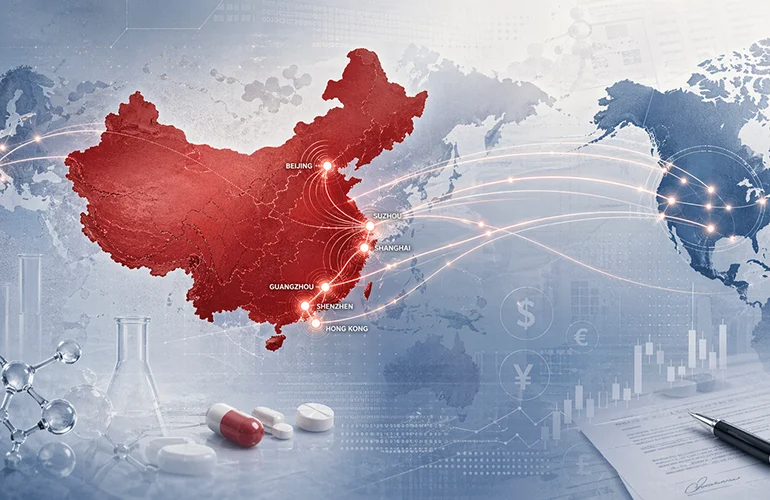
Over the past 16 months, Chinese-domiciled biotechnology companies have emerged as significant players in the global pharmaceutical landscape, securing approximately six out of 26 major licensing and acquisition deals. These transactions collectively represent nearly one-third of the total headline value, amounting to a staggering $53 billion. This surge in cross-border collaborations underscores a pivotal shift in the biopharma industry, with China transitioning from a historical focus on generics and contract manufacturing to a powerhouse of innovative drug discovery and development. The majority of these high-value partnerships, roughly half, have involved U.S.-origin firms, predominantly in mergers and acquisitions. Additionally, just under 30% of these deals were licensing agreements with Chinese-headquartered companies, while the remainder comprised mixed transactions involving European firms, highlighting a broad international recognition of China’s burgeoning biotech capabilities.
The Ascendance of Chinese Biopharma Innovation
The dramatic increase in outbound licensing and M&A deals involving Chinese biotechs is not an isolated phenomenon but rather the culmination of years of strategic investment, policy support, and a maturing domestic innovation ecosystem. For decades, China’s pharmaceutical industry was primarily characterized by the production of generic drugs and active pharmaceutical ingredients (APIs) for global markets. However, a concerted effort by the Chinese government, coupled with a growing pool of scientific talent and substantial venture capital funding, has fueled a profound transformation. Initiatives such as "Made in China 2025" and reforms by the National Medical Products Administration (NMPA), which streamlined drug approval processes and aligned them more closely with international standards, have created an environment conducive to novel drug development. This shift has enabled Chinese companies to not only innovate for their vast domestic market but also to develop assets with global appeal, attracting the attention of leading multinational pharmaceutical corporations (MNCs) seeking to replenish their pipelines and tap into new therapeutic modalities.
A Detailed Chronology of Landmark Collaborations
The 16-month period under review showcases a series of significant transactions that illustrate the growing confidence of Western pharmaceutical giants in Chinese innovation. These deals span various therapeutic areas, from metabolic diseases to oncology and cardiovascular conditions, reflecting the breadth of research and development underway in China.
The trend gained significant momentum in late 2024. In December, pharmaceutical behemoth Merck initiated a substantial partnership by licensing Jiangsu Province-headquartered Hansoh Pharma’s oral obesity candidate, HS-10535. This agreement, valued at up to $2 billion, signaled Merck’s strategic interest in the burgeoning market for obesity treatments and its recognition of Hansoh Pharma’s capabilities in developing novel metabolic disease therapies. Hansoh Pharma, a leading Chinese pharmaceutical company known for its strong R&D pipeline, provided Merck with a promising asset in a highly competitive and lucrative therapeutic area.
Merck’s engagement with Chinese biotechs continued into the following year. In March 2025, the company returned to China, securing a licensing agreement for Hengrui Pharma’s heart drug, HRS-5346. This separate deal, also valued at up to $2 billion, underscored Merck’s strategy of diversifying its pipeline through external innovation, particularly in critical areas like cardiovascular disease. Hengrui Pharma, another prominent Chinese pharmaceutical enterprise, reinforced its reputation as a source of innovative compounds with this significant global partnership.
The momentum carried through 2025 with other major players joining the fray. Last July, Pfizer, one of the world’s largest pharmaceutical companies, entered into a substantial licensing agreement with 3SBio for its cancer candidate, SSGJ-707. The terms of this deal included a robust $1.25 billion upfront payment, with potential milestone payments reaching up to $4.8 billion, complemented by a planned $100 million equity investment. This collaboration highlighted the global pharmaceutical industry’s focus on oncology and the increasing recognition of Chinese biotechs as developers of advanced cancer therapeutics. 3SBio, a pioneer in China’s biopharmaceutical sector, demonstrated its ability to develop high-value assets capable of attracting top-tier global partners.
Further diversifying the types of collaborations, in June 2025, AstraZeneca signed an artificial intelligence (AI)-led chronic-disease research pact with Hebei Province-based CSPC Pharmaceutical Group. This innovative partnership, potentially worth up to $5.3 billion, emphasized the integration of advanced technologies like AI into drug discovery and development. It also showcased CSPC’s commitment to leveraging cutting-edge approaches for chronic disease management and AstraZeneca’s strategic move to enhance its R&D efficiency and explore new therapeutic pathways.
The trend continued unabated into 2026, marking a period of sustained activity and even larger deal values. In January, AbbVie announced a significant licensing agreement for RemeGen’s RC148, a novel bispecific antibody targeting advanced solid tumors. This deal, valued at up to $5.6 billion, further validated the potential of Chinese-developed biologics in oncology, a highly competitive and high-stakes therapeutic area. RemeGen, known for its innovative antibody-drug conjugate (ADC) and bispecific antibody platforms, gained a powerful global partner in AbbVie to accelerate the development and commercialization of RC148.
Just weeks later, AstraZeneca deepened its commitment to Chinese innovation by returning to CSPC Pharmaceutical Group. This time, the collaboration focused on obesity and weight-related drug candidates, with a staggering deal value of up to $18.5 billion, including an upfront payment of $1.2 billion. This monumental agreement reflects the escalating global interest in anti-obesity medications and underscores the belief in CSPC’s capabilities to deliver transformative therapies in this space. The size of this deal alone speaks volumes about the perceived value and potential of Chinese-developed assets.
In early March 2026, Sanofi added to the growing list of Western partners, licensing rovadicitinib from Sino Biopharm’s Chia Tai Tianqing unit for up to $1.53 billion. This deal further diversified the therapeutic areas of collaboration, focusing on blood cancer, and showcased the depth of the Chinese pharmaceutical pipeline across various indications.
By late March, Eli Lilly expanded its existing collaboration with Hong Kong-listed, yet Cambridge, Massachusetts-headquartered, Insilico Medicine. This expanded into a comprehensive licensing and research pact valued at up to $2.75 billion. Insilico Medicine, a pioneer in AI-driven drug discovery, represents a unique hybrid entity that bridges Eastern and Western innovation, further blurring geographical lines in the global biopharma landscape. This partnership highlights the increasing importance of AI and advanced computational methods in accelerating drug development, an area where Chinese firms are making significant strides.
Strategic Rationale: Why Global Pharma is Looking East
The reasons behind this surge in cross-border collaborations are multifaceted, reflecting both the evolving capabilities within China and the strategic imperatives of global pharmaceutical companies.
Firstly, pipeline innovation and diversification are paramount for MNCs facing patent cliffs, increasing R&D costs, and the constant pressure to deliver novel therapies. Chinese biotechs have demonstrated a remarkable ability to develop innovative drug candidates, particularly in areas like oncology, autoimmune diseases, and metabolic disorders, often leveraging cutting-edge technologies and novel mechanisms of action. This access to fresh, de-risked assets provides a valuable opportunity for Western firms to augment their pipelines without the full upfront R&D investment.
Secondly, R&D velocity and cost-effectiveness play a crucial role. As noted by Fangning Zhang, a partner at McKinsey, China "combines next-generation modality leadership and R&D velocity that runs faster and at lower cost than industry norms." This efficiency is partly due to a large, well-educated talent pool, a supportive regulatory environment that has expedited clinical trials, and often lower operational costs compared to Western counterparts. For MNCs, partnering with Chinese firms can translate into faster drug development timelines and more efficient capital deployment.
Thirdly, access to the vast Chinese market remains a significant draw. While many of these deals are global licensing agreements, a strong partnership with a Chinese firm can also facilitate market entry and penetration within China, which is rapidly becoming one of the largest and fastest-growing pharmaceutical markets globally. Domestic partners often possess invaluable local market knowledge, regulatory expertise, and established commercial infrastructure.
Fourthly, advancements in specific therapeutic areas and modalities have positioned Chinese biotechs as leaders. For example, in areas like bispecific antibodies, ADCs, and cell therapies, Chinese companies have shown a remarkable pace of innovation and clinical progress, making them attractive partners for global players seeking expertise in these complex fields. The deals with RemeGen for a bispecific antibody and CSPC for AI-led research exemplify this.
China’s Maturing Innovation Ecosystem and Global Recognition
The burgeoning success of Chinese biotechs is underpinned by a robust and rapidly maturing innovation ecosystem. According to Citeline’s Pharmaprojects database, 2025 marked a historic milestone: more new drugs made their market debut in China than anywhere else globally, surpassing the U.S. for the first time on this critical metric. This achievement is a testament to the accelerated pace of drug development and regulatory approvals within the country.
McKinsey’s Fangning Zhang further emphasized this shift, telling Citeline sister publication Scrip that Asia, with China at its forefront, is rapidly becoming "biopharma’s emerging epicenter." This designation reflects not only the volume of innovation but also the quality and sophistication of the scientific output. Chinese academic institutions and biotech companies are increasingly publishing in top-tier scientific journals and presenting at international conferences, signaling a growing influence on global scientific discourse.
The ecosystem benefits from several key factors:
- Government Support: Continuous investment in R&D, favorable tax policies, and streamlined regulatory pathways.
- Talent Pool: A growing number of highly skilled scientists, clinicians, and entrepreneurs, many of whom have returned from leading institutions in the West.
- Venture Capital: A robust and active venture capital market that provides crucial funding for early-stage and growth-stage biotechs.
- Manufacturing Capabilities: While historically focused on generics, Chinese contract development and manufacturing organizations (CDMOs) are increasingly capable of supporting complex biologic and small molecule development at global standards.
Broader Impact and Future Outlook
The implications of this trend are far-reaching, reshaping the global biopharmaceutical landscape in several ways.
For Western Pharmaceutical Companies, these collaborations offer a vital pathway to pipeline innovation, risk diversification, and potentially faster market access. However, they also necessitate careful navigation of cultural differences, intellectual property considerations, and evolving geopolitical dynamics. Successful partnerships will require robust due diligence and a deep understanding of the local operating environment.
For Chinese Biotechs, these deals provide crucial validation of their scientific capabilities, significant capital infusion for further R&D, and access to the global commercialization expertise and reach of MNCs. This helps them transition from regional players to global innovators, fostering sustainable growth and attracting further investment. It also accelerates their learning curve in global regulatory affairs and market access strategies.
The Global Biopharma Landscape is becoming more decentralized and competitive. The concentration of R&D power is shifting, leading to a more diverse set of drug candidates and therapeutic approaches. This could ultimately benefit patients worldwide by accelerating the availability of novel treatments. The increased competition may also put downward pressure on R&D costs and drug pricing in the long term, though this is a complex interplay of many factors.
Looking ahead, the momentum is expected to continue. Tom Barsha, head of Asia Pacific M&A at BofA Securities, predicts that the total value of China’s licensing-out deals will double again over the next 18 to 24 months. This forecast suggests that the current surge is not a temporary spike but rather the beginning of a sustained period of growth and integration for Chinese biopharma on the global stage.
However, challenges remain. Intellectual property protection continues to be a point of emphasis for Western partners, requiring robust contractual frameworks. Geopolitical tensions could introduce uncertainties, though the current trend suggests that scientific and commercial imperatives often transcend political differences in the biopharma sector. Regulatory complexities across different jurisdictions also demand careful management. Despite these potential hurdles, the economic and scientific drivers behind these collaborations appear strong enough to sustain this significant growth trajectory.
In conclusion, the past 16 months represent a landmark period for Chinese biotechs, solidifying their position as indispensable partners in global pharmaceutical innovation. The substantial value and frequency of these deals underscore a paradigm shift, where China is not just a market or a manufacturing hub, but a rapidly evolving epicenter of cutting-edge drug discovery and development. This transformation promises to profoundly impact how new medicines are discovered, developed, and delivered to patients worldwide for years to come.