

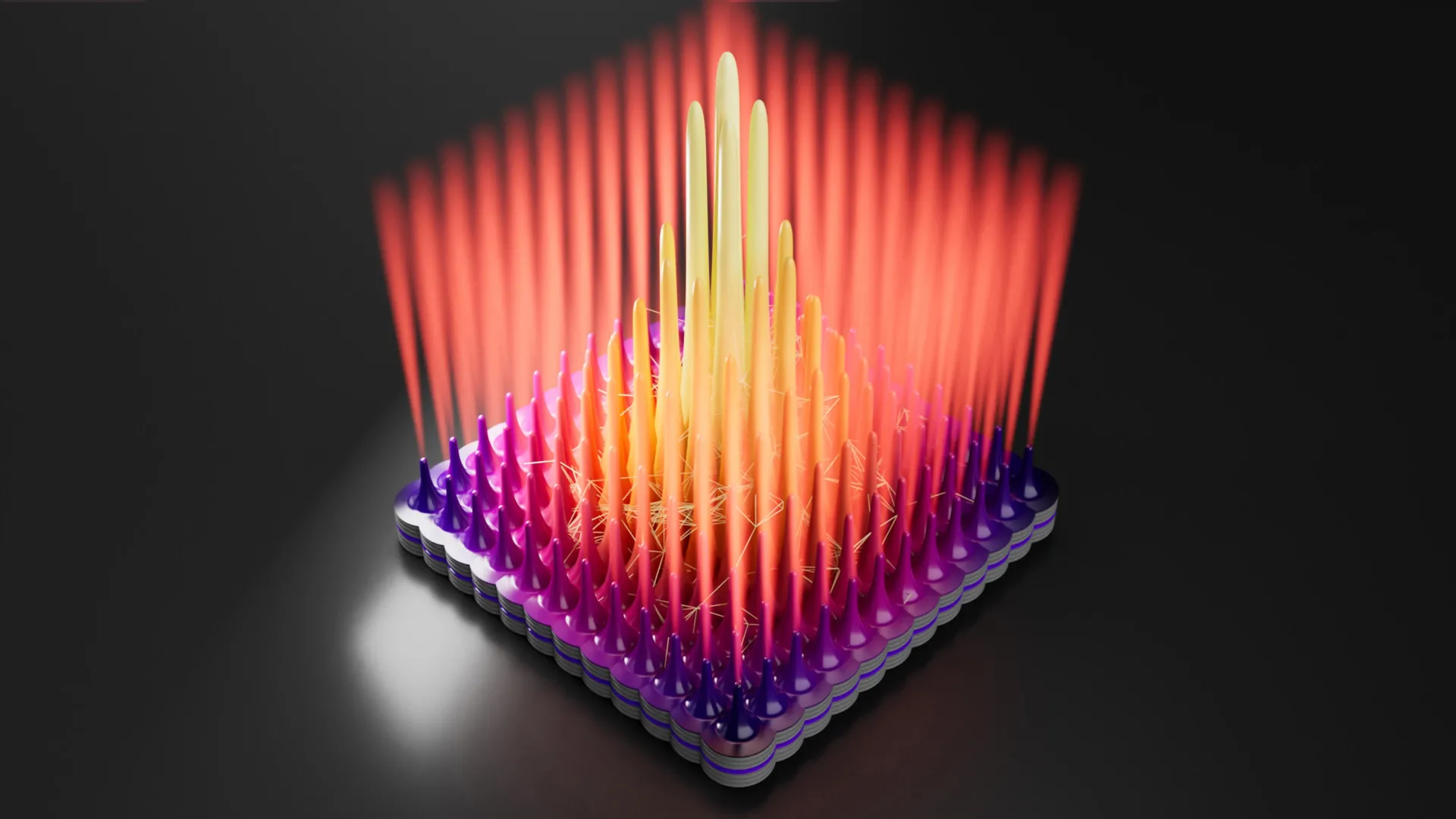
In a landmark achievement for the field of condensed matter physics, researchers at the University of Würzburg have successfully provided the first experimental evidence that the Kardar-Parisi-Zhang (KPZ) equation—a fundamental theory describing the growth of interfaces—holds true in two-dimensional systems. This discovery, published following years of theoretical anticipation and preliminary one-dimensional successes, marks a pivotal moment in the study of non-equilibrium physics. By utilizing a highly controlled environment involving ultracold semiconductors and light-matter hybrids known as polaritons, the team has demonstrated that the chaotic, random growth patterns seen in nature follow a universal mathematical blueprint even when expanded into higher dimensions.
The Genesis of the KPZ Equation and the Quest for Universality
The story of this breakthrough begins in 1986, when physicists Mehran Kardar, Giorgio Parisi, and Yi-Cheng Zhang introduced a stochastic partial differential equation intended to model the temporal evolution of the boundary of a growing aggregate. Known as the KPZ equation, it was designed to capture the essence of how surfaces evolve when subjected to both deterministic growth and random fluctuations.
The power of the KPZ equation lies in its "universality." In physics, universality refers to the phenomenon where vastly different physical systems—regardless of their microscopic details—behave in an identical manner when viewed at a macroscopic scale. Since its inception, the KPZ framework has been applied to a staggering array of phenomena: the way a coffee stain spreads on a paper napkin, the growth of bacterial colonies in a Petri dish, the propagation of a wildfire’s front, and even the deposition of thin films in semiconductor manufacturing.
However, for nearly four decades, the full scope of this universality remained partially theoretical. While the mathematical foundations were robust, observing these patterns in a laboratory setting—especially in two dimensions—presented immense technical hurdles. The challenge stems from the fact that growth processes are inherently "out of equilibrium." Unlike systems in equilibrium, which settle into a stable state over time, growing surfaces are dynamic, non-linear, and influenced by constant noise.
The Challenge of Measuring Two-Dimensional Growth
Until recently, experimental verification of the KPZ model was largely confined to one-dimensional (1D) systems. In 2022, a significant step was taken when researchers in Paris confirmed KPZ behavior in a 1D quantum system. Yet, the leap from one dimension to two dimensions (2D) is not merely a matter of adding an axis; it represents a fundamental increase in complexity.
"When surfaces grow, the process is always nonlinear and random," explains Siddhartha Dam, a postdoctoral researcher at the Würzburg-Dresden Cluster of Excellence ctd.qmat. "In physics, we describe such systems as being out of equilibrium. Engineering a system capable of simultaneously measuring how a non-equilibrium process evolves in space and time is extremely challenging—especially because these processes unfold on ultrashort timescales."
In a 1D system, growth occurs along a line, making fluctuations easier to track. In a 2D system, the surface expands across a plane, and the fluctuations can interact in far more complex ways. To capture this, scientists needed a medium that could grow rapidly enough to be observed but could also be measured with femtosecond precision. This led the Würzburg team to the frontier of light-matter interaction: the world of polaritons.
Constructing the Quantum Laboratory: Polaritons and Gallium Arsenide
To bridge the gap between theory and reality, the researchers at the University of Würzburg’s Chair of Technical Physics designed a sophisticated quantum experiment. The centerpiece of this setup is a semiconductor made from gallium arsenide (GaAs). To reach the necessary quantum state, the material was cooled to an extreme temperature of -269.15°C (approximately 4 Kelvin), just above absolute zero.
At these temperatures, the team utilized a laser to continuously stimulate the semiconductor. This stimulation creates "excitons"—pairs of electrons and holes within the material. When these excitons interact with photons (particles of light) trapped within the material’s structure, they form "polaritons."
Polaritons are often described as "quasiparticles." They are hybrids that possess the characteristics of both light and matter. Because they are part light, they move extremely fast and have a very low mass; because they are part matter, they interact strongly with one another. Crucially for this experiment, polaritons are short-lived, existing for only a few picoseconds (trillionths of a second) before decaying. This fleeting existence makes them the perfect candidates for studying "growth" in a quantum fluid, as they are constantly being created by the laser and disappearing, creating a dynamic, non-equilibrium state.
Precision Engineering via Molecular Beam Epitaxy
The success of the experiment relied heavily on the structural integrity of the material itself. The researchers employed a technique known as molecular beam epitaxy (MBE) to grow the gallium arsenide crystals. MBE allows scientists to deposit material one atomic layer at a time under ultra-high vacuum conditions, ensuring near-perfect purity and control.
"By precisely controlling the thickness of individual material layers, we were able to tune their optical properties and hence fabricate the necessary highly reflective mirrors," says Simon Widmann, a doctoral researcher who worked alongside Siddhartha Dam.
The structure functioned as a "microcavity"—a hall of mirrors for light. By trapping photons between these layers, the researchers forced the light to interact repeatedly with the excitons in the "quantum film" of the gallium arsenide. This level of control allowed the team to "tune" the system, adjusting the laser’s precision to a micrometer scale to observe how the polariton density evolved over time. This evolution, they discovered, mapped perfectly onto the predictions made by the KPZ equation in two dimensions.
A Chronology of Discovery: From 1986 to 2024
The journey to this experimental proof has been a multi-decade marathon involving theoretical physicists and experimentalists across the globe.
- 1986: Mehran Kardar, Giorgio Parisi, and Yi-Cheng Zhang publish their seminal paper, defining the KPZ equation and proposing the concept of universality in surface growth.
- 2015: Sebastian Diehl, a professor at the University of Cologne and a key member of the current research team, publishes a theoretical framework suggesting that KPZ behavior could be observed in "driven-dissipative" quantum systems, such as polariton condensates.
- 2022: An experimental team in Paris achieves the first confirmation of KPZ scaling in a one-dimensional polariton system, proving that quantum fluids can indeed serve as a testing ground for the theory.
- 2024: The Würzburg team, utilizing advanced 2D material fabrication and high-speed optical tracking, confirms the theory in two dimensions, completing the "missing piece" of the universality puzzle.
Sebastian Diehl, reflecting on the achievement, noted: "The experimental demonstration of KPZ universality in two-dimensional material systems highlights just how fundamental this equation is for real non-equilibrium systems."
Supporting Data and Technical Significance
The data gathered by the Würzburg team focused on the "scaling exponents" of the polariton system. In the KPZ model, the roughness of a growing surface is not random in a chaotic sense; rather, it follows specific mathematical power laws. By measuring the spatial correlation (how one part of the surface affects another) and the temporal correlation (how the surface changes over time), the researchers were able to calculate these exponents.
In the 2D experiment, the researchers found that the fluctuations in the polariton density exhibited the exact statistical distribution predicted by the KPZ equation. This is significant because it confirms that the laws governing the growth of a macroscopic "real-world" surface—like a front of ice forming on a window—are identical to those governing the density of quantum particles at temperatures near absolute zero.
Broader Implications and Future Applications
The verification of KPZ universality in 2D has implications that reach far beyond the confines of theoretical physics. Understanding how surfaces grow and fluctuate at the quantum level is essential for the future of nanotechnology and materials science.
- Semiconductor Manufacturing: As electronic components shrink to the atomic scale, understanding the "noise" and randomness in material growth becomes critical. The KPZ equation provides a roadmap for predicting and potentially controlling these fluctuations during the fabrication of next-generation chips.
- Quantum Computing: The study was conducted within the "ctd.qmat" Cluster of Excellence, which focuses on topological physics and quantum materials. Understanding non-equilibrium states is a prerequisite for developing stable quantum bits (qubits) that can operate in dynamic environments.
- Machine Learning and Complexity: Interestingly, the KPZ equation has recently found utility in the analysis of neural networks. The way information "grows" and propagates through layers of a machine learning model can be modeled using similar non-equilibrium frameworks.
- Biological Modeling: From the spread of pathogens to the growth of tumors, biological systems are the ultimate non-equilibrium systems. Providing a firm physical basis for 2D growth laws helps biologists develop more accurate predictive models for population dynamics.
Conclusion: A Milestone in Modern Physics
The work of Siddhartha Dam, Simon Widmann, Sebastian Diehl, and their colleagues at the University of Würzburg stands as a testament to the power of interdisciplinary collaboration. By combining the abstract beauty of 1980s mathematics with the cutting-edge material science of the 21st century, they have turned a theoretical prediction into an experimental reality.
As physics continues to move away from the study of static, equilibrium systems toward the messy, moving, and "living" world of non-equilibrium dynamics, the KPZ equation will remain a cornerstone of our understanding. This first 2D proof not only validates decades of work by Kardar, Parisi, and Zhang but also opens the door to a new era of precision quantum engineering, where the very randomness of nature can be measured, predicted, and eventually harnessed.


















Leave a Reply