The landscape of data engineering is undergoing a profound transformation, driven by an exponential surge in data volume, velocity, and complexity. As organizations increasingly rely on data for strategic decision-making, the demand for robust, scalable, and maintainable data pipelines has never been more critical. Python, with its unparalleled versatility and a rapidly expanding ecosystem, continues to solidify its position as the lingua franca for data professionals. By 2026, the data engineering toolkit will feature a sophisticated array of Python libraries designed to tackle the most demanding challenges, moving beyond traditional solutions to embrace efficiency, real-time processing, and enhanced data governance. This article delves into ten pivotal Python libraries that are set to define the cutting edge of data engineering practices, offering solutions across pipeline orchestration, data ingestion, quality assurance, and high-performance transformations.
The Evolving Landscape of Data Engineering: Meeting Future Demands
Data engineering, once a niche discipline, has become central to enterprise success. The shift towards cloud-native architectures, the proliferation of data sources, and the imperative for real-time insights have significantly amplified the complexity of building and managing data infrastructure. Data engineers are no longer just moving data; they are architects, quality assurance specialists, and performance optimizers. The global data volume, projected to reach over 180 zettabytes by 2025 according to Statista, underscores the immense scale at which data operations must function. This necessitates tools that are not only powerful but also intuitive, enabling smaller teams to manage larger, more intricate systems. Python, already a cornerstone for data science and machine learning, offers a unique advantage by bridging the gap between analytical development and production-grade engineering. Its extensive library support, active community, and readability make it an ideal choice for constructing the resilient, observable, and cost-effective data pipelines demanded by the mid-2020s. The libraries highlighted here represent a strategic evolution in addressing these challenges, moving towards more declarative, performant, and integrated solutions.
Pillars of Modern Data Engineering: Key Areas of Innovation
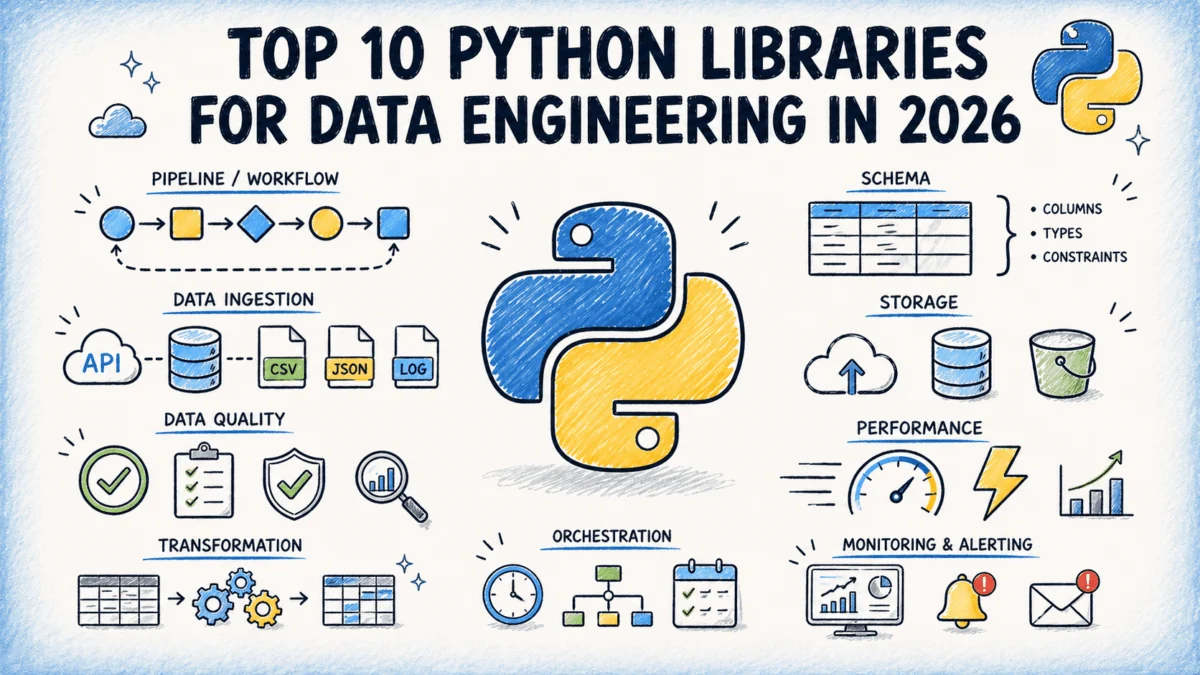
To effectively navigate the demands of modern data systems, these libraries are categorized into four critical areas that consume significant engineering effort: pipeline orchestration and workflow management, data ingestion and format handling, data quality and schema management, and storage, serialization, and performance optimization. Each category addresses a distinct facet of the data lifecycle, providing specialized tools that integrate seamlessly into a cohesive data stack.
I. Orchestrating Complexity: Pipeline Management and Workflow Automation
Effective data engineering hinges on the ability to reliably schedule, monitor, and manage complex data flows. As pipelines grow in number and interdependencies, robust orchestration becomes paramount to prevent failures, ensure data freshness, and provide operational visibility.
1. Prefect: Intelligent Workflow Orchestration for Resilient Pipelines
In the realm of workflow orchestration, where traditional schedulers often introduce overhead and inflexibility, Prefect emerges as a modern, Python-native solution designed for resilience and observability. Unlike rigid Directed Acyclic Graph (DAG) frameworks that can be cumbersome to manage, Prefect embraces a "code-first" approach, allowing data engineers to define, schedule, and monitor data pipelines using pure Python. This significantly reduces the cognitive load associated with infrastructure setup and configuration.
Prefect’s key differentiators, making it indispensable by 2026, include its dynamic DAG capabilities, which adapt to data conditions and allow for more intelligent retries and error handling. Its emphasis on a "flow-run" model, coupled with robust logging and a user-friendly UI, provides unparalleled visibility into pipeline execution, enabling proactive issue detection and faster debugging. Industry reports indicate that inefficient pipeline management can account for up to 30% of data engineering team’s time spent on maintenance. Prefect directly tackles this by offering features like automatic retries, caching, and state management, minimizing manual intervention and maximizing pipeline uptime. Its growing adoption in cloud environments, supporting serverless deployments and seamless integration with various data platforms, positions it as a cornerstone for building adaptive and failure-resistant data workflows in the coming years.
2. SQLMesh: Revolutionizing SQL Transformation Management and CI/CD
Managing SQL transformations across development, staging, and production environments has historically been one of the most error-prone and time-consuming aspects of data engineering. The traditional approach often involves manual testing, fragile deployment scripts, and a lack of true version control for data models. SQLMesh directly addresses these pain points by extending the capabilities pioneered by tools like dbt, introducing a semantic understanding of data models and a robust framework for true Continuous Integration/Continuous Deployment (CI/CD) for SQL pipelines.
SQLMesh’s innovation lies in its ability to create "virtual data environments." This allows developers to test changes to SQL models in isolated, production-like environments without affecting live data, ensuring that deployments are safe and reversible. Its semantic understanding means it comprehends the lineage and dependencies of data models, facilitating impact analysis and preventing unintended side effects. For organizations where SQL remains the primary language for data transformation – a trend projected to continue with the rise of data warehouses and lakehouses – SQLMesh provides a critical layer of safety and agility. It empowers data teams to adopt software engineering best practices for their data assets, reducing deployment risks and accelerating the pace of data product development. By 2026, as data governance and auditability become even more stringent, SQLMesh’s ability to manage safe, auditable SQL transformations will be an invaluable asset.
II. Bridging the Data Gap: Ingestion and Real-time Processing
The first step in any data pipeline is getting data from its source to a usable destination. This process, often referred to as ingestion, can range from simple batch transfers to complex real-time stream processing. The diverse nature of data sources and the increasing demand for immediate insights necessitate flexible and high-performance ingestion tools.
3. dlt (data load tool): Streamlining Data Ingestion with Code-Native Simplicity
The repetitive nature of building custom connectors and ingestion scripts from scratch has long been a drain on data engineering resources. dlt (data load tool) offers an elegant, open-source Python library solution that simplifies data ingestion from virtually any source to any destination with minimal boilerplate code. Its philosophy centers on enabling data engineers to focus on the data itself rather than the mechanics of moving it.
dlt distinguishes itself by providing a high-level, declarative API that abstracts away the complexities of schema inference, data type handling, and incremental loading. This means engineers can define sources and destinations with just a few lines of Python, allowing the library to intelligently manage the underlying data transfer and schema evolution. As the number of SaaS applications and disparate data sources continues to grow, tools like dlt become critical for rapidly onboarding new data streams without significant development effort. It democratizes the ingestion process, empowering data teams to be more agile and responsive to business needs. Its focus on security, observability, and compliance, baked into its design, makes it a reliable choice for production-grade ingestion pipelines by 2026, supporting a wide array of data warehouses and lakehouses.
4. Bytewax: High-Performance Stream Processing in Pure Python
Real-time data processing has traditionally been the domain of complex, JVM-based frameworks like Apache Flink or Apache Spark Streaming, often requiring a steep learning curve for Python developers. Bytewax shatters this barrier, offering a Python-native stream processing framework built on a high-performance Rust core. It brings a dataflow programming model to streaming pipelines, allowing Python developers to build sophisticated, stateful real-time applications with a familiar API.
Bytewax’s hybrid architecture – Python for API simplicity and Rust for execution speed – positions it uniquely to address the growing demand for real-time analytics, particularly in domains like IoT, financial trading, and fraud detection. Its ability to process millions of events per second with low latency, coupled with its Python accessibility, means more data teams can leverage streaming data without needing specialized JVM expertise. The framework supports common stream processing patterns, including windowing, stateful operations, and fault tolerance, making it suitable for production environments. As businesses increasingly demand immediate insights and operational intelligence, Bytewax is poised to become a go-to solution for Python-centric teams looking to implement robust, real-time data pipelines by 2026, bridging the performance gap often associated with Python in high-throughput scenarios.
5. PySpark: Scaling Distributed Large-Scale Batch Processing with Enduring Relevance
For datasets that far exceed the capacity of a single machine, PySpark, the Python API for Apache Spark, remains the undisputed industry standard for large-scale batch and streaming data processing across clusters. Despite the emergence of newer, more specialized tools, Spark’s mature ecosystem, extensive feature set, and proven scalability ensure its continued relevance, especially for petabyte-scale ETL (Extract, Transform, Load) and complex data transformations.
PySpark’s strength lies in its ability to abstract away the complexities of distributed computing, allowing data engineers to write Python code that executes efficiently across a cluster of machines. Its RDD (Resilient Distributed Dataset) and DataFrame APIs provide powerful abstractions for data manipulation, supporting SQL, machine learning, graph processing, and stream processing. While some lighter-weight alternatives are gaining traction for mid-scale tasks, PySpark’s robust fault tolerance, optimization engine, and broad integration with cloud storage (e.g., S3, ADLS) and various data formats make it indispensable for enterprise-grade big data solutions. As data lakehouses become more prevalent, PySpark continues to be a critical component for processing and refining raw data into analytical-ready formats. Its role as a foundational technology for big data will remain strong through 2026, particularly for organizations operating at significant scale and needing a comprehensive, unified analytics engine.
III. Ensuring Trust: Data Quality and Schema Governance
Data quality issues are notoriously expensive to fix once they propagate downstream. Proactive measures, including robust validation and schema enforcement, are crucial for maintaining data integrity and building trust in data assets.
6. Great Expectations: Defining and Validating Data Quality Across the Lifecycle
Preventing data quality issues from reaching production is a paramount concern for any data-driven organization. Great Expectations stands out as a Python library specifically designed for defining, documenting, and validating data quality rules throughout the entire data pipeline lifecycle. It shifts data quality from a reactive debugging task to a proactive, integrated component of data engineering.
The library’s core innovation lies in its "Expectations" – human-readable assertions about data, such as "this column should not contain null values" or "this column should be within a certain range." These expectations can be easily defined and executed at various stages of a pipeline, providing immediate feedback on data quality. Furthermore, Great Expectations automatically generates "Data Docs," comprehensive, searchable documentation of data assets and their quality profiles, fostering transparency and collaboration across data teams. With the increasing emphasis on data governance, compliance (e.g., GDPR, CCPA), and the growing cost of "bad data" – estimated to cost U.S. businesses billions annually – Great Expectations provides a critical framework for ensuring data trustworthiness. By 2026, its role in establishing data contracts, validating data invariants, and generating auditable data quality reports will be central to building reliable and accountable data platforms.
7. Pandera: Enforcing Schemas at the Function Level for Robust Pipelines
Catching schema violations as early as possible in a pipeline is far more efficient than debugging corrupt data much later. Pandera is a statistical data validation library that brings type-hinting and schema enforcement directly to popular DataFrame libraries like pandas and Polars. It allows data engineers to define explicit data contracts for their DataFrames, ensuring that data conforms to expected structures and types at the point of transformation.
Pandera integrates seamlessly with existing Python data processing code, allowing developers to define schemas using a declarative API and then apply these schemas as decorators to functions or directly to DataFrames. This ensures that any incoming or outgoing DataFrame adheres to its defined structure, catching errors such as missing columns, incorrect data types, or out-of-range values before they can cause downstream failures. Its ability to generate synthetic data for testing, along with its statistical validation capabilities, makes it a powerful tool for developing robust and error-resistant data transformations. As data pipelines become more modular and complex, enforcing schemas at the function level, as Pandera does, becomes indispensable for maintaining code quality, reducing debugging time, and building confidence in the integrity of data flowing through the system. By 2026, such inline schema enforcement will be a standard practice for defensive data engineering.
IV. Performance and Portability: Storage, Serialization, and High-Performance Transforms
Efficient data processing requires not only powerful compute engines but also optimized storage formats, serialization techniques, and DataFrame libraries capable of handling increasing data volumes without compromising performance.
8. DuckDB: Running In-Process Analytical Queries with Unmatched Speed
The need to perform fast analytical queries on large local files without the overhead of spinning up a full-fledged data warehouse has led to the rise of specialized embedded databases. DuckDB is an in-process analytical database that executes OLAP (Online Analytical Processing) queries with remarkable speed, directly on various file formats such as Parquet, CSV, and JSON, all from within a Python process.
DuckDB fills a crucial gap for data engineers and analysts working with mid-sized datasets (gigabytes to terabytes) that reside on local storage or object storage. Its columnar-oriented design, vectorized execution engine, and sophisticated query optimizer enable it to outperform traditional database engines for analytical workloads in many scenarios. For tasks like data exploration, feature engineering, and ad-hoc analysis, DuckDB offers the familiarity of SQL combined with the performance benefits of a purpose-built analytical engine, all without the need for complex infrastructure. Its ability to seamlessly integrate with Python DataFrames (pandas, Polars) and perform operations like joins and aggregations directly on files makes it an invaluable tool for reducing the "data movement tax." By 2026, DuckDB will be a staple in data scientists’ and engineers’ local toolkits, bridging the gap between flat files and full data warehouses for rapid, efficient analysis.
9. Polars: The Next Generation of High-Performance DataFrames
While pandas has been the de facto standard for data manipulation in Python, its limitations concerning performance at scale and memory efficiency have become increasingly apparent. Polars, a DataFrame library written in Rust, addresses these shortcomings head-on, delivering significantly faster performance on most transformation workloads, coupled with a clean, expressive API and true multi-threading capabilities.
Polars distinguishes itself through several key architectural choices: a Rust backend for raw speed and memory safety, a columnar memory model, and lazy evaluation. Lazy evaluation allows Polars to optimize query plans before execution, leading to more efficient processing and out-of-core capabilities, enabling it to handle datasets larger than available RAM. Its multi-threaded design fully leverages modern CPU architectures, making it a compelling alternative to pandas for mid-to-large scale ETL tasks. As datasets continue to grow and computational efficiency becomes a critical factor in cloud cost management, Polars offers a powerful solution for data engineers seeking to accelerate their data transformation pipelines without abandoning the Python ecosystem. The rapid adoption of Polars indicates its trajectory to become a leading DataFrame library by 2026, challenging the dominance of pandas in performance-critical applications.
10. Ibis: Writing Backend-Agnostic Data Transformations for Universal Portability
The proliferation of diverse data backends—from local files and relational databases to cloud data warehouses and distributed query engines—often forces data engineers to write backend-specific SQL or switch between different DataFrame APIs (e.g., pandas for local, PySpark for distributed). This creates fragile, hard-to-port codebases and increases the cognitive load. Ibis addresses this challenge by providing a Python DataFrame library that compiles the same expression code to SQL for over 20 different backends, including BigQuery, Snowflake, DuckDB, Spark, and Postgres.
Ibis acts as a universal DataFrame API, allowing engineers to define their data transformations once in Python, and then execute them efficiently on whichever backend is most appropriate for the task at hand. This backend-agnostic approach dramatically improves code portability, reduces vendor lock-in, and simplifies the management of complex data architectures. It empowers data teams to choose the right engine for the right job without rewriting their transformation logic. As organizations increasingly adopt hybrid and multi-cloud strategies, and as data estates become more fragmented, Ibis’s ability to provide a consistent interface across disparate data systems will be invaluable. By 2026, Ibis will be a critical tool for building flexible, future-proof data pipelines that can seamlessly adapt to evolving infrastructure choices, fostering a truly composable data stack.
The Strategic Imperative: Why These Libraries Matter for 2026
The confluence of these ten Python libraries represents more than just a collection of tools; it signifies a strategic shift in how data engineering challenges are approached. By 2026, the successful data organization will be one that leverages these kinds of innovative, open-source solutions to build data platforms that are:
- Highly Automated and Resilient: With tools like Prefect and SQLMesh, data pipelines will be more intelligent, self-healing, and governed by robust CI/CD practices.
- Agile and Efficient in Ingestion: dlt and Bytewax will enable rapid onboarding of new data sources and real-time processing capabilities, keeping pace with business demands.
- Trustworthy and Governed: Great Expectations and Pandera will embed data quality and schema enforcement directly into the development lifecycle, ensuring data integrity from source to consumption.
- Performant and Cost-Effective: DuckDB, Polars, and PySpark will provide scalable and efficient processing engines, optimizing resource utilization and reducing operational costs for diverse data volumes.
- Portable and Future-Proof: Ibis will ensure that transformation logic remains adaptable across a heterogeneous data ecosystem, safeguarding investments in data infrastructure.
The data engineering profession is continuously evolving, and the Python ecosystem is at the forefront of this innovation. These libraries, individually powerful and collectively transformative, empower data engineers to build the next generation of data platforms that are not only robust and scalable but also agile, observable, and deeply integrated into the fabric of data-driven enterprises. The outlook for Python in data engineering is one of continued growth and sophistication, cementing its role as the essential language for shaping the future of data.