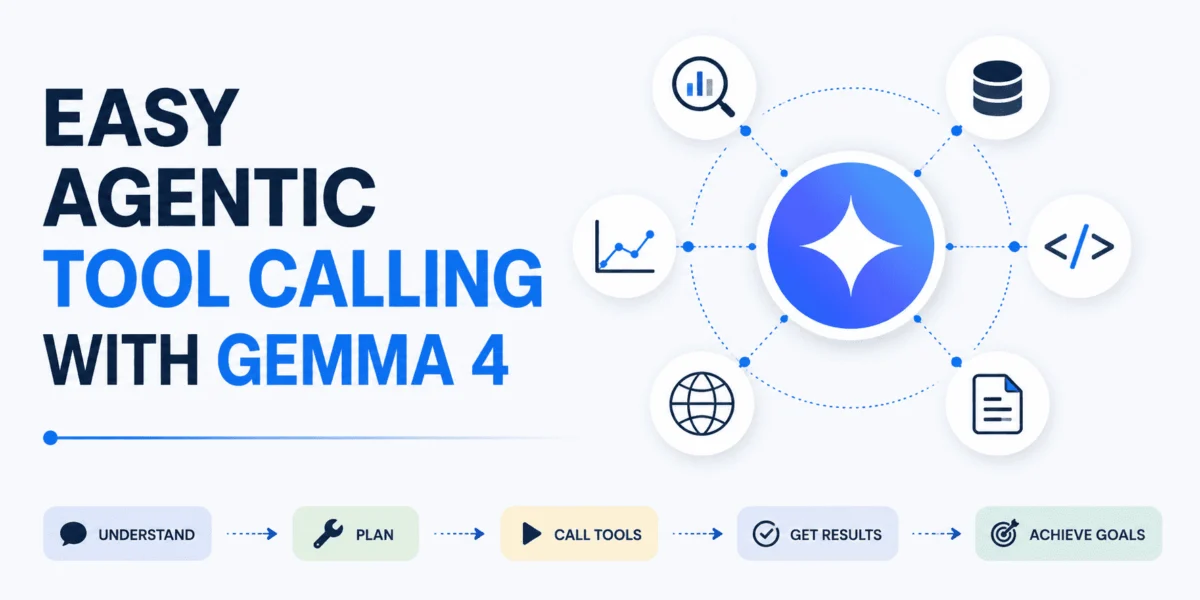
The landscape of artificial intelligence is rapidly evolving, moving beyond mere conversational capabilities to embrace a more profound form of "agency," where large language models (LLMs) can interact with their environment and execute tasks autonomously. A recent development highlighted by Machine Learning Mastery and further explored by KDnuggets showcases how Google’s Gemma 4 model, specifically the gemma4:e2b edge variant, is being empowered with advanced tool-calling capabilities that enable it to reason about and interact with its local machine environment. This marks a significant shift from LLMs that merely retrieve information from external APIs to those that can inspect local file systems and execute sandboxed code, pushing the boundaries of what local AI agents can achieve.
The Evolution of Agentic AI: A New Frontier
Initially, LLMs gained prominence for their ability to generate human-like text, engage in conversations, and synthesize information from vast datasets. However, their utility was often limited by inherent constraints: a lack of real-time information access, difficulties with precise arithmetic or complex logical reasoning, and an inability to interact with the physical or digital environment beyond their training data. The introduction of "tool calling" emerged as a critical paradigm shift, allowing LLMs to interface with external utilities, such as weather APIs, news feeds, or currency converters. This expanded their reach, transforming them from static knowledge bases into dynamic information brokers.
However, even these early tool-calling agents largely remained in the realm of "retrieval augmented generation" (RAG), acting as sophisticated chatbots with enhanced data access. The true essence of "agency" in AI, as many practitioners define it, necessitates a model’s capacity to engage with its immediate operational context. This includes reading local files, executing code, modifying system states, or invoking other processes. It is this deeper interaction with the host system that introduces a notion of environment, state, and consequential reasoning, moving LLMs closer to behaving as genuine software agents.
The Gemma 4 model, particularly its gemma4:e2b variant, is notable for its compact size, allowing it to run efficiently on local hardware like a laptop without requiring high-end GPUs. This local deployability, combined with its competency in structured output necessary for reliable tool orchestration, makes it an ideal candidate for exploring advanced agentic patterns. The underlying architecture for tool orchestration remains consistent with earlier models, relying on Python functions, JSON schema definitions, and a two-pass query-and-synthesis loop. The pivotal change lies in the nature and scope of the tools themselves, shifting from remote API clients to direct, albeit carefully controlled, system interaction.
Building the Foundation: Sandboxed Tools for Local Interaction
The core of Gemma 4’s enhanced agency stems from two newly integrated tools: a sandboxed local filesystem explorer and a restricted Python interpreter. These tools empower the model to transcend the boundaries of external data retrieval and engage directly with its local environment.
1. Tool 1: A Sandboxed Filesystem Explorer (list_directory_contents)
The list_directory_contents tool grants Gemma 4 the ability to survey the contents of specified directories. While seemingly straightforward, implementing such a tool securely is paramount. A naive implementation could inadvertently expose sensitive system areas, leading to severe security vulnerabilities. For instance, allowing an LLM to freely traverse directories like /, ~, or ../../etc could grant it access to critical system files or API keys.
To mitigate this risk, a robust security design pins the tool’s operations to a predefined "safe base directory" (SAFE_BASE_DIR) at the script’s inception, typically the current working directory. Any request that attempts to resolve a path outside this confined workspace is strictly rejected. This is achieved by resolving the requested path to an absolute path, then verifying that it either matches the SAFE_BASE_DIR or begins with the SAFE_BASE_DIR followed by a directory separator. This simple yet effective pattern blocks common directory traversal attacks, ensuring the model’s "curiosity" remains within permissible bounds.
The function then proceeds to list files and directories, formatting each entry with clear indicators such as [DIR] or [FILE] and byte sizes for files. This structured, human-readable output is crucial for the model to parse and synthesize a coherent response in its subsequent pass. The JSON schema for this tool is designed to be permissive, with the path parameter being optional and defaulting to the workspace root, encouraging the model to explore its immediate environment first. Crucially, the tool’s description includes a subtle prompt engineering hint: "Use this to inspect the environment before answering questions about local files." This guides Gemma 4 to proactively utilize the tool when a user poses a query about local files, rather than relying on its internal knowledge, which could be outdated or speculative.
2. Tool 2: A Restricted Python Interpreter (execute_python_code)
The execute_python_code tool is arguably the more powerful and pedagogically significant of the two. LLMs, especially smaller variants, often struggle with precise arithmetic, complex string manipulations, or multi-step logical branching. A tool that allows the model to write and execute deterministic Python code offers a superior solution to these challenges compared to attempting to reason through them in natural language.
The implementation of this interpreter leverages Python’s exec() function, but with stringent security measures. The most critical step involves replacing the __builtins__ namespace entirely with a carefully curated whitelist of safe functions. This proactively disables potentially dangerous functions such as open(), eval(), exec(), compile(), __import__, and input(), which are not directly available within the snippet’s global scope. To enhance utility, frequently used modules like math and statistics are pre-imported into the snippet’s global environment, preventing the model from having to navigate __import__ restrictions.
To provide feedback to the model, contextlib.redirect_stdout is used to capture any output printed by the executed code snippet. This ensures that the model receives a precise record of the interpreter’s actions. A specific error message is returned if the code executes successfully but produces no output, guiding the model to use print() statements. This seemingly minor detail is vital, as small models frequently write expressions without explicit print() calls, and an empty return could lead to the model fabricating an answer.
It is vital to underscore the security context of this Python interpreter. While the whitelist approach significantly reduces common risks, it is explicitly designed as a "learning sandbox" for single-user, local agent development. Python’s exec function, even with stripped builtins, can be bypassed by a determined adversary through advanced object introspection techniques (e.g., ().__class__.__mro__). For production-grade applications or untrusted environments, a more robust isolation layer—such as a subprocess with seccomp filters, containerization (Docker/Podman), or specialized sandboxing libraries like RestrictedPython—would be indispensable. The current implementation prioritizes ease of understanding and demonstration over hardened enterprise-level security.
The Orchestration Loop: Seamless Tool Integration
The core orchestration loop that facilitates tool calling in Gemma 4 remains structurally consistent with previous iterations, underscoring the robustness of the underlying framework. When the model is queried with a user prompt and the registered tool schema, it analyzes the request. If it determines that a tool is necessary to fulfill the query, it generates a tool_calls block in its response. Each call within this block specifies the function name and its arguments, which are then dispatched against a predefined TOOL_FUNCTIONS dictionary containing the actual Python function implementations.
Upon execution, the result of each tool call is appended back into the message history as a role: tool entry. This enriched payload is then re-fed to Ollama, allowing the model to synthesize a final, grounded answer that incorporates the real-world information obtained from the tool. This two-pass pattern—query, execute tool, re-query, synthesize—is fundamental to how agentic LLMs operate.
For enhanced developer experience, a minor tweak in the command-line interface (CLI) formatting is introduced. Given that the execute_python_code tool’s code argument can be a multi-line string, a utility function is used to flatten and truncate string arguments for display purposes. This prevents complex code snippets from cluttering the console while ensuring the full, original string is passed to the function for execution.
Practical Demonstrations: Agency in Action
The efficacy of these new agentic capabilities is best illustrated through practical examples.
Filesystem Exploration: When prompted with a query like, "What scripts are in my current folder, and which one looks like it should be used to process CSVs?", Gemma 4 first calls list_directory_contents with path='.'. It then processes the tool’s output, which lists files like README.md, csv_cleaner.py, main.py, notes.txt, and sales_report.py. Based on this concrete, observed information, the model accurately infers that csv_cleaner.py is the likely candidate for CSV processing, demonstrating grounded reasoning over mere speculation.
Deterministic Computation: For a numerically precise task such as, "What is the standard deviation of the numbers 12, 18, 23, 24, 29, 31, 35, 41, 44, 47, rounded to four decimal places?", Gemma 4 opts to use execute_python_code. It generates a Python snippet utilizing the pre-imported statistics.stdev function and round(), then prints the result. The tool returns "11.4659", which the model then confidently incorporates into its final response, bypassing its inherent limitations in complex arithmetic.
Sequential Tool Use: A more complex query, "Look at the files in the current folder and tell me the total size in kilobytes, rounded to two decimal places," showcases the model’s ability to orchestrate multiple tools sequentially. First, it calls list_directory_contents to obtain file sizes. Then, it extracts these sizes and feeds them into execute_python_code with a snippet that sums the values, divides by 1024 to convert to kilobytes, and rounds to two decimal places. The model successfully executes both tools in the correct order, with the output of the first informing the input of the second, culminating in an accurate answer: "The five files in the current folder total 15.33 KB." This multi-tool, chained reasoning highlights a significant leap in agentic capabilities for a 2-billion-parameter model running on a standard laptop without a dedicated GPU.
Crucially, the implemented safety guards perform as expected. Attempting to list contents of restricted system directories (e.g., /etc) results in an "Access denied" error from list_directory_contents, which Gemma 4 gracefully reports. Similarly, trying to execute forbidden operations like open('/etc/passwd').read() within the Python interpreter yields a NameError due to open not being in the whitelist. These failures degrade gracefully into informative error messages, preventing system compromise and reinforcing the controlled nature of the agent’s interaction.
Broader Implications and Future Trajectories
The advancement of agentic tool calling with models like Gemma 4 has profound implications for the future of AI development and human-computer interaction.
Empowering Local AI: The ability to run capable LLMs and their tools locally on consumer-grade hardware democratizes AI development. It reduces reliance on cloud infrastructure, improves data privacy by keeping sensitive information on-device, and opens doors for offline AI applications in edge computing, embedded systems, and personal assistants. This local agency aligns with a growing trend towards more distributed and private AI solutions.
Transforming Automation: Agentic LLMs have the potential to revolutionize automation in various sectors. In software development, they could assist with code analysis, debugging, and environment setup. In data science, they could automate data cleaning, preliminary analysis, and report generation. Beyond these, the paradigm extends to database queries, shell commands, Git operations, and document parsing. Each new capability, integrated through a secure tool-calling loop, amplifies the agent’s utility.
Security and Trust: While the current implementation serves as a learning sandbox, the expansion of LLM agency into local system interaction necessitates a robust focus on security. The principle of "build the perimeter first, then hand the model the keys" becomes paramount. Developers must design tools with the "least privilege" principle in mind, ensuring agents only have access to what is strictly necessary for their tasks. As LLMs gain more control, developing formal verification methods, runtime monitoring, and human-in-the-loop oversight mechanisms will be critical to building trust and preventing unintended consequences.
The Path Forward: The journey from simple chatbots to sophisticated agents capable of observing, reasoning, and acting within their environment is accelerating. The work with Gemma 4 demonstrates that even relatively small, locally runnable models can exhibit compelling agentic behavior when equipped with the right tools and robust safety mechanisms. The interesting questions are no longer about whether an LLM can call a function, but rather what functions it should be allowed to call, how securely those functions are implemented, and what level of autonomy we are willing to grant these increasingly capable AI entities. As this field matures, the focus will continue to be on striking a delicate balance between maximizing utility and ensuring safety, paving the way for a new generation of intelligent, autonomous systems.