Researchers from Kyoto University and Hiroshima University have announced a significant milestone in the field of quantum mechanics by successfully demonstrating a method to perform entangled measurements on W states, a complex form of multi-photon entanglement that has eluded practical measurement for over a quarter of a century. This development addresses a critical bottleneck in quantum information science, providing a streamlined way to verify and utilize quantum states that are essential for the next generation of quantum computers, secure communication networks, and quantum teleportation protocols. By utilizing the unique properties of cyclic shift symmetry and a specialized quantum Fourier transform circuit, the team has bridged a gap that has existed since the initial proposals for entangled measurements in the late 1990s.
The Evolution of Quantum Entanglement and the Challenge of Complexity
Quantum entanglement represents a fundamental departure from the classical understanding of physics. In a classical system, the properties of individual components—such as the position or velocity of a billiard ball—can be measured independently. However, in an entangled quantum system, particles like photons or electrons become so inextricably linked that the state of one cannot be described independently of the others, regardless of the distance separating them. This phenomenon, which Albert Einstein famously dismissed as "spooky action at a distance," is now recognized as the primary resource for quantum technologies.
While entanglement is a powerful tool, it is also notoriously difficult to manage. To harness entanglement for practical use, scientists must be able to characterize the state of the particles they have produced. Historically, the primary method for this has been quantum state tomography (QST). QST is a process where many identical copies of a quantum state are prepared and measured in various ways to reconstruct the full state of the system. However, QST suffers from the "curse of dimensionality." As the number of photons in a system increases, the number of measurements required to estimate the state grows exponentially. For a two-photon system, the process is manageable, but for systems involving dozens of photons, the time and resources required for tomography become prohibitive.
To circumvent this, researchers have sought "entangled measurements." Unlike tomography, which estimates a state through repeated sampling, an entangled measurement can identify a specific quantum state in a single operation. While such measurements were realized for Greenberger-Horne-Zeilinger (GHZ) states—a type of entanglement where all particles are perfectly correlated—the W state remained a formidable challenge.
Distinguishing the W State: Robustness and Utility
In the landscape of multi-partite entanglement, the W state and the GHZ state represent two distinct "classes" of entanglement that cannot be transformed into one another through local operations. The GHZ state is often described as "all-or-nothing" entanglement; if one particle in a GHZ triplet is lost or measured, the entanglement between the remaining two particles is instantly destroyed.
In contrast, the W state is characterized by its remarkable robustness. If one photon in a three-photon W state is lost, the remaining two photons still retain a high degree of entanglement. This resilience makes the W state particularly valuable for quantum communication and networking, where signal loss is a common occurrence in fiber-optic cables or satellite links. Despite its advantages, the lack of a reliable, single-shot measurement technique for W states has limited their application in complex quantum protocols.
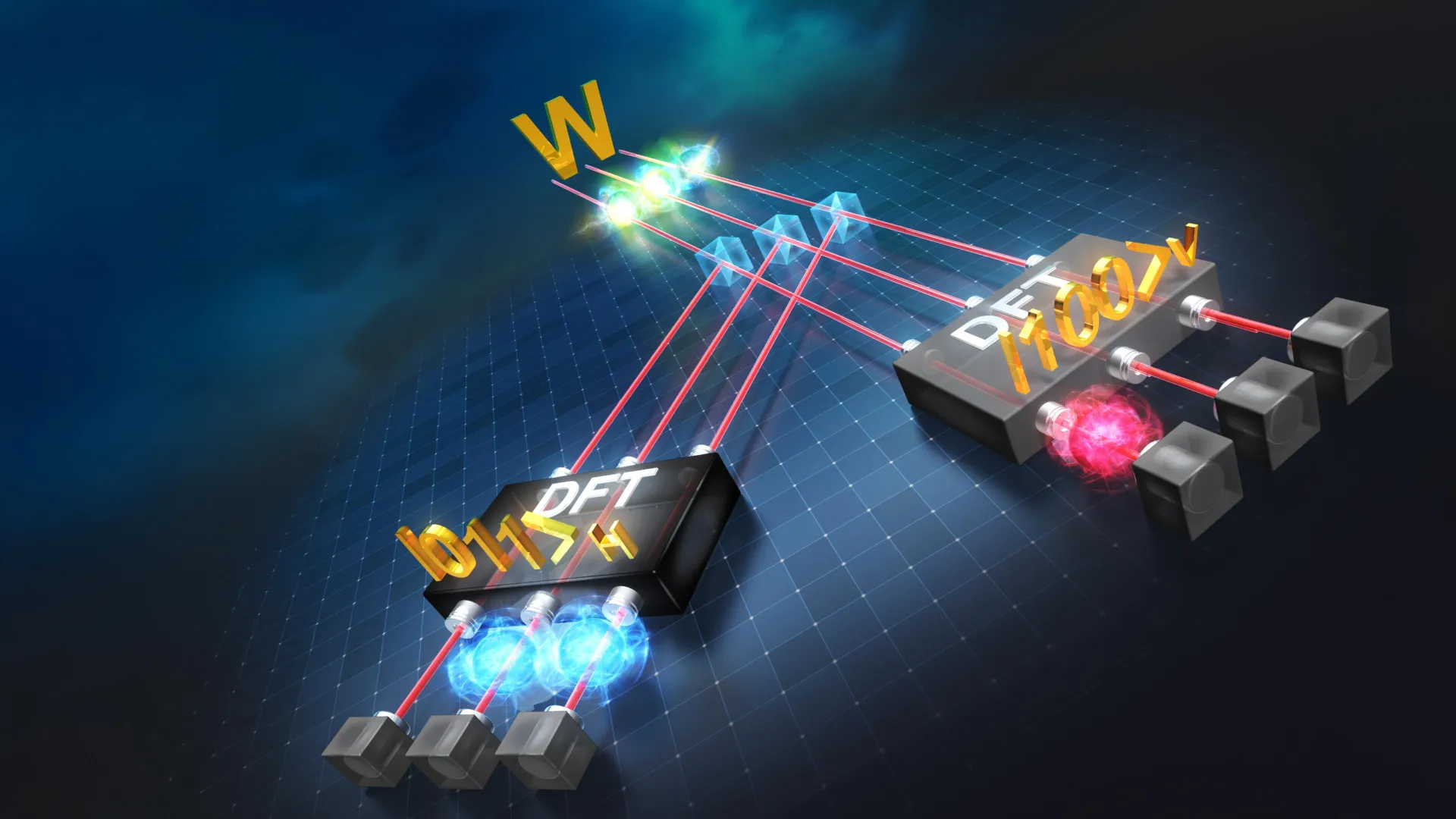
The Kyoto and Hiroshima team, led by corresponding author Shigeki Takeuchi, identified that the key to unlocking the W state lay in its "cyclic shift symmetry." This mathematical property implies that if the particles in a W state are shifted in a circular order, the state remains unchanged. By designing a photonic quantum circuit that performs a quantum Fourier transformation (QFT) specifically tailored for this symmetry, the researchers were able to map the complex, hidden correlations of the W state onto measurable signals at specific output ports of their device.
Experimental Realization and Technical Specifications
The experimental setup involved the construction of a highly stable optical quantum circuit. One of the primary hurdles in quantum optics is maintaining the phase stability of the light paths. Most laboratory setups require active feedback loops and constant adjustments to prevent environmental vibrations or temperature changes from decohering the quantum states. The Kyoto-Hiroshima team, however, developed a device that demonstrated exceptional passive stability, allowing it to function for extended periods without the need for active control.
In the experiment, three single photons were prepared in specific polarization states and injected into the quantum circuit. The device was designed to distinguish between different varieties of three-photon W states. The success of the experiment was measured through "fidelity"—a metric that quantifies how closely the experimental result matches the ideal theoretical outcome. High fidelity indicates that the device can reliably identify the W state despite the inherent noise and imperfections of physical hardware.
The researchers reported that the circuit successfully transformed the three-photon inputs into distinct output patterns that allowed for the unambiguous identification of the W state. This achievement marks the first time that a genuine experimental demonstration of an entangled measurement for the 3-photon W state has been achieved, coming more than 25 years after similar methods were proposed for the GHZ state.
A Timeline of Progress in Photonic Quantum Systems
The success of the W state measurement is part of a broader, rapidly accelerating timeline of achievements in quantum photonics. To understand the significance of this work, it is necessary to view it within the context of recent global developments:
- 1935: The Einstein-Podolsky-Rosen (EPR) paper introduces the concept of entanglement as a challenge to the completeness of quantum mechanics.
- 1964: John Bell proposes Bell’s Theorem, providing a way to experimentally test the non-classical nature of entanglement.
- 1990s: Theoretical foundations for GHZ and W states are established, and the first GHZ state measurements are proposed.
- Early 2000s: Experimental realization of multi-photon GHZ states begins to flourish in laboratory settings.
- Late 2025: Researchers achieve all-photonic quantum teleportation using photons generated from distinct quantum dots within a hybrid urban network, proving that entanglement can be maintained across diverse hardware.
- Early 2026: A team reports the development of an integrated photonic chip capable of generating and manipulating multipartite cluster states, a precursor to scalable quantum computing.
- Mid 2026: A three-node quantum network is tested across existing fiber-optic infrastructure in New York City, utilizing entanglement swapping to bridge links.
- Present: The Kyoto and Hiroshima team successfully demonstrates the entangled measurement of the W state, completing a major missing piece of the quantum measurement puzzle.
Expert Reactions and Industry Implications
The scientific community has reacted with optimism to the breakthrough. Shigeki Takeuchi emphasized that the discovery was not merely a technical fix but a deepening of the fundamental understanding of quantum concepts. "In order to accelerate the research and development of quantum technologies, it is crucial to deepen our understanding of basic concepts to come up with innovative ideas," Takeuchi stated.
Independent analysts suggest that the ability to perform entangled measurements on W states will have immediate implications for several areas:
- Quantum Teleportation: Teleporting a quantum state requires a Bell state measurement (for two photons) or an entangled measurement (for more). The ability to use W states in this process allows for more robust teleportation protocols that are less sensitive to the loss of a single carrier photon.
- Quantum Communication Protocols: Multi-party quantum key distribution (QKD) relies on the ability to verify shared entanglement. The W state’s robustness makes it an ideal candidate for "quantum conferences" where more than two parties need to share a secure key.
- Measurement-Based Quantum Computing (MBQC): In MBQC, calculations are performed by making measurements on a highly entangled initial state. Expanding the repertoire of measurable states allows for more flexible and efficient computing architectures.
- Quantum Networking: As evidenced by the 2026 New York City fiber tests, the "Quantum Internet" is moving toward real-world infrastructure. The Kyoto-Hiroshima device’s stability is a critical feature for hardware that must eventually operate outside the controlled environment of a physics lab.
The Path to Scalability: From Benchtop to Chip
The current demonstration utilized a three-photon system, but the theoretical framework proposed by the team is applicable to W states with any number of photons. The next phase of the research will focus on scaling the method to larger systems. As the number of photons increases, the complexity of the optical circuit grows, necessitating a move from bulk optics—where mirrors and splitters are aligned on a large table—to integrated photonics.
Integrated photonic circuits, which etch quantum components onto small chips of silicon or lithium niobate, offer a path toward mass production and miniaturization. The Kyoto and Hiroshima team has already expressed intentions to develop on-chip photonic quantum circuits for these entangled measurements. If successful, this would allow for the integration of W state detectors directly into quantum routers and repeaters.
The ability to "read" complex quantum states quickly and reliably is the final hurdle in making quantum information as movable and manipulable as classical data. By providing a solution for the elusive W state, researchers have not only solved a decades-old puzzle but have also provided a vital tool for the construction of a global, entanglement-based information economy. This advancement ensures that the future of quantum technology will be defined by systems that are not only faster and more secure but also resilient enough to function in the complexities of the real world.