The healthcare industry, a cornerstone of global well-being, paradoxically contributes an estimated 4.4% of total global emissions annually, placing it among the most carbon-intensive sectors. A significant portion of this environmental footprint, approximately 71%, originates from the sprawling healthcare supply chain, which critically includes the pharmaceutical and biotechnology sectors. This intricate web of research, manufacturing, and distribution poses a complex challenge to global sustainability efforts, even as leading pharmaceutical companies increasingly commit to ambitious environmental targets.
The Pervasive Pharmaceutical Footprint: An Unpacking of Emissions Sources
The journey of a medicine, from discovery to patient use, is inherently resource-intensive and generates substantial environmental impact. Medicines themselves contribute an estimated 20% to 55% of healthcare’s total carbon footprint. This broad range reflects the varied processes involved, encompassing corporate operations, the synthesis of Active Pharmaceutical Ingredients (APIs), and the vast manufacturing infrastructure required for drug production.
Pharmaceutical manufacturing, in particular, stands out for its resource demands. The industry often generates a staggering 25 to 100 kilograms of chemical waste for every single kilogram of active drug produced. This inefficiency is largely driven by the extensive use of solvents, which typically account for 80% to 90% of the total mass in pharmaceutical processes and are the primary contributor to Process Mass Intensity (PMI). PMI, a critical metric measuring the total mass of materials used per unit of product, ranges from a median of 168 to 308 in the pharmaceutical sector. This figure is significantly higher when compared to other chemical industries, underscoring the unique challenges faced by pharmaceutical manufacturers in minimizing waste and maximizing efficiency. The multi-step synthesis often required for complex APIs, coupled with purification processes, contributes heavily to this elevated PMI, demanding substantial energy and material inputs at each stage.
Beyond direct manufacturing waste, pharmaceutical residues represent another critical environmental concern. These residues enter the environment through multiple pathways, including patient excretion, emissions from manufacturing plants, and the improper disposal of unused or expired medicines. While current exposure levels of pharmaceuticals in drinking water are generally considered low risk to human health, the long-term ecological effects are a growing concern. Studies have shown potential impacts on aquatic life, including endocrine disruption and altered behavior in fish, highlighting the need for comprehensive environmental risk assessments.
A particularly alarming aspect of pharmaceutical pollution is the presence of antibiotic residues in manufacturing effluents and wastewater. These residues, even at low concentrations, can act as selective pressures, promoting the development and spread of antibiotic resistance among microbial populations. This contributes to the global crisis of antibiotic resistance, leading to the emergence of "superbugs" that render once-effective treatments obsolete and pose a severe threat to public health worldwide. The World Health Organization (WHO) has repeatedly warned about the escalating crisis of antimicrobial resistance, making the responsible management of antibiotic manufacturing waste a global imperative.
A Growing Commitment: Pharma’s Push for Sustainability
Recognizing these profound environmental challenges and the increasing scrutiny from regulators, investors, and the public, many pharmaceutical companies have voluntarily embraced sustainability goals and initiatives. This shift reflects a broader industry movement towards integrating Environmental, Social, and Governance (ESG) principles into core business strategies, moving beyond traditional corporate social responsibility.
Major players in the sector have articulated ambitious targets. Companies such as AstraZeneca, Johnson & Johnson, and Novartis have publicly committed to achieving carbon neutrality, with goals typically set for the 2040s. These commitments often involve significant investments in renewable energy, process optimization, and supply chain decarbonization. The evolving landscape of corporate climate action is also reflected in the broader sector. According to the My Green Lab 2025 Carbon Impact Report, sector alignment with the critical 1.5-degree Celsius trajectories of the Paris Agreement surged dramatically from 30% in 2024 to 52% in 2025. This indicates a growing recognition within the industry of the urgency of climate action and a more widespread adoption of science-based targets.
Individual company reports illustrate these efforts. AstraZeneca, for instance, reported being on track to achieve an impressive 98% reduction in operational emissions by 2026, demonstrating substantial progress in its direct energy use and facility management. In 2025 alone, the company also reported reducing its water use by 23% and waste production by 13%, highlighting a multi-faceted approach to environmental stewardship. Similarly, Sanofi reported that, as of 2024, it is on track to achieve carbon neutrality by 2030, having already reduced its emissions by 47% compared to its 2019 baseline. Beyond carbon, Sanofi is also aiming for 100% of its manufacturing sites to implement robust monitoring and management plans specifically designed to control pharmaceuticals in the environment, addressing the critical issue of PiE.
The Paradox of Progress: Rising Emissions Amidst Green Initiatives
Despite these commendable individual corporate efforts and the growing alignment with global climate targets, a significant paradox emerges when viewing the industry’s overall environmental performance: total emissions continue to rise. The rapid scale-up of production to meet ever-increasing global health demands frequently outpaces the efficiencies gained through sustainability initiatives, leading to higher absolute emissions.
This trend is exemplified by leading companies. Novo Nordisk, a major pharmaceutical firm, reported a 19% increase in its total emissions between 2024 and 2025. This rise was primarily driven by the acquisition of new production sites and a corresponding increase in energy use, reflecting the challenges of integrating growth strategies with decarbonization efforts. Even companies demonstrating strong operational reductions often face this challenge. While AstraZeneca successfully decreased its operational (Scope 1 and 2) emissions, its absolute Scope 3 emissions — emissions from its value chain — grew by 24% from its 2019 baseline. Similarly, Eli Lilly’s Scope 3 emissions significantly rose, from approximately 2.99 million metric tons in 2021 to 5.14 million in 2023, illustrating a sector-wide struggle with indirect emissions.
Overall, the emissions from the healthcare industry, including its pharmaceutical component, continue an upward trajectory. The 2022 My Green Lab report highlighted that the total carbon output of public companies in the sector increased by 15%, rising from 197 million tCO2e (tonnes of carbon dioxide equivalent) in 2020 to 227 million in 2021. The subsequent year saw a further increase in the sector’s carbon impact, from 3.9% of global emissions in 2021 to 5% in 2022. The most recent report indicates a 2% increase in absolute emissions from 2023 to 2024, signaling that while individual efforts are underway, the collective impact remains a significant concern.
Navigating the Scopes: The Dominance of Scope 3 Emissions
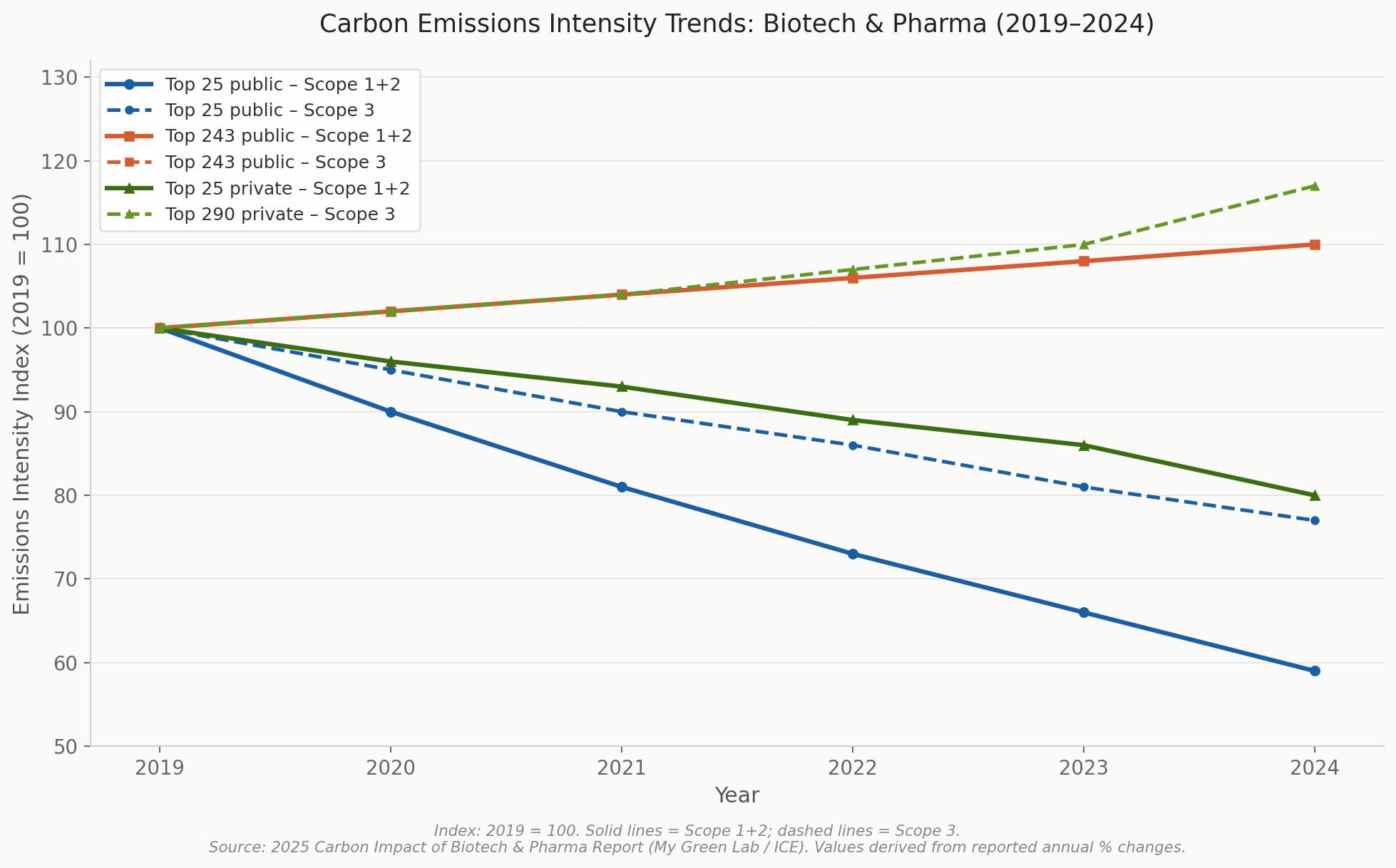
To accurately measure and manage carbon output, the industry categorizes its emissions according to the Greenhouse Gas (GHG) Protocol. This framework divides emissions into three scopes:
- Scope 1: Direct emissions from owned or controlled sources (e.g., fuel combustion in company vehicles, manufacturing processes, on-site power generation).
- Scope 2: Indirect emissions from the generation of purchased energy (e.g., electricity, heating, cooling).
- Scope 3: All other indirect emissions that occur in a company’s value chain, both upstream and downstream.
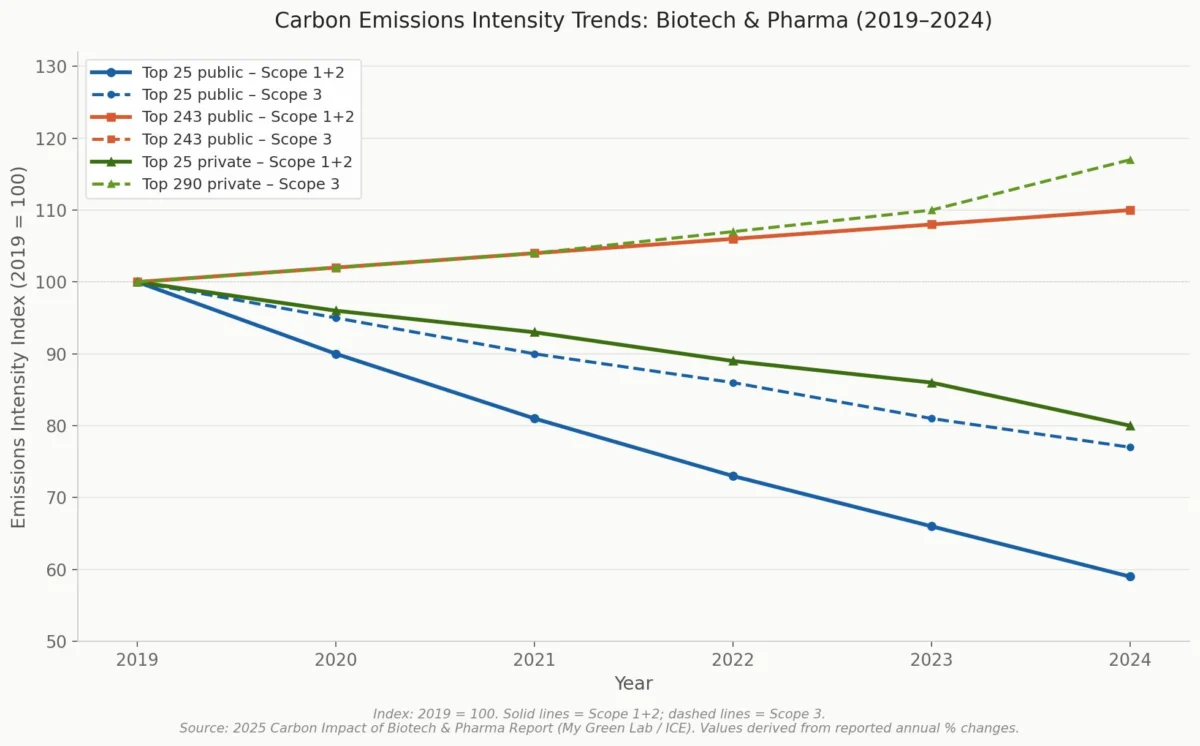
While the top 25 public pharmaceutical companies have shown notable success in reducing their Scope 1 and 2 emissions through operational efficiencies and the adoption of renewable energy, the overall carbon intensity of the industry is rising. This increase is primarily attributable to the collective impact of smaller and private firms, which may have fewer resources for sustainability initiatives, and, most significantly, to the pervasive and challenging Scope 3 emissions. Scope 3 emissions represent an overwhelming 82% of the industry’s total carbon footprint, making them the most critical frontier in decarbonization efforts.
For pharmaceutical companies, Scope 3 emissions encompass a vast array of activities. These include emissions from purchased goods and services, such as the energy-intensive Active Pharmaceutical Ingredient (API) synthesis, the extraction and processing of raw materials, and the complex logistics of outsourced manufacturing. Capital goods, like the construction of new research facilities or manufacturing plants, also contribute. Upstream transportation of materials, the use of sold products (e.g., propellants in inhalers, energy consumed by medical devices), and the end-of-life disposal of products by consumers and healthcare systems are all substantial components of Scope 3. Among these, emissions from API synthesis, raw material sourcing, and outsourced manufacturing often stand as the largest and most complex sources of carbon emissions for pharmaceutical companies.
The management of Scope 3 emissions presents a formidable challenge precisely because they occur outside the direct operational control of pharmaceutical companies. These emissions are embedded within the supply chains of countless suppliers, distributors, and end-users across the globe. Effective reduction strategies therefore require a fundamental shift from internal operational improvements to a holistic, value-chain-wide approach.
Forging a Path Forward: Strategies for Systemic Change
Addressing the escalating emissions profile of the pharmaceutical industry, particularly the pervasive Scope 3 challenge, necessitates a multi-pronged and collaborative strategy. Companies cannot tackle this issue in isolation; engagement across the entire value chain is paramount.
One crucial strategy involves supplier engagement and incentivization. Pharmaceutical companies can leverage their purchasing power and influence to require or incentivize their suppliers to set their own robust sustainability targets, transition to renewable energy sources, and adopt greener manufacturing practices. This could involve developing comprehensive supplier codes of conduct, offering training and technical support, or even collaborating on joint innovation projects to develop more sustainable materials and processes. Programs like the Pharmaceutical Supply Chain Initiative (PSCI) exemplify collaborative efforts to drive responsible practices throughout the supply chain.
Further progress can be made through the widespread adoption of green chemistry and sustainable engineering principles. This goes beyond simply managing waste to fundamentally redesigning chemical processes to minimize environmental impact from the outset. Key approaches include:
- Atom Economy: Maximizing the incorporation of all materials used in the process into the final product, thereby reducing waste.
- Catalysis: Utilizing catalysts to accelerate reactions, reduce energy consumption, and avoid hazardous reagents.
- Alternative Solvents: Replacing traditional volatile organic compounds (VOCs) with more benign alternatives like water, supercritical CO2, or ionic liquids, and developing robust solvent recycling programs.
- Process Intensification: Designing smaller, more efficient reactors and continuous manufacturing processes that reduce energy and material footprints.
- Waste Valorization: Developing methods to convert unavoidable waste streams into valuable products.
Transitioning to renewable energy is another critical lever, not only for Scope 1 and 2 emissions but also for influencing Scope 3. Pharmaceutical companies can invest in renewable energy projects directly, purchase renewable energy credits, and actively support policies that accelerate the clean energy transition, thereby encouraging their suppliers to do the same.
Optimizing logistics and transportation is essential for reducing emissions from global supply chains. Shifting freight from air shipping, which is highly carbon-intensive, to lower-emission modes like sea or road transport, where feasible, can yield significant reductions. Route optimization, consolidation of shipments, and investment in electric or alternative-fuel fleets are also vital. Furthermore, considering localized manufacturing where possible can shorten supply chains and reduce transportation emissions.
Finally, a product lifecycle approach to sustainability is gaining traction. This involves designing products with environmental impact in mind from the earliest stages of research and development. This could include developing less impactful active ingredients, using biodegradable excipients, designing recyclable packaging, and exploring take-back programs for unused medicines to prevent their entry into the environment.
Broader Implications: Public Health, Policy, and Reputation
The pharmaceutical industry’s environmental performance carries profound implications that extend far beyond corporate balance sheets. From a public health perspective, the industry’s carbon footprint contributes directly to climate change, which in turn exacerbates health crises globally, from heat-related illnesses and respiratory diseases to the spread of infectious diseases. Addressing these emissions is not merely an environmental imperative but a fundamental public health responsibility, embodying the "One Health" concept that links human, animal, and environmental health.
In terms of policy and regulation, a failure by the industry to make substantial progress on its emissions could trigger stricter governmental oversight. Regulatory bodies, particularly in regions like the European Union with its ambitious Green Deal, are increasingly scrutinizing supply chain emissions and product lifecycle impacts. New regulations could mandate more stringent reporting, set caps on emissions, or even impose carbon taxes, adding significant costs to operations.
Moreover, the industry’s reputation and trust are at stake. As public awareness of climate change and environmental degradation grows, consumers, healthcare providers, and investors are increasingly demanding greater transparency and accountability from corporations. A strong commitment to sustainability can enhance brand reputation, attract talent, and build consumer loyalty, while perceived greenwashing or insufficient action can lead to reputational damage and investor skepticism. ESG funds, which prioritize environmentally and socially responsible companies, represent a growing segment of the investment landscape, further pressuring pharmaceutical firms to demonstrate tangible progress.
Ultimately, the challenge of reducing pharmaceutical emissions represents not just a burden but also an immense opportunity for innovation. By embracing green chemistry, sustainable manufacturing, and circular economy principles, the industry can drive the development of new, more efficient processes and products. This proactive approach can lead to competitive advantages, foster technological breakthroughs, and contribute meaningfully to a healthier planet, aligning the industry’s mission of improving human health with the urgent need for environmental stewardship. The path ahead requires not just incremental improvements, but a systemic transformation across the entire value chain to truly bend the emissions curve and secure a sustainable future for healthcare.