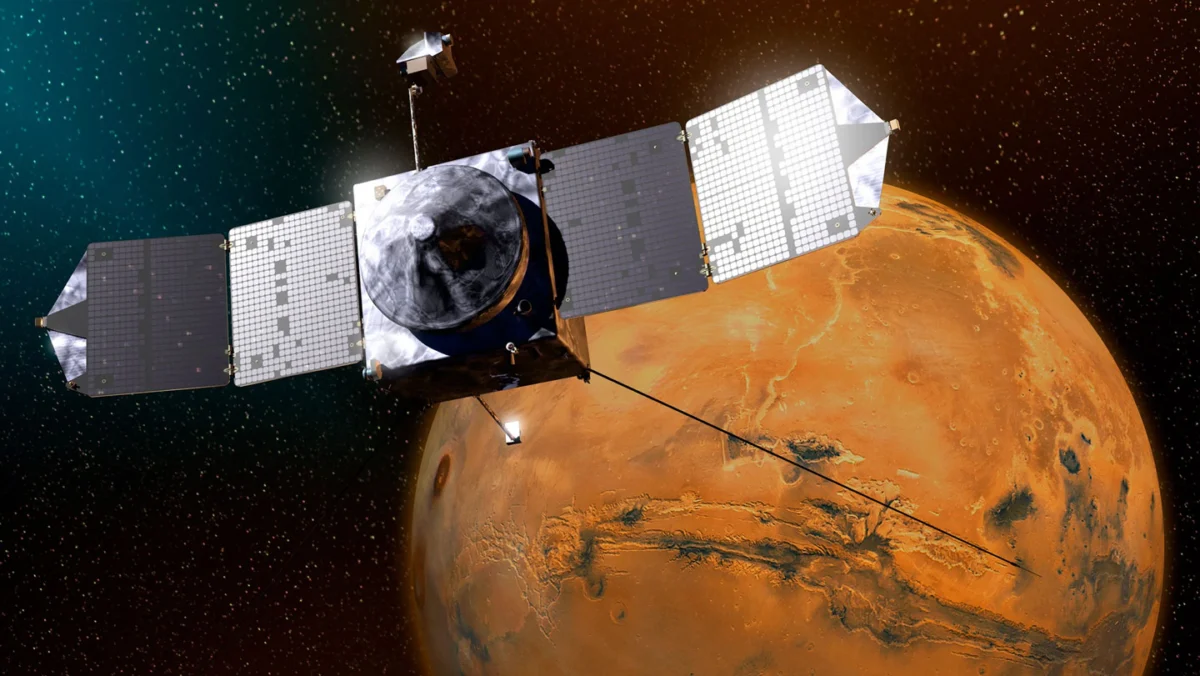
NASA has officially concluded its Mars Atmosphere and Volatile Evolution (MAVEN) mission, marking the end of a decade-long endeavor to understand the Red Planet’s atmospheric history and its transformation from a potentially habitable world to the arid planet observed today. The decision comes six months after the veteran spacecraft unexpectedly ceased communication, leaving scientists without a crucial scientific instrument and a vital node in the interplanetary communication network.
A Silent Farewell to a Martian Pioneer
The final chapter of the MAVEN mission was written on June 3rd, when NASA announced the spacecraft is irretrievable. Project manager Mike Moreau of NASA’s Goddard Space Flight Center in Greenbelt, Maryland, conveyed the somber news at a press conference, likening the mission’s end to the loss of a cherished colleague. "The conclusion is that the spacecraft is not recoverable," Moreau stated. "The team has really experienced the loss of a loved one with the end of the mission here."
MAVEN’s silence began in December 2025, shortly after it passed behind Mars. When it re-emerged, its signal could not be reacquired by Earth-based radio dishes. Limited data received on December 6th suggested the spacecraft was inexplicably spinning at approximately 2.7 revolutions per minute, a highly anomalous state for a spacecraft designed for stable orbital operations. "Any kind of rotation was anomalous," Moreau explained. A subsequent review board convened in February determined that this uncontrolled rotation likely drained the spacecraft’s batteries, severing its communication capabilities. The precise root cause of this destabilizing rotation remains under ongoing investigation.
A Decade of Discovery: Unlocking Mars’ Atmospheric Secrets
Launched in September 2014, MAVEN’s primary objective was to investigate how Mars lost its atmosphere and water over billions of years. To achieve this, the orbiter was designed to execute periodic "deep dips" into the upper layers of the Martian atmosphere, a maneuver that allowed its suite of sophisticated instruments to gather unprecedented data.
One of MAVEN’s most significant contributions has been its detailed analysis of atmospheric escape. The mission confirmed that the solar wind, a constant stream of charged particles emanating from the Sun, plays a crucial role in stripping gases from Mars’ atmosphere. Unlike Earth, which is shielded by a robust planetary magnetic field, Mars possesses only localized magnetic anomalies. This lack of a global magnetosphere leaves its atmosphere vulnerable, with MAVEN data indicating that Mars loses approximately 100 grams of atmosphere every second.
The Sun’s Impact on Martian Climate Evolution
The intensity of this atmospheric loss is exacerbated during solar storms, events characterized by solar flares and coronal mass ejections that release bursts of plasma and energetic particles. During such events, the rate of atmospheric escape can increase by a factor of ten. Scientists also infer that Mars likely experienced even more rapid atmospheric depletion in its early history, when the Sun was younger and emitted more frequent and powerful superflares. MAVEN’s findings provide crucial context for understanding the evolution of planetary atmospheres across the cosmos.
MAVEN also provided the first direct observation of "atmospheric sputtering" on any planet. This process occurs when energetic heavy ions from the solar wind collide with atmospheric molecules, effectively "splashing" lighter, neutral molecules out into space. This direct observation of sputtering on Mars offers a vital comparative perspective for understanding atmospheric loss mechanisms on other planets, including our own.
"We now have a better understanding of atmospheric escape at Mars than any other planet, including Earth," stated MAVEN principal investigator Shannon Curry, a planetary scientist at the University of Colorado Boulder. This enhanced understanding is critical for reconstructing Mars’ climatic history.
From a Warm, Wet World to an Arid Expanse
MAVEN’s research strongly supports the hypothesis that Mars was once a much warmer and wetter planet, potentially capable of sustaining liquid water on its surface and, consequently, life. The gradual erosion of its atmosphere by the solar wind is considered a primary driver for its transformation into the cold, dry environment observed today.
"The mission provided the strongest evidence yet for why Mars went from a warm, wet world (capable of supporting liquid water) to the cold, dry environment it is today," commented geoscientist Vicky Hamilton of the Southwest Research Institute in Boulder, Colorado. While definitive evidence of past Martian life remains elusive, MAVEN’s findings significantly strengthen the case for its past habitability.
Beyond Atmospheric Escape: Auroras and Dust Storms
MAVEN’s scientific contributions extended beyond atmospheric escape. The mission also identified novel types of auroras on Mars, phenomenon typically associated with planetary magnetic fields. In a remarkable coordinated effort, MAVEN worked with the Perseverance rover to capture the first-ever surface-based observation of a Martian aurora, offering future human explorers a glimpse of what these celestial light shows might look like from the ground.
Furthermore, MAVEN observed the significant impact of a global dust storm in 2018. It documented how these massive atmospheric events can loft water molecules to high altitudes, facilitating their escape into space. This observation provided a crucial piece of the puzzle in understanding the long-term water budget of Mars.
The Communication Network: A Vital Link Under Strain
Beyond its scientific payload, MAVEN served as a critical component of the Mars Relay Network, a collaborative effort between NASA and the European Space Agency comprising five satellites. This network facilitates communication between Mars surface assets, such as rovers and landers, and mission control on Earth.
Tiffany Morgan, NASA Mars Exploration Program director, acknowledged MAVEN’s "key component" status. While the rovers have adapted to operating with four satellites in the network, the loss of MAVEN has resulted in occasional communication delays. "MAVEN was critical in getting science data, as opposed to operational data," Morgan noted. "But the Mars Relay Network is resilient enough at this time to accommodate the loss of MAVEN."
However, the long-term implications for Mars communication infrastructure are a growing concern. NASA is actively planning a new Mars Telecommunications Network to ensure robust communication for future missions, including the ambitious Mars Sample Return campaign and potential human exploration. Yet, this next-generation network is not expected to be operational until 2030 or later.
In the interim, the existing Mars Relay Network satellites are aging, with some dating back 10 to 25 years. This aging infrastructure faces potential budget cuts and increased vulnerability. "Our Mars infrastructure is growing increasingly more fragile every year," expressed planetary scientist Briony Horgan of Purdue University.
Geoscientist Vicky Hamilton echoed these concerns, highlighting that current surface missions must now rely on older orbiters like Mars Odyssey and Mars Reconnaissance Orbiter. The continued operation and funding of these vital assets are subjects of ongoing budgetary discussions within NASA, adding a layer of uncertainty to the future of Mars exploration communication.
Legacy and Future of Martian Exploration
Despite its silent departure, the MAVEN mission leaves an indelible mark on our understanding of Mars. Its comprehensive data set has fundamentally reshaped our perception of the Red Planet’s atmospheric evolution and its potential for past habitability. The scientific knowledge gained will inform future missions and continue to be a cornerstone of Martian research for years to come.
As NASA navigates the loss of MAVEN and works to bolster its communication infrastructure, the focus remains on the continued exploration of Mars. The insights provided by MAVEN serve as a powerful testament to the value of long-term, dedicated scientific missions in unraveling the complex histories of our celestial neighbors. The quest to understand Mars, and perhaps one day to visit it with humans, is undeniably richer due to the pioneering work of the MAVEN orbiter.