A giant barn owl, a rodent known as a hutia, and a burrowing bee ventured into a cave. Only two emerged. The one that remained was the creature incapable of flight, its story etched into the very bones it once inhabited. This extraordinary tale, unfolding over millennia on the Caribbean island of Hispaniola, has recently been brought to light by a team of paleontologists, revealing an unprecedented instance of prehistoric life adapting to and utilizing the remnants of its predecessors.
The initial scene, pieced together from fossil evidence, suggests a natural predatory event thousands of years ago. A giant barn owl, likely a formidable hunter of its time, brought a hutia back to its chosen lair—a cave—to nourish its young. The meal was swift, leaving behind the skeletal remains of the unfortunate rodent. It was within these discarded bones, nestled in the clay-rich silt that had accumulated in the cave’s depths, that a subsequent chapter of life began. A solitary burrowing bee, in search of a safe and stable location to construct its nest, discovered a unique opportunity.
The Unlikely Architects: Bees and Fossilized Sockets
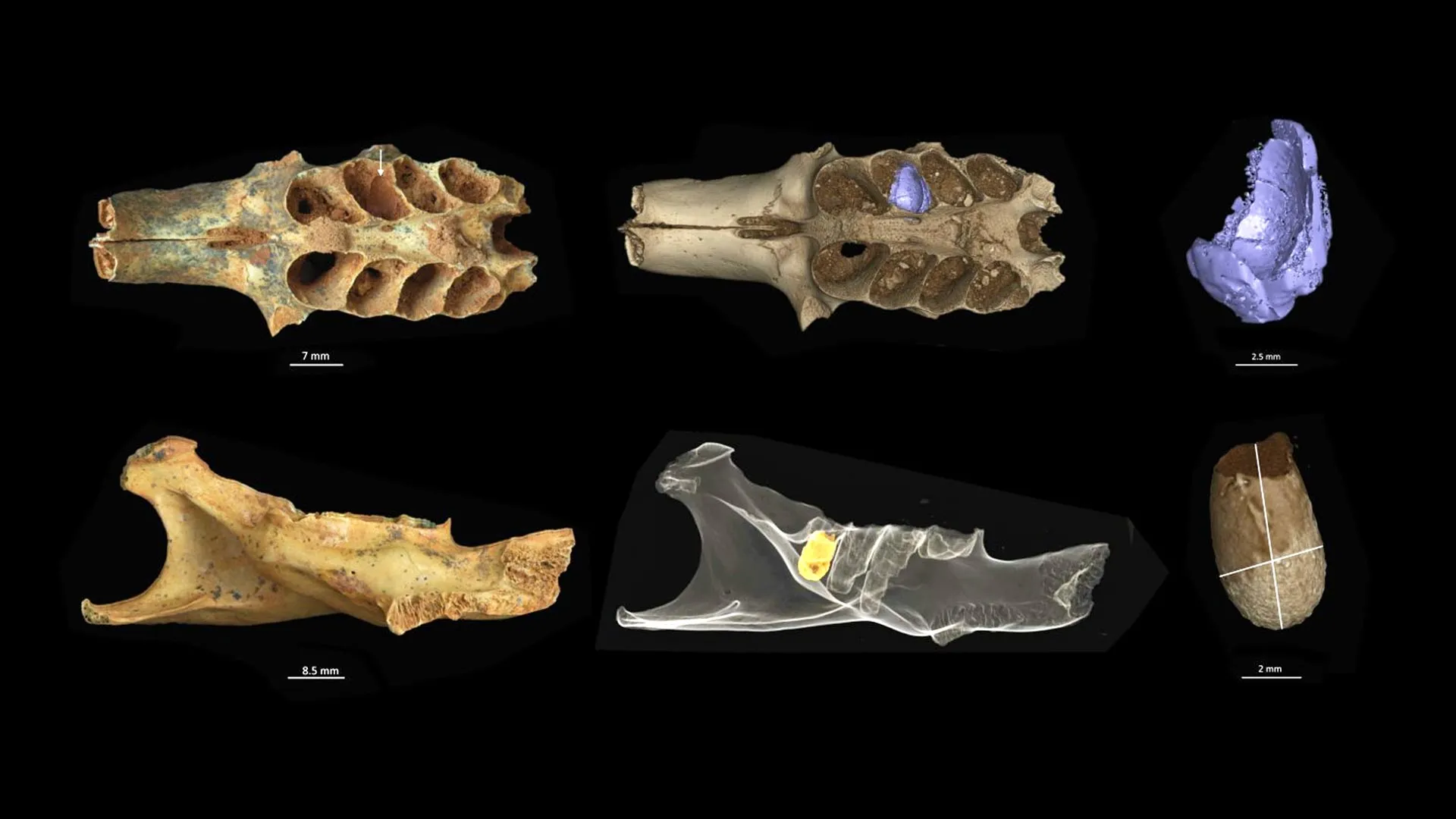
The bee, driven by instinct, began excavating into the fine silt. Its subterranean quest led it to the scattered remains of the hutia. It was here that the bee encountered a remarkable series of pre-existing structures: the empty sockets, known as alveoli, within the hutia’s jawbone where its teeth had once resided. These natural cavities, devoid of their original occupants, proved to be an ideal size and shape for the bee’s nesting needs.
What began as a single bee’s serendipitous discovery soon evolved into a recurring phenomenon. Over time, subsequent generations of burrowing bees, drawn to the same cave, followed suit. They utilized these ancient, hollowed-out spaces within the fossilized hutia jaws as ready-made, secure nesting sites. The abandoned larder of the owl transformed into a nursery for a new species, a testament to the enduring ingenuity of nature. This intricate relationship, preserved by the cave’s stable environment, remained hidden until modern-day scientific inquiry unearthed this astonishing record of ancient behavior.
A Detective’s Keen Eye Uncovers a Hidden Narrative
The pivotal moment in this discovery hinged on meticulous observation during the excavation process. Lazaro Viñola Lopez, then a doctoral student at the Florida Museum of Natural History, was leading the fieldwork. His particular interest lay in a specific species of hutia, rare and infrequently found elsewhere on Hispaniola. The Cueva de Mono, located in the southern Dominican Republic, proved to be an exceptionally rich source, yielding thousands of fossils believed to belong to this singular hutia species. The sheer volume of remains strongly indicated that the cave had served as a long-term feeding ground for giant barn owls, a practice that likely spanned numerous generations.
Lopez, instead of the typical practice of thoroughly cleaning fossil specimens by removing all surrounding sediment from within cavities, adopted a more deliberate approach. He meticulously inspected each fossil, paying close attention to the details. It was during this detailed examination that one particular cavity within a hutia jawbone caught his attention. Its internal surface was remarkably smooth, a stark contrast to the rough, porous texture typically associated with bone.
Mistaken Identity: From Wasps to the True Architects
Lopez’s initial hypothesis drew from a prior experience. "I’d seen something similar in Montana when I was collecting dinosaur fossils in 2014," he recalled. At that time, he and his colleagues had discovered wasp cocoons interspersed with fossil material. He promptly assumed a similar explanation applied here, envisioning a brief scientific note detailing the presence of wasp nests within the hutia mandibles. He even shared this preliminary idea with fellow doctoral student Mitchell Riegler, who initially expressed skepticism due to the perceived niche nature of the project.
The idea remained dormant until Riegler accepted a challenge from a former mentor to complete a scientific paper within a week. The two students then engaged in a collaborative effort, a rapid-fire writing exercise that reignited their interest in the unusual fossil findings. As they delved deeper into the research, comparing the fossilized structures with known examples of insect nests, a discrepancy emerged. Their initial assumption of wasp nests began to falter.
The critical turning point came when the team began researching ichnofossils—traces of past biological activity, such as footprints, burrows, or nests. They learned that wasp nests are typically constructed from chewed plant matter and saliva, resulting in rough, uneven interior walls. The structures they had found, however, possessed smooth, polished interiors. This characteristic, they discovered, is indicative of a different builder: bees. Many bee species, particularly solitary burrowing bees, coat the interior of their nests with a waxy secretion. This secretion provides waterproofing and creates the smooth, finished surface observed in the fossilized cavities. The realization dawned: they were not documenting wasp nests, but rather the ancient nurseries of bees.
A Discovery of Rare and Unprecedented Behavior
This correction significantly elevated the importance of their findings. The use of pre-existing fossil structures by burrowing bees for nesting, without any apparent modification of the cavities, represents an exceptionally rare behavior. Scientific literature documented only one other known instance of burrowing bees nesting within a cave environment, and crucially, none that involved the utilization of already formed fossil cavities. A previous report described bees drilling into human bones, a behavior distinct from the passive occupation of natural hollows observed in the Cueva de Mono.
The researchers recognized the profound implications of their discovery and shifted their focus to a more comprehensive study. They consulted with contemporary experts in bee biology and meticulously reviewed existing scientific literature. Viñola Lopez even returned to the Cueva de Mono to conduct further geological surveys and contextualize his findings within the cave’s broader environmental history.
During their research, the cave faced an unexpected threat. Plans were initiated to develop the land and potentially convert the cave into a septic tank. Fortunately, these plans were ultimately halted. However, the looming threat galvanized the research team into a rapid "rescue mission" to recover as many fossils as possible before any potential damage could occur. This urgent effort proved successful, yielding a significant collection of crucial specimens.
Beyond the Jawbone: Diverse Fossil Homes for Bees
The comprehensive study, ultimately published in the prestigious journal Proceedings of the Royal Society B, provides an in-depth analysis of the cave’s geological history and the remarkable nesting habits of these ancient bees. The research revealed that the bees’ chosen nesting sites were not confined solely to the hutia jaws. In several instances, nests were discovered within the pulp cavity of a sloth tooth, an indication that these bees were opportunistic nesters, utilizing any suitable hollow space. Tree sloths were once native to the Caribbean islands but have since gone extinct. Another nest was identified within a hutia vertebra, occupying the space that once housed the animal’s spinal cord.
Advanced imaging techniques, such as CT scans, provided further astonishing details. These scans revealed that some cavities contained multiple layers of nests, stacked one inside another like a set of Russian dolls. This observation indicated that certain bee species not only reused cavities but also built successive nests within the same space if it remained empty. In one particularly striking example, six distinct nests were found meticulously arranged within a single hutia alveolus.
Karst Landscape: A Driving Force Behind the Behavior
The research team also proposed a compelling environmental explanation for this unusual nesting behavior. The landscape surrounding the Cueva de Mono is characterized by karst topography, a geological formation composed of soluble rock, primarily limestone, which often results in sharp, irregular terrain and a scarcity of stable soil.
"The area we were collecting in is karst, so it’s made of sharp, edgy limestone, and it’s lost all of its natural soils," explained Riegler. "I actually fell on it at one point, so I can tell you all about it." This sharp, unstable terrain makes it difficult for burrowing insects to establish traditional ground nests. Any soil that does accumulate on the surface is prone to erosion and often washes into caves. Within these sheltered cave environments, this transported sediment can settle and form pockets of suitable material for nesting. It is theorized that these accumulations provided some of the only viable nesting conditions for burrowing bees in the region, driving them to seek out alternative, pre-existing cavities within fossilized remains.
A Cave of Unfolding Stories
The researchers are continuing their exploration of the numerous other fossils recovered from the Cueva de Mono, with further discoveries anticipated in future publications. Their ongoing work promises to shed more light on the complex ecological interactions and adaptations that occurred on Hispaniola in prehistoric times.
This remarkable study, detailing how the ancient larder of a predator became a nursery for insects, underscores the extraordinary adaptability of life. It highlights how even the most seemingly disparate elements of an ecosystem can intersect and influence one another across vast stretches of time. The Cueva de Mono, once a silent repository of skeletal remains, has revealed itself to be a vibrant chronicle, offering a unique window into the ingenious ways life finds a foothold and flourishes, even in the most unexpected of circumstances. The cave continues to hold secrets, waiting for further investigation to unravel more chapters of its ancient narrative.