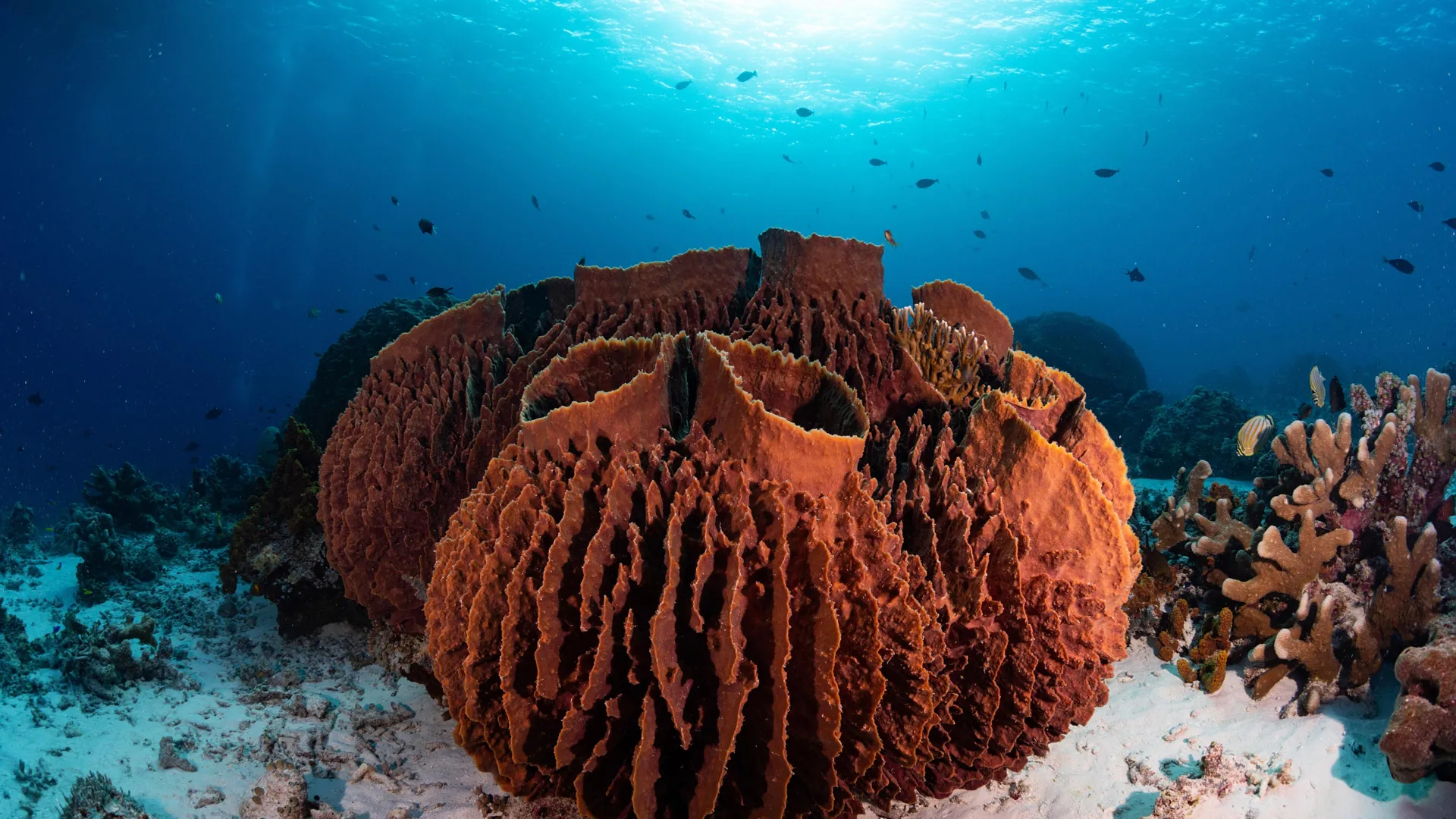
Researchers at the Massachusetts Institute of Technology (MIT) have unearthed compelling new chemical evidence within exceptionally ancient rock formations, strongly indicating that some of the very first animals to grace our planet were likely the evolutionary precursors to modern sea sponges. This groundbreaking discovery, detailed in the latest issue of the Proceedings of the National Academy of Sciences, significantly bolsters the theory that sponges represent one of the earliest branches on the animal tree of life, predating the diversification of most other major animal groups.
Unearthing Molecular Echoes of Ancient Life
The scientific team meticulously analyzed "chemical fossils"—molecular remnants of biological molecules that have been preserved for hundreds of millions of years within sedimentary rocks. These ancient signatures, locked away in strata dating back over 541 million years, offer a unique window into the biosphere of the Ediacaran Period, a critical era just before the explosive Cambrian radiation of complex life.
The focus of this latest investigation was a class of organic molecules known as steranes. These steranes are exceptionally stable byproducts of sterols, which are fundamental components of cell membranes in all complex life forms, including animals. By deciphering the intricate molecular architecture of these steranes, the MIT researchers were able to trace their origins to a specific group of organisms.
"We are essentially reading a molecular diary left behind by life billions of years ago," stated Professor Roger Summons, the Schlumberger Professor of Geobiology Emeritus in MIT’s Department of Earth, Atmospheric and Planetary Sciences (EAPS) and a senior author on the study. "The precise structure of these steranes is like a fingerprint, allowing us to infer the type of organism that produced the original sterols."
The Demosponges Connection: A Deeper Dive
The newly identified steranes were linked to demosponges, which constitute the largest and most diverse class of modern sea sponges. Today, demosponges exhibit an astonishing array of forms, sizes, and colors, inhabiting virtually every marine environment worldwide as sessile filter feeders. Their ancient counterparts, the researchers propose, would have been similarly soft-bodied marine organisms.
"While we cannot visualize their exact appearance, it is highly probable that these early animals were exclusively marine, lacked any skeletal structures, and were soft-bodied," explained Lubna Shawar, the lead author of the study and a former MIT EAPS Crosby Postdoctoral Fellow, now a research scientist at Caltech. "The chemical signatures we’ve found are particularly characteristic of the membrane lipids found in demosponges."
The presence of these sponge-specific chemical biomarkers adds substantial weight to the hypothesis that demosponges, or their direct ancestors, were among the pioneering animals on Earth. This challenges earlier assumptions about the timeline of animal evolution, pushing back the origins of complex animal life further into the Precambrian eon.
Revisiting a Landmark 2009 Discovery
This current research builds directly upon a foundational study published by Summons and his colleagues in 2009. That earlier work examined rocks from an outcrop in Oman, also dating to the Ediacaran Period (approximately 635 to 541 million years ago). In those rocks, the team detected an unusually high concentration of steranes derived from 30-carbon (C30) sterols. At the time, these rare steroid molecules were tentatively attributed to ancient sea sponges, suggesting their existence well before the Cambrian explosion, a period of rapid diversification of animal life.
However, the 2009 findings were not universally accepted. Some scientific perspectives suggested that these C30 steranes might have been produced by other, less understood organisms, or even potentially formed through non-biological geological processes. The ambiguity left room for doubt about the definitive identification of early sponges.
The Power of the Unusual: C30 and C31 Sterols
The new study addresses these lingering questions by identifying another, even rarer, chemical fossil within the same Precambrian rock samples. This second biomarker, a 31-carbon (C31) sterol derivative, is far less likely to have arisen from abiotic processes, further strengthening the biological origin of the molecular suite.
The researchers focused their analysis on Ediacaran-aged rocks sourced from drill cores and outcrops in Oman, western India, and Siberia. Their quest involved searching for steranes, which are the geologically stable forms of sterols. Sterols are indispensable components of cell membranes in all eukaryotes—organisms characterized by having a nucleus and other membrane-bound organelles, including plants, fungi, and animals.
"If an organism lacks sterols or comparable membrane lipids, it’s generally not considered a eukaryote," Professor Summons elaborated. The fundamental structure of sterols consists of four interconnected carbon rings. Organisms genetically modify this core structure by attaching various carbon side chains and chemical groups, a process that dictates the specific type of sterol produced. For instance, human cholesterol is a C27 sterol, while plant sterols typically have 29 carbon atoms.
"Finding a sterol with 30 carbons is already quite unusual," noted Shawar. "It suggests a specialized metabolic pathway not common in many organisms."
The 2009 research had identified a C30 sterol linked to a specific enzyme, the gene for which is prevalent in demosponges. In their latest investigation, the team realized that this same gene in demosponges could also produce an even more uncommon C31 sterol. Upon re-examining their meticulously collected rock samples, they discovered abundant C31 steranes co-occurring with the previously identified C30 forms.
"These highly specialized steranes were present all along," Shawar emphasized. "It required us to refine our analytical questions and deepen our understanding of their origins to fully unlock their significance."
Laboratory Validation: Recreating Ancient Biochemistry
To definitively confirm the biological source of these ancient steranes, the research team undertook a series of rigorous laboratory experiments. They began by studying living demosponges, confirming that certain species indeed produce C31 sterols—the direct biological precursors to the C31 steranes found preserved in the rocks.
Subsequently, the scientists synthesized eight different C31 sterols in the laboratory. These synthesized molecules served as crucial reference standards. They then subjected these synthesized sterols to conditions designed to mimic the geological processes of burial, heat, and pressure over millions of years. The resulting breakdown products were meticulously compared to the C31 steranes extracted from the ancient rock samples.
The results were striking. Only two of the eight synthesized sterols, when subjected to geological transformation, yielded compounds that precisely matched the C31 steranes found in the Ediacaran rocks. The absence of the other six potential transformation products strongly suggested that the molecules found in the ancient strata were not the result of random, non-biological chemical reactions occurring in the environment.
Triangulating the Evidence: Rock, Sponge, and Lab
This comprehensive approach, combining geochemical analysis of ancient rocks, biochemical studies of modern organisms, and controlled laboratory experiments, provides an exceptionally robust case for the biological origin of the C30 and C31 steranes. The evidence converges to point unequivocally towards early ancestors of demosponges as the organisms responsible for producing these distinctive molecular signatures.
"It’s a powerful confluence of evidence," stated Professor Summons. "We have the chemical signatures in the rock, we have the biological counterparts in modern sponges, and we can recreate the transformation process in the lab. These three lines of mutually reinforcing evidence all converge on the conclusion that these sponges were indeed among the earliest animals to appear on Earth."
Lubna Shawar added, "This study demonstrates a critical methodology for authenticating biomarkers, ensuring that a detected signal truly originates from life itself, rather than from contamination or non-biological chemistry."
Implications for Understanding Early Animal Evolution
The implications of this research extend far beyond identifying the first sponges. By establishing C30 and C31 sterols as reliable indicators of ancient demosponges, the researchers have developed a powerful new tool for tracing the evolutionary history of early animal life.
The team plans to expand their search by analyzing Ediacaran rocks from diverse geological locations around the globe. Currently, the available data suggests that these primitive sponges thrived during the Ediacaran Period. With a broader sampling strategy, the researchers hope to refine the timeline for the emergence of not only sponges but potentially other early animal groups as well, shedding further light on the critical evolutionary transitions that occurred during this pivotal period in Earth’s history.
This research was made possible through support from various institutions, including the MIT Crosby Fund, the Distinguished Postdoctoral Fellowship program, the Simons Foundation Collaboration on the Origins of Life, and the NASA Exobiology Program, underscoring the collaborative and multi-faceted nature of scientific inquiry into the deepest questions of life’s origins. The discovery offers a tangible glimpse into the dawn of animal life, transforming our understanding of the planet’s earliest complex ecosystems and the evolutionary journey that led to the biodiversity we see today.