In the sophisticated laboratories of the University of California, Santa Barbara, a team of materials scientists led by Stephen Wilson has unveiled a significant discovery in the field of condensed matter physics, potentially paving the way for the next generation of quantum technologies. The research, recently published in the prestigious journal Nature Materials, details a novel method for manipulating unconventional magnetic states through a phenomenon known as the "frustration of long-range order." By interleaving different types of physical frustration within a single material, the team has opened a new frontier in the study of quantum disordered magnetism, a state where particles remain in a constant flux even at temperatures approaching absolute zero.
While the immediate applications of this discovery are still on the horizon, the implications for fundamental science are profound. The work focuses on how the internal architecture of a crystal lattice can be engineered to prevent atoms from reaching a stable, low-energy state, thereby forcing them into exotic configurations that could host long-range quantum entanglement. This fundamental inquiry seeks to answer how scientists might eventually control the delicate "spins" of electrons to store and process information in ways that traditional silicon-based electronics cannot.
The Mechanics of Magnetic Frustration
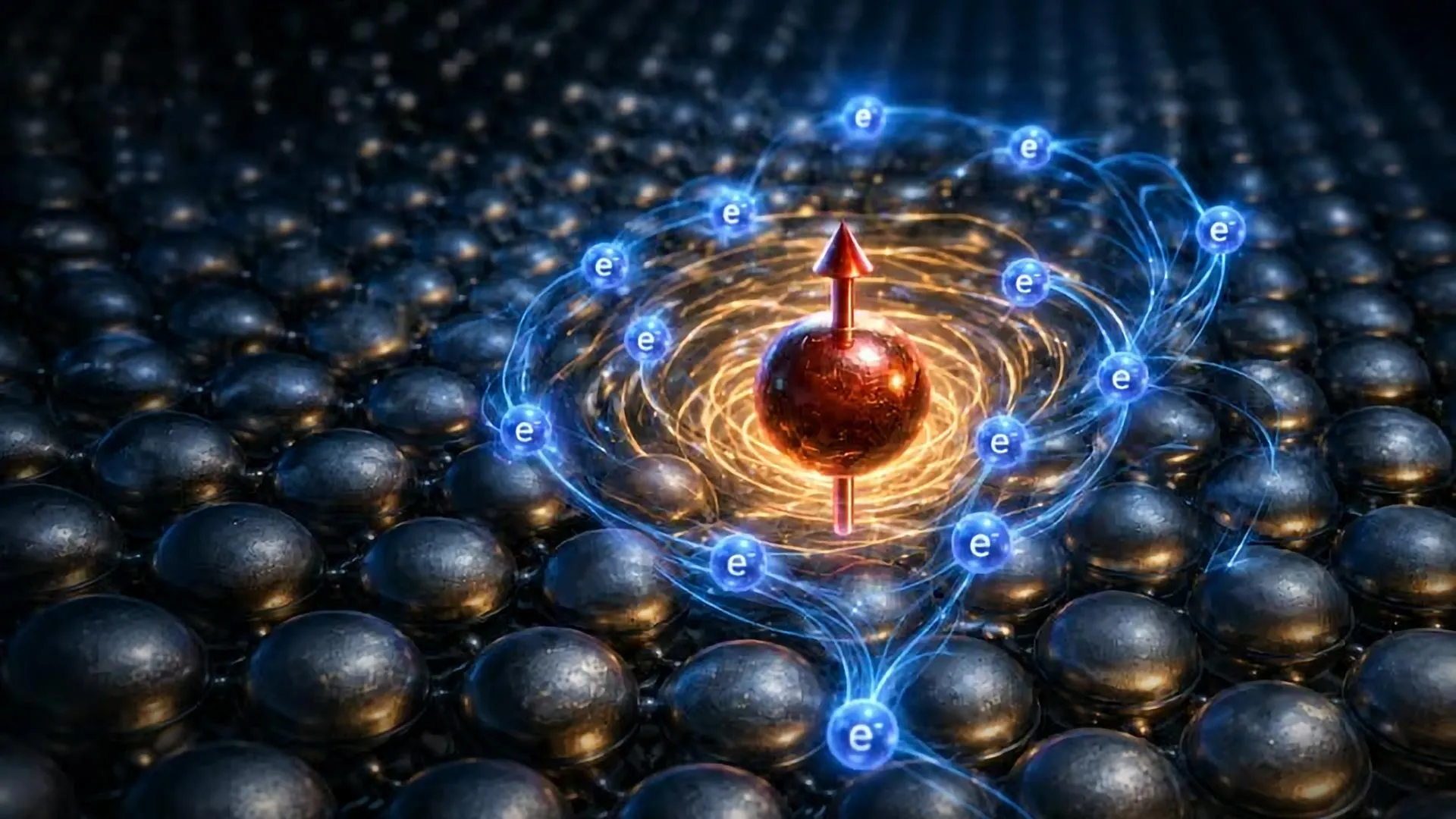
To understand the significance of the UCSB study, one must first grasp the concept of magnetism at the atomic level. In a crystal lattice, atoms possess magnetic dipole moments, which can be visualized as tiny bar magnets. These moments interact with their neighbors, seeking to arrange themselves in a configuration that minimizes the system’s total energy—a state known as the "ground state." At absolute zero, every physical system is expected to settle into this state.
In many materials, these magnetic moments prefer to point in opposite directions to one another, a behavior known as antiferromagnetism. In a standard square lattice, this is easily achieved: if one atom points "up," its four immediate neighbors can all point "down," creating a stable, alternating pattern. However, the UCSB team focused on a triangular lattice, where this simple binary logic fails.
In a triangular arrangement, if two atoms point in opposite directions, the third atom in the triangle is placed in a geometric paradox. It cannot be "opposite" to both of its neighbors simultaneously. This conflict is what physicists call "geometric frustration." The magnetic moments are effectively trapped in a state of perpetual competition, unable to find a stable orientation. This frustration prevents the material from "freezing" into a standard magnetic order, keeping the system in a state of constant quantum fluctuation.
Introducing Bond Frustration and Atomic Dimers
The innovation of Wilson’s research lies in the introduction of a second, simultaneous layer of conflict: bond frustration. While magnetic frustration involves the orientation of electron spins, bond frustration involves the physical sharing of electrons between ions. When two nearby ions attempt to share an electron to form a chemical bond, they create what is known as an atomic dimer.
In specific geometries, such as the triangular or honeycomb lattices investigated by the UCSB team, the formation of these dimers is restricted. Just as the magnetic moments cannot find a universal "down" position, the bonds themselves cannot find a universal arrangement that satisfies the entire lattice. This creates a network of "frustrated bonds."
These frustrated networks are remarkably sensitive to external stimuli, particularly mechanical strain. Because the bonds are already in a state of tension and instability, even a slight physical distortion of the crystal lattice can shift the balance, partially relieving the frustration and forcing the system into a new state. The Wilson group’s study is among the first to examine a rare class of materials where both magnetic frustration and bond frustration are "interleaved"—existing concurrently within the same atomic structure.
The Strategic Role of Lanthanides
The experimental framework for this study relies on a specific group of elements known as lanthanides, found at the bottom of the periodic table. Over the last decade, the materials science community has recognized lanthanides as ideal candidates for creating frustrated magnetic states due to their unique electronic shells and strong spin-orbit coupling.
By arranging lanthanide moments in a triangular network, researchers can induce an "intrinsically quantum disordered state." The UCSB project sought to "functionalize" this exotic state by embedding it within a lattice that also exhibits bond frustration. The goal was to see if the two frustrated systems would "talk" to one another.
"One thing we tried to do in this project was to functionalize that exotic state by embedding it in a crystal lattice that has an additional degree of bond frustration," Wilson explained. This dual-layered approach allows researchers to use one system as a lever to control the other.
Chronology of the Research and Scientific Context
The path to this discovery has been built on several years of incremental progress in quantum materials research.
- 2017–2019: Research groups globally began demonstrating that triangular lattice materials containing lanthanides could suppress traditional magnetic ordering, hinting at the existence of "quantum spin liquids."
- 2020–2022: The UCSB team and others began exploring how "strain engineering"—the application of physical pressure to a crystal—could alter the magnetic properties of these materials.
- 2023: Wilson’s laboratory identified a specific material candidate that exhibited signs of both dimer formation (bond frustration) and frustrated magnetism.
- 2024: The publication of "Interleaved bond frustration in a triangular lattice antiferromagnet" in Nature Materials formalized the discovery of the coupling between these two frustrated systems.
This timeline reflects a broader shift in the field from observing passive properties of materials to actively engineering "ferroic responses," where a small change in one parameter (like mechanical strain) leads to a massive change in another (like magnetic order).
Data and Implications for Quantum Information Science
The data presented in the study suggests that when these two frustrated systems are coupled, the material becomes highly tunable. In traditional materials, magnetic properties and structural properties are often isolated. In this interleaved system, however, the researchers found that applying a small amount of strain could induce a specific magnetic order, while applying a magnetic field could, conversely, induce changes in the physical structure of the crystal.
This "cross-talk" is of particular interest to the field of quantum information science. One of the holy grails of the field is the creation and maintenance of "long-range entanglement." This is a state where the quantum states of particles are linked regardless of the distance between them. Some quantum disordered magnetic states are theorized to host this entanglement naturally.
The challenge has always been how to access or manipulate this entanglement without destroying the delicate quantum state. The UCSB research suggests that bond frustration could provide the necessary "handle." If entanglement exists within the magnetic layer, scientists might be able to "nudge" or control it by manipulating the frustrated bond layer via external strain.
Broader Impact and Future Directions
The implications of Wilson’s work extend beyond the laboratory. By demonstrating that multiple forms of frustration can coexist and influence one another, the study provides a blueprint for designing "multiferroic" materials—substances that exhibit multiple ferroic properties simultaneously.
From a technical standpoint, this could lead to the development of new sensors that are incredibly sensitive to magnetic fields or mechanical pressure. In the realm of computing, it offers a potential pathway toward "topological quantum computing," where information is stored in the global properties of a system (like the frustrated lattice) rather than in individual particles, making the data much more resistant to environmental noise and errors.
"It’s a way of imparting in things a functionality or response to other things to which it would otherwise not respond," Wilson noted. This concept of "proximity-induced order" suggests that by placing two different frustrated lattices close together, researchers can nucleate entirely new types of matter that do not exist in nature.
The academic community has reacted with cautious optimism. While the transition from "fundamental science" to "functional device" is often measured in decades, the ability to engineer these responses at the atomic level is a necessary first step. The UCSB team plans to continue their investigation by testing different lanthanide combinations and varying the levels of strain to map out the full "phase diagram" of these interleaved systems.
As quantum technology moves from theoretical physics into the realm of materials engineering, the work of Stephen Wilson and his colleagues serves as a critical bridge. By mastering the art of frustration, they are finding order in chaos, and in doing so, defining the building blocks of the quantum future.