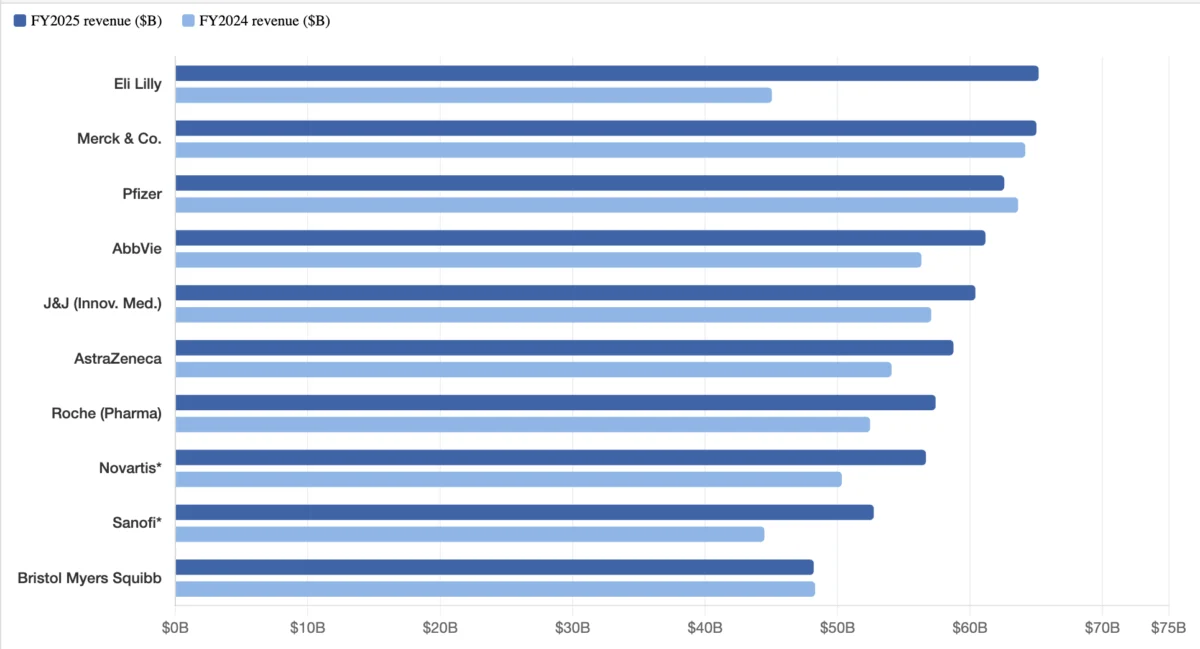
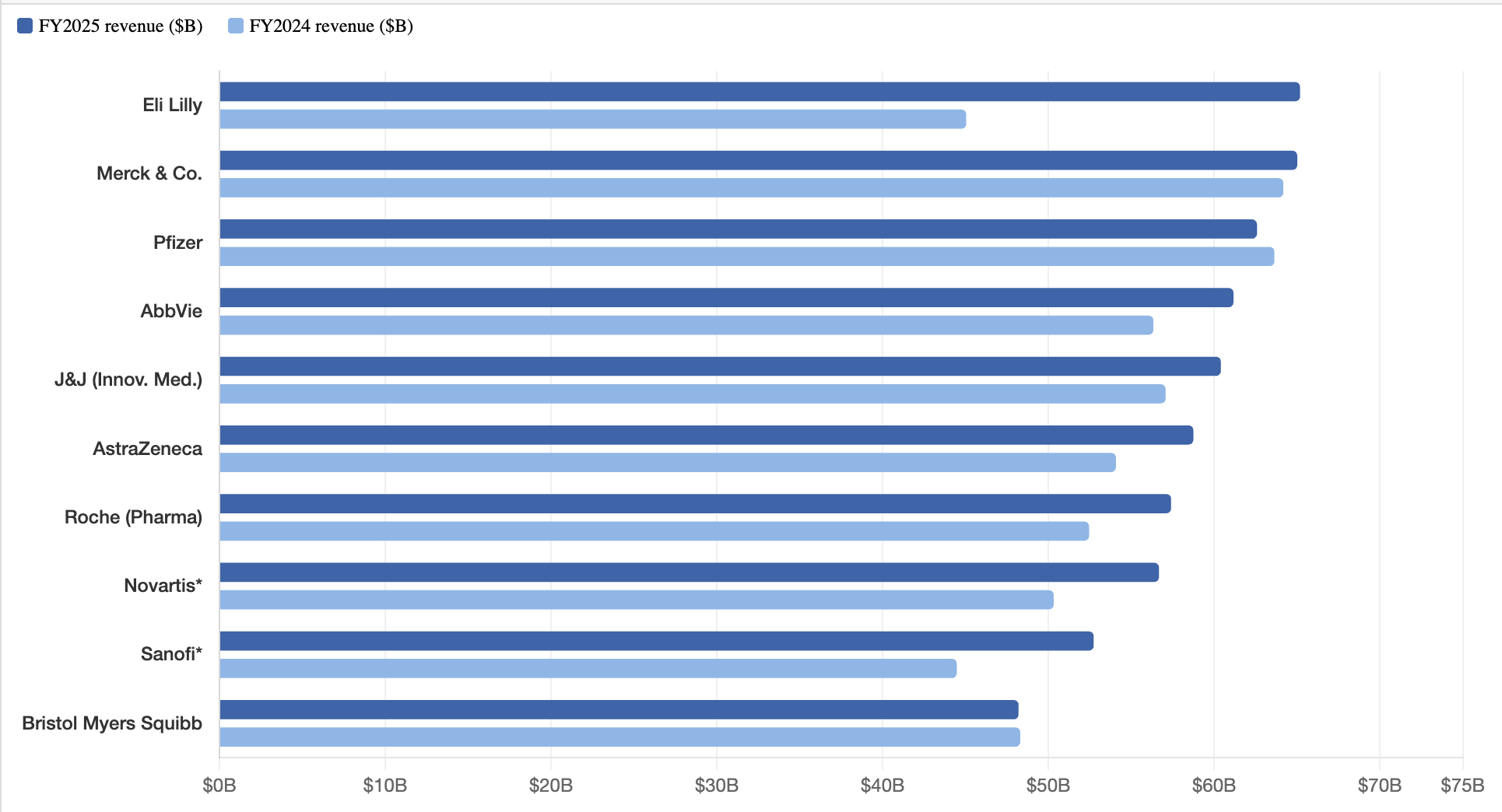
Eli Lilly and Company has officially ascended to the pinnacle of the global pharmaceutical industry, achieving the coveted position of the world’s top-earning pharma company by revenue in fiscal year 2025. This landmark achievement, driven almost entirely by the unprecedented success of its dual GLP-1/GIP receptor agonist tirzepatide, marketed as Mounjaro for type 2 diabetes and Zepbound for chronic weight management, marks a significant shift in the pharmaceutical landscape. The Indianapolis-based giant posted a staggering $65.2 billion in total revenue for FY2025, narrowly surpassing long-standing industry leader Merck & Co., which reported approximately $65.0 billion. This remarkable surge represents an approximately 44.7% year-over-year revenue jump for Lilly, equating to a gain of roughly $20.1 billion in a single year, an acceleration that has stunned market analysts and redefined growth expectations within the sector.
The Meteoric Rise of Eli Lilly: An Unprecedented Trajectory
Just over a year prior, in November of 2024, industry projections cautiously suggested that Eli Lilly might overtake Merck by late 2026 under what were then considered optimistic base-case assumptions. The reality has not only materialized a full year ahead of schedule but has also exceeded even the most ambitious forecasts. Lilly’s internal guidance for 2026, set between $80 billion and $83 billion, already outpaces the earlier model’s base case of $77.2 billion, signaling sustained momentum. To fully appreciate the scale of this transformation, it is crucial to look at Lilly’s recent historical performance: the company reported $24.5 billion in revenue in 2020. In a mere five years, Lilly has nearly tripled its annual revenue, a growth rate that is virtually unparalleled among pharmaceutical majors of its size and history. This trajectory underscores a strategic execution and product pipeline success story that few could have predicted with such accuracy.
The Engine of Growth: Tirzepatide’s Unstoppable Dominance
At the heart of Lilly’s phenomenal ascent lies tirzepatide, the active pharmaceutical ingredient behind both Mounjaro and Zepbound. This single franchise has become an unparalleled commercial success, generating a combined $36.5 billion in revenue in FY2025. Mounjaro, approved for type 2 diabetes, nearly doubled its sales, reaching $23.0 billion with a year-over-year growth of 99%. Its counterpart, Zepbound, specifically indicated for chronic weight management, experienced an even more explosive trajectory, nearly tripling its revenue to $13.5 billion, marking an astonishing 175% year-over-year increase.
The combined revenue of Mounjaro and Zepbound alone now surpasses the total annual revenue of entire established pharmaceutical companies such as Bristol Myers Squibb or Sanofi. This illustrates not only the immense demand for these therapies but also the profound impact a single, highly effective drug can have on a company’s financial standing and market position. The rapid adoption of tirzepatide products reflects a significant unmet medical need in both the diabetes and obesity markets, coupled with compelling clinical data demonstrating superior efficacy compared to existing treatments.
Understanding Tirzepatide: A Dual-Action Breakthrough
Tirzepatide operates as a novel dual agonist, simultaneously activating both the glucagon-like peptide-1 (GLP-1) and glucose-dependent insulinotropic polypeptide (GIP) receptors. This dual mechanism of action distinguishes it from earlier GLP-1-only agonists, such as Novo Nordisk’s semaglutide (Ozempic/Wegovy), and is believed to contribute to its enhanced efficacy.
For type 2 diabetes, Mounjaro has demonstrated superior A1C reduction and weight loss compared to other antidiabetic agents, including other GLP-1 receptor agonists, in numerous clinical trials. The SURPASS clinical trial program, for instance, showed that tirzepatide significantly lowered A1C levels by up to 2.58% and resulted in average weight reductions of up to 12.4 kg (27.4 lbs) in patients with type 2 diabetes.
Following its initial success in diabetes, Lilly pursued and gained approval for tirzepatide under the brand name Zepbound for chronic weight management in adults with obesity or overweight with at least one weight-related comorbidity. The pivotal SURMOUNT clinical trial program demonstrated truly transformative weight loss results. In SURMOUNT-1, patients receiving the highest dose of tirzepatide achieved an average weight loss of 22.5% (approximately 52 lbs) over 72 weeks, a figure previously only seen with bariatric surgery. These impressive clinical outcomes have fueled physician confidence and patient demand, translating directly into the staggering sales figures witnessed in FY2025.
A Shift in the Pharmaceutical Hierarchy: Lilly Edges Out Merck
Lilly’s ascent to the top spot marks a notable power shift within the pharmaceutical industry. While the margin separating Lilly and Merck was relatively slender, approximately $169 million, the direction of their respective trajectories tells a compelling story. Lilly’s revenue surged by nearly 45%, driven by its metabolic franchise. Merck, by contrast, saw its revenue remain essentially flat year-over-year.
Merck’s portfolio, while robust, has faced different dynamics. Keytruda, its blockbuster oncology drug, continues to be a dominant force, but its growth rate has naturally moderated after years of explosive expansion and the company is actively preparing for its eventual patent expiration. While Merck has diversified its pipeline and made strategic acquisitions, the sheer magnitude and speed of Lilly’s tirzepatide-driven growth proved insurmountable in FY2025. This comparison highlights the intense competition and the critical importance of a leading-edge, high-demand product portfolio in determining industry leadership.
Analyst Perspectives and Market Reactions
The financial community has largely reacted with enthusiasm, though perhaps a touch of retrospective awe, to Lilly’s performance. Many analysts had underestimated the speed at which tirzepatide would penetrate the market and contribute to the company’s top line. Following the FY2025 results, investment banks and financial institutions rapidly revised their growth forecasts for Lilly, with some now projecting even higher peak sales for the tirzepatide franchise and an extended period of market dominance in the metabolic disease space.
Lilly’s market capitalization has soared in tandem with its revenue growth. As of early 2026, the company’s valuation had climbed significantly, reflecting investor confidence in its current product portfolio and future pipeline. This robust valuation is underpinned by the strong cash flow generated by Mounjaro and Zepbound, which provides Lilly with substantial resources for reinvestment in research and development, further acquisitions, and strategic partnerships. The sustained investor interest also signals a broader market belief in the long-term potential of GLP-1/GIP agonists and the expanding therapeutic applications of these compounds beyond diabetes and obesity.
Addressing Unprecedented Demand and Supply Challenges
The extraordinary demand for Mounjaro and Zepbound has not been without its challenges, primarily related to manufacturing and supply chain management. Lilly has openly acknowledged these hurdles, stating that meeting the unprecedented global demand for tirzepatide has become a top priority. The company has invested billions of dollars in expanding its manufacturing capacity, including building new facilities and upgrading existing ones, both domestically and internationally.
These investments are crucial not only to capitalize on the current market opportunity but also to ensure patient access and maintain market share against fierce competition. Analysts note that Lilly’s ability to scale production effectively will be a key determinant of its sustained leadership position. The company has also been proactive in communicating with healthcare providers and patients regarding supply status, demonstrating a commitment to transparency during periods of high demand. This proactive approach helps manage expectations and maintain trust, critical factors in a competitive market.
The Broader Landscape: Competition and Future Outlook
While Lilly currently enjoys a significant lead, the metabolic disease market is intensely competitive. Novo Nordisk, with its own GLP-1 agonist semaglutide (Ozempic/Wegovy), remains a formidable rival. Novo Nordisk has also reported strong sales for its products and is actively investing in expanding its manufacturing capacity and pipeline. The rivalry between Lilly and Novo Nordisk is shaping up to be one of the most defining competitive narratives in the pharmaceutical industry for the foreseeable future.
Looking beyond tirzepatide, Lilly’s future outlook appears robust. The company has a diverse pipeline with promising candidates in areas such as Alzheimer’s disease (donanemab), oncology, and immunology. While tirzepatide is undeniably the primary growth driver, Lilly’s long-term strategy involves leveraging the immense profits from its metabolic franchise to fund continued innovation across multiple therapeutic areas. The success of Mounjaro and Zepbound provides a strong financial foundation, enabling Lilly to take calculated risks on novel therapies and maintain its leadership in pharmaceutical innovation.
Methodological Nuances in Pharma Ranking
It is important to acknowledge the methodology behind these industry rankings. As the original source noted, this is a practical, pharma-focused ranking built from company fiscal-year reporting, with segment carve-outs where needed. It is not always a clean "apples-to-apples" comparison of the world’s largest drugmakers, as different companies may have varying fiscal year ends, divestitures, acquisitions, or different focuses (e.g., pure-play pharma vs. diversified healthcare conglomerates). For instance, a company like Johnson & Johnson operates across pharmaceuticals, medical devices, and consumer health, making a direct revenue comparison solely based on pharmaceutical sales complex. However, within the context of pure pharmaceutical product sales, Lilly’s achievement in FY2025 is unequivocally significant and indicative of its newfound market dominance. This ranking primarily focuses on the revenue generated from patented pharmaceutical products, which is where Lilly has demonstrated exceptional growth.
Beyond Tirzepatide: Lilly’s Diverse Pipeline and Strategic Vision
While tirzepatide has been the undeniable superstar, Lilly’s strategic vision extends far beyond its metabolic franchise. The company has made substantial investments in other high-potential areas. Its Alzheimer’s drug candidate, donanemab, for instance, has shown promising results in clinical trials and is currently undergoing regulatory review. If approved, donanemab could represent another multi-billion-dollar franchise for Lilly, addressing a massive unmet need in neurodegenerative diseases.
Furthermore, Lilly’s oncology and immunology pipelines contain several innovative molecules that hold the potential for future breakthroughs. The company’s commitment to cutting-edge research, exemplified by its early adoption of advanced biological therapies and its focus on novel mechanisms of action, positions it well for sustained growth. The financial windfall from Mounjaro and Zepbound provides Lilly with unprecedented flexibility to accelerate these programs, acquire promising early-stage assets, and attract top scientific talent, further solidifying its long-term competitive advantage.
Conclusion: A New Era for Eli Lilly
Eli Lilly’s ascendancy to the top of the pharmaceutical industry in FY2025 is a testament to the power of scientific innovation, strategic execution, and effective market penetration. The extraordinary success of Mounjaro and Zepbound has not only propelled the company to unprecedented revenue levels but has also fundamentally reshaped its trajectory and market perception. From a revenue of $24.5 billion in 2020 to $65.2 billion in 2025, Lilly’s journey has been nothing short of spectacular, defying prior predictions and setting new benchmarks for growth. As Lilly navigates the complexities of unprecedented demand, intense competition, and an ever-evolving regulatory landscape, its position as the world’s leading pharma company marks a new era, characterized by bold innovation and a relentless pursuit of solutions for some of humanity’s most pressing health challenges. The pharmaceutical world will undoubtedly watch closely as Lilly leverages this newfound leadership to shape the future of medicine.