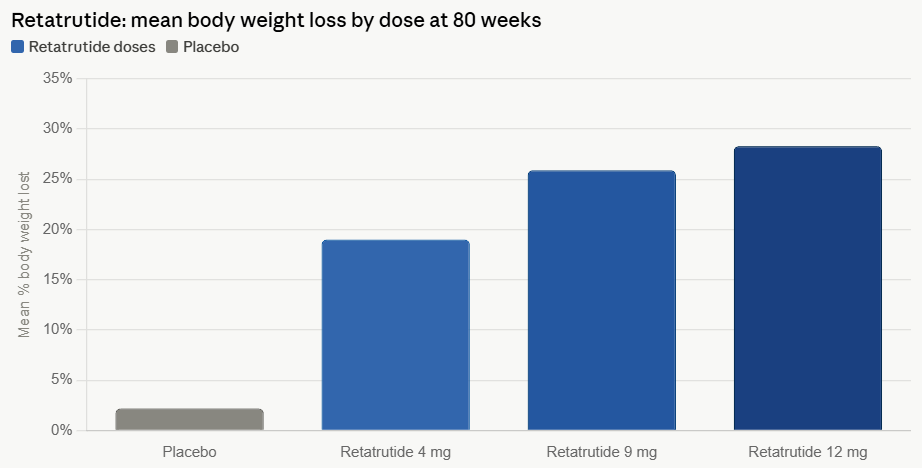
Eli Lilly and Company’s investigational drug, retatrutide, a groundbreaking triple hormone receptor agonist, has delivered an average weight loss of 28.3% over 80 weeks at its highest dose in recent Phase 3 trials. This remarkable efficacy positions retatrutide as potentially the most potent pharmacological intervention for obesity to date, surpassing the average weight loss observed with other GLP-1 based medications currently on the market or in advanced development. However, these impressive results are accompanied by an increased severity and prevalence of side effects, including common gastrointestinal issues, a distinct burning or "pins and needles" sensation (dysesthesia), and a concerning loss of muscle mass, prompting a nuanced discussion about its potential role in the evolving landscape of obesity treatment.
Unpacking the Efficacy: A New Benchmark in Weight Management
The data from the TRIUMPH-1 Phase 3 trial underscore retatrutide’s transformative potential. Achieving nearly 20% weight loss with an intermediate 4 mg dose and escalating to an unprecedented 28.3% with the 12 mg dose, retatrutide’s performance pushes the boundaries of pharmacological obesity management. This level of weight reduction approaches outcomes historically associated primarily with bariatric surgery, which typically yields 25-35% total body weight loss.
To put this in context, current leading GLP-1 receptor agonists offer substantial, but lesser, weight loss. Eli Lilly’s own tirzepatide (marketed as Zepbound for weight loss), a dual GLP-1/GIP agonist, has shown an average weight loss of around 22.5% in clinical trials. Novo Nordisk’s semaglutide (Wegovy), a GLP-1 agonist, typically achieves about 15-17% weight loss. Even Novo Nordisk’s CagriSema, a dual amylin/GLP-1 agonist, demonstrated an average weight loss of 22.7% after 68 weeks in its REDEFINE-1 Phase 3 trial, though it subsequently failed to show non-inferiority to tirzepatide in a head-to-head comparison over 84 weeks. Retatrutide’s 28.3% stands as a significant leap forward, offering patients and clinicians a new benchmark in efficacy for pharmacotherapy.
Kenneth Custer, executive vice president and president of Lilly Cardiometabolic Health, articulated the company’s perspective on these findings, stating, "TRIUMPH-1 highlights the importance of options and the potential for retatrutide to help people across various stages of their obesity journey. From the 4 mg dose, reaching nearly 20% weight loss with one escalation step, to the 12 mg dose that delivered a level of weight loss long associated with bariatric surgery, retatrutide offers the potential for a patient-centric approach to obesity. Together with Zepbound and Foundayo, retatrutide could build on Lilly’s commitment to match treatments to the needs and preferences of patients." This statement underscores Lilly’s strategy to diversify its portfolio of weight management drugs, catering to a broader spectrum of patient needs and therapeutic goals.
The Triple Agonist Mechanism: A Deeper Dive into Retatrutide’s Action
Retatrutide’s superior efficacy is attributed to its unique mechanism of action as a triple agonist, simultaneously activating receptors for glucagon-like peptide-1 (GLP-1), glucose-dependent insulinotropic polypeptide (GIP), and glucagon. This multi-pronged approach distinguishes it from earlier generations of weight loss medications.
- GLP-1: This incretin hormone plays a crucial role in glucose homeostasis by stimulating insulin secretion, suppressing glucagon release, and slowing gastric emptying, which contributes to increased satiety and reduced food intake. Most existing weight loss drugs, like semaglutide, primarily leverage this pathway.
- GIP: Another incretin hormone, GIP also stimulates insulin secretion and may have additional metabolic benefits, including effects on fat metabolism and potentially bone health, as discussed later. Tirzepatide, a dual agonist, incorporates GIP activation.
- Glucagon: Historically known for its role in raising blood glucose, glucagon also has direct effects on energy expenditure and satiety, particularly when administered peripherally. By activating glucagon receptors, retatrutide aims to further enhance energy expenditure and provide additional appetite suppression, contributing to its profound weight loss effects.
The synergistic activation of these three pathways is believed to be the driving force behind retatrutide’s enhanced efficacy. This represents a significant evolution in obesity pharmacotherapy, moving beyond single and dual receptor targeting to a more comprehensive metabolic modulation.
Navigating the Side Effect Landscape: Tolerability Concerns Emerge
Despite the groundbreaking efficacy, the Phase 3 data for retatrutide also revealed a higher incidence and severity of adverse events compared to other GLP-1 class drugs. Common side effects, consistent with other incretin-based therapies, include nausea and vomiting, which are often transient but can be debilitating for some patients. More concerning, however, are the higher discontinuation rates due to adverse effects and the emergence of specific side effects like dysesthesia and significant muscle mass loss.
At the highest dose of retatrutide, 11.3% of participants discontinued treatment due to adverse effects. This rate is notably higher than that observed with other prominent weight loss medications: tirzepatide (6.1%), semaglutide (8.0%), and orforglipron (10.3%), another investigational oral GLP-1 by Lilly. This higher discontinuation rate suggests that while retatrutide offers unparalleled weight loss, its tolerability profile may limit its widespread applicability, especially for patients who are highly sensitive to side effects.
Dysesthesia: An Unsettling Sensation
A particularly notable side effect reported with retatrutide is dysesthesia, characterized by abnormal skin sensations such as burning, tingling, or a "pins and needles" feeling. Approximately 12.5% of participants on the highest dose of retatrutide experienced these symptoms. While generally described as mild to moderate and often resolving during treatment, its prevalence is a point of comparison with other drugs.
For instance, Lilly’s oral nonpeptide GLP-1, orforglipron, reported dysesthesia in only 1.2% of participants at its highest dose. Conversely, high doses of semaglutide (7.2 mg) in experimental trials caused this side effect in a higher proportion of participants, 22.9%. Intriguingly, many other GLP-1s currently available do not list dysesthesia as a significant adverse effect.
The precise mechanism underlying dysesthesia in the context of these medications is not fully understood. Researchers hypothesize that it may be linked to the activation of glucagon or GLP-1 receptors, given their expression on central and peripheral nerves. Another proposed cause involves transient shifts in B vitamins and electrolytes, which are crucial for nerve health, potentially induced by rapid weight loss and reduced food intake. This area warrants further investigation to understand and mitigate this particular side effect.
Muscle Mass Preservation: A Growing Concern in Weight Loss Therapy
Rapid and substantial weight loss, regardless of the method, often involves a reduction in both fat mass and lean body mass, including muscle. This is a critical consideration for weight loss therapies, as excessive muscle loss can have detrimental effects on metabolic rate, physical function, and overall health.
Data from trials for other GLP-1 class drugs highlight this concern. For orforglipron, an average of 26.9% of the total weight loss was attributed to a loss in lean mass. CagriSema showed a 14.4% reduction in lean soft-tissue mass. Given retatrutide’s profound average weight loss of 70.3 lbs, if a similar proportion of lean mass is lost (ranging from 20% to 35% as seen in GLP-1 weight loss generally), this could translate to approximately 14 to 24.6 lbs of muscle mass loss.
Direct body composition data specifically for retatrutide has not yet been published, but additional results from the Phase 3 trial, which are expected later this year, will be crucial in providing a clearer picture of its impact on lean mass. The loss of muscle mass is not merely an aesthetic concern; it is a key driver of bone density decline, as it reduces the dynamic strain on the skeleton, thereby accelerating disuse signaling and increasing the risk of osteoporosis. This has led to a focus on developing next-generation weight loss candidates, such as XW020 by SciWind Bio, a long-acting injectable peptide specifically designed to induce body weight reduction while actively preserving muscle mass.
The Bone Density Conundrum: Rapid Weight Loss and Skeletal Health
The effect of retatrutide on bone density remains to be seen, but the broader class of GLP-1s has been shown to cause a decrease in bone density proportional to weight loss. Rapid and substantial weight loss mechanically reduces the static and dynamic loads on the skeleton. The body responds by increasing bone resorption (breakdown) and decreasing bone formation, leading to a decline in bone mineral density (BMD).
According to a 2025 review published in Nature Bone Research, rapid weight loss is associated with approximately 1% to 3% BMD loss for every 10% of body weight lost. This is a significant concern, particularly for long-term use of highly effective weight loss medications.
Several studies underscore this risk. One study indicated that non-diabetic GLP-1 users who maintained stable weights had a 22% higher osteoporosis risk compared to those on other weight loss medications, with the risk intensifying as weight loss increased. Furthermore, five-year follow-up data presented at the AAOS 2026 meeting revealed that GLP-1 users had a significantly higher risk of osteoporosis than matched controls (4.1% compared to 3.2%). These findings highlight a critical area for ongoing monitoring and research as these potent weight loss drugs become more widely used.
GIP’s Protective Role: A Potential Mitigator for Bone Loss
An interesting aspect of retatrutide’s triple agonist mechanism, particularly its GIP receptor activation, offers a potential silver lining regarding bone density. Research suggests that the GIP hormone may provide a protective effect that counteracts some of the bone loss associated with weight reduction. This hypothesis stems from the presence of GIP receptors on osteoblasts (bone-forming cells) and osteoclasts (bone-resorbing cells). In animal models, GIP agonists have demonstrated beneficial effects on tissue-level bone material properties.
A 2025 mechanistic review published in The Journal of Clinical Endocrinology and Metabolism specifically highlighted that tirzepatide, which also activates the GIP receptor, showed less BMD loss than would be expected for the amount of weight loss achieved. This suggests that the GIP component of tirzepatide might offer some protective benefit against weight loss-induced bone demineralization. As retatrutide also acts as a GIP agonist, there is hope that its GIP component might similarly mitigate some of the bone density concerns, though specific data for retatrutide is still pending.
Market Dynamics and Competitive Landscape
Eli Lilly is aggressively positioning itself as a leader in the burgeoning obesity treatment market. With Zepbound (tirzepatide) already on the market and Foundayo (an investigational oral GLP-1) in its pipeline, retatrutide represents a significant addition to Lilly’s arsenal. This multi-product strategy aims to capture different segments of the patient population, offering various levels of efficacy, administration routes, and tolerability profiles.
The market reaction to retatrutide’s data has been mixed, reflecting the trade-off between efficacy and side effects. RBC Capital Markets analyst Trung Huynh hailed the results, stating, "The clean safety profile, combined with best-in-class efficacy across all doses, makes this a clean win for [Lilly]." This perspective emphasizes the sheer power of the weight loss achieved.
However, William Blair analysts offered a more cautious outlook, suggesting that retatrutide’s tolerability profile "could confine the drug to use in patients at the higher end of the BMI spectrum," implying that tirzepatide might "continue to serve as the go-to medication, due to its balanced efficacy and tolerability profile." This analysis points to a potential segmentation of the market, where patients with severe obesity seeking maximum weight loss might opt for retatrutide, while those prioritizing a more manageable side effect profile might stick with tirzepatide or semaglutide.
The global obesity drug market is projected to reach tens of billions of dollars in the coming years, driven by the escalating obesity epidemic and increasing awareness of obesity as a chronic disease requiring medical intervention. Lilly’s strong presence in this space positions it for significant growth, but competition, particularly from Novo Nordisk, remains fierce. The ongoing development of novel mechanisms and formulations, including oral peptides and drugs focused on muscle preservation, signals a dynamic and rapidly evolving therapeutic landscape.
Industry Reactions and Broader Implications
The emergence of drugs like retatrutide has significant implications for public health, healthcare systems, and patient care. Endocrinologists and obesity specialists will need to carefully weigh the benefits of unprecedented weight loss against the increased risk of side effects, particularly for long-term treatment. The concept of "personalized medicine" will become even more critical, allowing clinicians to tailor treatment plans based on individual patient characteristics, comorbidities, tolerability, and treatment goals.
For healthcare systems, the widespread adoption of highly effective obesity medications could lead to a reduction in obesity-related comorbidities such as type 2 diabetes, cardiovascular disease, and certain cancers, potentially offsetting some of the drug costs in the long run. However, the initial cost of these therapies and ensuring equitable access will be paramount challenges. Patient advocacy groups will likely champion access to these transformative treatments while also emphasizing the importance of comprehensive care that includes lifestyle modifications and long-term support.
The Road Ahead: Future Research and Regulatory Pathway
The medical community eagerly awaits further data from the retatrutide Phase 3 program, particularly the detailed body composition analyses that will quantify muscle mass changes. These results will be crucial for fully understanding the long-term metabolic and functional consequences of such substantial weight loss. Ongoing long-term safety studies will also be essential to monitor for any unforeseen adverse events, especially concerning bone health and neurological symptoms.
Following the completion of its Phase 3 trials, Eli Lilly will pursue regulatory approval from agencies like the U.S. Food and Drug Administration (FDA) and the European Medicines Agency (EMA). The review process will meticulously scrutinize the balance between retatrutide’s unparalleled efficacy and its side effect profile, potentially leading to specific labeling or recommendations regarding patient selection.
Retatrutide represents a pivotal moment in the fight against obesity. Its ability to induce weight loss previously only seen with surgery offers immense hope for millions grappling with this chronic disease. However, its notable side effect profile, particularly concerning dysesthesia and muscle/bone health, mandates careful consideration and ongoing research. As the scientific understanding of obesity and its pharmacotherapy continues to evolve, drugs like retatrutide challenge clinicians and patients alike to navigate a new era of potent, yet complex, treatment options. The ultimate success of retatrutide will hinge on how effectively these challenges are managed, ensuring that its groundbreaking benefits can be safely and broadly realized for those who need them most.