In a landmark development for the field of photonics, researchers at Nanyang Technological University, Singapore (NTU Singapore) have demonstrated that one of the most famous experiments in the history of physics can be repurposed to create advanced topological light structures. By revisiting the "Poisson spot" experiment—a 19th-century cornerstone of wave optics—the team has uncovered a remarkably simple and cost-effective method to generate optical skyrmions. These complex, swirling patterns of light were previously thought to require highly sophisticated and expensive engineered materials, but the NTU breakthrough proves they can be manifested using little more than a laser and a simple circular disc. The study, published in the prestigious journal Optica, signals a paradigm shift in how scientists approach the creation and manipulation of light for next-generation computing and data storage.
The Nature and Potential of Optical Skyrmions
To understand the significance of the NTU discovery, one must first grasp the nature of skyrmions. Originally proposed by British physicist Tony Skyrme in the 1960s within the context of nuclear physics, skyrmions are topological solitons—stable, localized configurations of a field that behave like particles. In the realm of optics, skyrmions are characterized by a "hedgehog-like" structure, where the properties of light, such as its polarization or phase, swirl in a specific, protected pattern.
These structures are "topologically protected," meaning they maintain their integrity even when subjected to external perturbations or medium distortions. This robustness makes them ideal candidates for information technology. In the same way that magnetic skyrmions are being explored for ultra-dense hard drives, optical skyrmions offer a way to encode data into the very structure of a light beam. Because these patterns can be incredibly small and highly stable, they could potentially lead to a revolution in high-speed optical communications and photonic computing, where light replaces electricity as the primary medium for logic operations.
A Historical Resurrection: The Poisson Spot and the Nature of Light
The NTU team’s methodology is rooted in a historical debate that defined the 19th century. In 1818, the French Academy of Sciences sponsored a competition to explain the properties of light. Civil engineer Augustin-Jean Fresnel submitted a memoir proposing that light behaved as a wave. One of the judges, the eminent mathematician Siméon Denis Poisson, was skeptical. He argued that if Fresnel’s wave theory were correct, light hitting a circular obstacle would diffract around the edges and interfere constructively at the very center of the shadow, creating a bright spot. Poisson believed this was an absurd prediction that disproved the wave theory.
However, when fellow judge Dominique-François-Jean Arago performed the experiment, the bright spot appeared exactly as the math predicted. This "Poisson spot" (sometimes called the Arago spot) became one of the most decisive pieces of evidence for the wave nature of light. For two centuries, it has been a staple of physics textbooks, primarily used to demonstrate diffraction.
The NTU researchers, led by Assistant Professor Shen Yijie from the School of Physical and Mathematical Sciences and the School of Electrical and Electronic Engineering, realized that this classical phenomenon held untapped potential. They discovered that the complex interference patterns occurring within and around the Poisson spot were the perfect breeding ground for topological singularities. By precisely controlling the coherence and polarization of the laser light hitting the disc, they could "induce" the formation of skyrmions within the shadow region.
Breaking the Barrier of Expensive Metamaterials
Until this breakthrough, the production of optical skyrmions was largely the domain of specialized laboratories equipped with metamaterials. Metamaterials are artificially structured media, often engineered at the nanometer scale, designed to have properties not found in nature. While effective, these materials are difficult to manufacture, expensive to procure, and often limited in their operational bandwidth.
The NTU approach eliminates these hurdles. "What is remarkable is that optical skyrmions can now be generated using a simple effect where light bends around an object, without relying on expensive, complex man-made metamaterials or highly specialized techniques," explained Assistant Professor Shen. This democratization of the technology means that laboratories with standard optical equipment can now engage in high-level topological physics research. By lowering the technical and financial barriers, the NTU team has effectively opened the floodgates for a new era of experimentation in light-based information science.
Simultaneous Generation of Four Skyrmion Types
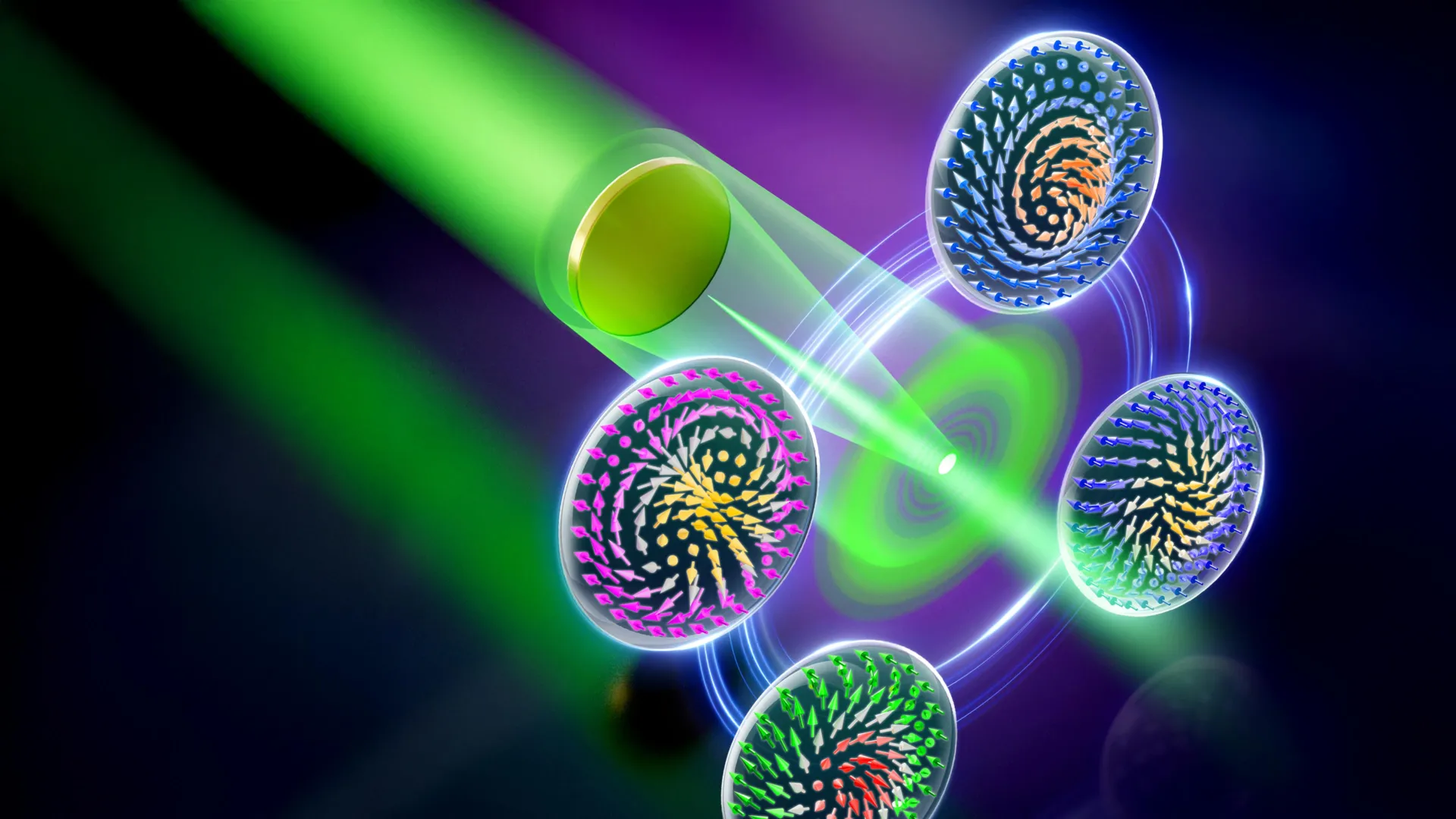
A particularly striking aspect of the NTU study is the efficiency of the Poisson spot setup. The researchers found that their method does not just produce a single type of skyrmion; it simultaneously generates four distinct topological field patterns:
- Spin Skyrmions: These relate to the intrinsic angular momentum of the light.
- Stokes Skyrmions: These are defined by the Stokes parameters, which describe the polarization state of the electromagnetic wave.
- Electric Field Skyrmions: Patterns formed by the vector orientation of the electric field.
- Magnetic Field Skyrmions: Patterns formed by the vector orientation of the magnetic field.
In previous experiments using metamaterials, researchers often struggled to generate even one type of skyrmion with high fidelity. The ability to produce all four simultaneously within the same light field allows for unprecedented comparative studies. Scientists can now observe how these different physical properties—electric, magnetic, and rotational—interact and evolve in real-time. This holistic view is crucial for developing "topological photonics," a field that seeks to use the global properties of a system to protect light from scattering and loss.
Technical Analysis: Stability and Control
The research utilized advanced computer simulations to map the vector fields of the generated Poisson spot. These simulations revealed intricate "swirling arrays of arrows," representing the direction and magnitude of the light’s properties at various points in space. The data confirmed that the structures were indeed skyrmions, exhibiting the mathematical requirement of "unity topological charge"—a measure of how many times the field wraps around a sphere.
The stability of these patterns is a key metric. Because the Poisson spot is a result of fundamental diffraction, the resulting skyrmions are inherently stable as long as the light source remains coherent. The NTU team demonstrated that by adjusting the distance between the disc and the observation plane, or by modifying the polarization of the incident laser, they could tune the size and characteristics of the skyrmions. This level of control is vital for any potential application in computing, where the ability to switch or modulate a state is the basis for binary logic.
A Chronology of Topological Light
The path to the NTU discovery is part of a broader timeline in physics that has seen topology move from abstract mathematics to a practical tool for engineering:
- 1818: The discovery of the Poisson spot confirms the wave nature of light.
- 1962: Tony Skyrme proposes the skyrmion model in particle physics.
- 2009: Magnetic skyrmions are experimentally observed in metallic thin films, sparking interest in "skyrmionics" for memory storage.
- 2018: Early theoretical work suggests that skyrmions could exist in optical fields.
- 2020-2023: Researchers begin using complex metamaterials and "optical needles" to create skyrmions in laboratory settings.
- 2024: The NTU Singapore team proves that these structures can be created using classical diffraction, bridging the gap between 19th-century optics and 21st-century information science.
Implications for the Future of Computing and Beyond
The long-term implications of this research are vast. As traditional silicon-based electronics approach their physical limits (often referred to as the end of Moore’s Law), the industry is searching for alternative ways to process data. Optical computing is a leading contender because light can carry more information than electrons and travels at much higher speeds with less heat generation.
Optical skyrmions could serve as the "bits" of a future photonic processor. Their topological protection means that data encoded in a skyrmion would be resistant to the "noise" and imperfections that usually plague optical systems. Furthermore, the fact that they can be generated so easily suggests that future optical chips might not need the incredibly complex internal architectures once envisioned, potentially leading to simpler, more robust designs.
Beyond computing, this research has applications in high-resolution microscopy and metrology. Because skyrmions contain features smaller than the wavelength of the light used to create them (sub-wavelength features), they could be used to image biological structures or semiconductor circuits with unprecedented precision.
Conclusion: A New Chapter in Optics
The work led by Assistant Professor Shen Yijie and his team at NTU Singapore serves as a powerful reminder that "old" physics often holds the keys to the future. By looking back at the Poisson spot, they have moved the field of topological photonics forward by a significant margin.
"Being able to produce and compare several skyrmions within one system could help researchers uncover new links between light’s electric, magnetic and other physical properties," Shen noted. This research does more than just simplify a manufacturing process; it provides a new laboratory for the fundamental study of light. As scientists continue to explore the "hedgehog" structures of the Poisson spot, the transition from theoretical physics to practical, light-based technology moves closer to reality. The simple circular disc, once a tool to prove that light is a wave, may now become the cornerstone of the next digital revolution.