Quantum mechanics has long challenged our fundamental understanding of reality, defying classical intuition with phenomena that once deeply troubled even Albert Einstein. At the heart of this paradox lies quantum entanglement, a state where particles such as photons become fundamentally intertwined, sharing a unified physical existence regardless of the physical distance separating them. While Einstein famously dismissed this non-local connection as "spooky action at a distance," modern physics regards entanglement as an indispensable resource. It serves as the foundational cornerstone for the next generation of technological revolutions, including quantum computing, ultra-secure quantum cryptography, and advanced quantum communication networks.
However, harnessing the full potential of entangled systems has historically encountered a severe bottleneck: the challenge of detection and verification. As researchers scale up quantum architectures from single-particle systems to complex, multi-photon states, identifying the precise nature of the entanglement produced has proven exceptionally difficult. Traditional methodologies, such as quantum tomography, demand an exponential escalation of data collection as additional photons are introduced into the system, making them increasingly impractical for large-scale operations.
Addressing this critical limitation, a collaborative research team spanning Kyoto University and Hiroshima University has unveiled a groundbreaking solution. By successfully engineering a novel entangled measurement technique capable of identifying the elusive W state—a vital multi-photon entangled configuration—the researchers have bridged a 25-year technological gap in quantum optics. This milestone not only opens new pathways for fundamental quantum physics but also provides practical tools essential for scaling future quantum infrastructure.
The Historical Context and the Measurement Dilemma
To understand the magnitude of the Kyoto and Hiroshima research breakthrough, one must examine the historical trajectory of quantum state measurement. For decades, the primary workhorse for analyzing quantum states has been quantum tomography. This technique requires scientists to perform a vast multitude of repeated measurements on an ensemble of identically prepared quantum systems. By statistically reconstructing the density matrix from these measurements, researchers can visualize and estimate the quantum state.
Yet, quantum tomography suffers from a debilitating scaling issue. The number of required measurements scales exponentially with the number of constituent particles, or qubits, in the system. For a modest system involving just a handful of photons, the data processing requirements skyrocket, consuming prohibitive amounts of time and computational resources.
In contrast, an entangled measurement offers a streamlined, "one-shot" alternative. Rather than laboriously reconstructing a state post-measurement via statistical analysis, a direct entangled measurement can instantly identify a specific quantum state upon interaction.
Historically, physicists successfully achieved such direct measurements for the Greenberger-Horne-Zeilinger (GHZ) state—a prominent form of multi-photon entanglement—over a quarter-century ago. The GHZ state represents an all-or-nothing form of correlation among three or more particles. However, the scientific community had struggled to devise or experimentally demonstrate a comparable single-shot measurement scheme for the W state. Unlike GHZ states, W states exhibit a different class of robustness; if one photon in a W-type entangled system is lost, the remaining particles retain a significant degree of entanglement. This resilience makes W states exceptionally valuable for quantum information processing, yet notoriously difficult to measure efficiently.
Bridging a 25-Year Gap: The Kyoto and Hiroshima Breakthrough
The recent breakthrough led by corresponding author Shigeki Takeuchi and his colleagues at Kyoto University and Hiroshima University successfully resolves this long-standing deficiency. The team’s experimental success centers on the realization of a direct entangled measurement for three-photon W states.
"More than 25 years after the initial proposal concerning the entangled measurement for GHZ states, we have finally obtained the entangled measurement for the W state as well, with genuine experimental demonstration for 3-photon W states," notes Takeuchi, reflecting on the historical significance of the milestone.
The achievement is the culmination of rigorous theoretical formulation and advanced experimental optics. To tackle the W state, the research team exploited a specific mathematical property inherent to these configurations: cyclic shift symmetry. In a cyclic shift, the spatial or polarization arrangement of the photons can be rotated in a repeating sequence while preserving the underlying physical invariants of the system.
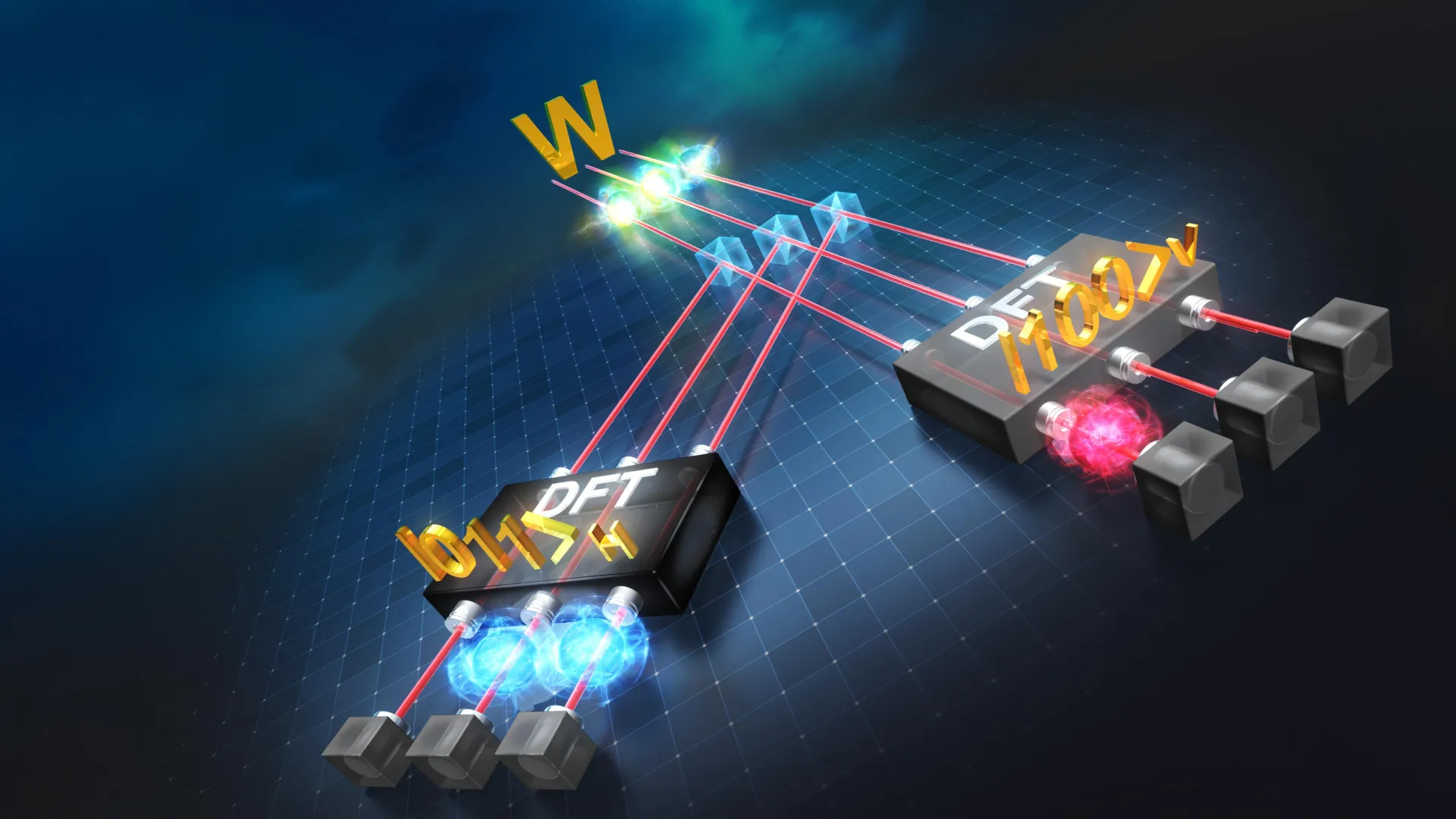
Leveraging this symmetry, the researchers designed a sophisticated photonic quantum circuit. At the core of this circuit is a quantum Fourier transformation, a mathematical operation executed optically that reorganizes quantum information to expose hidden correlations and patterns that would otherwise remain undetectable through standard observation methods. Crucially, the mathematical framework underpinning their design is inherently scalable, theoretically capable of accommodating W states comprising an arbitrary number of photons.
Experimental Validation and Circuit Stability
Following their theoretical modeling, the research team constructed a physical testing apparatus utilizing high-stability optical quantum circuits. In experimental quantum optics, system drift caused by environmental fluctuations—such as microscopic temperature shifts or mechanical vibrations—frequently undermines data fidelity. To mitigate this, the researchers engineered an optical architecture capable of sustained, long-term operation without necessitating active electronic stabilization or continuous recalibration.
The experimental validation involved injecting three individual photons with precisely tuned polarization states into the custom-built optical circuit. Upon traversing the network of beam splitters, phase shifters, and waveplates, the system successfully distinguished among various configurations of three-photon W states. Each distinguished configuration corresponded to a unique non-classical correlation shared mutually among the incoming photons.
To rigorously evaluate the performance of their device, the research team quantified the fidelity of the entangled measurement. In quantum information science, fidelity serves as a critical performance metric, quantifying how closely an experimental process approximates an ideal theoretical operation. Specifically, it measures the statistical probability that the optical device yields the correct outcome when fed a pure W-state input. The high fidelity achieved in the Kyoto-Hiroshima experiment underscored the precision and reliability of the cyclic shift symmetry approach.
Implications for Quantum Teleportation and Communication
The successful demonstration of W-state entangled measurements carries profound implications for multiple domains within quantum technology. Among the most direct beneficiaries is quantum teleportation.
Despite the dramatic phrasing often popularized in science fiction, quantum teleportation does not involve the physical movement of matter or energy through space. Instead, it is a protocol that transfers the exact quantum state—and consequently, the information contained within it—from one location to another by utilizing pre-existing entanglement as a quantum channel. The efficiency and fidelity of quantum teleportation protocols rely heavily on the precision of Bell-state or generalized multi-particle entangled measurements. By introducing a reliable method for measuring W states, researchers now possess an expanded toolkit for orchestrating complex quantum state transfers across distributed networks.
Furthermore, the advance feeds directly into the development of advanced quantum communication protocols. Secure communication networks, such as those utilizing Quantum Key Distribution (QKD), depend on the ability to transmit and verify multi-photon entangled states over long distances without interception. W states are particularly attractive for multi-party quantum communication networks because their entanglement remains robust even when particle loss occurs in transmission channels.
Beyond communication, the methodology paves the way for advanced iterations of measurement-based quantum computing. In this computational paradigm, processing is driven not by sequences of logic gates applied to independent qubits, but by performing measurements on a pre-existing, highly entangled cluster state. Efficiently identifying and manipulating these entangled states is a prerequisite for scaling quantum computational hardware.
Future Horizons: Scaling to Larger Quantum Systems
With the initial three-photon demonstration successfully completed, the research consortium is already setting its sights on broader horizons. The immediate priority for the team is to extend the mathematical and experimental framework beyond the three-photon threshold, scaling the technique to handle larger and more complex multi-photon entangled states.
Scaling up quantum optical systems, however, presents formidable engineering obstacles. As the number of photons increases, the complexity of the optical circuits grows correspondingly, heightening the risk of optical losses and phase errors. To address this, the researchers intend to transition their macroscopic optical table setups into integrated photonic quantum circuits—microscopic photonic chips etched onto semiconductor substrates.
Developing on-chip entangled measurement devices would drastically reduce the physical footprint of the technology, rendering it compact, highly stable, and easily integratable into commercial semiconductor manufacturing pipelines. Such miniaturization is widely viewed by industry experts as an essential stepping stone toward commercializing quantum photonic processors.
As research groups worldwide race to build scalable quantum hardware, foundational advancements in measurement science remain vital. By cracking the puzzle of W-state entanglement measurement after a quarter-century of theoretical stagnation, the collaborative team at Kyoto University and Hiroshima University has provided the global scientific community with a powerful new instrument.
"In order to accelerate the research and development of quantum technologies, it is crucial to deepen our understanding of basic concepts to come up with innovative ideas," Takeuchi concludes. As this methodological framework matures and scales toward larger systems, it promises to accelerate the transition of quantum technology from theoretical physics laboratories into robust, real-world applications.