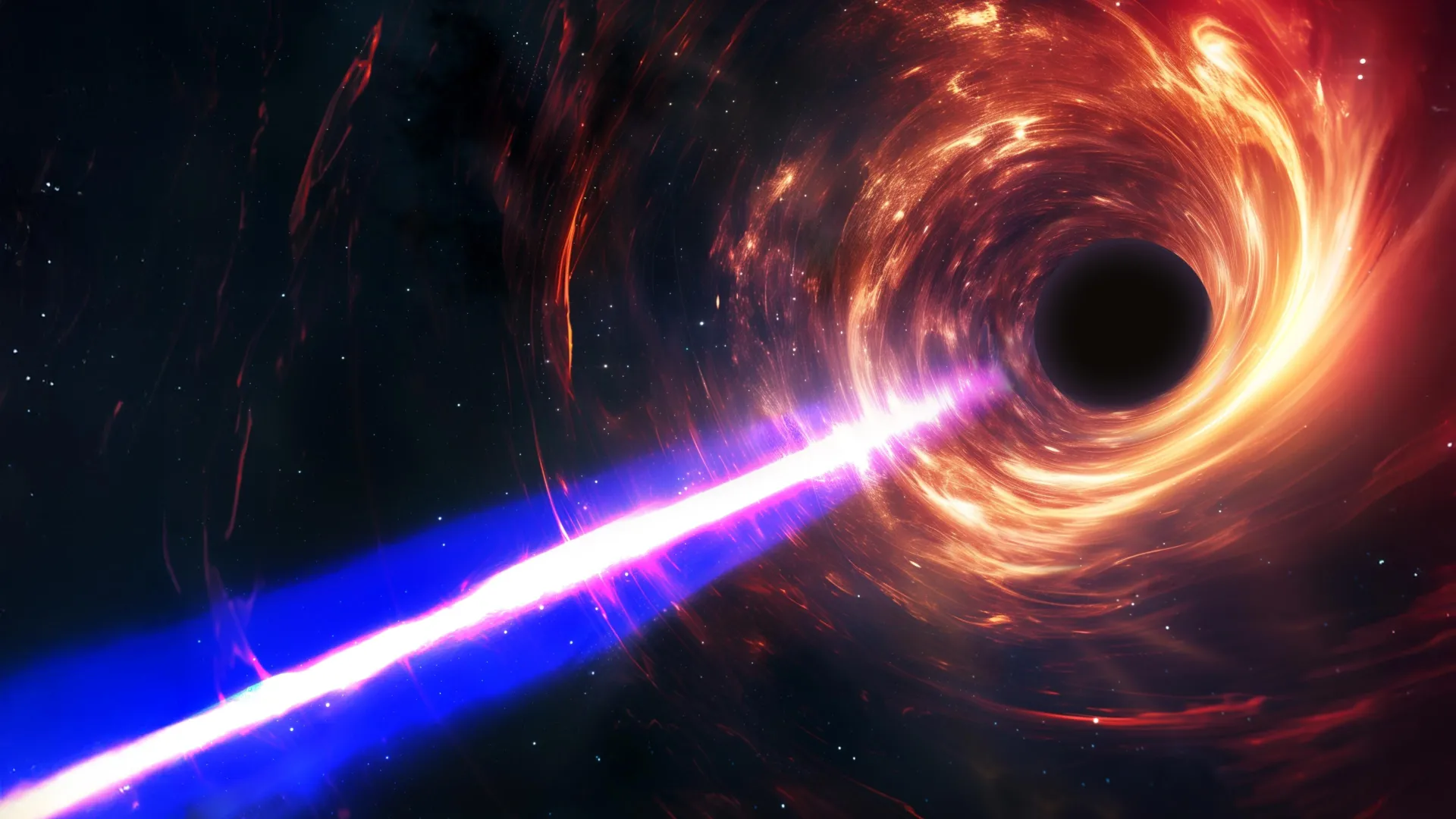
An international collaboration of astronomers, co-led by researchers from the Institute for Advanced Study (IAS) and Curtin University, has identified what appears to be a universal physical law governing one of the most violent and energetic behaviors in the cosmos: the production of powerful plasma jets by black holes. Published in the journal Nature Astronomy under the title A universal critical accretion rate for black hole jet formation, the study demonstrates that black holes of vastly different scales launch these relativistic outflows at the exact same critical stage of their feeding cycles. This fundamental threshold applies universally, encompassing both stellar-mass black holes—which typically weigh roughly ten times the mass of our Sun—and supermassive giants millions or billions of times heavier.
The breakthrough research was spearheaded by Andrew Mummery, the Martin A. and Helen Chooljian Member for 2025–2030 in the School of Natural Sciences at the IAS, alongside Adelle Goodwin, a Forrest Research Foundation Fellow at Curtin University’s International Centre of Radio Astronomy Research (ICRAR) situated in Western Australia. By synthesizing years of multi-wavelength observational data collected from ground-based facilities and space telescopes across the United States, Australia, India, South Africa, and Earth orbit, the research team successfully linked the erratic feeding habits of black holes to their external energetic outbursts.
Decoding the Mechanics of Tidal Disruption Events
To arrive at this unifying conclusion, the research team focused heavily on tidal disruption events (TDEs). These cataclysmic occurrences transpire when an unfortunate star wanders into the gravitational sphere of influence of a supermassive black hole residing at the center of a galaxy. The extreme tidal forces exerted by the black hole—where the gravitational pull on the near side of the star vastly exceeds that on the far side—stretch and ultimately shred the stellar body apart into a long stream of gas and plasma.
Tidal disruption events provide astronomers with a rare, dynamic laboratory. Rather than watching a black hole slowly sip ambient gas over millions of years, scientists can witness a sudden, massive influx of stellar material being abruptly delivered to the gravitational engine.
"We really wanted to figure out this massive puzzle," explained lead investigator Andrew Mummery. "Why do some supermassive black holes blast out radio jets right after shredding a star, while others just sit there looking completely dormant, only to suddenly fire up their jets months or even years later?"
Pop-culture analogies often describe black holes as cosmic vacuum cleaners, sucking in everything in their vicinity with indiscriminate power. However, astrophysical reality is far more chaotic and messy. As Adelle Goodwin pointed out, when a black hole tears apart a star, it does not swallow everything neatly in one clean motion. Instead, a complex cosmic dance ensues. While a fraction of the stellar debris spirals inward toward the event horizon, a significant portion is violently expelled outward into the surrounding interstellar medium through powerful winds, radiation pressure, and collimated magnetic jets. These gargantuan cosmic outflows transport matter and energy across vast intergalactic distances, playing a crucial role in regulating the life cycles and evolution of host galaxies.
Accelerating the Timeline of Cosmic Evolution
For decades, astrophysicists have operated under the theoretical assumption that black holes scale in their behavior, obeying the same fundamental laws of general relativity and magnetohydrodynamics regardless of their mass. Proving this hypothesis empirically, however, has proven extraordinarily difficult. Because supermassive black holes operate on enormous spatial and temporal scales, the evolutionary phases of their feeding cycles can unfold over thousands, hundreds of thousands, or even millions of years—far too slow for human observational timescales.
Tidal disruption events offer a clever observational workaround to this temporal barrier. When a supermassive black hole consumes a shredded star, the entire feeding and eruption cycle accelerates dramatically, playing out over the course of just a few years or even months. This compressed timeline grants scientists a high-speed window into processes that would otherwise remain opaque and untrackable in real time.
The conceptual spark that catalyzed the study originated in an unexpected venue. During an academic astrophysics conference held in Madrid, Spain, Mummery and Goodwin found themselves deep in discussion at a local establishment. As they compared notes on accretion physics, they realized that a specific mathematical threshold long known to govern jet production in stellar-mass black holes might share a direct, scalable equivalence with the behavior of supermassive black holes.
Methodology and Observational Rigor
To rigorously test this hypothesis, the research team compiled a comprehensive dataset of twenty observed tidal disruption events. They analyzed electromagnetic emissions spanning the entire spectrum, utilizing optical light, ultraviolet observations, high-energy X-rays, and low-frequency radio waves.
From this initial group, the astronomers narrowed their sample down to ten exceptionally high-quality events. These specific candidates were selected because they possessed complete, unambiguous datasets that allowed the team to reliably determine both the instantaneous feeding rate (accretion rate) of the black hole and the precise timing of its associated radio outflows.
The systematic analysis of these ten events uncovered two distinct, temporally separated phases during which powerful jets can form. The first phase occurs early in the lifecycle of the event, while the black hole is consuming the stellar material at an extraordinarily high, near-maximal rate. The second phase, conversely, materializes much later—often hundreds or thousands of days after the initial stellar destruction.
Pinpointing the Two Percent Eddington Threshold
It was the analysis of the second, delayed phase that yielded the most profound insight. The researchers discovered that these late-stage jets consistently fire when the black hole’s feeding rate drops to approximately two percent of its Eddington limit.
The Eddington limit represents the theoretical maximum luminosity a celestial body can achieve when there is a balance between the outward pressure of radiation and the inward gravitational pull of the matter flowing inward. When an accretion disk operates at two percent of this critical limit, physical conditions shift in a manner that favors the rapid collimation and launch of relativistic jets.
Crucially, this exact two percent threshold is already well-documented in the scientific literature as the universal trigger for jet formation in stellar-mass black holes residing within our own Milky Way galaxy. Finding the identical numerical threshold governing supermassive black holes millions of times more massive confirms that the fundamental physics of accretion and jet launching is scale-invariant. The machinery operates on identical principles, whether the central engine weighs ten solar masses or ten billion.
Practical Applications for Future Astronomy
Beyond its profound theoretical implications for astrophysics and general relativity, this discovery offers immediate practical value for the broader astronomical community. Telescope time on premier global facilities is heavily oversubscribed, and scheduling observations of transient cosmic events is notoriously difficult.
By establishing that delayed jets consistently emerge at the two percent Eddington threshold, astronomers now possess a predictive tool. Instead of monitoring a tidal disruption event continuously for years in the blind hope of catching a radio flare, researchers can calculate precisely when the black hole’s feeding rate will cross the critical threshold. This allows observatories to schedule targeted campaigns with maximum efficiency, ensuring that telescope time is dedicated to moments of peak activity while minimizing wasted observation of dormant periods.
This predictive capability will become increasingly vital with the advent of next-generation astronomical facilities. Chief among these is the Square Kilometre Array (SKA), a massive international radio telescope project currently under construction in South Africa and Australia, which is scheduled to begin full scientific data collection by 2028. The SKA will discover transient radio sources by the thousands, making predictive models like the one developed by Mummery and Goodwin essential for managing data flow and targeting follow-up observations.
"We hope that our work will pave the way for even more profound discoveries about our universe," Mummery concluded, emphasizing that understanding how black holes regulate their energy output is a cornerstone of modern cosmological research. As observational techniques continue to sharpen, this newly uncovered universal rule will serve as a foundational benchmark for mapping the life cycles of galaxies across the observable universe.