

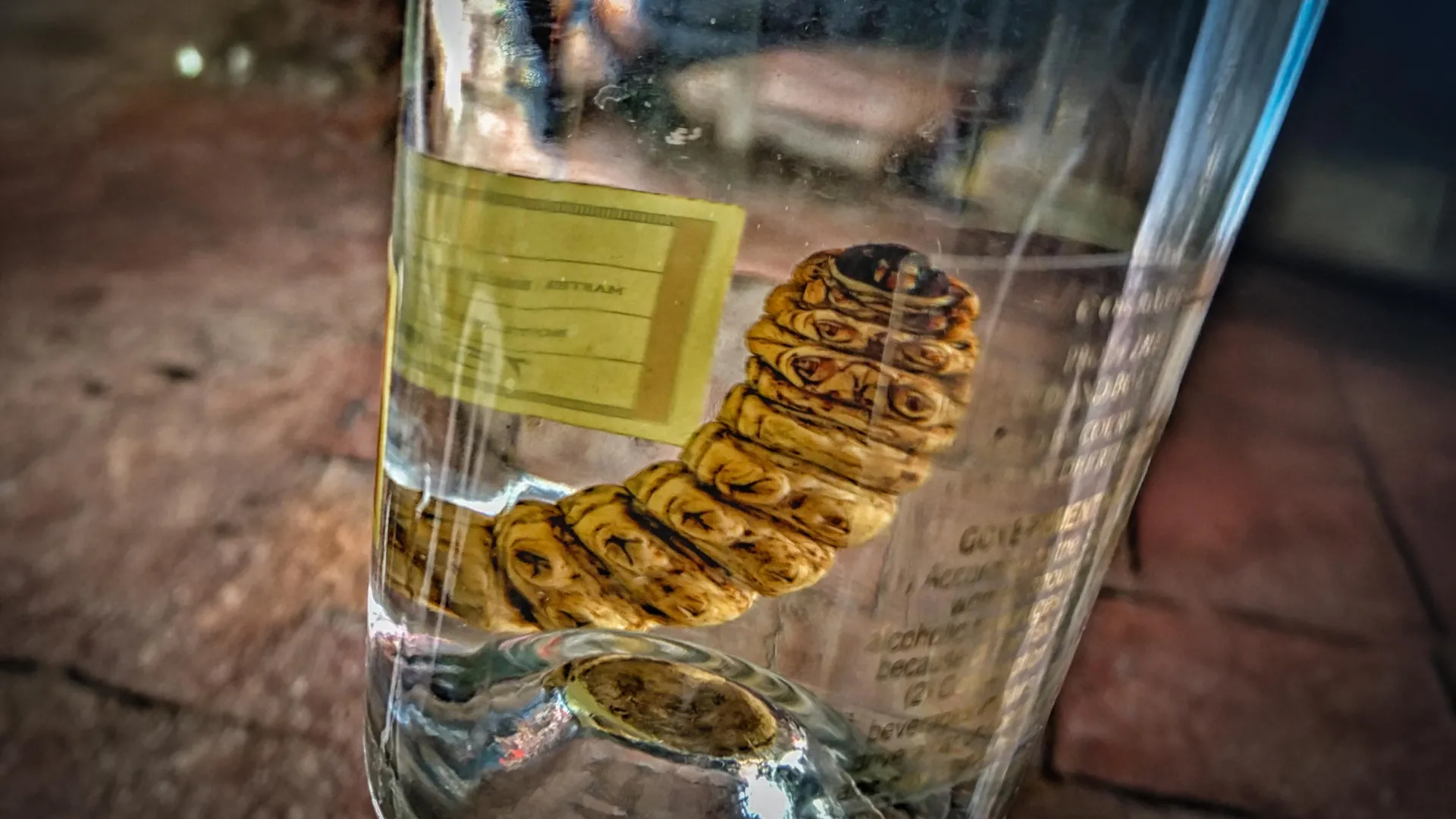
For decades, a curious passenger has resided at the bottom of many mezcal bottles: a pale, coiled "worm" preserved in alcohol, adding an air of enigma to this beloved agave spirit. While this iconic embellishment has long captivated consumers and fueled speculation about its identity, groundbreaking scientific research has definitively settled the debate. Scientists have now conclusively demonstrated that this famous bottle stowaway is not a worm at all, but rather the larva of a specific moth species. This revelation, while demystifying a long-standing spirit tradition, simultaneously shines a spotlight on critical sustainability challenges as mezcal’s global popularity continues its meteoric rise.
Mezcal, a distilled beverage crafted from the agave plant—the same botanical family that yields tequila—is typically enjoyed in its pure form. However, a small but notable segment of mezcal production incorporates these larvae, known in Spanish as gusanos de maguey. While mezcal itself boasts a rich history stretching back centuries in Mexico, the practice of infusing bottles with these larvae is a far more recent innovation, appearing to have originated in the 1940s. This relatively recent addition has, ironically, become one of mezcal’s most enduring and recognizable visual trademarks.
Unraveling a Longstanding Spirit Enigma
The true identity of these bottled larvae has been a persistent puzzle for connoisseurs and scientists alike. Over the years, various classifications have been proposed, including moth larvae, butterfly larvae, and even weevil larvae. The observed variations in color and appearance among different bottled specimens further fueled the suspicion that more than one insect species might be involved, deepening the mystery.
Dr. Akito Kawahara, a curator at the Florida Museum’s McGuire Center for Lepidoptera and Biodiversity, noted the challenges in definitively identifying the larvae. "It’s relatively easy to broadly determine the kind of larva based on the shape of the head, but their identity has never been confirmed," Dr. Kawahara stated. "This is probably because most biologists are not looking inside mezcal bottles." This statement underscores the unique, almost accidental, nature of the research opportunity.
The Scientific Expedition to Oaxaca
To finally resolve this enduring question, Dr. Kawahara and his research team embarked on a scientific expedition in 2022 to Oaxaca, Mexico, a region intrinsically linked with mezcal production. Their mission was to gather a diverse range of gusanos de maguey from various mezcal brands. During their travels, they visited numerous distilleries, meticulously collecting samples from as many different bottles as they could procure.
The preserved larvae, while visually striking, offered limited morphological clues. Their bodies, having been submerged in alcohol for extended periods, were well-preserved but had lost many of the distinctive external features that are crucial for precise insect identification. However, this very preservation proved instrumental in another way: it effectively protected the larvae’s genetic material.
DNA Analysis Unveils the Agave Redworm Moth
The researchers successfully extracted and analyzed DNA from 18 specimens, anticipating that the results might indicate the presence of several different insect species. This expectation was rooted in the fact that gusanos de maguey are typically harvested from wild agave plants, rather than being raised under controlled, standardized commercial conditions.
A prominent candidate for identification had long been the tequila giant skipper (Aegiale hesperiaris), a butterfly whose caterpillars are known to feed on agave plants. The large, whitish larvae of this skipper seemed a plausible match for many of the pale gusanos observed in mezcal bottles, and its common name further cemented its status as a leading suspect.
However, the genetic analysis presented a surprising and definitive answer. Every larva that yielded usable genetic data was identified as the agave redworm moth (Comadia redtenbacheri). Furthermore, specimens that did not produce sufficient DNA for analysis were morphologically identified by the team as belonging to the same species.
This consistent genetic fingerprint suggests that the mezcal "worm" is not a random assortment of agave-dwelling insects. Instead, at least within the sampled bottles, it appears to be exclusively the caterpillar of the agave redworm moth. The research team also proposed a compelling explanation for the pale or "white worm" appearance sometimes reported: larvae that have been preserved in alcohol for extended durations may gradually lose their natural reddish pigmentation over time.
The Growing Global Appetite for Mezcal and its Implications
The definitive identification of the mezcal "worm" arrives at a pivotal moment for the spirit. Mezcal is experiencing an unprecedented surge in global popularity, extending far beyond its traditional Mexican markets. This international demand is fueled by a growing consumer fascination with artisanal spirits, small-batch production, and unique cultural narratives.
This rapid expansion, however, introduces complex challenges. While tequila production has largely transitioned to industrial-scale operations, mezcal remains predominantly crafted in smaller, often rural, facilities across Mexico. The traditional mezcal-making process involves roasting the rounded hearts of agave plants in underground fire pits or kilns, followed by crushing, fermentation, and small-batch distillation. As demand escalates, concerns are mounting about the capacity of producers, landowners, and delicate agave ecosystems to scale up production sustainably without incurring long-term ecological damage.
This sustainability concern extends directly to the agave redworm moth and its larvae. Known as chinicuiles, these larvae have been a traditional food source in Mexico for centuries, forming an integral part of the local cuisine. However, the wild harvesting of these larvae can be intensive. Critically, chinicuiles are not simply gathered from the surface of the agave plant; they burrow into the core of their host plants. The process of collecting them often necessitates the destruction of the agave itself.
"Agave worms are still fairly common, but the impact of mezcal becoming popular can have long-term negative effects on local populations because they are harvested in the wild," Dr. Kawahara cautioned. His statement highlights the direct link between the burgeoning mezcal market and the ecological pressures placed upon the chinicuiles and their host plants.
Emerging Research Adds Urgency to Sustainability Efforts
More recent scientific investigations are reinforcing and amplifying these sustainability concerns. A 2025 study published in Botanical Sciences examined the impact of chinicuil extraction on Agave applanata populations. The research revealed that agave populations subjected to larval extraction exhibited significantly lower growth rates compared to those left undisturbed. The study reported that larvae extraction could lead to a reduction in agave populations by as much as 57 percent. Notably, juvenile agave plants, which are crucial for the long-term persistence and regeneration of populations, were found to be particularly vulnerable to harvesting for larvae.
While this specific research focused on agave populations rather than mezcal bottles, it powerfully underscores a broader, critical issue: the market demand for edible agave larvae has tangible consequences for both the insect and the plant upon which it depends. The study further noted that harvesting practices can sometimes involve sacrificing the agave plant before it reaches sexual maturity, a practice that can fundamentally alter future population dynamics and genetic diversity.
For mezcal producers and the communities involved in harvesting, these findings signal a need for more sophisticated and sustainable production strategies. If the demand for bottles featuring gusanos continues to grow, local communities may be compelled to implement more effective methods for managing wild harvesting, explore the feasibility of raising larvae on dedicated agave farms, or develop innovative cultivation techniques that minimize or eliminate the destruction of host plants.
From Novelty to a Symbol of Ecological Stewardship
The mezcal "worm," initially conceived perhaps as a marketing novelty to distinguish the spirit and add an element of intrigue, has, through scientific inquiry, evolved into something far more significant. DNA analysis has not only provided a clear identity for this small creature but has also illuminated its deep, intrinsic connection to the agave landscapes of Mexico. The future of this iconic embellishment is now inextricably tied to how conscientiously mezcal’s rapidly expanding popularity is managed, ensuring that its cultural heritage and ecological foundation are preserved for generations to come. The success of this iconic spirit now hinges on a delicate balance between global market demand and local ecological responsibility.











Leave a Reply