

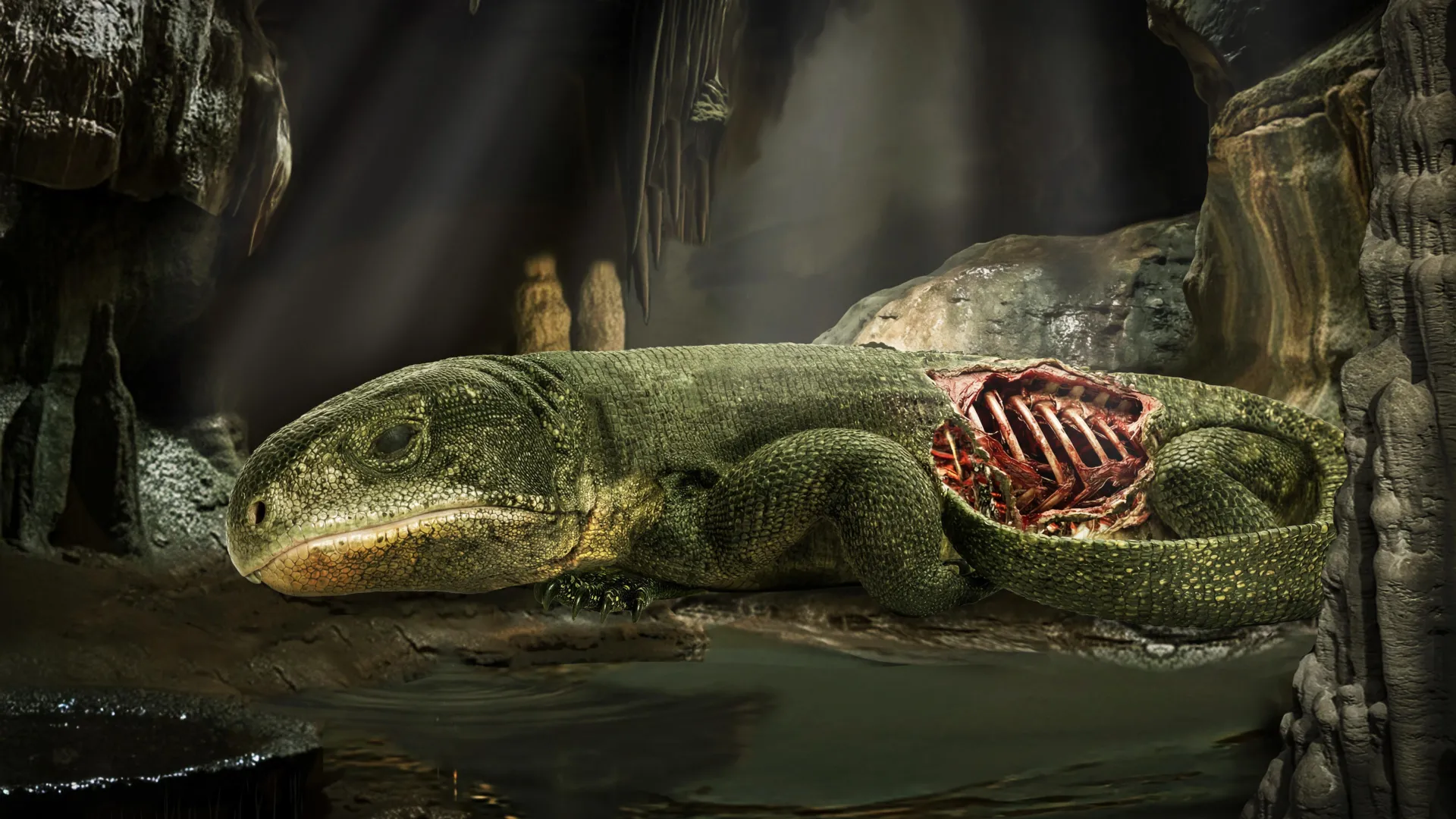
Every breath you take is part of a very ancient story. The steady movement of your chest, the muscles between your ribs pulling outward, and the air filling your lungs feel completely routine. Yet this familiar process traces back hundreds of millions of years. A remarkably preserved reptile that died in an Oklahoma cave about 289 million years ago has now revealed the earliest known example of this breathing system in amniotes—a group that includes reptiles, birds, mammals, and their shared ancestors, among the first animals to fully adapt to life on land. This groundbreaking discovery, published in the prestigious journal Nature, not only illuminates the evolutionary origins of terrestrial respiration but also pushes the boundaries of our understanding of fossil preservation with the detection of ancient proteins nearly 100 million years older than previously identified.
A Window into the Permian: The Exceptional Case of Captorhinus aguti
The fossil, belonging to a small, lizard-like reptile named Captorhinus aguti, hails from the early Permian period, a pivotal era in Earth’s history. This period, roughly 299 to 252 million years ago, witnessed significant evolutionary shifts, including the diversification of reptiles and the ongoing colonization of terrestrial environments. Captorhinus aguti, though only a few inches long, is an extraordinary specimen. Unlike most fossils that primarily preserve skeletal remains, this individual was found encased in a three-dimensional mummified state. This remarkable preservation extends beyond bones to include delicate structures such as skin, calcified cartilage, and crucially, traces of proteins that have redefined the timeline for biomolecular preservation in the fossil record.
Ethan Mooney, who co-led the study while a student at the University of Toronto in Professor Robert R. Reisz’s lab and is now a PhD candidate at Harvard University, described Captorhinus as a "critical critter to understanding early amniote evolution." These early reptiles, which varied in size from mere centimeters to several feet, were among the vanguard of terrestrial vertebrates, exhibiting remarkable success and widespread distribution across the ancient continents. Their adaptation to life on land laid the groundwork for the subsequent radiation of all terrestrial vertebrates.
The Richards Spur Lagerstätte: A Fossilization Hotspot
The extraordinary preservation of the Captorhinus aguti specimen is attributed to its discovery at the Richards Spur cave systems near Fort Sill, Oklahoma. This site, renowned in paleontological circles, is a rich repository of late Paleozoic life, offering an unparalleled glimpse into terrestrial ecosystems from a bygone era. The unique geological conditions within these ancient caves created a microenvironment conducive to exceptional fossilization. A combination of oil seep hydrocarbons, which likely acted as natural preservatives, and oxygen-free mud, effectively shielded the organic materials from decomposition. This protective cocoon allowed for the preservation of not only the skeletal framework but also soft tissues that are typically lost to time and decay.
The result is a fossil that appears remarkably intact, frozen in its final moments with one limb tucked beneath its body, providing an unprecedented three-dimensional view of ancient anatomy. This level of detail is exceedingly rare and offers scientists a unique opportunity to reconstruct the biology and lifestyle of extinct organisms with remarkable accuracy.
Unveiling Ancient Anatomy: High-Tech Imaging and Intricate Details
To explore the secrets held within the rock, researchers employed state-of-the-art imaging techniques. Neutron computed tomography (nCT), conducted at a specialized facility in Australia, allowed for non-destructive examination of the fossil. This powerful technology enabled scientists to peer beneath the surrounding matrix, revealing intricate details of the internal and external structures without causing any damage to the precious specimen.
During the analysis, Mooney made a series of astonishing observations. "I started to see all these structures wrapped around the bones," he recounted, describing "very thin and textured" layers. Further investigation confirmed the presence of a complete wrapping of skin around the torso of the animal. This scaly skin exhibited a distinct, accordion-like texture with concentric bands covering much of the body, from the torso up to the neck. This intricate patterning bears a striking resemblance to the scales found on modern-day worm lizards, a group of small, burrowing reptiles that still inhabit the Earth today. This comparison highlights the enduring evolutionary legacy of certain anatomical features.
Reconstructing the Dawn of Rib-Based Respiration
The preserved skin was just one piece of the puzzle. By meticulously studying three Captorhinus specimens from Richards Spur, the research team was able to reconstruct a complete picture of how this ancient reptile breathed. One particularly informative fossil revealed a segmented cartilaginous sternum, along with sternal ribs, intermediate ribs, and crucial connections linking the ribcage to the shoulder girdle.
This comprehensive anatomical dataset provided the first clear evidence of the structures underlying a novel breathing system in an early amniote. Scientists were able to definitively reconstruct the mechanism of costal aspiration breathing. This system, which is fundamental to the respiration of most terrestrial vertebrates today, involves the coordinated action of muscles situated between the ribs. These muscles contract and relax, expanding and compressing the chest cavity, thereby drawing air into the lungs and expelling carbon dioxide.
A Leap Forward from Amphibian Respiration
The evolutionary significance of this discovery lies in its contrast with the breathing mechanisms of earlier terrestrial vertebrates, primarily amphibians. Before the evolution of rib-based breathing, amphibians relied on a more rudimentary system. They utilized cutaneous respiration (breathing through their skin) and a buccal pump mechanism, which involves pushing air into their lungs through movements of the mouth and throat. While this method is effective for many amphibians today and supports their generally less active lifestyles, it inherently limits their capacity for strenuous activity due to its lower efficiency in oxygen uptake and carbon dioxide removal.
The development of costal aspiration breathing in early amniotes represented a profound evolutionary leap. It facilitated deeper, more efficient airflow, ensuring a consistent and ample supply of oxygen to fuel more active metabolisms. This enhanced respiratory capacity was a critical innovation that empowered these early land-dwellers to exploit a wider range of terrestrial niches and engage in more dynamic behaviors.
Professor Reisz articulated the profound implications of their findings, stating, "We propose that the system found in Captorhinus represents the ancestral condition for the kind of rib assisted respiration present in living reptiles, birds, and mammals." This suggests that the fundamental mechanics of breathing that sustain the vast diversity of terrestrial vertebrates today originated with these early amniotes.
A Game Changer for Terrestrial Life
The advent of ribcage-assisted breathing was not merely a physiological upgrade; it was a "game changer" for life on land. As Mooney aptly put it, this innovation "allowed these animals to adopt a much more active lifestyle." This increased mobility and metabolic capacity likely played a pivotal role in the successful colonization and diversification of terrestrial environments by amniotes. Their ability to sustain higher activity levels would have provided advantages in foraging, predator evasion, and competition, ultimately contributing to their evolutionary success and eventual dominance in terrestrial ecosystems.
This evolutionary step is considered a key innovation that underpins the radiation of reptiles, birds, and mammals, setting the stage for the diverse array of terrestrial life forms we see today. It highlights how seemingly simple biological systems can have far-reaching evolutionary consequences.
Ancient Proteins: Pushing the Boundaries of Paleontological Science
Beyond the revelations about respiration, the Captorhinus aguti fossil yielded another remarkable discovery: the presence of ancient proteins. Using advanced synchrotron infrared spectroscopy, researchers detected remnants of original proteins embedded within the fossil’s bone, cartilage, and skin. These biomolecular traces are astonishingly old, dating back approximately 289 million years. This finding dramatically eclipses previous records for protein preservation in fossils, with these newly identified molecules predating previously known examples in dinosaur fossils by nearly 100 million years.
"The protein remnant finding is exceptional," Mooney emphasized. "It dramatically pushes our understanding of what is possible in terms of soft tissue preservation in the fossil record." This discovery opens up new avenues for research, potentially allowing scientists to investigate the molecular biology of ancient organisms in unprecedented detail. It raises the tantalizing prospect of extracting and analyzing ancient biomolecules from even older specimens, offering new insights into the biochemistry of extinct life.
A Legacy of Discovery and Future Research
The invaluable Captorhinus aguti fossils are now curated at the Royal Ontario Museum in Toronto, where they will remain accessible for ongoing scientific scrutiny and research. Ethan Mooney continues his work at Harvard University, dedicating his efforts to unraveling the evolutionary history of early reptiles.
Discoveries like this are crucial for constructing a more complete and nuanced understanding of how early vertebrates transitioned to life on land and how fundamental evolutionary innovations, such as efficient respiration, shaped the trajectory of life on Earth. The study of these ancient creatures not only illuminates our planet’s deep past but also underscores the interconnectedness of all life and the remarkable resilience and adaptability of biological systems over vast geological timescales. The story of the Captorhinus aguti is a testament to the enduring power of scientific inquiry to reveal the profound narratives etched in the fossil record, reminding us that even the most routine biological functions carry echoes of an unimaginably ancient past.














Leave a Reply