

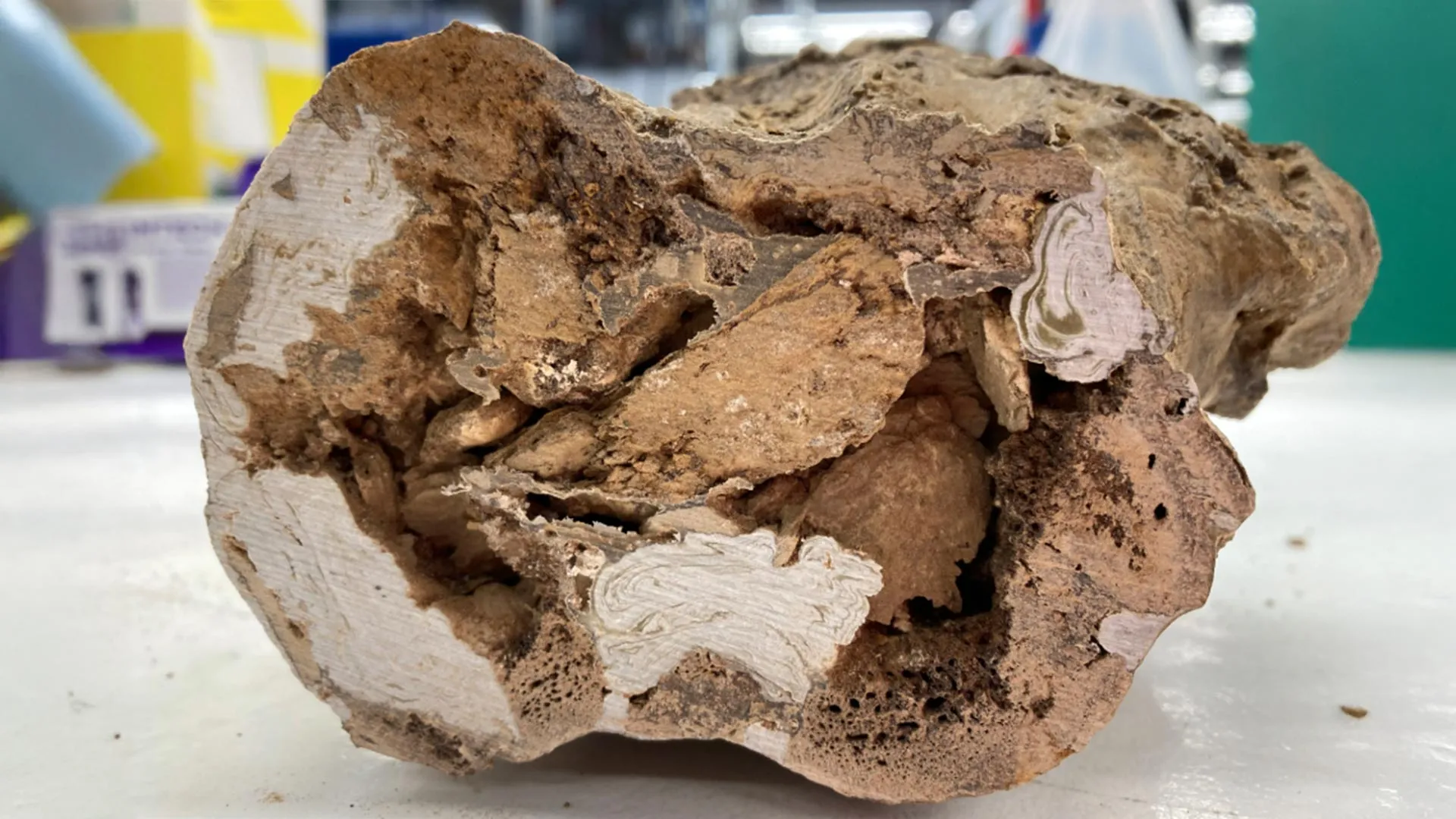
For decades, the prevailing scientific consensus held that dinosaur fossils were merely mineralized remnants, their original biological material long surrendered to the relentless march of time and geological processes. This deeply ingrained belief painted fossils as inert stone replicas of ancient life. However, an extraordinary study centered on a remarkably preserved Edmontosaurus fossil is dramatically challenging this assumption, potentially rewriting our understanding of fossilization and the enduring legacy of prehistoric life. Researchers, spearheaded by a team from the University of Liverpool, have uncovered compelling evidence suggesting that traces of original organic molecules, most notably collagen, persist within dinosaur bones dating back approximately 66 million years. This groundbreaking discovery lends potent new support to a controversial hypothesis that has polarized the paleontological community for over three decades, reigniting a debate about the very nature of fossil preservation.
The Unveiling of Endogenous Collagen
The cornerstone of this pivotal research is a 22-kilogram sacrum, a crucial component of the hip region, belonging to an Edmontosaurus. This specimen, recovered from the famed Hell Creek Formation in South Dakota, represents a significant find. The Edmontosaurus, a large, herbivorous dinosaur characterized by its distinctive duck-like bill, roamed the Earth alongside iconic predators such as Tyrannosaurus rex during the twilight of the Cretaceous Period. Its presence in the Hell Creek Formation, a rich repository of Late Cretaceous fossils, makes it an ideal subject for such an investigation.
Employing a sophisticated array of advanced laboratory techniques, the research team meticulously analyzed the fossilized bone. These methods included cutting-edge protein sequencing, a process that deciphers the order of amino acids within a protein, and various forms of mass spectrometry. Mass spectrometry, in particular, allows scientists to identify and quantify molecules by measuring their mass-to-charge ratio. Through this rigorous analytical battery, researchers detected definitive remnants of collagen embedded within the fossilized bone matrix.
Collagen, a fibrous structural protein, is the most abundant protein in mammals and is the primary building block of connective tissues, including bone, skin, tendons, and cartilage. Its ubiquity in bone tissue makes it a particularly significant biomarker. Crucially, collagen is considered one of the most challenging biomolecules to definitively attribute to the original organism when found in ancient specimens, as it is also produced by modern bacteria and can easily contaminate samples. Therefore, its identification in this context, when subjected to stringent analytical protocols, carries immense weight.
Adding further validation to the findings, researchers from the University of California, Los Angeles (UCLA) independently identified hydroxyproline within the same fossil sample. Hydroxyproline is a non-essential amino acid that is a crucial component of collagen. Its presence strongly corroborates the identification of degraded collagen fragments as being genuinely endogenous to the dinosaur, rather than a product of modern contamination or microbial activity.
Professor Steve Taylor, chair of the Mass Spectrometry Research Group at the University of Liverpool’s Department of Electrical Engineering & Electronics, a key figure in the study, articulated the significance of their findings. "This research shows beyond doubt that organic biomolecules, such as proteins like collagen, appear to be present in some fossils," he stated, underscoring the definitive nature of their conclusions. "Our results have far-reaching implications. Firstly, it refutes the hypothesis that any organics found in fossils must result from contamination." This direct refutation of the contamination hypothesis is critical, as it has been the primary scientific hurdle for proponents of preserved organic material in dinosaur fossils.
A Decades-Long Scientific Schism
The assertion that soft tissues and proteins can survive within dinosaur fossils has been a source of intense and often acrimonious debate within the scientific community since the early 2000s. Skeptics have consistently argued that any organic material detected in such ancient specimens is almost certainly a result of modern contamination, either from laboratory procedures, environmental exposure, or residual bacterial activity. This skepticism stems from the general understanding of molecular degradation over geological timescales. Proteins, being complex organic molecules, are generally expected to break down into simpler compounds relatively quickly when exposed to environmental factors like heat, moisture, and microbial action.
One of the most influential and controversial moments in this debate occurred in 2005 when paleontologist Mary Schweitzer and her colleagues reported the discovery of soft tissue structures, including what appeared to be blood vessels and unmineralized bone matrix, within a Tyrannosaurus rex fossil. This announcement sent shockwaves through the field, challenging established paradigms of fossilization. Subsequent studies, building on Schweitzer’s pioneering work, identified possible collagen and structures resembling blood vessels in additional dinosaur specimens, including hadrosaurs, a group to which Edmontosaurus belongs. However, each of these claims faced persistent scrutiny and calls for more robust evidence to rule out contamination definitively.
The current Edmontosaurus analysis distinguishes itself through its methodological rigor and the use of multiple, independent testing approaches applied to the same fossil specimen. By integrating various analytical techniques—including advanced microscopy, detailed chemical analysis, and precise protein sequencing—the research team aimed to create an irrefutable case for the endogenous origin of the detected molecules. This multi-pronged approach significantly strengthens the argument that the identified collagen fragments are not post-mortem contaminants but rather original components of the dinosaur’s bone tissue.
The findings of this landmark study were formally published in the peer-reviewed journal Analytical Chemistry in 2025, under the title "Evidence for Endogenous Collagen in Edmontosaurus Fossil Bone." The journal’s selection of this publication underscores the scientific community’s recognition of the study’s significance and its potential to alter established scientific dogma.
The Profound Implications of Molecular Persistence
The confirmation that proteins, such as collagen, can indeed survive within fossils for tens of millions of years opens up entirely new avenues for scientific inquiry into extinct life forms. This discovery moves beyond simply understanding the physical form of ancient creatures to potentially unlocking insights into their very biological makeup and evolutionary history.
If molecular traces can persist, scientists may gain an unprecedented ability to study evolutionary relationships between dinosaur species. Subtle differences in protein sequences can reveal genetic connections and divergence points that are often obscured or difficult to discern solely from skeletal morphology. This could lead to a more refined and accurate phylogenetic tree for dinosaurs, resolving long-standing questions about their ancestry and diversification.
Furthermore, the analysis of preserved biomolecules could provide invaluable information about dinosaur physiology, including their growth patterns, aging processes, and susceptibility to diseases. For instance, studying the structure and composition of collagen might reveal details about how dinosaurs built and maintained their skeletal systems, how they adapted to different environments, or even evidence of past injuries or pathologies. This could paint a far more dynamic and nuanced picture of dinosaur life than previously imaginable.
Professor Taylor highlighted the necessity of re-examining historical fossil collections. "Scientists may now need to revisit fossil samples collected over the past century," he suggested. "Cross-polarized light microscopy images taken decades ago could contain overlooked evidence of preserved collagen in ancient bones." He further elaborated on the potential of these historical records: "These images may reveal intact patches of bone collagen, potentially offering a ready-made trove of fossil candidates for further protein analysis. This could unlock new insights into dinosaurs, for example revealing connections between dinosaur species that remain unknown." This statement suggests that the current breakthrough might be the key to unlocking a wealth of previously unrecognized data from existing museum collections worldwide.
The Unanswered Question: Mechanisms of Molecular Survival
The discovery naturally raises a profound scientific question: how have these delicate organic molecules managed to survive for such immense geological timescales? Proteins, by their very nature, are prone to degradation. Over millions of years, the forces of diagenesis—the physical and chemical changes that occur in sediments and rocks after deposition—are expected to break down complex organic structures. Yet, the Edmontosaurus fossil demonstrates that under specific, albeit not yet fully understood, conditions, microscopic biological structures can be preserved.
Current scientific hypotheses explore the possibility that interactions between collagen molecules and the surrounding mineral matrix within the bone may play a crucial protective role. The mineralization process, where organic bone tissue is gradually replaced by minerals, could potentially encapsulate and shield fragments of collagen from complete decay. Recent research into fossil biomolecules suggests that particular burial environments, characterized by specific chemical compositions and geological pressures, coupled with the inherent microscopic structure of bone tissue, may create exceptionally stable conditions that significantly slow down the rate of chemical breakdown.
The Edmontosaurus genus, in particular, has a history of yielding exceptionally well-preserved specimens. Over the past century, numerous Edmontosaurus fossils have been discovered that retain remarkably detailed skin impressions and other soft tissue features, leading to their popular moniker, "dinosaur mummies." These exceptional examples of preservation have long hinted at the possibility of more than just mineral replacement occurring during fossilization. More recent paleontological expeditions continue to unearth Edmontosaurus specimens exhibiting surprisingly detailed soft tissue preservation, including evidence of fleshy structures and intricate skin anatomy.
Taken together, these persistent discoveries are fundamentally reshaping the scientific perception of fossils. Instead of viewing them exclusively as inert stone casts or mineralized replicas of ancient skeletal structures, researchers are increasingly coming to see some fossils as remarkably stable molecular time capsules. These capsules, under specific conditions, appear capable of preserving tantalizing traces of prehistoric biology, offering an unparalleled glimpse into life millions of years ago. The Edmontosaurus study serves as a powerful testament to this evolving understanding, pushing the boundaries of what we believed was possible in the study of ancient life and opening a new chapter in paleontology.


















Leave a Reply