Deep within the subterranean tunnels of the Franco-Swiss border, modern science has achieved a remarkable feat that bridges the gap between the birth of the cosmos and contemporary particle physics. Researchers operating the world’s most powerful particle accelerator have successfully captured direct observational evidence of microscopic wakes—akin to the ripples left behind by a watercraft—generated by elementary particles tearing through a substance known as quark-gluon plasma (QGP). This exotic state of matter, frequently characterized by theoretical physicists as the universe’s original and hottest liquid, populated space for merely a few millionths of a second following the Big Bang.
The findings, spearheaded by a dedicated collaboration of researchers from the Massachusetts Institute of Technology (MIT) working in tandem with the international CMS Collaboration at CERN’s Large Hadron Collider (LHC), were recently published in the peer-reviewed journal Physics Letters B. By confirming that high-energy quarks generate distinct splashes, waves, and swirls as they traverse the dense subatomic medium, the discovery validates longstanding theoretical frameworks and opens an unprecedented window into the fundamental properties of matter under extreme conditions.
Recreating the First Microseconds of the Universe
To comprehend the significance of this discovery, science must cast its gaze back nearly 13.8 billion years. In the universe’s absolute earliest moments, temperatures soared to trillions of degrees Celsius. Under such unimaginable thermal stress, ordinary atomic structures could not exist. Instead, the universe was filled with an intensely hot, unbound soup of fundamental particles: quarks, the building blocks of matter, and gluons, the force-carrying particles that bind them together via the strong nuclear interaction.
In this primordial state, known as quark-gluon plasma, quarks and gluons raced about at velocities approaching the speed of light. However, as the universe rapidly expanded, it cooled. Within a few millionths of a second, the temperature dropped sufficiently for quarks and gluons to condense, binding together permanently into protons, neutrons, and the heavier atomic nuclei that make up the stars, planets, and living organisms of the modern cosmos.
For decades, recreating this exotic phase of matter remained the holy grail of high-energy nuclear physics. The realization came with the advent of ultra-relativistic heavy-ion colliders, such as the Relativistic Heavy Ion Collider (RHIC) at Brookhaven National Laboratory and, more recently, the Large Hadron Collider (LHC) at CERN. By accelerating heavy ions—such as lead nuclei—to velocities nearing the speed of light and crashing them together, physicists can briefly recreate the extreme temperatures and densities of the early universe. These collisions generate minuscule, fleeting droplets of quark-gluon plasma that endure for less than a quadrillionth of a second before flashing out of existence.
The Fluid Dynamics of Subatomic Particles
One of the most profound discoveries regarding quark-gluon plasma over the past twenty years is its behavior as a fluid. Rather than acting as a loose, chaotic gas of independent particles, QGP flows with virtually zero internal friction, earning it the designation of a near-"perfect" liquid. This unexpected characteristic has driven a generation of theoretical and experimental research aimed at understanding how microscopic entities interact within such a dense, frictionless continuum.
Among the theoretical pioneers of this field is Krishna Rajagopal, the William A. M. Burden Professor of Physics at MIT. Years prior to the current experimental breakthrough, Rajagopal and his colleagues developed an influential theoretical framework known as the hybrid model. This model predicted that if an exceptionally energetic quark were to travel through a droplet of quark-gluon plasma, it would interact heavily with the surrounding medium, disturbing the fluid and leaving behind a tangible wake—causing the plasma to ripple, splash, and swirl in its path.
Despite the elegance of the theoretical predictions, observing these microscopic wakes presented an immense experimental hurdle. The primary obstacle stemmed from the nature of high-energy particle collisions. When physicists attempted to study wakes by tracking pairs of quarks and antiquarks flying off in opposite directions, the disturbance created by the first particle would inevitably overlap and overshadow the wake generated by the second. Consequently, individual wakes remained stubbornly hidden beneath the noise of complex collision debris, eluding detection across multiple experimental runs.
A Novel Experimental Technique Using Z Bosons
Overcoming this analytical roadblock required a paradigm shift in how researchers tagged and tracked particle interactions within the LHC data. The breakthrough came from an MIT research team led by Yen-Jie Lee, working in close coordination with Professor Yi Chen’s group at Vanderbilt University.
Instead of searching for troublesome quark-antiquark pairs, the research team devised a clever workaround: utilizing Z bosons as a clean reference point, or "tag." A Z boson is a neutral elementary particle associated with the weak nuclear force. Crucially, Z bosons interact very weakly with the surrounding quark-gluon plasma, allowing them to pass through the dense subatomic soup virtually undisturbed. Furthermore, they are produced at characteristic, easily identifiable energy levels.
Within the chaotic environment of a heavy-ion collision, countless quarks and gluons collide continuously. On rare occasions, these high-energy interactions produce a high-momentum Z boson flying in one direction, paired with a single, high-energy quark traveling in the nearly opposite direction.
This configuration provided the ideal experimental setup. As the Z boson sails cleanly through the plasma without leaving a mark, the solitary quark plunges directly into the exotic fluid, disturbing the surrounding material and generating a clear, uncompromised wake. By treating the Z boson as a directional marker, the physicists gained a reliable way to isolate the effects of a single quark moving through the QGP without interference from a secondary wake.
Unearthing Signals from Billions of Collisions
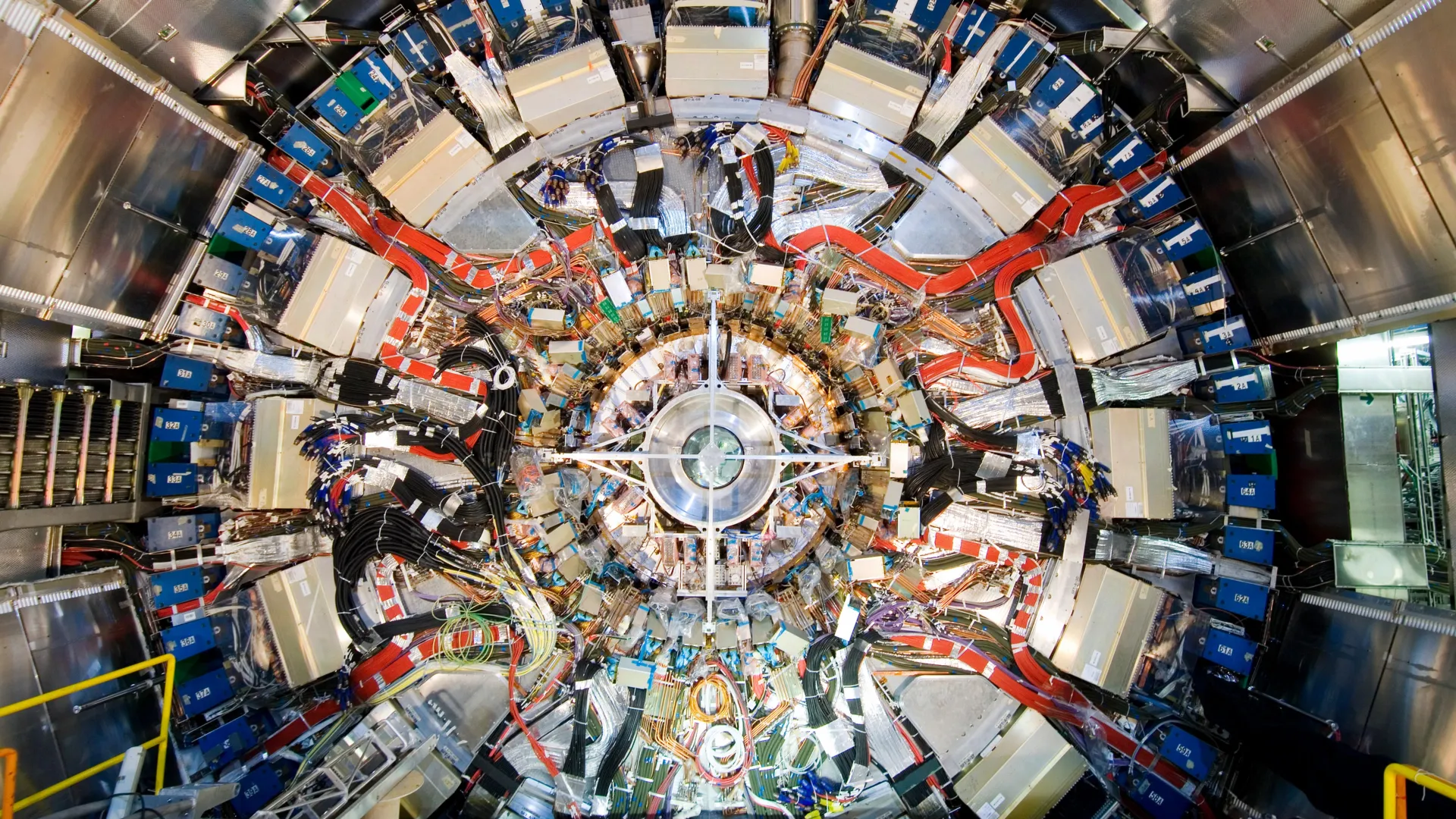
Putting this novel methodology into practice demanded vast computational power and meticulous data analysis. The researchers turned to the Compact Muon Solenoid (CMS) experiment, one of the massive, general-purpose particle detectors positioned along the 27-kilometer ring of the Large Hadron Collider at CERN.
The CMS Collaboration—a massive global network of physicists, engineers, and graduate students—scoured through an enormous dataset comprising roughly 13 billion heavy-ion collisions. Out of this astronomical number of events, the team successfully identified approximately 2,000 specific collisions that produced the requisite Z boson paired with a high-momentum quark.
For each of these targeted events, the researchers mapped the precise distribution of energy across the short-lived droplet of quark-gluon plasma. The results were striking. Across the dataset, the team repeatedly observed distinct fluid-like patterns of splashes, ripples, and swirling motion situated directly opposite the trajectory of the Z boson.
Because the Z boson itself interacts negligibly with the medium, these localized disturbances could be attributed with high confidence directly to the solitary quark plowing through the material. Moreover, the observed characteristics of the wakes matched the quantitative predictions generated by Rajagopal’s hybrid model, providing robust empirical validation for years of theoretical work.
"This is something that many of us have argued must be there for a good many years, and that many experiments have looked for," noted Rajagopal, reflecting on the milestone achievement.
Yen-Jie Lee emphasized the implications of the measurement, stating that the observations demonstrate how incredibly dense the primordial plasma truly is. The medium possesses sufficient density to physically decelerate a relativistic quark, generating fluid-like splashes and swirls. "With this experiment, we are taking a snapshot of this primordial quark soup," Lee added.
Broader Implications and Future Horizons
The successful detection of quark wakes marks a transformative shift in heavy-ion physics. Rather than merely observing the macroscopic properties of quark-gluon plasma as a whole, physicists now possess a localized probe—the quark wake—that can be used to interrogate the microscopic internal structure of the exotic fluid.
Looking forward, the research team plans to refine their analytical techniques and apply them to larger datasets as the Large Hadron Collider continues its scheduled operational runs at higher luminosities and energies. By systematically measuring variables such as the physical size of the wakes, their propagation speed, their spatial extent, and the precise rate at which they dissipate, scientists hope to extract fundamental thermodynamic and transport properties of quark-gluon plasma.
These detailed measurements promise to yield deeper insights into the behavior of matter during the universe’s first microseconds, shedding light on the fundamental forces that shaped the evolution of the cosmos. As experimental techniques grow increasingly sophisticated, humanity’s ability to peer back into the opening moments of creation continues to expand, transforming abstract cosmological theories into empirically verified science.