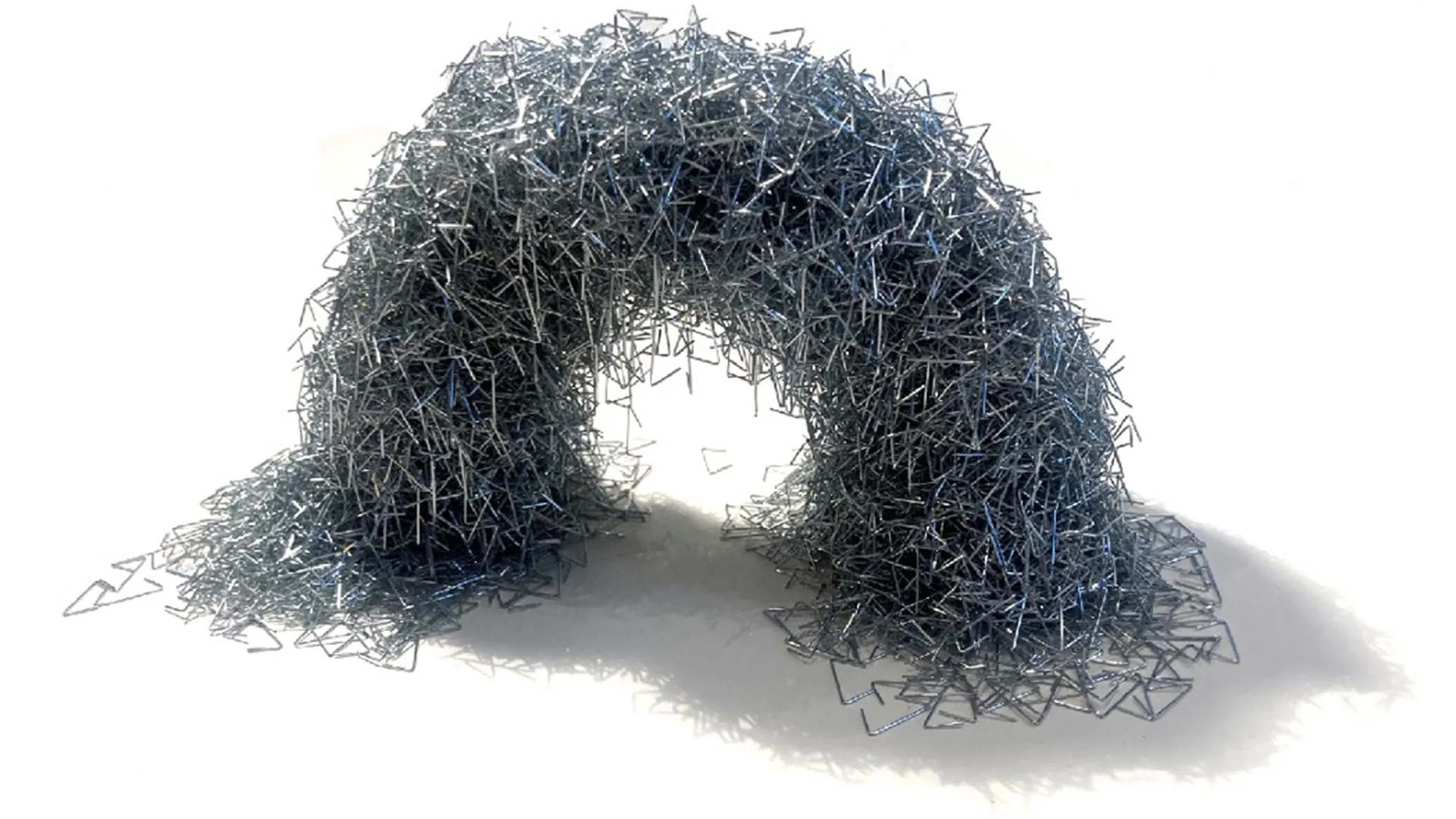
The humble office staple, when compressed into a dense, chaotic bundle, exhibits a mechanical paradox that has long intrigued physicists and engineers. While each individual wire is a separate entity, the collective mass behaves with the structural integrity of a solid, resisting separation with surprising tenacity. Yet, this same "solid" can be induced to disintegrate into a loose pile of individual components through specific vibrations. Researchers at the Paul M. Rady Department of Mechanical Engineering at the University of Colorado Boulder have identified this phenomenon as a gateway to a new class of "entangled granular materials." By manipulating the geometry of individual particles, the team aims to create substances that are simultaneously strong, adaptable, and entirely recyclable, potentially transforming industries ranging from civil engineering to autonomous robotics.
The study, recently published in the Journal of Applied Physics, marks a significant advancement in the field of soft matter physics and bioinspired design. Led by Professor Francois Barthelat, head of the Laboratory for Advanced Materials & Bioinspiration, the research team transitioned from studying traditional building blocks to exploring the complex mechanics of interlocking, non-convex geometries. The findings suggest that by moving away from simple shapes like spheres or grains of sand, engineers can "program" the mechanical properties of a material through its constituent geometry rather than its chemical composition.
The Physics of Non-Convexity and Entanglement
To understand the breakthrough, one must first look at the behavior of traditional granular materials. Common substances like sand or gravel are composed of "convex" particles—shapes where any line drawn between two points on the surface stays within the particle. Because these grains are smooth and lack protruding features, they cannot interlock. When a pile of sand is subjected to tension, the grains simply slide past one another, offering zero tensile strength.
"Sand is the classic example of a granular material, but its shape limits its utility in structural applications," explained PhD student Youhan Sohn, a lead researcher on the project. "By changing the geometry from convex to non-convex—shapes with indentations or ‘arms’—we can fundamentally alter how the particles interact. We found that certain shapes allow particles to hook into one another, creating a web of mechanical connections that provide the material with internal cohesion."
This phenomenon is known as entanglement. In nature, entanglement is a primary source of structural integrity. Bird nests are perhaps the most visible example, where thin, flexible twigs are woven into a rigid, load-bearing bowl. On a microscopic level, human bone achieves its remarkable strength through the entanglement of mineralized collagen fibrils. The CU Boulder team sought to replicate this natural efficiency using engineered particles that could be mass-produced and controlled.
Chronology of Discovery: From Simulation to Physical Trials
The research progressed through a rigorous three-stage process: computational modeling, physical prototyping, and mechanical testing. The timeline of the study began with the use of Monte Carlo simulations, a sophisticated computational technique used to predict the probability of different outcomes in complex systems.
During the simulation phase, the team tested an array of geometric configurations, including crosses, stars, and various "U-shaped" designs. The objective was to identify which specific geometry maximized the statistical likelihood of entanglement when the particles were poured or compressed into a container. The simulations revealed that "two-legged" particles—essentially U-shaped staples—offered the most efficient balance between ease of flow and strength of interlocking.
Following the digital phase, the researchers moved to physical validation. Using 3D printing and precision manufacturing, they created thousands of small, staple-like particles. These were subjected to "pickup tests," a standard metric in granular physics where a portion of the material is lifted to see how much of the surrounding mass remains attached through entanglement.
The results were definitive: the staple-shaped particles outperformed all other geometries. They created a material that possessed both high tensile strength (the ability to resist being pulled apart) and high toughness (the ability to absorb energy and resist fracturing). In traditional materials science, strength and toughness are often mutually exclusive; a material that is very hard is often brittle, while a material that is flexible is often weak. The entangled staple-mass, however, bypassed this trade-off.
Mechanical Performance and Reversibility
A defining characteristic of the CU Boulder discovery is the material’s "tunable" nature. Unlike concrete or glues, which undergo a permanent chemical change to harden, the entangled staple material relies entirely on mechanical geometry. This allows the state of the material to be toggled using external stimuli—specifically, vibration.
Saeed Pezeshki, a PhD student involved in the mechanical testing, noted that the material’s response to vibration is highly frequency-dependent. "We discovered that we could control the degree of entanglement by applying different vibration patterns," Pezeshki said. "Gentle, low-amplitude vibrations act as a catalyst for entanglement, shaking the particles just enough so they settle into the ‘crooks’ of their neighbors, effectively knitting the mass together. Conversely, high-energy, high-amplitude vibrations provide enough kinetic energy to unhook the particles, causing the structure to liquefy and flow like a fluid."
This reversibility is a cornerstone of the research. It allows for the creation of a "temporary solid" that can be cast into a shape, used for a structural purpose, and then "melted" back into its constituent parts without any loss of material quality.
Implications for Sustainable Construction and the Circular Economy
The potential applications for this technology in the construction industry are profound. Currently, the global construction sector is one of the largest contributors to landfill waste and carbon emissions, largely due to the use of permanent binders like cement and asphalt. Once a concrete building reaches the end of its life, it must be demolished, resulting in rubble that is difficult to recycle.
If large-scale structures could be built using entangled granular materials, the demolition process could be replaced by a recovery process. A bridge or a wall made of engineered staples could be "disentangled" using industrial vibrators, allowing the particles to be collected and reused in a new project immediately.
"We are looking at a future where buildings could be assembled and disassembled rather than built and destroyed," Professor Barthelat stated. "This aligns with the principles of a circular economy, where the ‘waste’ of one project becomes the ‘raw material’ for the next. While scaling these small staples up to the size of construction girders presents engineering challenges, the fundamental physics remains the same."
Swarm Robotics and the "Terminator" Analogy
Beyond civil engineering, the research has caught the attention of the robotics community. The ability of a collection of independent units to aggregate into a single functional object is a primary goal of swarm robotics.
In this context, each "staple" could potentially be a small, autonomous robot. When the swarm needs to cross a gap or lift a heavy object, the individual robots would entangle themselves to form a rigid bridge or a mechanical arm. Once the task is complete, they would disentangle and return to their individual states.
Professor Barthelat alluded to the science-fiction implications of this capability, referencing the T-1000 character from the film Terminator 2, which is composed of a "liquid metal" that can transition between fluid and solid forms to pass through obstacles. "The idea of a material that can change its shape to slide under a door and then transform back into a solid structure is something that’s on everybody’s mind in this field," Barthelat said. "Our work provides a mechanical pathway to achieving that kind of transition without needing complex chemistry or high temperatures."
Future Directions: The "Burr" Particle
The CU Boulder team is not stopping at the staple design. Their current research has already moved toward even more complex geometries. Drawing inspiration from the "burrs" of plants like the Burdock, which use tiny hooks to cling to animal fur, the researchers are testing particles with multiple protruding legs and hooked ends.
These "multi-legged" designs are expected to increase the "coordination number"—the average number of contact points per particle—thereby exponentially increasing the strength of the entanglement. Preliminary tests suggest that these burr-like particles could create materials with structural properties approaching those of high-performance polymers, but with the added benefit of total reversibility.
The Laboratory for Advanced Materials & Bioinspiration is currently seeking partnerships to explore the industrial scaling of these materials. While challenges remain regarding the cost of precision-manufacturing billions of complex-shaped particles, the team believes that the environmental and functional benefits will eventually outweigh the initial investment.
"It’s a strange material because it occupies a middle ground," Barthelat concluded. "It’s not quite a solid, and it’s not quite a liquid. It’s something exotic, and that’s exactly what makes it so promising for the future of engineering."