The landscape for American biotechnology firms has undergone a profound transformation in recent years, shifting from a period of robust investment and rapid growth to one characterized by heightened caution, both from regulators and investors. This evolving domestic environment, coupled with the burgeoning, increasingly streamlined biotechnology sector in China, has created an exceptionally challenging arena for innovative U.S. companies. Success, once a high-risk, high-reward proposition demanding patient capital, has grown significantly more elusive, compelling American biotech to strategically redefine its approach to drug development, market differentiation, and global competition. The imperative is clear: forge new pathways that navigate the complexities of intellectual property (IP) appropriation by lower-cost Chinese competitors, maximize investment in popular and low-risk drug development areas, or pioneer innovative operational models that open new markets and drive cost efficiencies. Each of these strategic pivots carries inherent risks, yet each also presents a compelling opportunity to differentiate not only from crowded markets dominated by existing drugs and their derivatives but also to effectively counter the escalating challenge posed by Chinese competition.
A Shifting Investment and Regulatory Climate
Prior to 2022, the U.S. biotech sector experienced a remarkable boom, fueled by a confluence of factors including low-interest rates, a surge in venture capital funding, a robust initial public offering (IPO) market, and a heightened public and private sector focus on health innovation, particularly during the COVID-19 pandemic. This era saw a significant influx of "patient capital" willing to back long-term, high-risk drug development cycles. According to data from the National Venture Capital Association (NVCA) and PitchBook, venture capital investment in U.S. biotech and pharma reached record highs in 2020 and 2021, with billions flowing into startups pursuing novel therapies across diverse disease areas. The rapid development of mRNA vaccines during the pandemic further underscored the potential for groundbreaking innovation and attracted unprecedented investor interest.
However, the investment climate began to cool dramatically in 2022. Rising inflation and subsequent aggressive interest rate hikes by the Federal Reserve made capital more expensive and shifted investor sentiment towards profitability and lower-risk ventures. The IPO market for biotech largely dried up, and many publicly traded biotech companies saw their valuations plummet. This financial retrenchment was compounded by increased scrutiny from U.S. regulatory bodies. The U.S. Food and Drug Administration (FDA), while maintaining its commitment to innovation, has faced calls for more rigorous review processes, particularly in areas like accelerated approvals, following certain high-profile cases. Concurrently, the Federal Trade Commission (FTC) has signaled a more aggressive stance on pharmaceutical mergers and acquisitions, citing concerns about market concentration and reduced competition, which further complicates exit strategies for biotech firms. This dual pressure of financial caution and regulatory tightening has created a formidable headwind for American biotech.
The Ascent of China’s Biotech Sector
While the U.S. market navigated these challenges, China’s biotechnology sector embarked on an ambitious growth trajectory, underpinned by substantial government support and strategic policy reforms. China’s "Made in China 2025" initiative explicitly targeted biotechnology as a key strategic industry, allocating significant resources to R&D, talent development, and infrastructure. Crucially, the China National Medical Products Administration (NMPA), particularly its Center for Drug Evaluation (CDE), has significantly streamlined regulatory constraints on drug development over the past decade. This streamlining, which includes faster review times for innovative drugs and a more predictable approval pathway, has directly led to an explosion of innovation within China.
According to reports from organizations like IQVIA and Evaluate Pharma, China’s share of global drug discovery and development has risen sharply. In 2023, China’s total R&D spending in the biopharmaceutical sector was estimated to be in the tens of billions of dollars, a dramatic increase from a decade prior. This rapid growth has fostered an environment where Chinese firms can develop and bring drugs to market with greater speed and at significantly lower costs compared to their U.S. counterparts. The combination of abundant capital (often state-backed or state-influenced), a large domestic patient population for clinical trials, and a more agile regulatory system has positioned China as a formidable competitor, particularly in the realm of biosimilars and "fast-follower" drug development.
One of the most significant challenges arising from China’s ascent is the phenomenon of "target herding" exacerbated by advanced analytics and artificial intelligence (AI). As Elliott Hershberg eloquently points out, the commodification of biopharma modalities has led to a situation where, the moment a promising new drug target emerges publicly with clinical data, dozens of companies, often from China, swiftly move to pursue the same idea. This was evident even a decade ago with the proliferation of over 200 PD-(L)1 inhibitor programs globally, a trend that dramatically compressed the market and diluted potential returns. Today, AI-powered drug discovery tools can rapidly analyze vast datasets, predict protein structures, and design new molecules, making it "trivially easy" to work around existing patent claims and create functionally equivalent molecules. China’s cost and speed advantages mean these fast followers can often beat innovators to market or at least follow so quickly that they effectively shorten the innovator’s period of patent exclusivity, making it difficult to recoup astronomical clinical development costs. This dynamic places immense pressure on U.S. firms to innovate beyond easily replicable targets and mechanisms.
Strategic Pathways for American Biotech
In response to these complex challenges, American biotech firms are exploring three distinct, yet potentially complementary, strategic pathways to secure a competitive edge and ensure long-term viability.
1. The Path of Secrecy and Novel Target Discovery: The Variant Bio Model
One potent strategy against target herding and IP appropriation is to develop truly novel targets that are not easily discoverable by competitors, and then to strategically manage intellectual property disclosure. Variant Bio exemplifies this approach. The company’s core solution lies in leveraging privileged access to genomic sequencing data derived from rare, isolated human populations. These populations, often due to their unique genetic histories and reduced genetic diversity, can reveal novel genetic clues linked to human diseases that are otherwise obscured in larger, more diverse datasets. This "genetic isolation" acts as a natural filter, highlighting disease-causing or protective variants with greater clarity.
Variant Bio’s methodology involves deep genomic analysis of these unique cohorts, identifying genetic variations that correlate with specific disease phenotypes or resistance. This allows them to pinpoint entirely new biological pathways and drug targets that are not yet known or publicly documented. By working in this "quiet isolation" for much of the development period, Variant Bio sidesteps the immediate competitive rush that plagues publicly known targets. Their strategy also involves withholding patent filings until the last possible minute, maximizing the period of trade secret protection while they advance their discoveries. This tactical delay is a high-stakes gamble, as it risks losing protection if a competitor independently discovers and patents the same target. However, for truly novel discoveries, the time required for independent replication can provide a substantial head start.
The success of this model hinges on several factors: the uniqueness and validity of the genetic insights, the company’s ability to translate these insights into druggable targets, and the operational excellence required to keep discoveries under wraps while advancing preclinical and early clinical development. This approach not only provides a durable competitive advantage by creating a de facto monopoly on certain targets but also opens up possibilities for treating diseases with previously unknown underlying biology, potentially addressing significant unmet medical needs. This strategy contrasts sharply with the "big data" approach of many AI-driven firms, which often focus on known targets with vast publicly available data. Variant Bio’s niche, therefore, is in pioneering, not perfecting, existing knowledge.
2. The Path of Funds-Maxxing Polypharmacology: Spyre Therapeutics and Kailera
A silver lining of the "modality commodification" trend is that the biotech industry has become exceptionally proficient at developing certain types of drug molecules, particularly monoclonal antibodies and peptide therapeutics. This accumulated expertise translates into lower technical development risk for individual molecules. Consequently, a second strategic pathway involves leveraging this proficiency to combine existing, well-understood modalities for enhanced efficacy, thereby creating a new layer of intellectual property protection and market differentiation. This is the essence of polypharmacology – targeting multiple pathways or receptors simultaneously to achieve superior therapeutic outcomes.

Combinatorial synergies, where the effect of two or more drugs together is greater than the sum of their individual effects, can unlock significant clinical advantages. Moreover, developing a stable, effective combination therapy requires a superior level of execution in drug design, formulation, and clinical development that is often beyond the capabilities of most fast-followers or copycats. The resulting enhanced therapeutic efficacy allows developers to aggressively capture market share from existing incumbents, even if the individual targets are not novel.
Spyre Therapeutics exemplifies this strategy in the inflammatory bowel disease (IBD) space. They are developing a portfolio of "bio-better" monoclonal antibody drugs that target well-established, "old-school" targets like IL-23, TL1A, and α4β7. While these individual targets are not new, Spyre’s innovation lies in developing proprietary antibodies designed for superior pharmacokinetic profiles (e.g., extended half-life for less frequent dosing) and then strategically combining them. For instance, an antibody targeting IL-23 alongside one targeting TL1A might offer more comprehensive blockade of inflammatory pathways than either alone. The IBD market, estimated to be over $20 billion globally and growing, is ripe for such innovation, particularly given the limitations of existing single-target therapies. While generic versions of blockbuster drugs like Humira (adalimumab) are becoming increasingly affordable, if a combination therapy can double efficacy, significantly improve patient quality of life, or reduce treatment burden, the U.S. healthcare system and patients will often justify a premium price.
Similarly, Kailera is applying a polypharmacological approach to the booming weight-loss peptide market. While semaglutide (the active ingredient in Ozempic and Wegovy) targets the GLP-1 receptor, Kailera is developing bivalent, trivalent, or even quadrivalent peptide constructs. These multi-agonist peptides simultaneously activate multiple metabolic pathways (e.g., GLP-1, GIP, glucagon receptors) to achieve significantly greater weight loss and improved metabolic health outcomes. The global obesity drug market is projected to reach over $100 billion by the early 2030s, driven by the profound unmet medical need. While multi-agonist peptides like Eli Lilly’s tirzepatide (Mounjaro/Zepbound) already demonstrate superior efficacy to semaglutide, Kailera aims to push these boundaries further. The challenge, as the article notes, is that while development risk may be lower due to known targets, development costs are not. Both Spyre and Kailera have raised over a billion dollars each to fund their sprawling clinical programs, reflecting the immense capital required for late-stage development of complex biologics. This "funds-maxxing" strategy requires deep pockets and strong investor confidence in the enhanced efficacy and market potential of combination therapies.
3. The Path of Novel Platforms and Cost Efficiency: Lumen Bio
A third, more capital-efficient yet inherently riskier, approach involves developing completely novel biomanufacturing platform technologies that offer transformative scalability and cost advantages, thereby opening up entirely new markets and therapeutic possibilities. Seattle-based Lumen Bio (co-founded by co-author Brian Finrow) represents this strategy. Like Spyre and Kailera, Lumen Bio’s pipeline includes biologic cocktail drugs designed for powerful therapeutic synergies. However, their unique differentiator lies in their proprietary biomanufacturing platform, which is designed to produce biologics with far greater scalability and at significantly reduced costs compared to traditional mammalian cell culture or microbial fermentation methods. While the specific nature of Lumen Bio’s platform (e.g., plant-based expression systems, algae, or yeast) is not detailed, the implications of such a platform are profound.
Novel biomanufacturing platforms, while offering immense potential, have experienced fluctuating investor enthusiasm. After a period of significant investment, particularly in areas like synthetic biology and advanced manufacturing during the early 2010s, investor caution increased post-2022. This is partly due to the biotech industry’s general preference for "commodified modalities" and technologies compatible with existing manufacturing infrastructure. Integrating a novel platform requires significant re-tooling, new regulatory pathways, and a departure from established supply chains, which can be daunting for large biopharma companies.
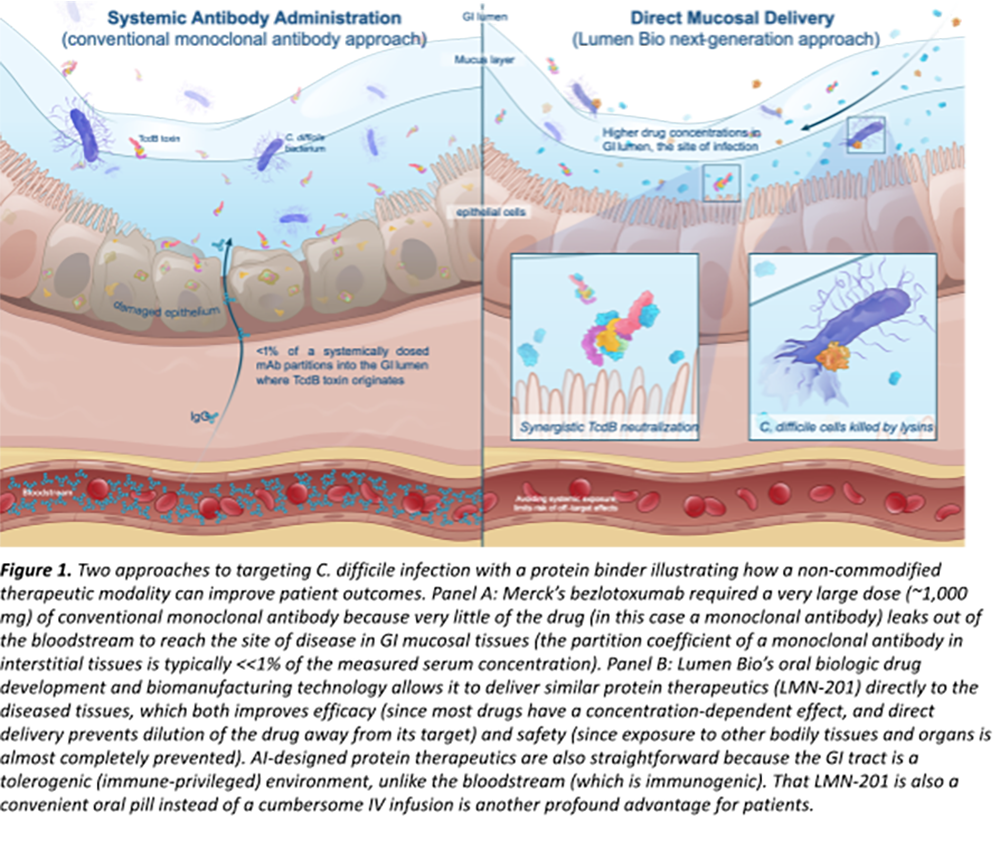
Despite these challenges, the competitive advantages of a truly novel platform can be overwhelming. Lumen Bio’s platform, by enabling dramatically lower production costs, makes previously unaddressable markets economically viable. This includes preventive drugs, which require very low per-dose costs to be broadly accessible, and international markets in low- and middle-income countries that cannot afford high-priced biologics. For example, Lumen Bio’s LMN-201 attacks the same target as Merck’s IV-infused antibody bezlotoxumab for Clostridioides difficile (C. diff) infection. However, LMN-201 is an orally administered biologic. The ability to treat C. diff orally, rather than through an intravenous infusion, drastically simplifies administration, reduces healthcare costs, and improves patient access and convenience, making it far easier to deploy both in hospitals and potentially for prophylaxis in high-risk settings.
Beyond the cost and accessibility benefits, a novel platform creates a formidable barrier to entry for competitors. The lack of pre-existing manufacturing capacity or expertise means that would-be copycats face a much steeper hill to climb to catch up to a novel product launch. The triumph of Moderna’s Covid-19 mRNA vaccine serves as a powerful illustration. While traditional vaccine manufacturers struggled with scale and speed, Moderna’s mRNA platform allowed for rapid design, production, and deployment, ultimately outcompeting legacy approaches and demonstrating the huge upside potential of platform-based innovation. For Lumen Bio, this means not just a new drug, but a new paradigm for delivering biologics.
Broader Implications and the Future of American Biotech
The strategic shifts underway in American biotech carry significant implications for the global pharmaceutical landscape, public health, and national economic competitiveness. These "new paths" are not merely business model adjustments; they represent a fundamental re-evaluation of how innovation is pursued, protected, and delivered in an increasingly competitive and cost-sensitive world.
For the U.S. Biotech Ecosystem: The emphasis on secrecy, sophisticated polypharmacology, and novel platforms suggests a potential bifurcation of the industry. On one hand, highly specialized firms like Variant Bio will focus on ultra-novel, high-risk, high-reward discoveries, operating under a veil of discretion. On the other, companies like Spyre and Kailera will command immense capital to optimize known modalities for superior efficacy, targeting large, established markets. A third segment, represented by Lumen Bio, will pioneer transformative manufacturing and delivery, aiming to democratize access to biologics. This may lead to more distinct funding models and investor profiles for each segment, with varying risk appetites and return expectations.
For Global Health: The Lumen Bio model, with its focus on cost-efficient and scalable manufacturing, holds particular promise for addressing global health challenges. Diseases prevalent in low-income settings, or those requiring widespread preventive measures, often remain underserved due to the prohibitive cost of traditional biologics. Platforms that can drastically reduce these costs could unlock access to life-saving therapies for millions worldwide, aligning commercial goals with humanitarian impact.
Addressing Chinese Competition: Each strategy provides a distinct defense against the formidable challenge posed by Chinese competition. Secrecy and true novelty (Variant Bio) make replication difficult due to lack of public information. Complex combinatorial synergies (Spyre, Kailera) require advanced execution beyond simple copying. Novel platforms (Lumen Bio) create manufacturing and supply chain barriers that are difficult to surmount quickly. This multi-pronged approach is critical for American biotech to maintain its technological leadership and IP advantage.
Policy Considerations: The U.S. government and regulatory bodies have a crucial role to play in fostering an environment where these new paths can flourish. This includes strengthening IP protection and enforcement, particularly against foreign appropriation; exploring incentives for risky, foundational platform technologies; and ensuring that domestic regulatory pathways remain competitive in terms of speed and predictability without compromising safety and efficacy. Dialogue around fair competition and market access with countries like China will also be vital.
Conclusion
The current era demands not just innovation, but "deep, durable innovation" from American biotech. This requires an astute understanding of market dynamics, an unwavering appetite for risk, and a clear pathway to both discovery and delivery. The three illustrative examples—Variant Bio’s commitment to genomic secrecy, Spyre and Kailera’s strategic maximization of polypharmacology, and Lumen Bio’s pioneering of novel biomanufacturing platforms—underscore the diverse yet essential approaches being adopted. Keeping a product secret offers a huge potential payoff, provided the secrecy can be maintained and investors exhibit patience. Modality commodification can reduce development risk, but success then hinges on proving superior efficacy and achieving successful market differentiation. Developing a new platform, while fraught with the inherent risks of any fully novel endeavor, also carries the unparalleled opportunity to unlock new markets and dramatically reduce product costs. The future competitive edge of American biotech, amidst intensifying global competition, particularly from China, will undoubtedly depend on the artful balancing of these tradeoffs, charting innovative courses that redefine what is possible in drug discovery and delivery for generations to come.
Brian Finrow is CEO, co-founder, and co-chair of Lumen Bioscience, a clinical-stage biotechnology company in Seattle. Kevin Klowden is an economist and principal at Melcene Advisory and senior fellow at the Milken Institute.