In a landmark development for the field of condensed matter physics, an international team of researchers has successfully demonstrated the creation of an unusual class of quantum states known as fractional Fermi seas. This discovery, detailed in a recent publication in the journal Physical Review Letters, marks a significant departure from established understanding of how quantum particles behave in one-dimensional environments. The study, a collaborative effort between the Nägerl group at the University of Innsbruck and theoretical physicist Alvise Bastianello of the CNRS and Université Paris-Dauphine, introduces a new critical phase of matter that emerges when quantum systems are pushed far from their traditional equilibrium states. By manipulating ultracold cesium atoms confined to a one-dimensional space, the team has bypassed the limitations of the Tomonaga-Luttinger liquid theory, which has served as the foundational framework for one-dimensional quantum mechanics for decades.
The Evolution of One-Dimensional Quantum Theory
To understand the significance of the fractional Fermi sea, one must first look at the traditional models of quantum matter. In three-dimensional space, the behavior of electrons in metals is typically described by Fermi liquid theory. However, when particles are restricted to moving in a single dimension—much like cars on a narrow one-way street—the physics changes fundamentally. In such systems, particles cannot move past one another without interacting. This leads to collective behavior where the identity of individual particles is lost to a unified "liquid" state.
Since the mid-20th century, the Tomonaga-Luttinger liquid (TLL) theory has been the standard paradigm for describing these systems. TLL theory predicts how density waves and spin waves propagate through a one-dimensional quantum fluid. While highly successful, TLL theory is largely restricted to systems at or near equilibrium—states where the system is in its lowest energy configuration or only slightly disturbed. The new research by the Nägerl and Bastianello teams transcends this paradigm by exploring what happens when a system is subjected to "Floquet engineering," a method of periodically driving a system to create new, non-equilibrium states of matter.
Experimental Methodology: The Cesium Atom Laboratory
The experimental foundation of this discovery lies in the use of ultracold cesium atoms. Unlike the electrons in a traditional wire, which are subject to impurities and lattice vibrations, ultracold atoms in an optical lattice provide a "clean" environment. This setup allows researchers to act as architects of quantum reality, tuning the parameters of the system with extreme precision.
The researchers at the Department of Experimental Physics in Innsbruck utilized laser cooling and magnetic trapping to bring cesium atoms to temperatures just a fraction of a degree above absolute zero. At these temperatures, the thermal motion of the atoms ceases to dominate, allowing the subtle effects of quantum mechanics to take center stage. The atoms were confined to one-dimensional tubes created by intersecting laser beams, effectively forcing them into a linear arrangement.
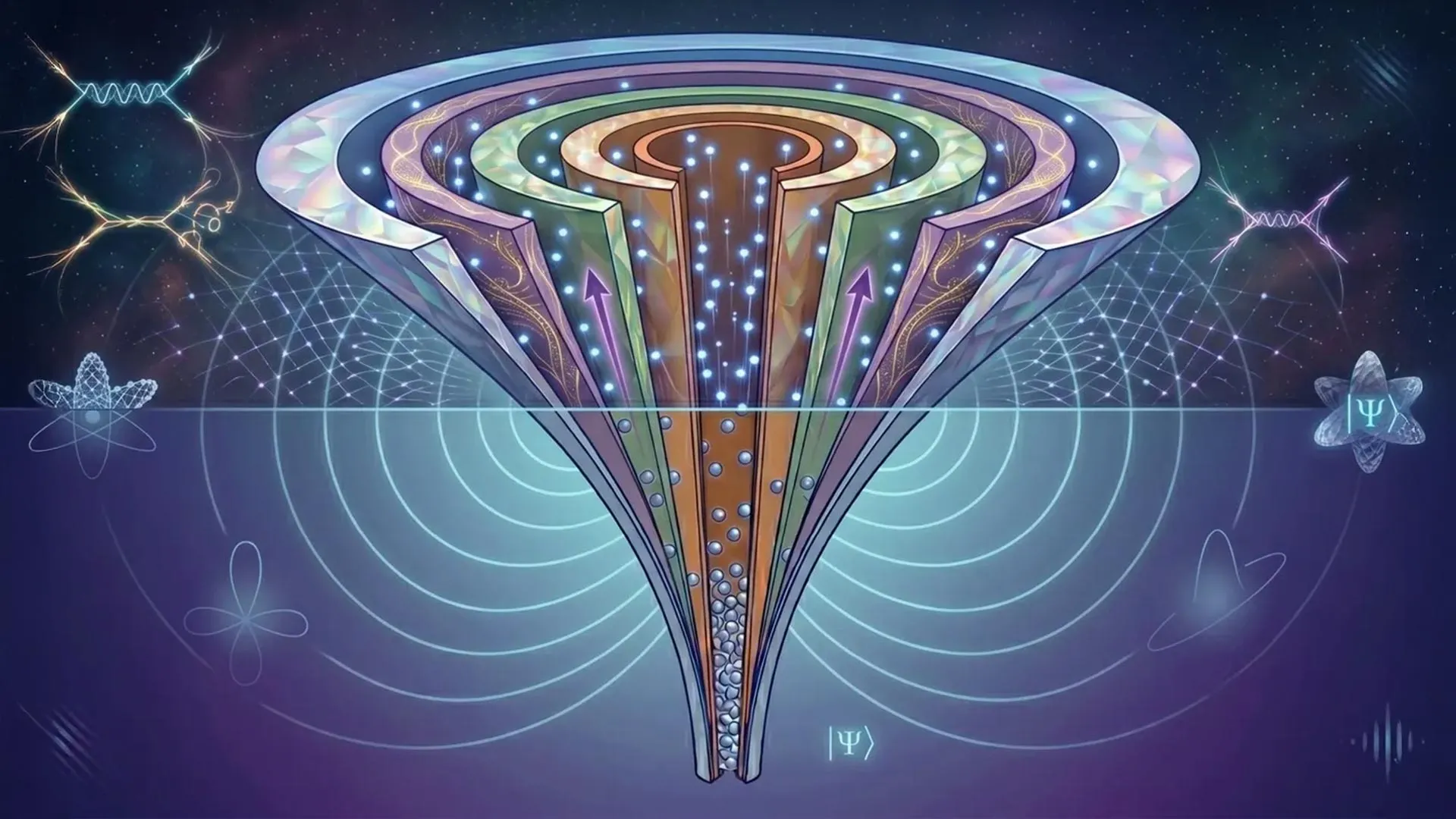
The breakthrough occurred when the team began to "drive" the system. By using Feshbach resonances—a tool that allows scientists to control the strength and nature of interactions between atoms using an external magnetic field—they repeatedly cycled the atoms between states of strong repulsion and strong attraction. This cyclic manipulation is what Alvise Bastianello refers to as forcing the atoms through "extreme conditions." Instead of collapsing or simply heating up into a disordered gas, the atoms reorganized into a highly structured, highly excited state: the fractional Fermi sea.
Defining the Fractional Fermi Sea
The term "Fermi sea" traditionally refers to the way fermions (particles like electrons or certain atoms) fill up energy levels. Due to the Pauli Exclusion Principle, no two fermions can occupy the same quantum state. Consequently, at absolute zero, they fill the lowest available energy levels one by one, creating a "sea" of occupied states up to a certain energy level known as the Fermi energy.
The "fractional" nature of the newly discovered state refers to a modified occupancy rule. In this state, the particles appear to occupy the available energy states in a way that suggests a reduction in the standard density of states. As lead author Yi Zeng explained, the interaction cycle does not merely add energy to the system; it fundamentally reorganizes the many-body state. The result is a configuration that is highly excited compared to the ground state but possesses a "hidden order" that prevents it from descending into thermal chaos.
This hidden order is manifested through specific mathematical correlations. The researchers observed Friedel oscillations—ripples in the density of the particles—that remained stable across various levels of repulsive interaction. These oscillations are a hallmark of quantum liquids, but in this case, they exhibited decay patterns and frequencies that do not align with the predictions of the standard Tomonaga-Luttinger liquid theory.
Chronology of the Research and Collaboration
The journey to discovering the fractional Fermi sea was a multi-year endeavor involving a tight feedback loop between theoretical prediction and experimental verification.
- Theoretical Conception (2021-2022): Alvise Bastianello and the theoretical team began modeling the effects of periodic driving on one-dimensional interacting systems. They hypothesized that specific "drive protocols" could lead to stable, non-equilibrium phases that had no counterparts in equilibrium physics.
- Experimental Design (2022): The Nägerl group in Innsbruck began adapting their cesium-atom apparatus to implement these high-frequency interaction cycles. This required perfecting the timing of magnetic field pulses to ensure the atoms stayed within the one-dimensional traps without escaping.
- Data Acquisition (2023): Preliminary experiments revealed that the system was not behaving like a standard heated gas. Instead of a broad distribution of energies, the atoms showed the distinct "shoulders" and correlation peaks indicative of a new phase.
- Verification and Analysis (Late 2023): Yi Zeng and the team performed rigorous statistical analysis on the correlation functions of the atoms. They confirmed that the state was indeed a "fractional" sea and that its properties were universal, meaning they did not depend on the specific starting conditions of the atoms.
- Publication (2024): The theoretical framework was published in Physical Review Letters, with a companion experimental paper currently under peer review to provide the direct evidence of the state’s realization.
Expert Reactions and the "Super-Fermion" Hypothesis
The physics community has reacted with significant interest to the findings, particularly regarding the potential for new quasiparticles. Quasiparticles are emergent phenomena where the collective behavior of many particles acts as if it were a single, distinct particle.
Hanns-Christoph Nägerl, the group leader in Innsbruck, has speculated on the nature of the entities within this fractional sea. "We are not yet sure how we should name these new quasiparticles," Nägerl stated. "Perhaps ‘super-Fermions’?" This moniker reflects the fact that while the particles still obey fermionic-like distribution rules, their collective properties are enhanced or modified by the non-equilibrium driving of the system.
Theoretical physicists not involved in the study have noted that this work opens a "third way" in quantum simulation. While the first way is to simulate known materials and the second is to explore purely theoretical models, this third way involves creating entirely new phases of matter that have no natural occurrence in the universe but are allowed by the laws of quantum mechanics.
Broader Implications for Quantum Technology
The discovery of the fractional Fermi sea has implications that extend beyond pure laboratory curiosity. It provides a new roadmap for the development of quantum simulators—devices that use controllable quantum systems to solve problems that are too complex for classical supercomputers.
By proving that stable, organized states can exist far from equilibrium, the researchers have expanded the "menu" of states available for quantum information processing. In traditional quantum computing, decoherence (the loss of quantum information to the environment) is often caused by the system moving toward thermal equilibrium. If phases like the fractional Fermi sea can be maintained in a stable, non-equilibrium state, they might offer new methods for protecting quantum information.
Furthermore, the study of these "super-Fermions" could lead to a better understanding of high-temperature superconductivity and other exotic electronic properties in solids. Many of the most mysterious materials in modern physics are thought to be governed by non-equilibrium processes or strong one-dimensional correlations. Having a controllable "simulator" in the form of cesium atoms allows scientists to test theories of these materials in a way that is impossible with bulk solids.
Conclusion and Future Directions
The work of the Nägerl group and Alvise Bastianello represents a milestone in the study of many-body quantum physics. By demonstrating that a fractional Fermi sea can be deliberately created and maintained, they have challenged the long-standing dominance of the Tomonaga-Luttinger liquid theory and opened a new frontier in non-equilibrium thermodynamics.
As the companion paper detailing the experimental realization moves through the final stages of review, the team is already looking toward the next steps. Future research will likely focus on the "lifetime" of these states—how long they can persist before eventually decaying—and whether similar fractional states can be created in two- or three-dimensional systems.
"The discovery of fractional Fermi seas shows how far we can push quantum simulation," Nägerl concluded. "We are not only reproducing known models but creating and probing states that go beyond established paradigms." This shift from observation to active creation marks a new era where the limits of matter are defined not by what we find in nature, but by the limits of our experimental ingenuity.