For centuries, water has remained the most scrutinized substance in the scientific world, yet its behavior at the extreme limits of physical space has continued to baffle researchers. A significant breakthrough published in the journal Science Advances has finally provided a definitive answer to a question that has divided the scientific community for more than a decade: What happens to the fundamental chemistry of water when it is squeezed into spaces only a few molecules wide? The study, led by a team from the University of Cambridge, reveals that the perceived changes in water’s reactivity in these "nanoconfined" environments are not caused by the confinement itself, but rather by intense internal pressures and specific surface interactions that had previously gone unmeasured.
This discovery resolves a long-standing paradox in the field of nanofluidics. For years, experimental results regarding the acidity and reactivity of water in nanopores were notoriously inconsistent, with different studies reporting wildly varying levels of chemical activity. By utilizing advanced machine learning simulations, the Cambridge researchers demonstrated that once factors such as pressure, density, and chemical potential are accounted for, the "mysterious" effects of confinement largely vanish, behaving instead according to established thermodynamic principles.
The Decade-Long Debate Over Nanoconfined Water
The study of water in restricted spaces is not merely an academic exercise; it is a fundamental requirement for understanding the natural world and advancing modern technology. Nanoscale pores and channels are ubiquitous, found in everything from the biological membranes that regulate human cells to the geological formations deep within the Earth’s crust. In technology, nanoconfinement is central to the operation of desalination membranes, hydrogen fuel cells, and high-performance batteries.
The central point of contention among scientists has been the process of water dissociation, or "water splitting." This is the chemical reaction where a neutral water molecule (H2O) splits into two charged particles: a hydronium ion (H3O+) and a hydroxide ion (OH-). This ratio of ions determines the pH of a solution, which dictates whether a substance is acidic or alkaline. Because pH influences the speed of chemical reactions and the stability of molecules like enzymes, understanding how confinement affects this balance is critical.
Previous experiments over the last ten years suggested that water becomes significantly more reactive when confined between two-dimensional materials. However, these experiments were difficult to replicate. Some researchers found massive increases in reactivity, while others found negligible changes. The lack of a unifying theory left engineers and physicists without a reliable framework for designing nanoscale devices.
The Role of Machine Learning in Molecular Discovery
To bridge the gap between these conflicting experimental results, the research team, led by Xavier R. Advincula of the Yusuf Hamied Department of Chemistry, turned to the frontiers of computational science. Traditional computer simulations of water chemistry are often forced to choose between speed and accuracy. Quantum mechanical simulations provide high accuracy but are computationally expensive, limiting researchers to very small systems and short timescales. Conversely, simpler classical models can handle larger systems but often fail to capture the complex electronic changes that occur during chemical reactions.
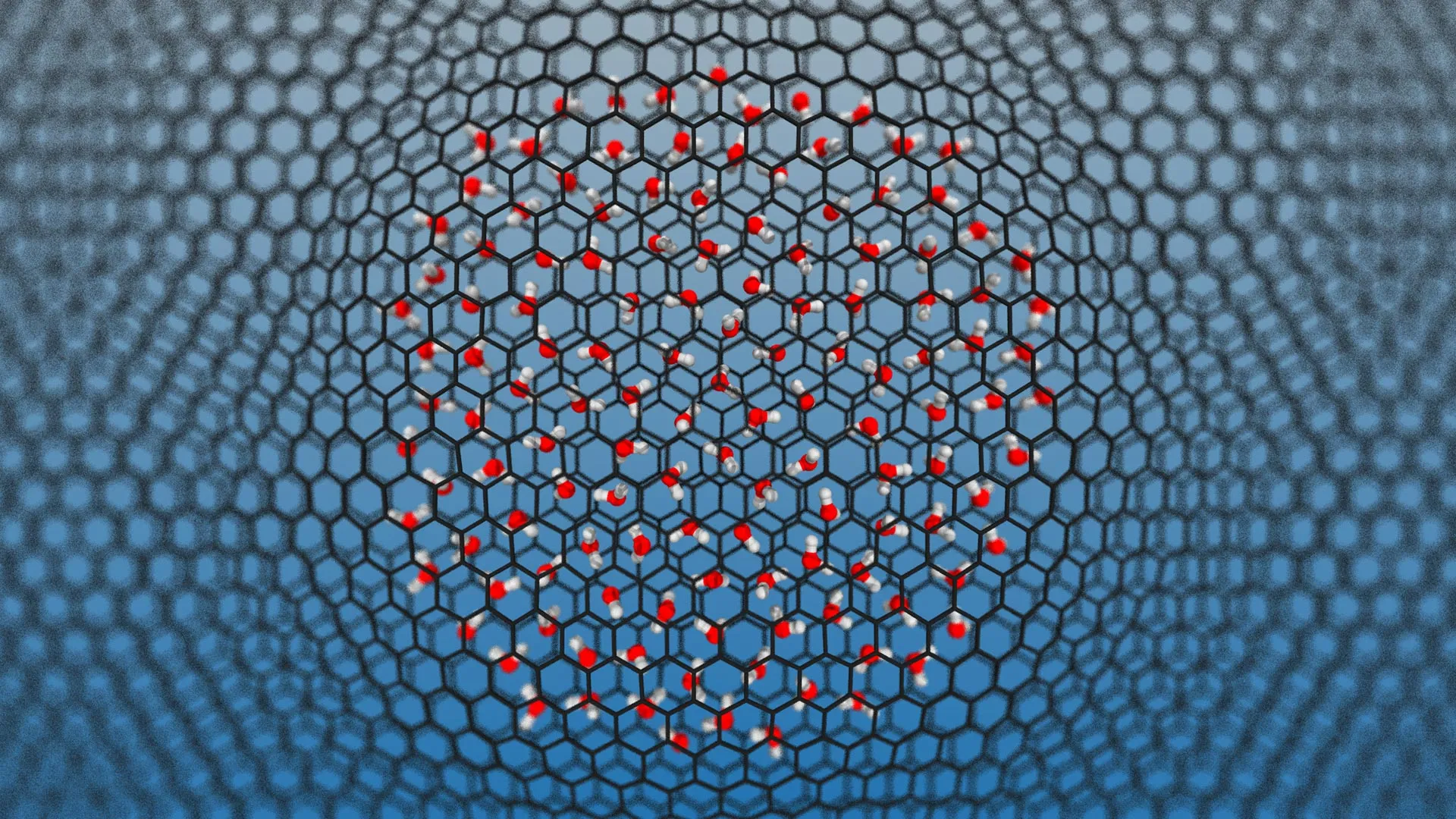
The Cambridge team overcame this hurdle by employing machine learning (ML) models trained on quantum mechanical data. These ML simulations allow for "quantum-accurate" results at a fraction of the computational cost, enabling the team to simulate water molecules trapped between layers of graphene and hexagonal boron nitride (hBN) under a vast range of conditions.
"The use of machine learning allowed us to explore a much broader range of parameters than was ever possible before," noted Advincula. "We could finally see the full picture of how density and pressure evolve within these tiny spaces."
The Hidden Power of Van der Waals Forces
One of the most striking findings of the study is the discovery of the immense pressures that naturally occur within nanoconfined spaces. When water is trapped between two-dimensional sheets like graphene, it is subjected to gigapascal-level pressures—forces equivalent to those found hundreds of kilometers beneath the Earth’s surface.
Crucially, these pressures are generated without any external force being applied. Instead, they result from van der Waals attraction. While the electromagnetic attraction between individual atoms is relatively weak, when it is scaled across the large surface area of two-dimensional materials, it becomes powerful enough to pull the sheets together with incredible force, crushing the water molecules trapped between them.
The simulations revealed that it is this intense pressure, rather than the physical act of being "confined," that drives the increased splitting of water molecules. When the researchers compared the behavior of confined water to "bulk" water (water in a standard container) subjected to the same high pressures, the chemical reactivity was nearly identical.
"What surprised us most was how much of the apparent confinement effect could be explained by thermodynamics," said Professor Angelos Michaelides, who oversaw the research. "Once pressure and chemical potential are properly accounted for, a great deal of the complexity simply falls into place. The contradictions in the literature were largely because scientists were comparing systems at different effective pressures or densities without realizing it."
Surface Chemistry: Graphene vs. Hexagonal Boron Nitride
While pressure was identified as the primary driver of reactivity, the study also highlighted the secondary but vital role of the confining material’s surface chemistry. The team compared two popular 2D materials: graphene, which is composed of carbon, and hexagonal boron nitride (hBN), which has a similar "honeycomb" structure but consists of boron and nitrogen atoms.
The results showed a marked difference in how these materials interact with water. Graphene is chemically inert; it does not participate in the water-splitting reaction, acting only as a physical barrier that applies pressure. In contrast, hBN is chemically active in this context. The simulations showed that when water molecules split between hBN sheets, the resulting hydroxide ions (OH-) form chemical bonds with the hBN surface.
This bonding stabilizes the ions, effectively lowering the energy barrier required for the water to split in the first place. Consequently, water confined in hBN exhibits even higher levels of dissociation than water in graphene, even at identical pressures. This finding proves that the choice of material is a powerful "tuning knob" that scientists can use to control the acidity and reactivity of water at the nanoscale.
Implications for Energy and Environmental Technology
The resolution of this scientific debate has immediate implications for the development of next-generation green technologies. By providing a "design principle" for nanoscale chemistry, the study allows engineers to move beyond trial-and-error methods.
- Hydrogen Fuel Cells: The efficiency of fuel cells depends on the movement of protons through narrow channels. Understanding how to manipulate water reactivity through pressure and surface selection could lead to membranes that operate at higher efficiencies and lower temperatures.
- Battery Technology: In lithium-ion and next-generation aqueous batteries, the behavior of the electrolyte at the electrode interface is essentially a problem of nanoconfinement. This research provides a framework for predicting how electrolytes will behave under the extreme local pressures found within battery pores.
- Desalination and Water Purification: As the world faces increasing water scarcity, the development of more efficient ion-selective membranes is paramount. The Cambridge study suggests that by tailoring the surface chemistry of membrane pores, it may be possible to better control which ions are allowed to pass through, potentially reducing the energy required for desalination.
Future Research and Practical Engineering
The research team is already looking toward the next phase of their investigation. While the current study focused on pristine sheets of graphene and hBN, real-world materials are rarely perfect. "Next, we plan to study more realistic environments that include defects and edges commonly found in practical materials," said Dr. Christoph Schran of the Cavendish Laboratory. "These defects often act as ‘active sites’ that can further accelerate chemical reactions."
Furthermore, the team is currently screening large families of other two-dimensional materials, such as transition metal dichalcogenides (TMDs), to identify combinations that can either enhance or suppress water reactivity for specific industrial uses. The goal is to create a comprehensive library of materials and pressures that can be used to "program" the behavior of water at the nanoscale.
By shifting the focus from the vague concept of "confinement" to the measurable metrics of pressure and surface interaction, the Cambridge study has provided the scientific community with a much-needed roadmap. It confirms that even in the strangest, most restricted environments, the fundamental laws of thermodynamics still hold sway—provided one knows where to look for the missing pieces of the puzzle.