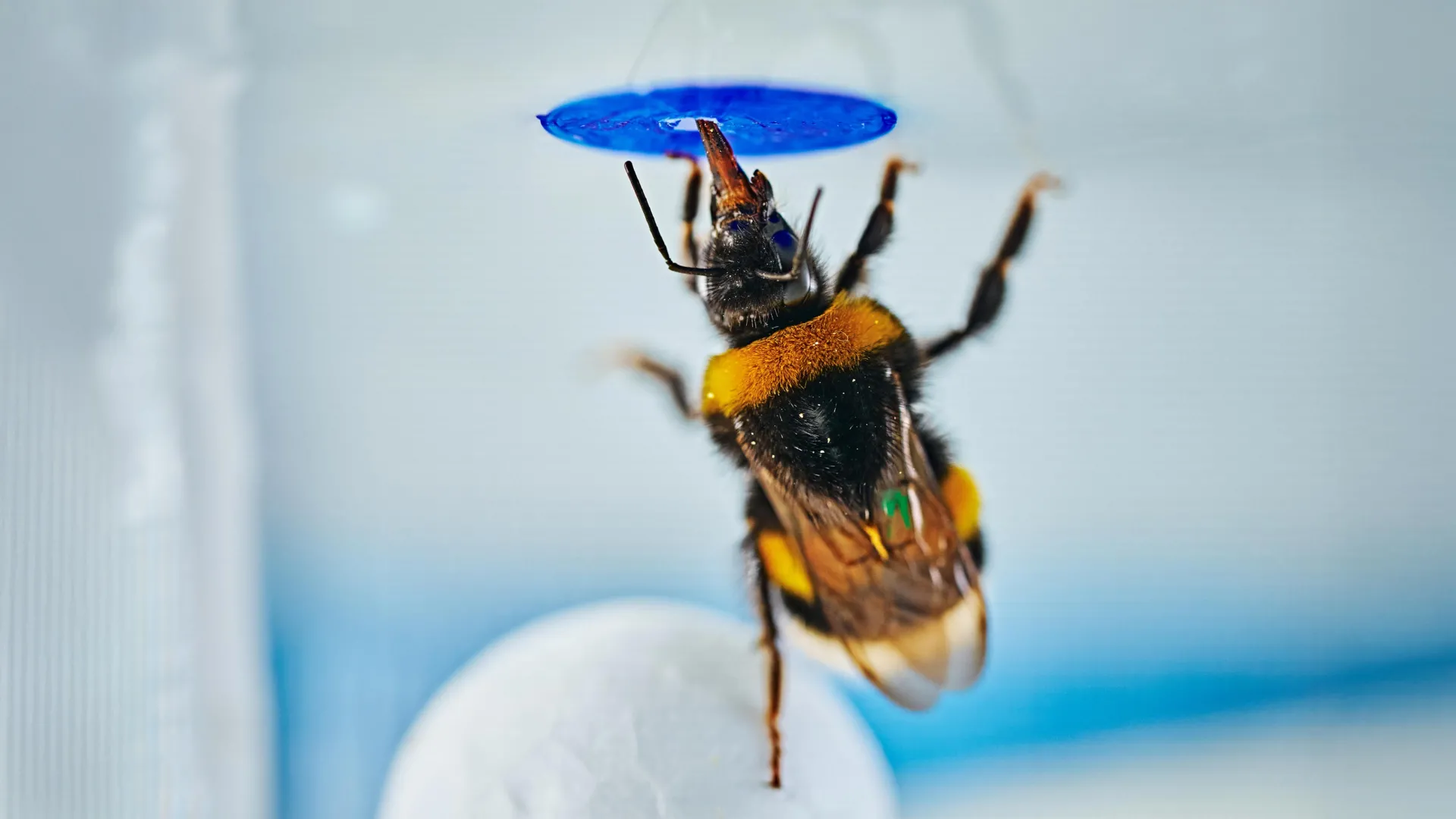
In a landmark study that challenges over a century of established cognitive theory, researchers have demonstrated that bumble bees are capable of spontaneous, goal-directed problem solving previously thought to be the exclusive domain of humans and large-brained vertebrates. The research, conducted by a collaborative team from the University of Oulu, the University of Helsinki, and the University of Turku in Finland, was published in the journal Science on June 4, 2026. The study reveals that the common bumble bee (Bombus terrestris) can navigate a complex, multi-step challenge involving object manipulation without any prior training or social demonstration, suggesting that the architecture of "intelligence" does not strictly depend on the sheer volume of neural matter.
For decades, the scientific community has looked to the "box-and-banana" experiments conducted by psychologist Wolfgang Köhler in the early 20th century as the gold standard for animal insight. Köhler observed that chimpanzees, when faced with a reward out of reach, could suddenly realize that stacking crates would allow them to reach the goal. This "aha" moment was categorized as spontaneous problem solving—a cognitive leap where an animal combines known elements of its environment in a novel way to achieve a specific objective. Until now, such feats were largely documented only in primates, cetaceans, and certain highly intelligent bird species like New Caledonian crows. The revelation that an insect with a brain the size of a poppy seed can perform a functionally equivalent task marks a paradigm shift in the field of comparative psychology.
The Experimental Framework: Replicating Insight in Insects
The research team, led by Akshaye Bhambore and Olli Loukola, designed an experiment specifically intended to isolate spontaneous insight from trial-and-error learning or simple associative conditioning. The challenge presented to the bees involved a transparent arena where a blue artificial flower—a known source of sucrose reward—was attached to the ceiling, well out of the bees’ physical reach. To access the nectar, the bees had to utilize a small ball located on the floor of the arena.
The experimental design was meticulous in its "naivety" requirements. Unlike previous studies where animals might have been trained on components of a task, these bees were entirely "naïve" to the solution. They were taught only two isolated facts: that blue flowers contain rewards and that the small balls in their environment were movable, non-threatening objects. They were never shown how to move the ball toward the flower, nor were they rewarded for interacting with the ball in any specific direction prior to the test.
When introduced to the test environment, the bees were forced to innovate. The successful individuals demonstrated a clear sequence of goal-directed actions: they located the ball, rolled it across the floor until it was positioned directly beneath the ceiling-mounted flower, and then climbed atop the ball to bridge the gap and reach the reward. This sequence required the bee to understand the spatial relationship between a mobile tool (the ball) and a stationary goal (the flower), a level of abstraction that suggests a sophisticated internal model of the physical world.
Methodological Rigor and Control Measures
To ensure that the bees’ success was not the result of accidental collisions or simple visual attraction, the Finnish team implemented a series of stringent control experiments. One of the most significant variations involved hiding the flower from the bees’ direct line of sight while they were moving the ball. In these "blind" trials, the bees could not simply steer the ball toward a visible target. Instead, they had to rely on a mental representation of where the flower was located in relation to their current position.
The researchers analyzed the movement patterns of the bees using high-resolution tracking software. "What makes this behavior especially remarkable is that the bees had never been trained to roll the ball," stated lead author Akshaye Bhambore. "Their behavior appeared goal-directed, with successful individuals showing more directed movement patterns rather than the erratic, exploratory paths typical of random search behavior."
The data indicated that the bees were not merely "playing" with the objects. In control groups where no reward was present, the bees showed significantly less interest in the balls, ruling out the hypothesis that the behavior was a form of object-play. Furthermore, the speed and directness with which the bees executed the task after an initial period of exploration pointed toward a cognitive "realization" rather than the slow, incremental improvements seen in trial-and-error learning.
Historical and Scientific Context
The study of insect cognition has undergone a revolution over the last two decades. For much of the 20th century, insects were viewed as biological automatons—creatures driven entirely by hard-wired instincts and simple reflexive responses to environmental stimuli. This view began to crumble as researchers discovered that bees could count, understand the concept of zero, communicate complex spatial information through the "waggle dance," and even learn to use tools by observing others.
However, "spontaneous" problem solving remained the final frontier. Social learning—where a bee copies a peer—is impressive, but it does not require the same level of individual cognitive "construction" as solving a novel problem in isolation. By successfully replicating the "box-and-banana" logic in an insect model, the Finnish researchers have bridged the gap between vertebrate and invertebrate intelligence.
The bumble bee brain contains approximately one million neurons. In contrast, the human brain contains roughly 86 billion, and even the chimpanzees studied by Köhler possess several billion. The fact that the same functional outcome (spontaneous problem solving) can be achieved with a brain that is several orders of magnitude smaller suggests that neural efficiency and specialized circuit architecture may be more important for complex cognition than total neuron count.
Official Responses and Academic Implications
The academic community has reacted with a mixture of surprise and validation. Dr. Olli Loukola, the senior author of the study, emphasized that while these findings are revolutionary, they should be interpreted with scientific caution. "We are not claiming that bees think like humans," Loukola noted. "But our findings show that miniature brains can generate flexible solutions to novel problems in ways we are only beginning to understand."
Co-author Ece Nur Akmeşe, from the University of Helsinki, described the experience of observing the bees as "genuinely fascinating." She noted that the transition from aimless exploration to a "highly efficient sequence of actions" was often sudden, mirroring the "insight" descriptions found in primate literature.
Independent experts in the field of neurobiology suggest that this study will likely lead to a re-evaluation of how "intelligence" is defined in biological systems. If spontaneous problem solving can emerge from the relatively simple neural networks of an insect, it implies that the capacity for flexible, goal-oriented behavior may be an ancestral trait or a common evolutionary solution to environmental complexity, rather than a late-stage development reserved for "advanced" mammals.
Broader Impact: From Evolution to AI
The implications of this research extend beyond the realm of entomology. In the field of evolutionary biology, the study suggests that the "cognitive toolkit" required for survival in complex environments might be more universal than previously assumed. Bumble bees face high-stakes decisions every day, navigating changing landscapes, identifying the most rewarding flowers, and managing the energy demands of the colony. Spontaneous problem solving would provide a significant survival advantage in an unpredictable environment.
In the realm of technology and Artificial Intelligence (AI), the bee’s ability to solve problems with minimal "hardware" is of intense interest. Modern AI models, such as Large Language Models (LLMs), require massive amounts of data and computational power to simulate reasoning. Engineers and roboticists are increasingly looking toward "neuromorphic" computing—systems inspired by the efficiency of insect brains—to create autonomous robots that can navigate and solve problems in real-time without relying on massive server farms.
Furthermore, the study carries weight in the ongoing discussions regarding animal welfare and conservation. As evidence of insect sentience and cognitive complexity grows, it challenges the ethical frameworks that often exclude invertebrates from protection. Understanding that bees are capable of what looks like "insight" adds a new layer of urgency to efforts to protect them from habitat loss, pesticide use, and climate change.
Conclusion and Future Directions
The study by Bhambore, Loukola, and their colleagues serves as a definitive marker in the timeline of cognitive science. By proving that bumble bees can spontaneously use tools to solve novel problems, the researchers have dismantled the long-standing "large-brain" requirement for complex reasoning.
The next phase of research will likely focus on the specific neural pathways involved in this behavior. Scientists hope to use advanced imaging techniques to observe the bee’s brain activity during the "eureka" moment to determine how different regions—such as the mushroom bodies, which are associated with learning and memory—interact to produce a novel solution.
As the study concludes, "For over a century, spontaneous object-based problem-solving has mostly been studied in vertebrates. Our study suggests insects may belong in that conversation too." This shift in perspective ensures that the humble bumble bee will no longer be seen as a mere pollinator, but as a sophisticated thinker capable of navigating a complex world through a unique and highly efficient form of intelligence.