In a landmark achievement for the field of quantum metrology, a team of researchers at Imperial College London has successfully demonstrated a prototype quantum sensor capable of overcoming the primary technical barrier to detecting the universe’s most elusive phenomena. The study, published in the journal Nature, provides the first real-world evidence that a sophisticated noise-cancellation technique—previously confined to theoretical models and idealized laboratory simulations—can function effectively in the complex environment required for large-scale physics experiments. By utilizing two long-baseline atom interferometers in tandem, the researchers have shown that it is possible to strip away overwhelming experimental noise to reveal incredibly faint signals, potentially opening a new window into the "dark" sectors of the cosmos.
The breakthrough is a cornerstone of the Atom Interferometer Observatory and Network (AION), a UK-wide collaborative initiative led by Imperial College London. The project aims to harness the peculiar laws of quantum mechanics to build sensors with unprecedented sensitivity. These sensors are designed to detect the subtle "whispers" of gravitational waves from the early universe and the influence of dark matter, the mysterious substance that constitutes approximately 85% of the matter in the universe but has never been directly observed.
The Challenge of the Quantum Whisper
For decades, the search for dark matter and new gravitational wave sources has been a pursuit of signal extraction. Current detectors, such as the Laser Interferometer Gravitational-Wave Observatory (LIGO) in the United States and Virgo in Italy, have successfully detected gravitational waves from massive events like black hole mergers. However, these instruments are optimized for a specific frequency range. There exists a vast "mid-band" of frequencies—where signals from the early universe or lighter dark matter particles might reside—that remains invisible to current technology.
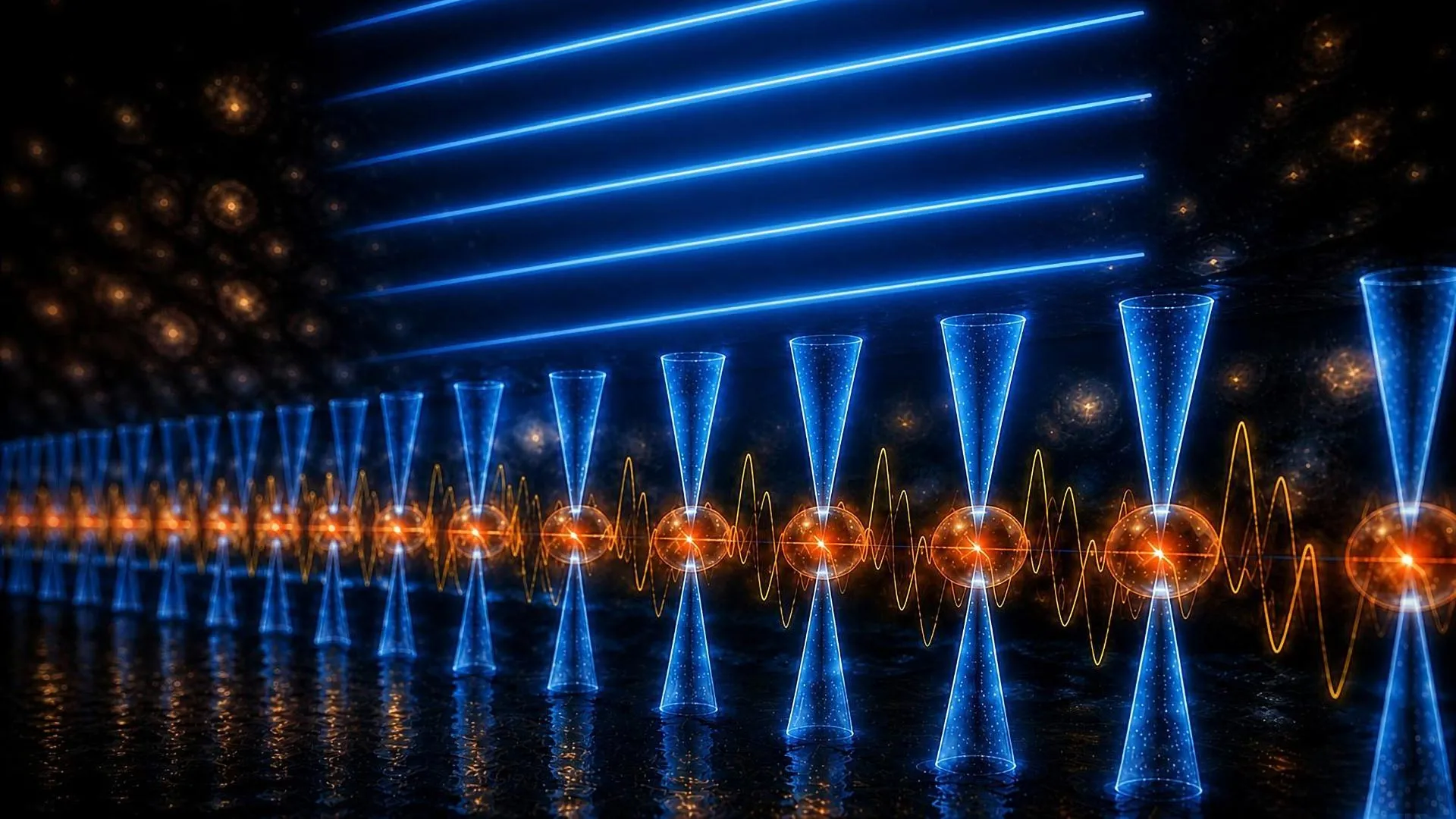
To probe these regions, scientists have turned to atom interferometry. Unlike traditional interferometers that use light to measure changes in distance, atom interferometers use the wave-particle duality of atoms. Clouds of ultracold atoms, cooled to temperatures just above absolute zero, are manipulated by laser pulses. These lasers act as "gratings," splitting the atomic wave packets and then recombining them. The resulting interference pattern is highly sensitive to any force acting on the atoms, such as gravity or interactions with hypothetical dark matter fields.
However, the very tool used to measure the atoms—the laser—presents a significant obstacle. Lasers suffer from "phase noise," which results from microscopic fluctuations in the light’s frequency and timing. In a long-baseline setup, where atoms might be separated by hundreds of meters or even kilometers, this laser noise is often millions of times stronger than the signal scientists are trying to detect. This noise effectively "blinds" the sensor, making it impossible to distinguish a cosmic signal from the jitter of the equipment.
A Breakthrough in Noise Cancellation
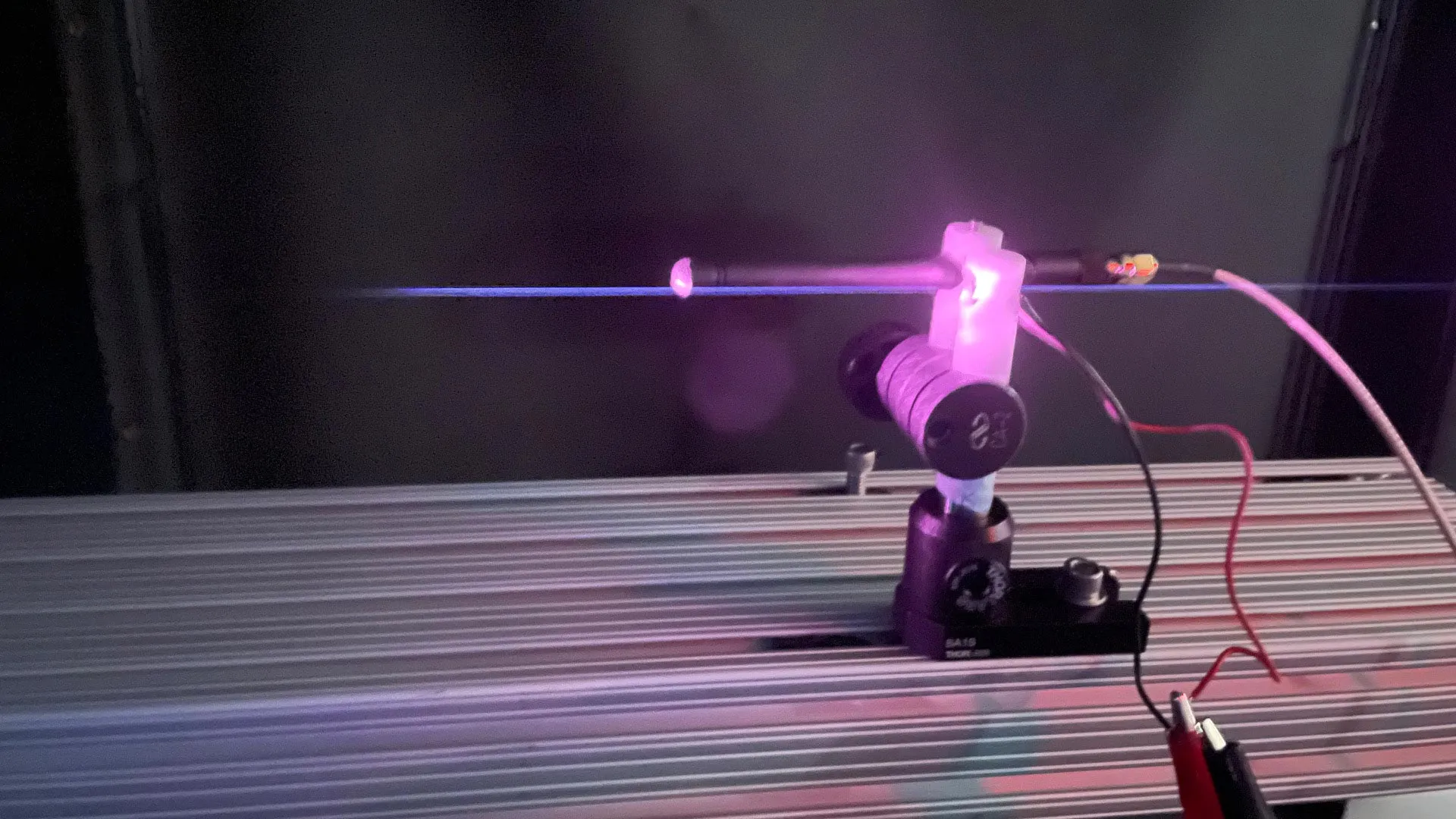
The research team at Imperial College London, operating within the Ultracold Strontium Laboratory, addressed this "blindness" by implementing a dual-interferometer system. The concept relies on a shared-mode architecture: by using the same laser to interrogate two separate clouds of strontium-87 atoms located at different points along a vertical or horizontal axis, the laser noise becomes a "common-mode" error. Because the noise affects both clouds identically, comparing the outputs of the two interferometers allows the noise to be subtracted, leaving only the differential signal between the two locations.
To rigorously test this, the researchers deliberately introduced extreme levels of artificial phase noise into their system—far exceeding the noise levels of standard laboratory lasers. Under these conditions, the data from a single interferometer appeared as a chaotic, random mess. However, when the data from both sensors were analyzed together, the noise vanished.
"The relationship between the two datasets revealed the system’s true behavior," the researchers noted. The team successfully recovered signals that were completely buried, reaching the fundamental sensitivity limit imposed by the laws of quantum physics, known as the Standard Quantum Limit. To further validate the system, they introduced a simulated "signal"—a tiny oscillation designed to mimic the effect of a passing gravitational wave or a dark matter field. Even when the noise was so loud that the signal was invisible to individual sensors, the dual-system approach identified it with remarkable clarity.
Chronology of Development and Global Collaboration
The path to this demonstration has been a multi-year journey of engineering and theoretical refinement. The AION collaboration was established to bridge the gap between small-scale laboratory experiments and massive international facilities.
- 2019–2021: The AION project received significant backing from the UK’s Quantum Technologies for Fundamental Physics (QTFP) program, a joint initiative by the Science and Technology Facilities Council (STFC) and the Engineering and Physical Sciences Research Council (EPSRC). During this phase, the theoretical framework for noise-resilient strontium interferometry was refined.
- 2022–2023: Construction and calibration of the tabletop prototype at Imperial College London. The team focused on using strontium-87, an isotope prized for its stable electronic transitions, which are also used in the world’s most accurate atomic clocks.
- 2024: The successful "stress test" of the noise-cancellation protocol and the subsequent publication in Nature, marking a transition from experimental proof-of-concept to a viable technology roadmap.
This work does not exist in isolation. It is part of a burgeoning global network. The AION team works in close coordination with the MAGIS (Matter-wave Atomic Gradients sensor Interferometric Sensor) project based at Fermilab in the United States. While AION focuses on the UK infrastructure, MAGIS-100 is currently under construction in a 100-meter-deep shaft at Fermilab, utilizing the same strontium-based interferometry principles demonstrated by the Imperial team.
Official Responses and Scientific Impact
The success of the prototype has drawn praise from the leadership of the AION collaboration and the wider physics community. Dr. Charles Baynham, co-lead of the Ultracold Strontium Laboratory, emphasized the shift from theoretical potential to practical reality. "We’ve known for a long time that quantum sensors can help us understand the universe, but it’s only recently that it’s become possible to build them with the resolution needed," Baynham stated.
Professor Oliver Buchmueller, the Principal Investigator of AION, highlighted the strategic importance of the findings. "This work marks an important milestone towards future large-scale quantum sensors for fundamental physics. It demonstrates, under realistic experimental conditions, a key technique relevant for next-generation atom interferometer facilities currently under development internationally."
The implications of this successful noise cancellation are profound for several areas of physics:
- Dark Matter Detection: Many models of dark matter suggest it could take the form of an ultralight field that causes fundamental constants, like the mass of the electron, to oscillate slightly. These oscillations would change the energy levels in atoms, a change that atom interferometers are uniquely positioned to measure.
- Mid-Band Gravitational Waves: By scaling these sensors to lengths of 10 meters, 100 meters, or more, scientists can detect gravitational waves in the 0.1 Hz to 10 Hz range. This would allow for the observation of intermediate-mass black hole mergers and provide a "heads-up" to LIGO for upcoming events.
- Testing General Relativity: The precision of these sensors allows for new tests of the Equivalence Principle—the idea that all objects fall at the same rate in a vacuum—at the quantum level.
The Roadmap to CERN and Beyond
The ultimate goal of the AION collaboration and its international partners is the construction of a kilometer-scale detector. One of the most ambitious proposals is the Atom Interferometry CERN Experiment (AICE). If greenlit, AICE would utilize the existing infrastructure at CERN, the world’s leading particle physics laboratory, to house a massive quantum sensor.
Such a facility would represent one of the largest quantum experiments ever attempted. By placing atom interferometers at great distances from one another—potentially linked by long-range laser links—scientists could achieve a level of sensitivity that would make the "invisible" universe visible.
Dr. Richard Hobson, co-lead at the Imperial lab, pointed out that the current experiment, while a prototype, is the essential first step toward these "Big Science" projects. "Our current experiment is just a prototype, but scaling it to a full-scale facility at laboratories such as CERN or Fermilab will allow us to tackle some of the deepest mysteries in physics," Hobson said.
Analysis of Implications for the Scientific Community
The Imperial College London demonstration serves as a de-risking event for multi-million-pound investments in quantum infrastructure. By proving that laser noise—once considered a potential "showstopper" for long-baseline atom interferometry—can be systematically eliminated, the researchers have provided the "green light" for the next phase of construction.
Furthermore, this research underscores a shift in how dark matter is hunted. For decades, the focus was on "WIMPs" (Weakly Interacting Massive Particles) using large underground tanks of liquid xenon. As those experiments have yet to find a definitive signal, the physics community is increasingly looking toward "wave-like" dark matter. The Imperial prototype proves that quantum sensors are the right tools for this new frontier.
As the AION collaboration continues to expand—incorporating experts from the Universities of Birmingham, Cambridge, Liverpool, King’s College London, Oxford, and the STFC Rutherford Appleton Laboratory—the focus now shifts to engineering challenges: maintaining vacuum stability over long distances and further cooling atom clouds to the pico-Kelvin regime. With the noise-cancellation hurdle largely cleared, the path to a new era of quantum-enabled astronomy is now clearly defined.