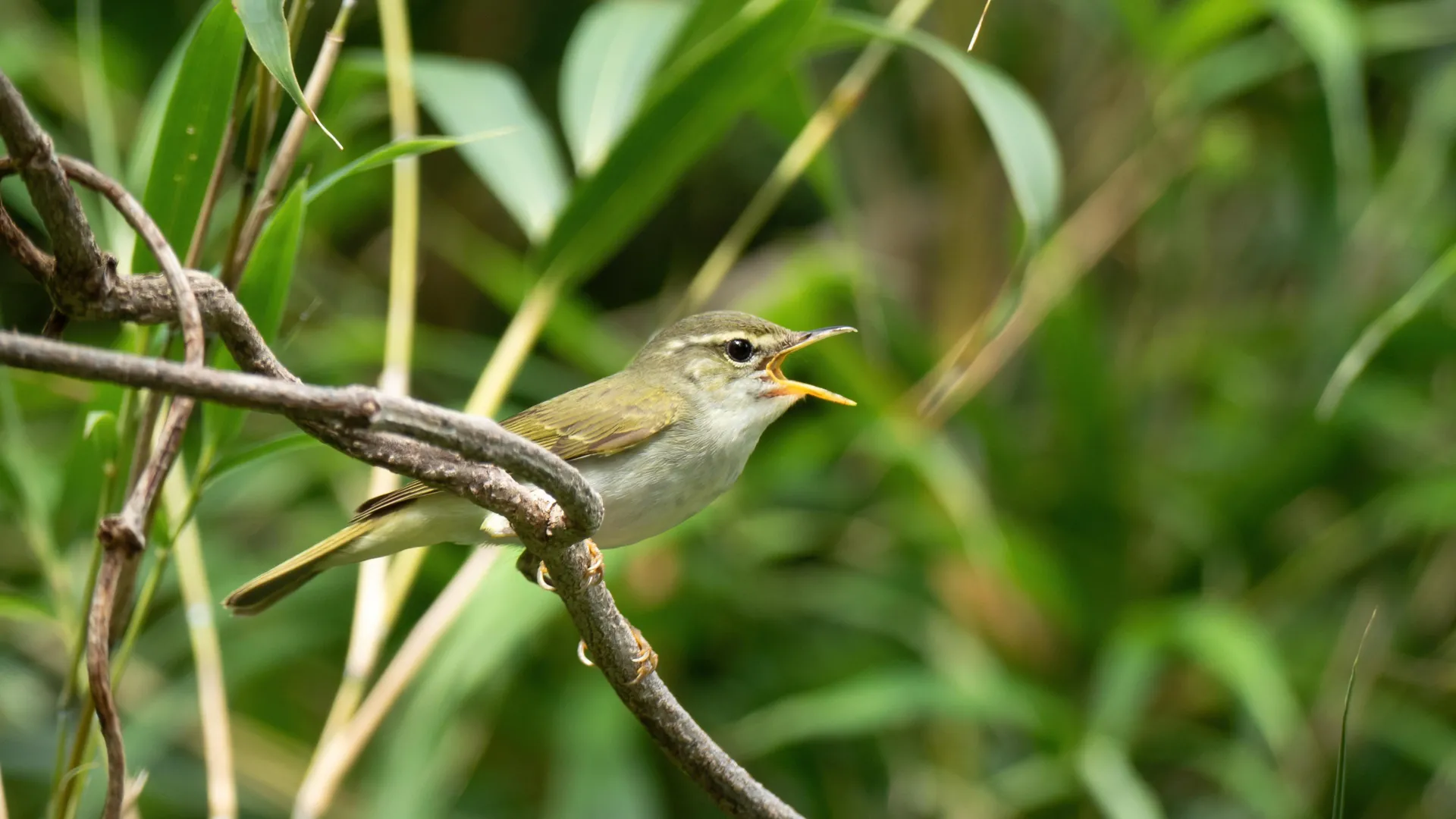
The quiet rustling of leaves in Japan’s remote island archipelagos has revealed a profound secret: a previously unrecognized bird species, the Tokara Leaf Warbler, has been formally identified after rigorous genetic analysis demonstrated it to be distinct from its close relative, the Ijima’s Leaf Warbler. This groundbreaking discovery, the first new bird species described in Japan since 1982, underscores the critical role of modern genetic techniques in uncovering hidden biodiversity, particularly in an era facing an escalating global biodiversity crisis.
The distinction between the two bird populations, initially observed a decade ago, was not apparent to the naked eye. Both the Ijima’s Leaf Warbler (Phylloscopus ijimae) and its newly identified counterpart, the Tokara Leaf Warbler (Phylloscopus tokaraensis), share nearly identical physical characteristics. It was only through painstaking DNA sequencing and comprehensive genomic analysis, complemented by detailed studies of their vocalizations and extensive fieldwork, that scientists could definitively delineate the two as separate species. This finding, spearheaded by an international collaboration of researchers from Uppsala University, the University of Gothenburg, and two leading Japanese scientific institutions, offers a compelling case study in the power of molecular biology to illuminate the natural world.
The Genesis of Discovery: A Decade of Scientific Inquiry
The journey to identify the Tokara Leaf Warbler began approximately ten years ago when initial genetic surveys of birds inhabiting the Izu Islands, situated south of Tokyo, and the Tokara Islands, located approximately 1,000 kilometers southwest, hinted at a divergence. These two island groups, while both home to the Ijima’s Leaf Warbler, presented populations with subtle but persistent genetic differences. This early observation ignited a sustained research effort, a multi-faceted investigation that spanned the subsequent decade.
The research team embarked on a rigorous program of data collection and analysis. This involved extensive fieldwork on both island chains, meticulously observing bird behavior, collecting feather and blood samples for genetic analysis, and conducting detailed acoustic recordings of their songs. The researchers also delved into the archives of natural history museums, examining existing specimens of the Ijima’s Leaf Warbler to compare their morphological and genetic profiles with the newly collected samples. This comprehensive approach was crucial to building an irrefutable body of evidence.
The pivotal moment arrived with the advent and refinement of whole genome sequencing technologies. These advanced analytical tools allowed scientists to compare the entire genetic makeup of the bird populations from the Izu and Tokara Islands. The results were conclusive: significant and consistent genetic differences were identified between the two groups, indicating a long period of evolutionary separation. These genomic findings were further corroborated by detailed comparisons of the birds’ songs. While subtle to the untrained ear, the vocalizations of the Tokara Island birds exhibited distinct patterns and frequencies compared to their Izu Island counterparts, serving as a critical behavioral marker of their speciation.
A Tale of Two Islands: Geographical Isolation and Evolutionary Divergence
The Ijima’s Leaf Warbler and the newly recognized Tokara Leaf Warbler are endemic to two distinct island groups within Japan’s vast archipelago. The Izu Islands, a volcanic chain stretching south from Tokyo Bay, provide one habitat. The Tokara Islands, a more remote and geologically younger chain further to the southwest, form the other. This geographical separation, spanning a considerable distance, has evidently played a crucial role in the evolutionary divergence of these two avian populations.
The Tokara Islands, in particular, present a challenging environment for species survival. The combined land area of the twelve islands that comprise the archipelago is a mere 100 square kilometers, a footprint smaller than that of the Swedish island of Fårö. This limited landmass means that any species inhabiting these islands faces inherent constraints on population size and genetic diversity.
Genetic Insights: Unraveling Hidden Biodiversity
The significance of this discovery extends far beyond the identification of a new species. It serves as a powerful testament to the importance of employing advanced genetic methodologies in conservation science. "This shows how important it is to use genetic methods to reveal hidden biodiversity at a time of global biodiversity crisis," stated Dr. Per Alström of Uppsala University, a lead researcher in the discovery. "These methods can help provide more complete knowledge on which to base future nature conservation efforts."
The research highlights a phenomenon known as cryptic speciation, where distinct evolutionary lineages exist within populations that are morphologically indistinguishable. In such cases, traditional taxonomic methods, relying heavily on physical characteristics, can overlook these hidden divergences. Genetic analysis, however, can pierce this veil of similarity, revealing deep-seated evolutionary histories and reproductive isolation.
The limited genetic diversity observed in both the Ijima’s Leaf Warbler and the Tokara Leaf Warbler is a cause for concern. Low genetic diversity can render populations more susceptible to environmental fluctuations, habitat degradation, and the emergence of diseases. However, the researchers also noted encouraging signs that both populations may have experienced some degree of recovery following earlier declines, suggesting a degree of resilience despite their vulnerabilities.
Conservation Imperatives: Protecting Two Vulnerable Island Endemics
The official description of the Tokara Leaf Warbler as a new species immediately elevates its conservation status. The Ijima’s Leaf Warbler is already classified as "Vulnerable" by the International Union for Conservation of Nature (IUCN) and is afforded special protection in Japan as a "Natural Monument." Given that the Tokara Leaf Warbler appears to be at least as rare as its Ijima counterpart, the research team strongly recommends that it also be granted "Vulnerable" status.
This recommendation is rooted in the inherent fragility of island ecosystems and the limited population sizes of both species. The small, isolated habitats mean that any negative impact, whether from climate change, invasive species, or human development, can have disproportionately severe consequences.
The researchers emphasize the critical need for ongoing monitoring of both bird populations. Continuous observation will be essential for tracking population trends, detecting early signs of decline, and implementing timely conservation interventions. This proactive approach is vital for ensuring the long-term survival of these unique and rare island birds. The discovery serves as a stark reminder that even in well-studied regions, the natural world still holds profound secrets, and dedicated scientific inquiry remains indispensable for understanding and protecting the planet’s rich tapestry of life.
Broader Implications: Genetic Tools in the Fight for Biodiversity
The identification of the Tokara Leaf Warbler is not merely a localized scientific achievement; it carries significant implications for global biodiversity conservation efforts. The methodologies employed – combining genetic analysis, bioacoustics, and extensive fieldwork – represent a powerful toolkit for uncovering hidden biodiversity in various taxa and ecosystems worldwide.
In an era where biodiversity loss is accelerating at an alarming rate, driven by habitat destruction, climate change, and pollution, the ability to accurately identify and delineate species is paramount. Conservation strategies, resource allocation, and policy decisions hinge on a precise understanding of what exists and where. Genetic tools offer an unparalleled capacity to resolve taxonomic uncertainties, reveal cryptic species, and assess the genetic health and distinctiveness of populations.
The research team’s findings offer a compelling argument for increased investment in genetic research and capacity building within conservation organizations and governmental agencies. By embracing these advanced techniques, scientists can paint a more accurate picture of Earth’s biological heritage, enabling more targeted and effective conservation actions. The case of the Tokara Leaf Warbler underscores the reality that many species may exist undetected, their unique evolutionary trajectories and ecological roles yet to be understood, highlighting the urgent need for continued exploration and scientific diligence in the face of unprecedented environmental challenges. The success of this endeavor serves as an inspiration and a blueprint for future discoveries that could be critical in safeguarding the planet’s invaluable biodiversity.