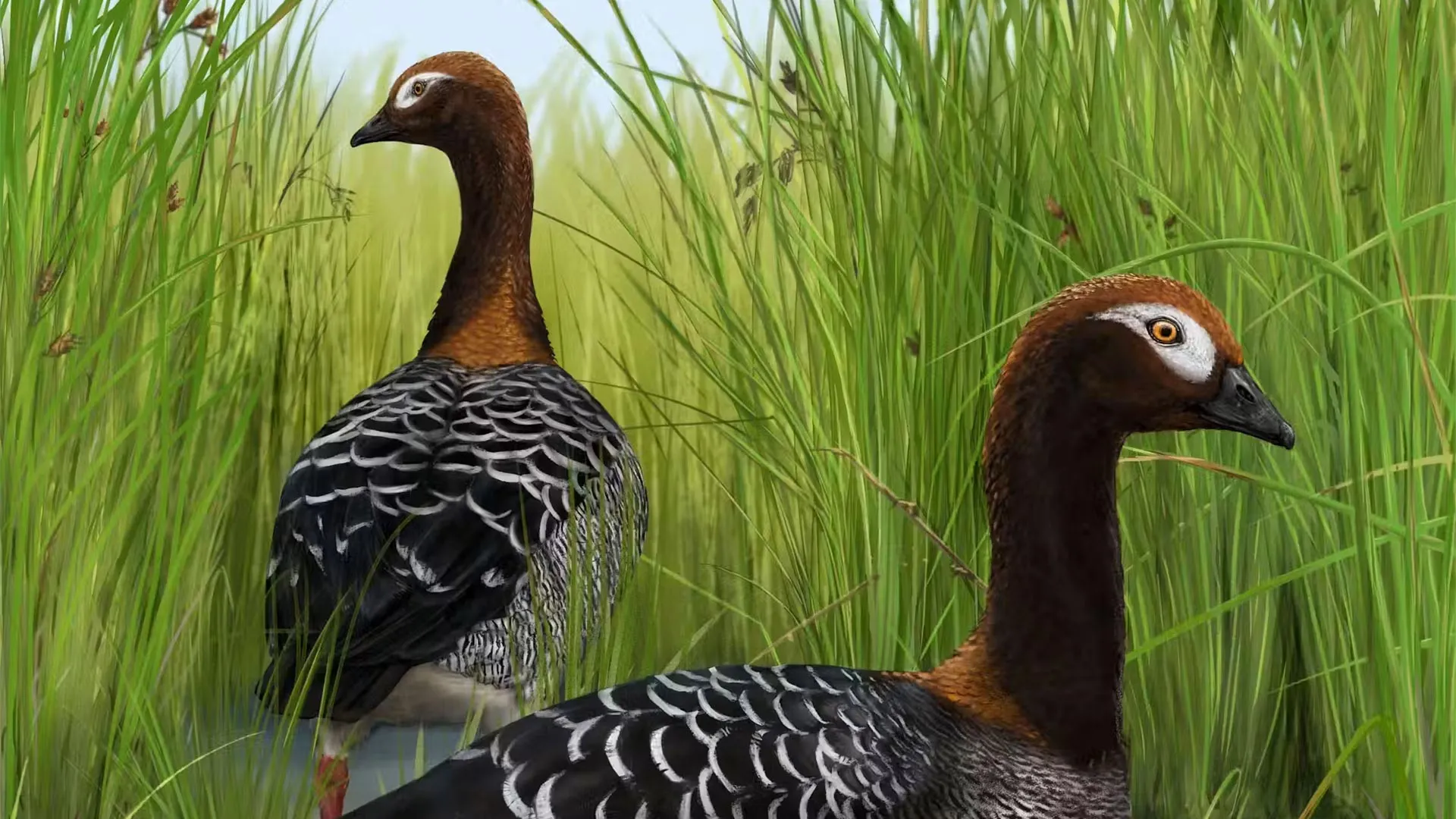
The discovery of a previously unknown species of fossil goose, unearthed from the ancient lakebed sediments of Central Otago, is profoundly reshaping scientific understanding of avian evolution in Aotearoa, New Zealand. Researchers from the University of Otago – ÅŒtÄkou Whakaihu Waka, in collaboration with international partners, have presented compelling evidence that the origins of New Zealand’s distinct birdlife were far more complex and dynamic than previously theorised. This groundbreaking find, detailed in the esteemed scientific journal Historical Biology, adds significant weight to the growing body of evidence suggesting a more intricate and fluid evolutionary journey for the nation’s unique avifauna.
Unearthing a New Species: Meterchen luti
The new study, co-authored by Associate Professor Nic Rawlence, Director of the Otago Palaeogenetics Laboratory, centres on the detailed examination of fossil material recovered from the renowned St Bathans Fossil Site. This exceptionally rich geological deposit, located in the Manuherikia Valley of Central Otago, has long been a cornerstone for understanding New Zealand’s prehistoric past, particularly its extinct vertebrate fauna. While waterfowl fossils are a common finding at St Bathans, the remains of geese have historically been considerably scarcer, prompting a deeper investigation by the research team.
Recognising the potential for overlooked discoveries, the international team, comprising experts from the University of Otago, the Museum of New Zealand Te Papa Tongarewa, and the University of Cambridge (UK), meticulously re-examined every fossil bone previously identified as belonging to geese. This rigorous reassessment involved a comparative analysis of these specimens against a broad spectrum of other fossil waterfowl from the St Bathans site, as well as an extensive collection of skeletal remains from both modern and extinct avian species.
"We determined that the bones included an undescribed species, the size of a small goose," stated Associate Professor Rawlence, highlighting the significance of their meticulous approach. This careful comparative anatomy and osteological analysis led to the identification of a distinct lineage, previously hidden in plain sight amongst the more abundant waterfowl fossils.
The newly identified species has been formally named Meterchen luti. The nomenclature itself carries a narrative, drawing inspiration from the classic nursery rhyme "Old Mother Goose." This choice poetically reflects the concept of an ancient goose emerging from the geological depths of a fossil deposit. The genus name, Meterchen, is derived from the ancient Greek word for "mother goose," while the species epithet, luti, is the Latin term for "of the mud," a direct nod to the sedimentary origins of its fossilised remains.
Crucially, the research indicates that Meterchen luti is not closely related to the recently extinct giant flightless New Zealand geese, scientifically known as Cnemiornis species, nor to their extant Australian relative, the Cape Barren Goose. This finding immediately challenges earlier assumptions about the evolutionary connections of geese in the region and opens new avenues of inquiry into the dispersal and diversification of waterfowl in ancient Zealandia.
A Dynamic Past: Rethinking New Zealand’s Avian Evolution
The implications of this discovery extend far beyond the identification of a new species. When considered in conjunction with recent advances in palaeogenetics and molecular evidence, the existence of Meterchen luti strongly suggests that New Zealand’s avian evolutionary history is considerably more intricate and dynamic than scientists once presumed.
Alan Tennyson, lead author of the study and a paleontologist at the Museum of New Zealand Te Papa Tongarewa, elaborated on the broader context of bird arrivals and evolution in New Zealand. He explained that while numerous bird species have successfully colonised the islands over millions of years, the ancestors of some of New Zealand’s most iconic large birds arrived surprisingly recently. This includes species such as the takahē, Forbes’ harrier, and the formidable Haast’s eagle, whose lineages trace back only four to five million years.
A prevailing theory previously posited that the St Bathans goose represented the direct ancestral lineage of the giant flightless Cnemiornis geese. This hypothesis suggested a very long evolutionary history for this lineage within Zealandia, potentially dating back at least 14 million years. Such an interpretation would have implied a deep-rooted presence of goose ancestors on the landmass that would eventually become New Zealand.
However, this earlier theory faced a significant challenge from contradictory genetic evidence. Molecular studies indicated that the ancestors of the Cnemiornis geese had arrived from Australia only about seven million years ago. This discrepancy led to the earlier theory being largely set aside by many researchers. The current rigorous reassessment of the fossil evidence, spearheaded by Tennyson and Rawlence, strongly supports the later arrival theory for the Cnemiornis lineage.
"Our rigorous reassessment supports the later arrival theory," Tennyson affirmed, underscoring the importance of integrating morphological and molecular data for a comprehensive understanding.
Chronology of Discovery and Analysis
The St Bathans Fossil Site has been a subject of scientific interest for decades, with its rich fossil deposits providing a window into the Pliocene epoch (approximately 5.3 to 2.6 million years ago) and the late Miocene (around 23 to 5.3 million years ago). Early excavations in the early 20th century, and more systematic work from the 1950s onwards, yielded a remarkable array of fossilised flora and fauna, including birds, reptiles, mammals, and fish.
The discovery of goose-like bones at St Bathans has a history of its own, with initial identifications dating back to earlier expeditions. However, the precise taxonomic status and evolutionary relationships of these specimens remained ambiguous until the present study.
Timeline of Key Developments:
- Late Miocene to Pliocene Epochs: The geological period during which the St Bathans Fossil Deposits were formed, representing ancient lake and riverine environments in Central Otago.
- Early to Mid-20th Century: Initial fossil discoveries at St Bathans, including fragments attributed to geese.
- Late 20th Century to Early 21st Century: Ongoing paleontological research at St Bathans, yielding a wealth of avian fossils, but with ongoing questions about goose taxonomy.
- Recent Years: Advances in palaeogenetics and molecular dating techniques provide new insights into avian evolution in New Zealand.
- Present Study: A comprehensive re-examination of St Bathans goose fossils by an international team, integrating morphological and comparative anatomical analysis.
- Publication in Historical Biology: The formal announcement of the discovery of Meterchen luti and its implications for New Zealand’s avian evolutionary history.
Supporting Data: The Power of Integrated Evidence
The current research exemplifies the power of a multidisciplinary approach to scientific inquiry. By combining detailed fossil analysis with the insights gleaned from modern genetic techniques, scientists are able to construct a more robust and nuanced picture of evolutionary processes.
Associate Professor Rawlence highlighted the significance of employing a comprehensive suite of analytical tools: "Using all the tools in the toolbox, including DNA and fossils, we can reconstruct how the dynamic geological, climatic and human history of Zealandia has shaped the evolution of Aotearoa fauna in ever more detail." This statement underscores the synergy between different scientific disciplines. While the direct DNA from such ancient fossils can be challenging to recover and analyse, the comparative morphology of Meterchen luti provides critical data that, when cross-referenced with genetic data from related extant and extinct species, allows for sophisticated phylogenetic reconstructions.
The St Bathans goose, Meterchen luti, represents a lineage that successfully reached Zealandia over 14 million years ago. However, its evolutionary trajectory ultimately led to extinction without leaving any surviving descendants. This underscores the fact that not all successful colonisations lead to long-term persistence or diversification. The success of a lineage is often contingent on a complex interplay of environmental factors, competition, and adaptation.
Broader Impact and Implications: A More Dynamic Zealandia
The discovery of Meterchen luti has profound implications for our understanding of how the unique avifauna of New Zealand evolved. It reinforces the concept of Zealandia not as a static evolutionary cradle, but as a dynamic landscape that has witnessed multiple waves of colonisation, diversification, and extinction over geological timescales.
The ancestors of Meterchen luti arrived in Zealandia over 14 million years ago, suggesting an ancient avian presence predating the arrival of the ancestors of some of the more recent colonisers. This ancient lineage ultimately died out, leaving no direct descendants. In contrast, the ancestors of the giant flightless Cnemiornis geese arrived much later, around seven million years ago, and underwent rapid and dramatic evolutionary changes to become the colossal birds that once roamed New Zealand.
This stark contrast highlights the differential success of various lineages and the influence of timing and environmental pressures. The relatively recent evolution of the giant flightless Cnemiornis geese serves as a particularly striking example of rapid morphological adaptation. These birds, reaching up to one metre in height and weighing up to 18 kilograms, were among the largest geese in the world. Their rapid evolution on an island environment, free from many mammalian predators, allowed for the development of flightlessness and gigantism. This phenomenon is a recurring theme in island biogeography, where isolation and unique ecological niches can drive evolutionary change at an accelerated pace.
The research team’s work suggests a pattern of avian colonisation and evolution that is far from linear. It points towards periods of significant faunal turnover, where ancient lineages may disappear, only to be replaced by more recent arrivals that then undergo remarkable evolutionary radiations. This ebb and flow of life, shaped by continental drift, climate change, and the vagaries of dispersal, paints a picture of a New Zealand avian history that is far richer and more complex than previously appreciated.
The study also serves as a crucial reminder of the ongoing process of scientific discovery. What was once an accepted narrative is constantly being refined and rewritten as new evidence emerges and analytical techniques advance. The humble fossilised bones of a small, ancient goose from Central Otago have, in this instance, provided a vital piece of the puzzle, fundamentally altering our perception of New Zealand’s unique natural heritage.
The scientific community will undoubtedly continue to explore the implications of this find, potentially leading to further investigations into the fossil record of St Bathans and other similar sites. The ongoing integration of fossil evidence with genetic data promises to unlock even more secrets about the evolutionary journeys that have shaped the extraordinary biodiversity of Aotearoa.