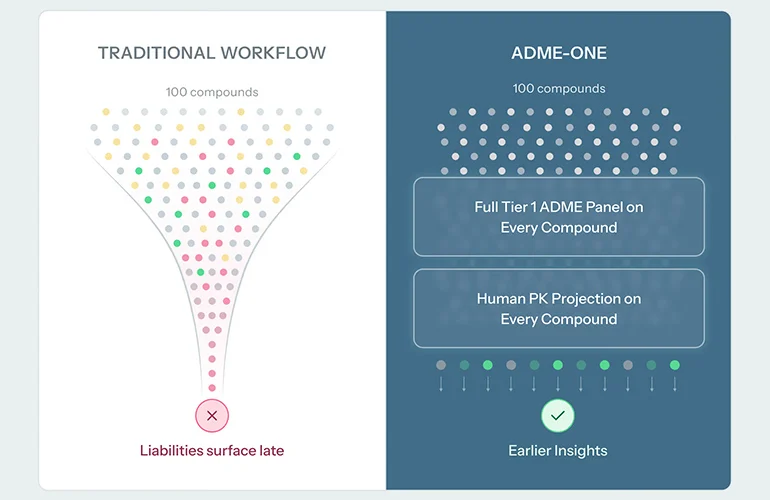
A new collaborative platform, ADME-One, has been launched by Ginkgo Datapoints, Tangible Scientific, and Inductive Bio, signaling a significant shift in the pharmaceutical industry’s approach to drug discovery. This innovative service leverages artificial intelligence (AI), advanced laboratory automation, and streamlined compound logistics to integrate comprehensive Absorption, Distribution, Metabolism, and Excretion (ADME) profiling much earlier in the drug development pipeline – specifically, at the critical hit identification (hit ID) stage, rather than the traditionally later lead optimization phase. This strategic repositioning aims to dramatically improve efficiency, reduce costs, and accelerate the identification of promising drug candidates with favorable human pharmacokinetic (PK) properties.
The Traditional Bottleneck in Drug Discovery
For decades, the drug discovery process has been characterized by a sequential, funnel-like approach. Initial stages involve identifying "hits" – molecules that show activity against a biological target. These hits are then refined into "lead compounds," which undergo extensive characterization and optimization. ADME profiling, which assesses how a drug is absorbed, distributed, metabolized, and excreted by the body, has historically been a resource-intensive step typically reserved for the lead optimization phase. This late-stage assessment often meant that significant time, effort, and financial resources were invested in compounds that ultimately failed due to poor ADME characteristics.
The "fail late, fail hard" phenomenon is a notorious challenge in pharmaceutical R&D. Industry data consistently show that a substantial percentage of drug candidates fail during preclinical and clinical development, with poor pharmacokinetics and toxicity often being primary culprits. Estimates suggest that only about 10% of compounds entering clinical trials successfully make it to market, and the average cost to develop a new drug can exceed $2 billion, including the cost of failures. Identifying ADME issues earlier can prevent the costly synthesis and testing of compounds destined for failure, thereby saving invaluable time and resources. By moving ADME assessment to the hit ID stage, medicinal chemists gain immediate insights into a compound’s potential human PK profile and estimated dose, allowing for more informed decisions and a more targeted approach to compound synthesis and optimization.
Introducing ADME-One: A Collaborative Innovation
The ADME-One platform is a testament to the power of inter-company collaboration, bringing together distinct but complementary expertise from three leading technology providers. Each partner plays a crucial role in delivering a holistic, high-throughput solution designed to address the inefficiencies of traditional ADME assessment.
Ginkgo Datapoints, a division of the renowned Ginkgo Bioworks, spearheads the automated laboratory assays. Their Boston-based facility is equipped with state-of-the-art robotics capable of running five critical Tier 1 ADME assays end-to-end: microsomal stability, cell permeability, kinetic solubility, CYP inhibition, and plasma protein binding. These assays provide fundamental data points on a compound’s behavior within biological systems. Microsomal stability indicates how quickly a compound is metabolized by liver enzymes, while cell permeability assesses its ability to cross biological membranes. Kinetic solubility determines how much of a drug can dissolve, impacting absorption. CYP inhibition identifies potential drug-drug interactions, and plasma protein binding influences a drug’s availability to reach its target. The automation implemented by Ginkgo ensures consistency, scalability, and rapid turnaround times for these crucial measurements.
Tangible Scientific contributes its expertise in sophisticated compound management workflows. In a high-throughput environment, precise tracking and handling of thousands of chemical samples are paramount. Tangible Scientific takes custody of physical samples, managing intake, plating, and real-time tracking for each order. This meticulous approach ensures sample integrity, reduces human error, and provides an unbroken chain of custody, which is vital for the reliability of experimental results and regulatory compliance. Their system ensures that the right compound reaches the right assay at the right time, a logistical challenge that can often bottleneck traditional screening efforts.
Inductive Bio completes the triumvirate with its advanced AI-powered Compass platform, which specializes in human pharmacokinetic (PK) projection. This is where the individual ADME readouts from Ginkgo’s assays are integrated and transformed into a comprehensive prediction of how a compound will behave in the human body. The Compass platform uses machine learning algorithms to synthesize data on potency, ADME properties, and other relevant factors to estimate human PK curves and even predict potential therapeutic doses. This integrated projection allows medicinal chemists to rank compounds not just by their individual properties, but by their overall potential as a viable drug candidate, providing a much-needed holistic view much earlier in the discovery process.
The Vision of Earlier PK and Dose Context
A central tenet driving the development of ADME-One is the increasing recognition among medicinal chemists that optimizing for human dose as early as possible is paramount. As Alex Taylor, Ph.D., head of medicinal chemistry at Inductive Bio, articulated, "Experienced medicinal chemists will tell you up front that dose is ultimately the thing you want to optimize for." This emphasis stems from several critical factors related to drug safety, efficacy, and patient adherence.
High daily doses, particularly when combined with high lipophilicity (fat-solubility), have been linked to increased risks of drug-induced liver injury (DILI). A notable Hepatology analysis, led by FDA-affiliated researchers, highlighted this "rule-of-two," underscoring the importance of considering dose and physicochemical properties together as a risk signal. While many high-dose drugs are safe, this relationship provides a crucial early warning. Another registry study found that drugs dosed at 50 mg per day or more carried significantly higher rates of liver failure, transplant, and death compared to those dosed below 10 mg. Beyond safety, lower doses are generally easier to formulate, leading to more patient-friendly drug products. Simpler dosing regimens, often enabled by lower and less frequent doses, are also strongly associated with better patient adherence, which directly impacts treatment success in clinical practice. Historically, gathering all the necessary data to accurately predict and optimize dose early in discovery has been a formidable challenge, largely due to data integration complexities and the sheer cost and time involved.
The ADME-One platform directly addresses this challenge by providing an early, integrated estimate of human PK and dose. This capability allows teams to evaluate compounds not just on their individual merits (e.g., high potency or good metabolic stability), but on the collective balance of their properties. Taylor pointed out that "sometimes compounds you think aren’t good enough to go forward, because they don’t meet your criteria for potency or metabolic stability, actually have a balance of all the properties such that they could go forward." The examples of triazole antifungals, fluconazole and itraconazole, vividly illustrate this point. Fluconazole is small, polar, weakly protein-bound, and renally cleared, while itraconazole is highly lipophilic, extensively protein-bound, widely distributed, and hepatically metabolized. Despite their vastly different ADME profiles, both became successful, widely used oral antifungals because their overall PK properties supported effective dosing. This highlights the value of an integrated PK projection over a siloed, assay-by-assay scorecard.
The Economic Imperative: Cost, Speed, and Automation
The pharmaceutical industry operates under intense economic pressure, with calls to "stay lean, be cost-competitive, be cost-conscious" echoing across the sector. This pressure has long necessitated the "screening-funnel approach," where costly, comprehensive assessments are delayed until only a few candidates remain. However, this strategy also limits the breadth of data available early on, potentially leading to the pursuit of suboptimal compounds. The ADME-One platform aims to break this paradigm by making early, comprehensive ADME and PK data economically viable for a much larger number of compounds.
The underlying shift in economics is largely attributable to advancements in laboratory automation. As Taylor noted, "The ability to run many compounds, a whole plate full, using the robotics on a weekly basis and turn that around in an automated way, that’s what’s made the difference." Automation drastically reduces the per-sample cost and accelerates turnaround times from weeks to days, transforming what was once a prohibitively expensive and slow process into an accessible, high-throughput service.
Furthermore, the ADME-One platform’s pricing strategy is designed to be competitive, positioning itself below industry standards and even challenging offshore Contract Research Organizations (CROs). This aggressive pricing is a direct response to broader geopolitical and economic trends, including the increasing demand for data sovereignty and a push by U.S. and European developers to repatriate preclinical work. Legislation like the BIOSECURE Act further incentivizes bringing R&D activities back onshore, emphasizing security and control over sensitive biological and chemical data. By offering a fully U.S.-based workflow with rapid results, ADME-One caters to these evolving industry needs, providing a secure, efficient, and cost-effective alternative.
Data Security and the Consortium Model
The integration of AI and machine learning into drug discovery, particularly when involving proprietary chemical matter, raises critical questions about data security and intellectual property. Inductive Bio has addressed this through a carefully constructed "consortium model" that operates independently of the three-company ADME-One partnership. This legal framework allows multiple partners to securely pool their data without any single partner gaining visibility into another’s specific compounds or results.
This pooled, anonymized data is crucial for training and continuously improving Inductive Bio’s global machine learning models. When a customer contributes their own experimental results, Inductive Bio then fine-tunes a local model on top of the global one, a process that Alex Taylor states usually delivers "a strong performance gain." Significant engineering effort has been invested to ensure that the pooled data is impossible to reverse-engineer, preventing any partner from deducing information about other compounds within the consortium. This robust security architecture is vital for fostering trust and encouraging participation from pharmaceutical companies who are highly protective of their proprietary chemical libraries.
Towards a Virtuous Cycle in Drug Design
The ultimate payoff of the ADME-One platform and Inductive Bio’s consortium model is the creation of a "virtuous cycle" in drug discovery. This continuous feedback loop begins with medicinal chemists designing new molecules on the Inductive platform, where they can immediately visualize predicted ADME parameters and how these translate into a human PK curve. This real-time predictive insight allows chemists to make informed decisions about which compounds to prioritize for synthesis, focusing on those with the most favorable predicted profiles.
Once selected compounds are synthesized, they enter the ADME-One platform, moving through Tangible Scientific’s management system to Ginkgo Datapoints’ automated assays. The resulting experimental ADME data is then fed back into Inductive Bio’s Compass platform, where it is used to validate and refine the initial human PK predictions. This empirical feedback helps to train and improve the underlying AI models, making them more accurate for future compound designs. As Taylor explains, "That helps train the models, makes them better the next time people are designing compounds, and it improves from there." This self-reinforcing process means that the platform becomes progressively more intelligent and effective with each new data point, fostering a "flywheel" effect where broader chemical matter continually enriches the global models, benefiting all participants.
AI as a Prioritization Tool, Not a Replacement for Science
Despite the advanced capabilities of AI and automation, Alex Taylor firmly positions their role as powerful prioritization tools, not as substitutes for empirical scientific inquiry. "Drug discovery is science at the end of the day, and science is not engineering," he asserted. "There’s still so much that needs to happen empirically. You can give your best guess of what a compound is going to do, but at the end of the day you need to reduce it to practice, synthesize it, and test it."
This perspective highlights the practical utility of prediction in a resource-constrained environment. Drug synthesis is inherently time-consuming and expensive. The ability to predict key ADME and PK parameters significantly improves the chances of selecting the most promising compounds for synthesis, ensuring that limited budgets and timelines are allocated to candidates with the highest probability of success. In essence, AI helps drug discovery teams make smarter, more data-driven bets, allowing them to focus their efforts on compounds that are most likely to yield a successful drug, thereby accelerating the entire discovery process while mitigating risk.
Broader Impact and Future Outlook
The launch of ADME-One represents a significant step forward in the ongoing digitalization and automation of drug discovery. By democratizing access to early, comprehensive ADME and PK insights, it has the potential to level the playing field for smaller biotechs and academic labs, enabling them to compete more effectively with larger pharmaceutical companies that traditionally had exclusive access to such sophisticated capabilities. This could foster greater innovation and diversification within the drug discovery ecosystem.
The shift towards early ADME and PK assessment is poised to reduce the high attrition rates typically seen in drug development, leading to more efficient pipelines and a greater probability of bringing novel therapies to patients faster. As the industry continues to embrace AI and automation, platforms like ADME-One will become increasingly critical, transforming drug discovery from a laborious, trial-and-error process into a more predictive, data-driven science. The consortium model’s ability to securely pool and leverage diverse chemical data also sets a precedent for collaborative innovation in a highly competitive field, demonstrating that shared insights, under the right framework, can benefit all.