The quest to reconcile the macroscopic world of gravity with the microscopic world of quantum mechanics has long been the "Holy Grail" of theoretical physics. For nearly half a century, this conflict has been most visible in the black hole information paradox—a theoretical stalemate that suggests either our understanding of gravity or our understanding of quantum physics is fundamentally incomplete. However, a groundbreaking study led by researcher Richard Pinčák and published in the journal General Relativity and Gravitation proposes a sophisticated solution that utilizes seven-dimensional geometry to bridge these gaps. By introducing spacetime torsion into a higher-dimensional framework, the research not only provides a mechanism to preserve quantum information but also identifies a startling connection to the Higgs field, potentially solving the "mass hierarchy problem" that has puzzled particle physicists for decades.
The Historical Conflict: Hawking’s Paradox and the Limits of Relativity
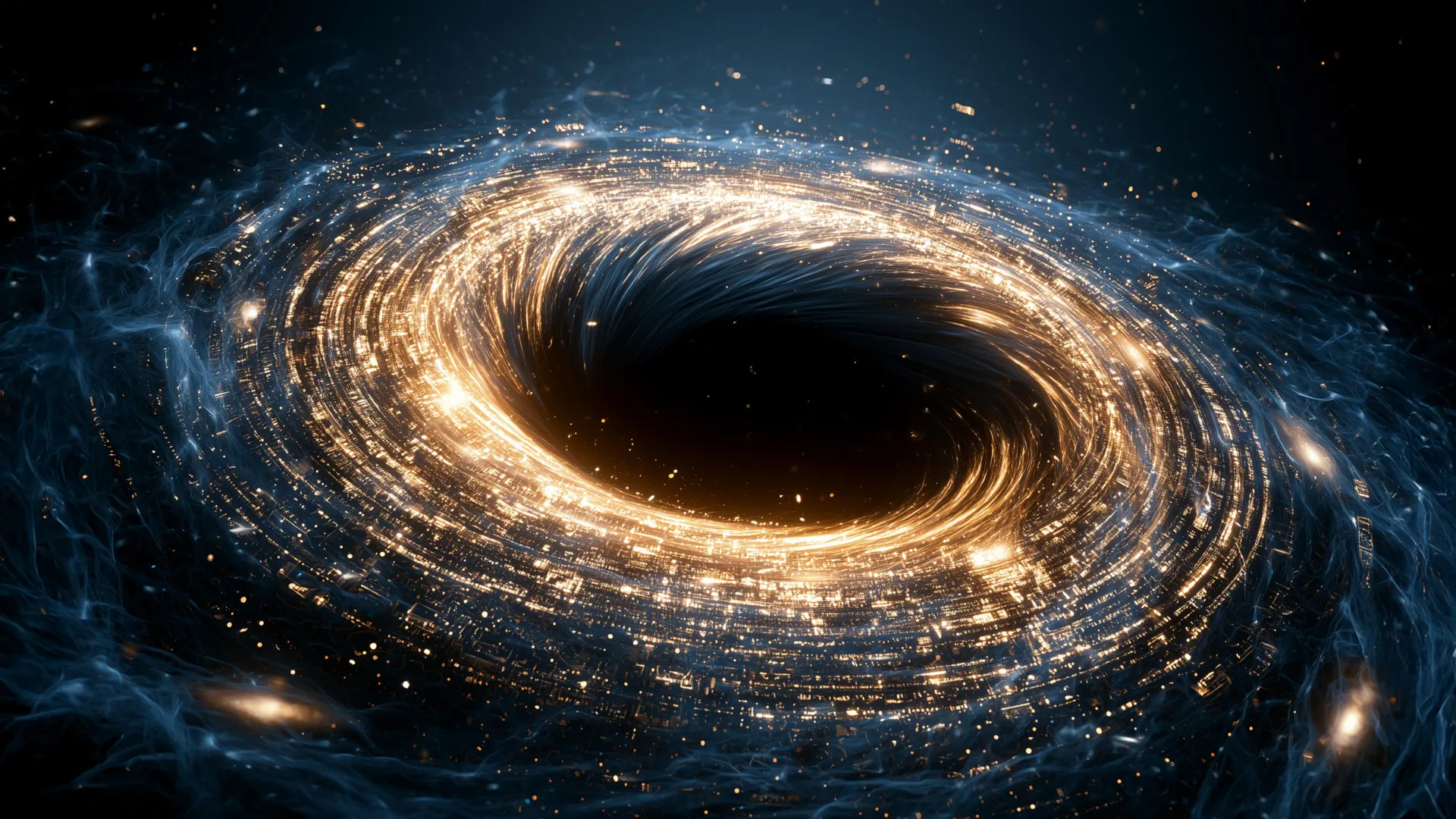
To understand the significance of Pinčák’s work, one must look back to 1974, when Stephen Hawking applied quantum field theory to the curved spacetime surrounding a black hole. Hawking’s calculations revealed that black holes are not truly "black" but instead emit a steady stream of thermal radiation, now known as Hawking radiation. This process implies that black holes lose mass over time, eventually evaporating and vanishing from the universe entirely.
The crisis emerged when physicists realized the implications of this evaporation for quantum mechanics. A core tenet of quantum theory is "unitarity," the principle that information about the state of a system must be preserved over time. If an object—such as a book or a star—falls into a black hole, and that black hole later evaporates into featureless thermal radiation, the information contained within the original object appears to be destroyed. This direct violation of quantum laws created the black hole information paradox, leading to decades of debate over whether information is truly lost, trapped in a different dimension, or leaked out in a way we cannot yet detect.
A Geometric Solution: Einstein-Cartan Theory and Spacetime Torsion
The study by Pinčák and his team departs from standard General Relativity by employing Einstein-Cartan theory. While Albert Einstein’s original theory describes gravity as the curvature of four-dimensional spacetime, Einstein-Cartan theory—developed in the 1920s—adds a second geometric property: torsion. If curvature is the "bending" of spacetime, torsion can be visualized as the "twisting" of spacetime.
In the newly published framework, this torsion is not merely a mathematical curiosity but a fundamental force that becomes dominant at the Planck scale—the smallest possible scale of length in the universe. The researchers explored this theory within the context of a 7-dimensional universe, specifically utilizing a mathematical structure known as a G2-manifold.
According to the model, as a black hole collapses or evaporates toward its final stages, the density of matter reaches a point where the repulsive effects of spacetime torsion become significant. Unlike standard gravity, which is purely attractive and leads to a singularity (a point of infinite density), the torsion field generates a powerful repulsive force. This force acts as a "quantum brake," halting the evaporation process before the black hole can vanish entirely.
The Discovery of Stable Remnants and Information Storage
The most striking result of the study is the prediction of a stable "remnant." Pinčák’s calculations suggest that Hawking evaporation does not end in a total disappearance. Instead, it leaves behind a microscopic relic with a specific mass of approximately $9 times 10^-41$ kg. These remnants are incredibly light—orders of magnitude lighter than an electron—yet they are gravitationally stable.
These remnants serve as the key to resolving the information paradox. Rather than being destroyed, the quantum information that once fell into the black hole is stored within the remnant’s complex geometry. The researchers identified that information is encoded in "quasi-normal modes"—essentially long-lived vibrations of the torsion field within the remnant.
The study provides a quantitative breakthrough in this area. For a black hole with the mass of our Sun, the model predicts a storage capacity of approximately $1.515 times 10^77$ qubits of information. This figure is significant because it aligns precisely with the amount of information required to account for the total entropy of the original black hole. By transforming the black hole from a "sink" where information vanishes into a "repository" where information is vibrantly stored, the theory preserves the laws of quantum mechanics without requiring a total rewrite of gravitational physics.
Bridging the Gap to Particle Physics: The Higgs Connection
While the resolution of the information paradox is a major achievement, the study’s implications extend into the realm of the Standard Model of particle physics. One of the greatest mysteries in the field is the "mass hierarchy problem"—the question of why the Higgs field has the specific strength it does, and why fundamental particles possess their specific masses.
The research team found that when they mathematically reduced their 7-dimensional model down to the 4-dimensional spacetime we observe, a specific energy scale emerged naturally. This scale, known as the electroweak scale, is approximately 246 GeV. In particle physics, this is the "vacuum expectation value" (VEV) of the Higgs field, the mechanism that grants mass to quarks, leptons, and W and Z bosons.
In Pinčák’s model, the vacuum expectation value of the torsion field is dynamically identical to the electroweak scale. This suggests that the same geometric twisting of spacetime that prevents black holes from disappearing is also responsible for the mass of every particle in the universe. This "geometric origin of mass" provides a potential path toward a Unified Field Theory, linking the largest structures in the cosmos (black holes) to the smallest (the Higgs boson) through the shared language of higher-dimensional geometry.
Timeline of Theoretical Development
The path to this discovery has been paved by several key milestones in theoretical physics:
- 1915: Einstein publishes General Relativity, defining gravity as spacetime curvature.
- 1922-1929: Élie Cartan and Einstein develop Einstein-Cartan theory, introducing torsion.
- 1974: Stephen Hawking proposes Hawking Radiation, initiating the information paradox.
- 1980s-1990s: String theory and M-theory popularize the idea of 7-dimensional "compactified" spaces (G2-manifolds).
- 2012: The Higgs Boson is discovered at CERN, confirming the electroweak scale of 246 GeV.
- 2024: Pinčák’s study unites these disparate threads, proposing torsion in a G2-manifold as the link between black hole remnants and the Higgs field.
Experimental Challenges and Future Observations
Despite the mathematical elegance of the theory, empirical verification remains a daunting challenge. The study notes that the particles associated with these extra dimensions—known as Kaluza-Klein excitations—would possess masses of roughly $8.6 times 10^15$ GeV. To put this in perspective, the Large Hadron Collider (LHC), the world’s most powerful particle accelerator, operates at energies around $1.3 times 10^4$ GeV. The energy required to "see" these extra dimensions directly is seven orders of magnitude beyond current human technology.
However, the researchers argue that the theory can be tested through indirect astronomical means. Because these $9 times 10^-41$ kg remnants are stable and do not emit light, they are primary candidates for Dark Matter. If the universe is populated by a vast "fog" of these Planckian relics left over from primordial black holes created during the Big Bang, their cumulative gravitational effect could explain the dark matter observations that currently baffle astronomers.
Furthermore, the "vibrational signatures" (quasi-normal modes) of these remnants might have left an imprint on the Cosmic Microwave Background (CMB) or could be detectable via future, high-sensitivity gravitational wave observatories. If a mathematical signature of 7-dimensional torsion can be found in the echoes of the early universe, it would provide the first direct evidence that our universe is far more complex than the four dimensions we perceive.
Broader Impact and Scientific Implications
The scientific community generally views such "Unified Theories" with a mix of excitement and skepticism. Proponents of the study suggest that the mathematical consistency between the 7D geometric reduction and the 246 GeV electroweak scale is too precise to be a mere coincidence. If the Higgs field is indeed a manifestation of spacetime torsion, it would revolutionize our understanding of the "Standard Model," shifting it from a collection of observed particles to a necessary consequence of geometry.
Critics, however, will likely point to the "energy gap" as a major hurdle. Without the ability to probe the $10^15$ GeV scale, the theory remains, for now, in the realm of mathematical physics rather than experimental reality. Nevertheless, Pinčák’s work provides a concrete framework that makes specific, falsifiable predictions about the mass of black hole remnants and the nature of information storage.
As the search for Dark Matter continues and gravitational wave astronomy enters a more precise era, the "twisted" 7-dimensional universe proposed by Richard Pinčák may move from a theoretical possibility to the cornerstone of a new physics. By resolving the black hole information paradox and providing a geometric home for the Higgs field, this research offers a rare glimpse into a reality where gravity and quantum mechanics finally speak the same language.