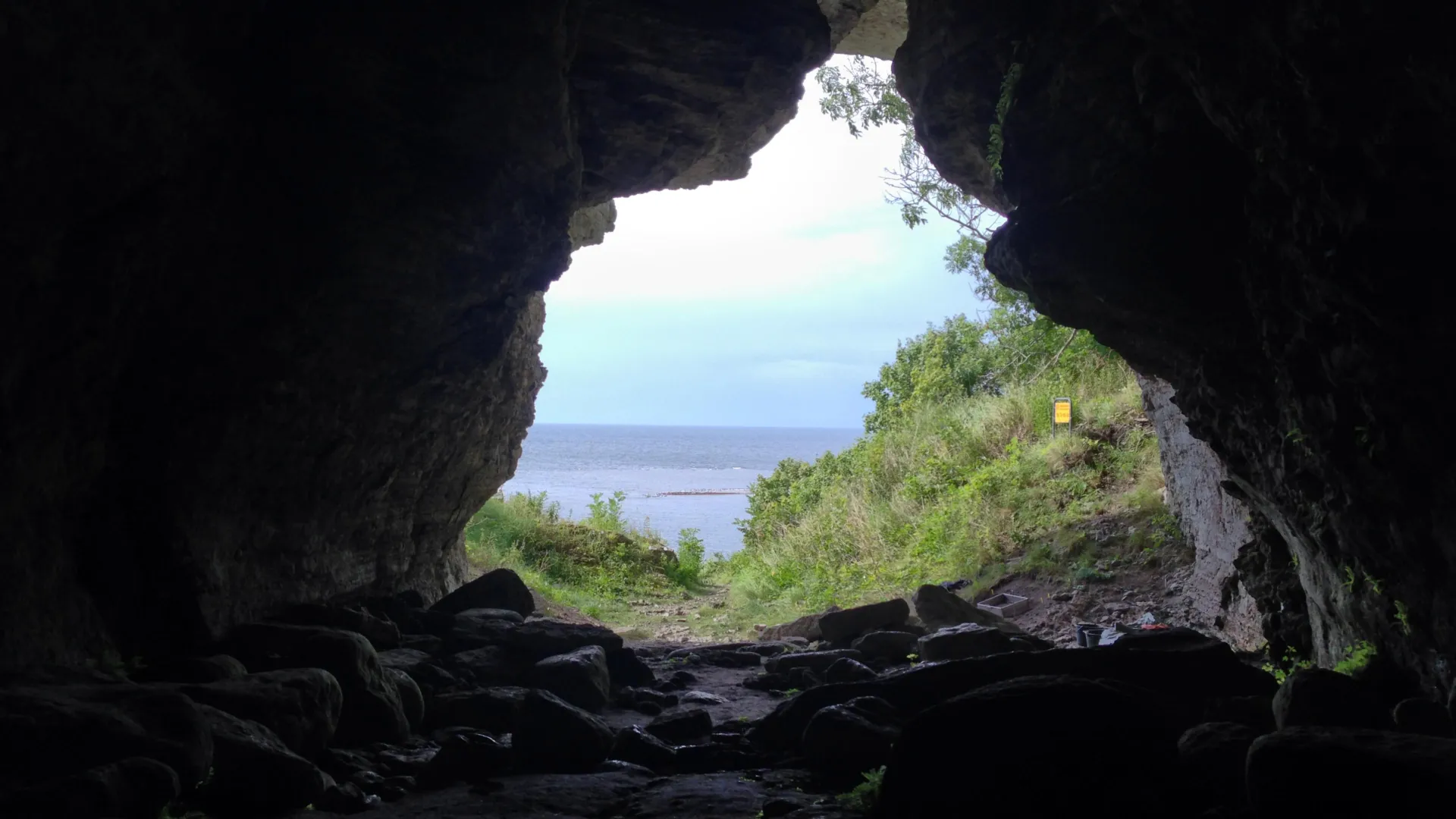
A groundbreaking discovery on the remote Swedish island of Stora Karlsö is forcing scientists to fundamentally re-evaluate their understanding of the complex relationship between early humans and wolves. The identification of wolf remains, radiocarbon dated to between 3,000 and 5,000 years old, on an island devoid of native land mammals presents a compelling puzzle. The inability of wolves to naturally colonize such an isolated landmass strongly indicates that prehistoric humans were responsible for their presence, initiating a cascade of implications regarding ancient human-animal management practices.
The Unforeseen Arrival: Wolves on an Island Isolated by Sea
The archaeological excavation at Stora Fårvar cave on Stora Karlsö has yielded skeletal remains of two canids. These ancient inhabitants, discovered within a site frequented by Neolithic and Bronze Age seal hunters and fishers, span a critical period in human prehistory, thousands of years before the advent of widespread agriculture and complex civilizations. Stora Karlsö, a mere 2.5 square kilometers in size, presents a stark ecological vacuum for terrestrial mammals. The natural dispersal of wolves, animals that are powerful terrestrial predators but incapable of traversing significant bodies of open water unaided, is an impossibility in this context. This geographical reality leads researchers to a singular, albeit astonishing, conclusion: humans actively transported these wolves to the island, likely by boat. This act alone signifies an unprecedented level of human intervention and management of wild carnivores.
The study, meticulously detailed in the esteemed journal Proceedings of the National Academy of Sciences, represents a collaborative effort by leading researchers from the Francis Crick Institute, Stockholm University, the University of Aberdeen, and the University of East Anglia. Their collective expertise in ancient genomics, osteology, and archaeology has converged to paint a picture of human-animal interactions far more nuanced and sophisticated than previously theorized.
Genetic Whispers: Identifying Wolves and Their Unconventional Diet
Initial examination of the two canid specimens raised immediate questions. While the archaeological context suggested a human presence, the precise identity of the animals and their relationship with the island’s inhabitants remained to be elucidated. Advanced genetic analysis provided a definitive answer: both individuals were unequivocally wolves, exhibiting no discernible traces of dog ancestry. This finding was particularly significant, as the prevailing narrative of human-wolf interaction in prehistory has largely been framed by the eventual domestication of wolves into dogs.
Further isotopic analysis, a powerful technique that reveals dietary patterns by examining the chemical signatures in an organism’s tissues, unveiled an even more remarkable aspect of these island wolves’ lives. The results indicated a substantial consumption of marine protein, including seals and fish, a dietary profile remarkably similar to that of the human populations inhabiting Stora Karlsö during the Neolithic and Bronze Ages. This dietary overlap strongly suggests that the wolves were not solely relying on the island’s limited natural resources but were being provisioned by humans.
Additional morphological and genetic observations further distinguished these island wolves from their mainland counterparts. They were found to be smaller in stature than typical wolves from continental Eurasia. Moreover, one of the wolf specimens exhibited exceptionally low genetic diversity, a characteristic often associated with isolated populations or animals subjected to selective breeding or intense management. This finding, when considered alongside the dietary evidence, begins to build a compelling case for a sustained and intentional human influence on these animals.
Dr. Linus Girdland-Flink of the University of Aberdeen, a lead author on the study, articulated the profound surprise of the discovery: "The discovery of these wolves on a remote island is completely unexpected. Not only did they have ancestry indistinguishable from other Eurasian wolves, but they seemed to be living alongside humans, eating their food, and in a place they could have only have reached by boat. This paints a complex picture of the relationship between humans and wolves in the past."
Rethinking Domestication: Beyond the Dog’s Ancestor
The implications of these findings extend far beyond a singular archaeological curiosity. They challenge the long-held, largely linear model of wolf domestication, which posits a gradual evolutionary process where wolves, drawn to human settlements by scraps and opportunistic scavenging, slowly adapted to human environments and eventually diverged into the domestic dog. The Stora Karlsö wolves, while genetically distinct from dogs, exhibit traits suggestive of a relationship that predates full domestication and diverges from the traditional pathway.
Researchers are cautious in definitively labeling the wolves as "tame" or "domesticated" in the conventional sense. The evidence points towards a more complex form of management or cohabitation. Whether they were kept in enclosures, allowed to roam freely within human settlements under supervision, or integrated into the community in some other capacity, their presence on an island inhabited by people unequivocally indicates a deliberate and sustained interaction.
Pontus Skoglund of the Ancient Genomics Laboratory at the Francis Crick Institute and senior author of the study, highlighted the paradigm shift: "It was a complete surprise to see that it was a wolf and not a dog. This is a provocative case that raises the possibility that in certain environments, humans were able to keep wolves in their settlements, and found value in doing so." This "value" could have encompassed a range of possibilities, from the wolves acting as deterrents to other predators, to their role in communal hunting strategies, or even symbolic or ritualistic significance.
Genetic Clues: The Fingerprint of Human Influence
The genetic data provides a crucial layer of evidence, underscoring the potential for human intervention. Anders Bergström of the University of East Anglia, a co-lead author, elaborated on the significance of the low genetic diversity observed in one of the wolf specimens. "The genetic data is fascinating," Bergström stated. "We found that the wolf with the most complete genome had low genetic diversity, lower than any other ancient wolf we’ve seen. This is similar to what you see in isolated or bottlenecked populations, or in domesticated organisms. While we can’t rule out that these wolves had low genetic diversity for natural reasons, it suggests that humans were interacting with and managing wolves in ways we hadn’t previously considered."
A population bottleneck, characterized by a drastic reduction in genetic variation, can arise from various factors. While natural events such as famines or disease outbreaks can lead to such a reduction, the context of human presence and provisioning on Stora Karlsö strongly suggests that human management, potentially involving selective breeding or the maintenance of a small, controlled population, could be the underlying cause. This genetic signature is akin to that seen in domesticated animals, hinting at a level of human control and influence that predates the widely understood timeline of dog domestication.
A Wolf That May Have Been Cared For: Evidence of Compassion or Pragmatism
Perhaps one of the most poignant aspects of the discovery is the examination of a Bronze Age wolf that suffered from a severe limb bone injury. The damage was extensive enough to have significantly impaired the animal’s mobility and hunting capabilities. However, the wolf survived for a considerable period after the injury, evidenced by the clear marks left on its skeleton. This survival, against the odds for a wild predator with such a debilitating condition, strongly suggests that the animal received some form of care or lived in an environment where its survival was not solely dependent on its ability to hunt large prey. This could imply a deliberate effort by humans to tend to the injured animal, perhaps out of a sense of empathy, or a pragmatic understanding of the benefits derived from its presence, even in a weakened state.
New Insights into Ancient Human-Animal Relationships: A Broader Perspective
The synergy between osteology, the scientific study of bones, and advanced genetic analysis has been instrumental in unlocking these new perspectives. This multidisciplinary approach has allowed researchers to glean insights that neither method could have provided in isolation. Professor Jan Storå of Stockholm University, a leading figure in osteoarchaeology, emphasized the transformative nature of this combined approach: "The combination of data has revealed new and very unexpected perspectives on Stone Age and Bronze Age human-animal interactions in general and specifically concerning wolves and also dogs."
The research collectively suggests that the spectrum of human-wolf interactions in prehistory was far more diverse than previously acknowledged. Instead of a binary of hunting or avoidance, the Stora Karlsö evidence points to a sophisticated engagement where certain prehistoric communities actively managed and cared for wolves, fostering long-term relationships that existed in a liminal space between wildness and full domestication.
This discovery opens a captivating new chapter in our understanding of early human ingenuity and adaptability. It hints at experimental approaches to coexistence, where humans explored the potential of living alongside powerful predators, forging bonds that, while not leading to the familiar dogs of today, represent a significant and previously unrecognized facet of our shared evolutionary history. The wolves of Stora Karlsö, an island separated from the mainland by both distance and circumstance, stand as silent witnesses to a forgotten experiment in human-animal partnership, challenging our assumptions and enriching our understanding of the deep past.