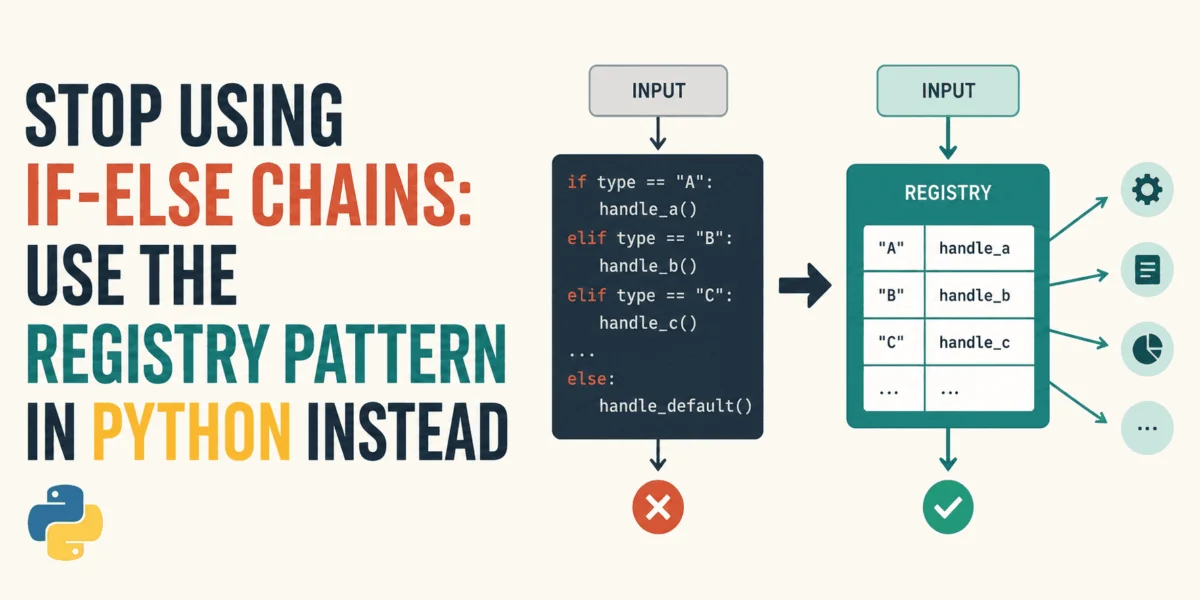
The challenge of managing escalating conditional logic in software development is a pervasive issue, particularly within Python codebases. What often begins as a modest function with a few branches—perhaps two or three—can rapidly evolve into an unwieldy block of if/elif/else statements, sometimes spanning hundreds of lines. This expansion, driven by the incremental addition of new cases and functionalities, inevitably leads to code that is not only difficult to read and understand but also perilous to modify. Such a structure directly contravenes fundamental software engineering principles, most notably the Open/Closed Principle, which dictates that software entities should be open for extension but closed for modification. In response to this prevalent architectural bottleneck, the registry pattern has emerged as a robust and elegant solution, offering a superior method for dynamic object or function lookup and management.
The Pervasive Challenge of Conditional Logic Bloat
The problem with extensive if/elif/else chains extends far beyond mere line count; it fundamentally impairs the health and scalability of a software project. Consider a typical scenario in a data science or machine learning application where a function get_model(name) is responsible for instantiating different model types based on a string identifier. Initially, it might handle LogisticRegression and RandomForestClassifier. Over time, SVC, XGBClassifier, and numerous other models are added, transforming the function into a monolithic dispatcher.
This approach suffers from several critical drawbacks. First, it introduces tight coupling, as the dispatcher function must possess explicit knowledge of every single option it can process. Any new model requires direct modification of this central function, increasing the risk of introducing regressions into already tested code paths. Second, it violates the Single Responsibility Principle, burdening a single function with both the logic for dispatching and the implicit knowledge of all available components. Third, the linear search inherent in if/elif/else chains, while often negligible for small numbers of branches, can become a performance bottleneck in highly dynamic systems with dozens or hundreds of options. Finally, such a structure inhibits introspectability, making it difficult for developers to programmatically discover what options are available without parsing the function’s internal logic. These issues collectively contribute to reduced maintainability, increased development time, and a heightened propensity for errors, particularly in collaborative environments where multiple developers might inadvertently introduce merge conflicts when modifying the same central conditional block.
Introducing the Registry Pattern: A Paradigm Shift in Dispatch
The registry pattern offers a strategic inversion of control, effectively resolving the limitations of traditional conditional chains. Instead of a centralized dispatcher being responsible for knowing and managing every possible option, each option autonomously announces its presence and capabilities to a central lookup mechanism. This mechanism, the "registry," functions as a dynamic catalog that maps specific keys (e.g., model names, payment types, transformation steps) to corresponding objects (functions, classes, or instances). In Python, this lookup table is almost invariably implemented as a dictionary, with the act of "registering" typically facilitated through the use of decorators.
The core benefit of this pattern lies in its adherence to the Open/Closed Principle. Once established, the dispatcher code that interacts with the registry remains static, "closed for modification." New functionalities or components can be added simply by defining them and registering them with the existing registry, thus "open for extension," without altering the core dispatch logic. This modularity not only simplifies feature development but also dramatically reduces the likelihood of introducing bugs into stable parts of the codebase.
The Evolution of the Registry Pattern in Python
The adoption of the registry pattern in Python can be seen as an evolutionary process, progressing from simple data structures to sophisticated, reusable architectural components.
Phase 1: The Dictionary as a Foundational Registry
The most rudimentary yet impactful step in implementing the registry pattern is to replace an if/elif/else chain with a dictionary lookup. This immediate transformation yields significant improvements. For instance, the get_model function, previously a long conditional, can be refactored to query a MODEL_REGISTRY dictionary.
MODEL_REGISTRY =
    "logreg": LogisticRegression,
    "random_forest": RandomForestClassifier,
    "svm": SVC,
    "xgboost": XGBClassifier,


def get_model(name):
    try:
        return MODEL_REGISTRY[name]
    except KeyError:
        raise ValueError(
            f"Unknown model: name!r. "
            f"Available: list(MODEL_REGISTRY)"
        ) from None
This simple refactoring provides immediate benefits: the dispatch operation becomes O(1) (constant time) regardless of the number of registered models, significantly improving performance for large registries. Furthermore, the available options become easily introspectable via list(MODEL_REGISTRY). The dispatcher function itself no longer needs modification for new models. However, this initial approach still requires manual maintenance of the MODEL_REGISTRY dictionary, meaning that adding a new model still involves editing a central dictionary and ensuring its class is imported, retaining a minor violation of the Open/Closed Principle.
Phase 2: Embracing Decorator-Based Automation for Decentralized Registration
To fully decentralize the registration process, Python’s decorator syntax provides an elegant and powerful mechanism. With a decorator-based registry, each function or class explicitly declares its own key and registers itself at the point of its definition. This eliminates the need for a central, manually updated list.
Consider a payment processing system. Instead of a large conditional block in process_payment, a registry can manage various payment handlers:
PAYMENT_HANDLERS =

def register(payment_type):
    def decorator(func):
        PAYMENT_HANDLERS[payment_type] = func
        return func
    return decorator

@register("credit_card")
def charge_credit_card(amount):
    return f"Charged $amount to credit card"

@register("paypal")
def charge_paypal(amount):
    return f"Charged $amount via PayPal"

@register("crypto")
def charge_crypto(amount):
    return f"Charged $amount in crypto"

def process_payment(payment_type, amount):
    handler = PAYMENT_HANDLERS.get(payment_type)
    if handler is None:
        raise ValueError(f"Unknown payment type: payment_type!r")
    return handler(amount)
In this revised structure, the process_payment dispatcher is concise and immutable. To add a new payment method, such as Apple Pay, a developer simply defines a new function, decorates it with @register("apple_pay"), and places it in the relevant file. This eliminates central file modifications, reduces the potential for merge conflicts in shared code, and positions the registration key directly alongside its associated implementation, enhancing code readability and discoverability. This approach fully embodies the Open/Closed Principle, as the system can be extended with new functionalities without altering existing, tested code.
Phase 3: Building a Reusable Registry Class for Robustness
As a codebase accumulates multiple registries, the recurring boilerplate for decorators and basic dictionary management becomes apparent. Encapsulating this logic within a dedicated Registry class offers several advantages, including improved error handling, collision detection, and a cleaner, more consistent API.
class Registry:
    """A reusable name-to-object registry."""

    def __init__(self, name):
        self.name = name
        self._registry =

    def register(self, key):
        def decorator(obj):
            if key in self._registry:
                raise KeyError(
                    f"key!r already registered in self.name!r"
                )
            self._registry[key] = obj
            return obj
        return decorator

    def get(self, key):
        if key not in self._registry:
            raise KeyError(
                f"key!r not found in self.name!r. "
                f"Available: list(self._registry)"
            )
        return self._registry[key]

    def __contains__(self, key):
        return key in self._registry

    def keys(self):
        return self._registry.keys()
This Registry class provides a robust framework. It includes checks to prevent duplicate key registrations and generates informative error messages when an unknown key is requested. Its get method ensures safe retrieval, and methods like __contains__ and keys() provide convenient introspection.
This class truly shines when used to define dynamic pipelines, where the sequence of operations is driven by data rather than hardcoded logic. For example, a text-processing pipeline can be configured as a list of strings, each corresponding to a registered transformation function:
transforms = Registry("transforms")

@transforms.register("lowercase")
def to_lower(text):
    return text.lower()

@transforms.register("strip")
def strip_whitespace(text):
    return text.strip()

@transforms.register("remove_digits")
def remove_digits(text):
    return "".join(c for c in text if not c.isdigit())

# The pipeline is now just data. It could come from a YAML file,
# a CLI argument, or a database row.
pipeline = ["strip", "lowercase", "remove_digits"]
text = "  Order #4521 CONFIRMED  "

for step in pipeline:
    text = transforms.get(step)(text)

print(repr(text))
# Output: 'order # confirmed'
Here, the program’s behavior is dictated by a simple data structure (pipeline), which could originate from an external configuration file, a command-line argument, or a database record. This decoupling of logic from configuration vastly improves flexibility, allowing non-programmers to reorder, add, or remove steps without touching the underlying code, thereby accelerating feature iteration and deployment.
Phase 4: Auto-Registering Classes with __init_subclass__
For scenarios where the registry primarily manages classes, Python 3.6 introduced __init_subclass__, a powerful class hook that fires automatically whenever a subclass is defined. This allows subclasses to register themselves without explicit decorators, streamlining the creation of extensible class hierarchies and plugin systems.
class DataLoader:
    _registry =

    def __init_subclass__(cls, fmt=None, **kwargs):
        super().__init_subclass__(**kwargs)
        if fmt:
            DataLoader._registry[fmt] = cls

    @classmethod
    def get_loader(cls, fmt):
        if fmt not in cls._registry:
            raise ValueError(
                f"No loader for fmt!r. "
                f"Available: list(cls._registry)"
            )
        return cls._registry[fmt]

class CSVLoader(DataLoader, fmt="csv"):
    def load(self, path):
        return f"Loading CSV from path"

class JSONLoader(DataLoader, fmt="json"):
    def load(self, path):
        return f"Loading JSON from path"

class ParquetLoader(DataLoader, fmt="parquet"):
    def load(self, path):
        return f"Loading Parquet from path"

loader = DataLoader.get_loader("parquet")
print(loader.load("sales.parquet"))   # Loading Parquet from sales.parquet
In this example, simply subclassing DataLoader and providing a fmt argument automatically registers the new loader class. This elegant mechanism is a cornerstone for many modern Python frameworks, enabling highly modular and extensible architectures where components "plug themselves in" without explicit registration calls in a central location. It significantly reduces boilerplate and makes the system inherently discoverable.
The Strategic Advantages: Why the Registry Pattern Matters
The adoption of the registry pattern transcends mere code aesthetics; it delivers tangible benefits that impact software project longevity, team productivity, and system adaptability.
Enhanced Maintainability and Scalability
By decoupling component selection from component implementation, the registry pattern dramatically reduces the cognitive load on developers. When a new feature is required, instead of navigating and modifying a sprawling conditional block, developers can focus on creating new, self-contained units of functionality that register themselves. This modularity makes individual components easier to test, debug, and understand, leading to higher code quality and reduced maintenance costs over the project’s lifecycle. For large-scale applications, this pattern enables graceful scaling, as the system can accommodate an ever-growing number of functionalities without the central dispatch mechanism becoming a bottleneck or a single point of failure.
Adherence to Software Design Principles
The registry pattern is a prime example of applying sound software design principles. Its core strength lies in its strict adherence to the Open/Closed Principle. Beyond this, it indirectly supports the Single Responsibility Principle by allowing dispatcher logic to focus solely on lookup, while individual components manage their own implementation and registration. It also aligns with the Dependency Inversion Principle, as high-level modules (the dispatcher) depend on abstractions (the registry interface) rather than concrete implementations of every component. This fosters a more flexible and robust architecture, resistant to changes in specific component implementations.
Facilitating Dynamic Behavior and Configuration
One of the most powerful implications of the registry pattern is its ability to enable dynamic behavior driven by external configuration. As demonstrated with the text processing pipeline, the execution flow of an application can be determined by data—a list of strings, a JSON configuration, or database entries—rather than being hardcoded. This capability is invaluable for building adaptable systems that can be reconfigured on the fly, customized for different users or environments, or extended by non-developers through intuitive configuration files. It moves the system closer to a "pluggable architecture" where components can be swapped in and out with minimal code changes.
Improved Collaboration and Reduced Merge Conflicts
In multi-developer environments, long if/elif/else chains are notorious sources of merge conflicts. Every new feature requiring a new branch in the conditional means developers might simultaneously modify the same lines of code. The decentralized nature of the registry pattern mitigates this issue significantly. Since new functionalities are typically added in new files or new sections of existing files, and then self-registered, the likelihood of concurrent modifications to the same central dispatcher code is drastically reduced, fostering smoother collaboration and fewer integration headaches.
Real-World Applications and Industry Relevance
The registry pattern is not an academic construct; it forms the backbone of numerous widely used tools and frameworks in the Python ecosystem.
- Web Frameworks and Routing: Many web frameworks utilize a form of registry for routing HTTP requests to specific handler functions or views. When you define a route in Flask or Django, you are essentially registering a URL pattern with a dispatcher that maps it to a callable.
- Machine Learning and Deep Learning Frameworks: Libraries like PyTorch Lightning, Hugging Face Transformers, and various MLOps platforms frequently use registries to manage different model architectures, optimizers, loss functions, or data preprocessing steps. This allows users to specify components by name in configuration files, facilitating experimentation and reproducibility.
- Plugin and Extension Systems: Operating systems, IDEs, and complex applications often rely on plugin architectures. The registry pattern is ideal for managing these, allowing third-party developers to register their extensions (e.g., custom parsers, exporters, or visualization tools) without modifying the core application code.
- Data Processing and ETL Pipelines: Beyond the simple text processing example, complex Extract, Transform, Load (ETL) pipelines often involve multiple steps. A registry can manage different transformation functions, data source connectors, or data sinks, enabling highly configurable and extensible data workflows.
- Command-Line Interface (CLI) Tools: Tools with numerous subcommands often use registries to map command names to specific functions that execute the command’s logic, simplifying the addition of new commands.
Practical Considerations and Best Practices for Implementation
While powerful, implementing the registry pattern effectively requires attention to several practical considerations:
- Clear Naming Conventions: Keys used for registration should be descriptive, consistent, and adhere to a clear naming convention to ensure discoverability and avoid ambiguity.
- Robust Error Handling: As demonstrated in the
Registryclass, providing informative error messages for unknown keys or registration collisions is crucial for debugging and usability. - Scope and Lifecycle: Determine whether the registry should be a global singleton (for application-wide components) or an instance-specific object (for context-dependent components). Understanding its lifecycle within the application is important.
- Testing Individual Components: The modular nature of the registry pattern greatly simplifies unit testing. Each registered component can be tested in isolation, as its functionality is decoupled from the dispatcher.
- Documentation: Explicitly document the registry, its purpose, and how to register new components to facilitate adoption by other developers.
Expert Perspectives and Industry Trends
Leading software engineers and architects consistently advocate for design patterns that promote modularity, extensibility, and maintainability. The sentiment across the industry is a strong move away from monolithic, tightly coupled architectures towards more distributed, service-oriented, and component-based designs. The registry pattern aligns perfectly with this trend, providing a fundamental building block for such systems. It embodies the principles of "loose coupling" and "high cohesion," which are cornerstones of scalable and resilient software. The increasing complexity of modern applications, coupled with the rapid pace of development and the need for continuous integration and delivery, makes patterns like the registry indispensable for managing complexity and ensuring long-term project viability. The Python community, known for its emphasis on readability and elegant solutions, has naturally embraced this pattern as a preferred alternative to brittle conditional logic.
Wrapping Up
The registry pattern offers a compelling alternative to the often-problematic if/elif/else chains that plague many Python codebases. By trading a growing, centralized, and difficult-to-extend conditional structure for a dynamic lookup table that components populate themselves, developers gain concrete advantages. The dispatcher code achieves stability, remaining closed for modification. New features can be integrated as new, self-contained units, minimizing disruptions to existing, tested functionalities. Furthermore, the behavior of the program can be driven by data, transforming rigid code into flexible, configurable systems. This paradigm shift provides genuine extension points for users and significantly enhances the maintainability, scalability, and collaborative efficiency of software projects.
Developers are encouraged to consider the registry pattern early in their design process. The next time a third elif clause is contemplated, pausing to evaluate whether a dictionary, a decorator, or a full Registry class would provide a more robust and extensible solution can save countless hours of future debugging and refactoring. The payoff is substantial: a future self, reviewing a concise, four-line dispatcher instead of a sprawling 200-line conditional ladder, will undoubtedly appreciate the foresight.