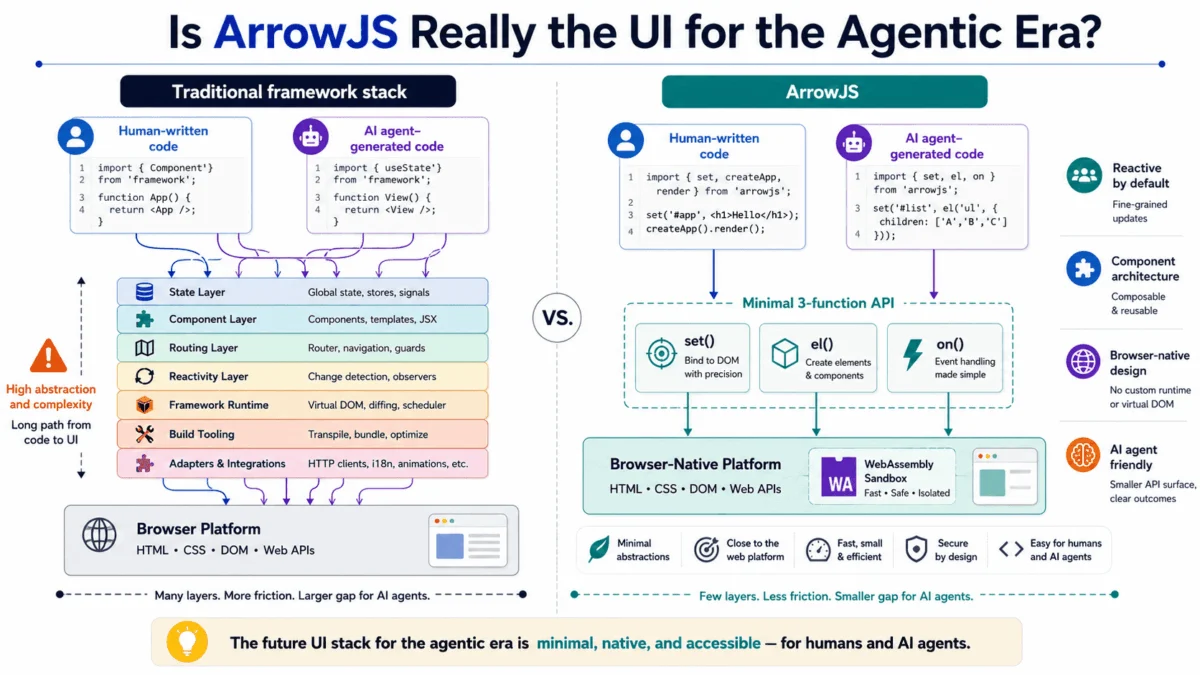
The landscape of software development is undergoing a structural transformation, shifting from a paradigm where human engineers write every line of code to an era where autonomous AI agents generate substantial portions of production applications. For the past decade, web frameworks such as React, Vue.js, and Angular have served as the foundation of the JavaScript ecosystem. However, these tools were conceptualized and optimized for human developers sitting at physical keyboards, leveraging implicit mental models, complex build configurations, and framework-specific syntax rules. As artificial intelligence coding assistants like Claude Code, GitHub Copilot, and Cursor become ubiquitous, industry engineers have identified a growing friction: traditional frameworks create persistent cognitive and execution hurdles for automated agents, frequently resulting in hallucinated syntax, broken state-management rules, and bloated build processes.
Entering this shifting technological environment, the release of ArrowJS 1.0 in early 2026 has introduced a radical counter-proposal. Positioned deliberately as the world’s first user interface framework tailored explicitly for the agentic era, ArrowJS strips away the abstractions that traditionally complicate automated code generation. By returning to native web platform primitives, minimizing its application programming interface (API) surface, and integrating advanced WebAssembly sandboxing for dynamic agent execution, the framework addresses the unique operational constraints of AI coding agents. This development forces a broader industry-wide reevaluation of how software tooling must evolve to accommodate non-human contributors in modern engineering workflows.
The Structural Mismatch Between AI Agents and Legacy Frameworks
To understand the engineering rationale behind ArrowJS, industry analysts point to the fundamental limitations artificial intelligence models encounter when interacting with dominant web frameworks. React, which commands a dominant market share utilized by more than 39 percent of global developers, relies heavily on conventions that require deep human internalization. Strict rules regarding hooks—such as the requirement that they must be executed in the exact same order during every render cycle—alongside nuanced boundaries between controlled and uncontrolled components, present significant hurdles for machine learning models. Because large language models function through statistical pattern recognition across vast corpuses of training data, these implicit constraints frequently manifest as plausible-looking yet fundamentally broken code edge cases.
Similarly, Vue.js and Svelte introduce proprietary compiler syntaxes, single-file component structures, and custom reactivity models that sit as intermediary layers between developer intent and native browser execution. For a human software engineer, these abstractions provide invaluable ergonomics, shorthand notations, and component encapsulation. For an autonomous AI agent, however, every proprietary abstraction layer translates into additional noise, increasing the probability of context degradation, token inefficiency, and syntax hallucinations.
Industry benchmarks indicate that as agents are tasked with generating larger, multi-file web applications, the accumulation of framework-specific rules exponentially increases error rates. Frameworks that demand complex build tooling, Babel configurations, or proprietary transformation pipelines create brittle execution loops where the agent must successfully navigate multiple layers of compilation before verifying whether its generated code actually functions.
Core Architecture of ArrowJS: Primitives for the Machine Age
ArrowJS addresses these systemic inefficiencies through a deliberate design philosophy centered on platform primitives, extreme minimalism, and native browser execution. By aligning its core architecture with features natively supported by modern web browsers, the framework eliminates the cognitive friction that plagues automated code generation.
The architectural foundation of ArrowJS rests upon three primary pillars:
-
Zero Compilation and Native Tagged Templates: ArrowJS eschews JSX entirely, bypassing the need for transpilers, Webpack configurations, or complex build steps. Instead, it leverages native JavaScript tagged template literals to define user interface components. The code executes directly within the browser runtime, which ships at an ultra-lightweight footprint of under 5 kilobytes. For an AI agent, this means code generation is WYSIWYG; the generated text is valid JavaScript that runs instantly without intermediate build artifacts.
-
A Microscopic API Surface: The entire framework API consists of precisely three functions:
reactive,html, andcomponent. These primitives handle state reactivity, template rendering, and modular composition respectively. According to framework maintainers, the complete documentation for ArrowJS fits comfortably within less than 5 percent of a standard 200,000-token large language model context window. This constraint ensures that an AI agent can ingest, reason about, and accurately implement the entire framework without risking context window saturation or memory decay. -
Secure WebAssembly Sandboxing for Dynamic Agent Execution: Perhaps the most distinguishing feature of ArrowJS 1.0 is its dedicated sandbox package. This architecture compiles agent-generated JavaScript or TypeScript code into WebAssembly (WASM), executing it in strict isolation from the host application. Historically, allowing an AI agent to dynamically generate and execute UI code on the fly posed severe security vulnerabilities via unsafe
eval()executions or user experience limitations inside clunky iframes. ArrowJS solves this challenge by permitting users to describe interfaces in natural language, prompting an agent to write the component, and safely rendering that component within a locked-down WASM sandbox in real time.
Industry Reception and Comparative Analysis
The introduction of ArrowJS 1.0 has sparked intense debate across software architecture forums, venture capital circles, and machine learning research labs. Proponents argue that the framework represents a visionary step forward, accurately anticipating a future where software is fluidly generated, modified, and executed by autonomous systems rather than static teams of human developers writing every boilerplate file by hand.
However, mainstream software engineering organizations maintain a pragmatic, cautious stance. The primary counterargument centers on the immense network effects and ecosystem maturity enjoyed by legacy frameworks. React’s greatest asset is not merely its API design, but its decade-long accumulation of third-party component libraries, enterprise design systems, comprehensive hiring pipelines, and millions of documented solutions on developer forums. With a modest open-source footprint hovering around 3,500 GitHub stars, ArrowJS faces a monumental adoption curve before it can be considered a viable replacement for enterprise-scale web applications.
Furthermore, technological advancements in generative AI models complicate the narrative. Prominent generative UI platforms, including v0 and Lovable, have deliberately doubled down on React and standard web stacks. These platforms leverage the massive volume of React training data currently available on the internet to drive high-fidelity code generation. Critics argue that as underlying foundational models grow more powerful, their capacity to memorize and execute complex framework rules will render specialized, minimalist frameworks redundant—implying that agent-hostile syntax may simply cease to be a barrier as artificial intelligence capabilities scale.
Implications for Data Science and Machine Learning Practitioners
For data scientists, quantitative researchers, and machine learning engineers, the emergence of agent-friendly frameworks introduces new architectural possibilities, particularly as organizations transition from static analytical dashboards to dynamic, AI-driven applications.
Traditional data science deployment stacks—such as Streamlit, Gradio, and FastAPI paired with vanilla HTML frontends—remain ideal for standard exploratory data analysis and model prototyping. However, as organizations deploy autonomous agents capable of querying databases, performing statistical transformations, and synthesizing insights on demand, the bottleneck increasingly shifts to the user interface.
Applications requiring generative user interfaces—such as adaptive executive dashboards that reconfigure themselves based on streaming analytical queries, or chat-driven data exploration tools where an agent constructs custom interactive visualizations in real time—benefit immensely from the ArrowJS architecture. By enabling safe, sandboxed, runtime UI generation without heavy build pipelines, ArrowJS provides the necessary infrastructure for systems that require programmatic interface synthesis.
Broader Economic and Software Development Outlook
As the software industry navigates the transition into the mid-2020s, the debate surrounding ArrowJS highlights a fundamental tension between human-centric developer ergonomics and machine-centric execution efficiency. Whether ArrowJS becomes an industry standard or remains a specialized niche tool will depend heavily on variables outside its control: the pace at which foundational model reasoning evolves, the willingness of dominant framework maintainers to introduce agent-optimized tooling, and the broader commercial adoption of generative UI architectures.
For engineering leaders, the framework serves as a timely case study in systems design. It forces technical teams to confront a question they may not yet know to ask: how do we design our foundational infrastructure when the primary consumer of our codebase is no longer a human developer, but an autonomous machine? For data professionals building the next generation of intelligent, responsive software systems, monitoring the trajectory of agent-native tooling has transformed from a speculative exercise into a strategic necessity.