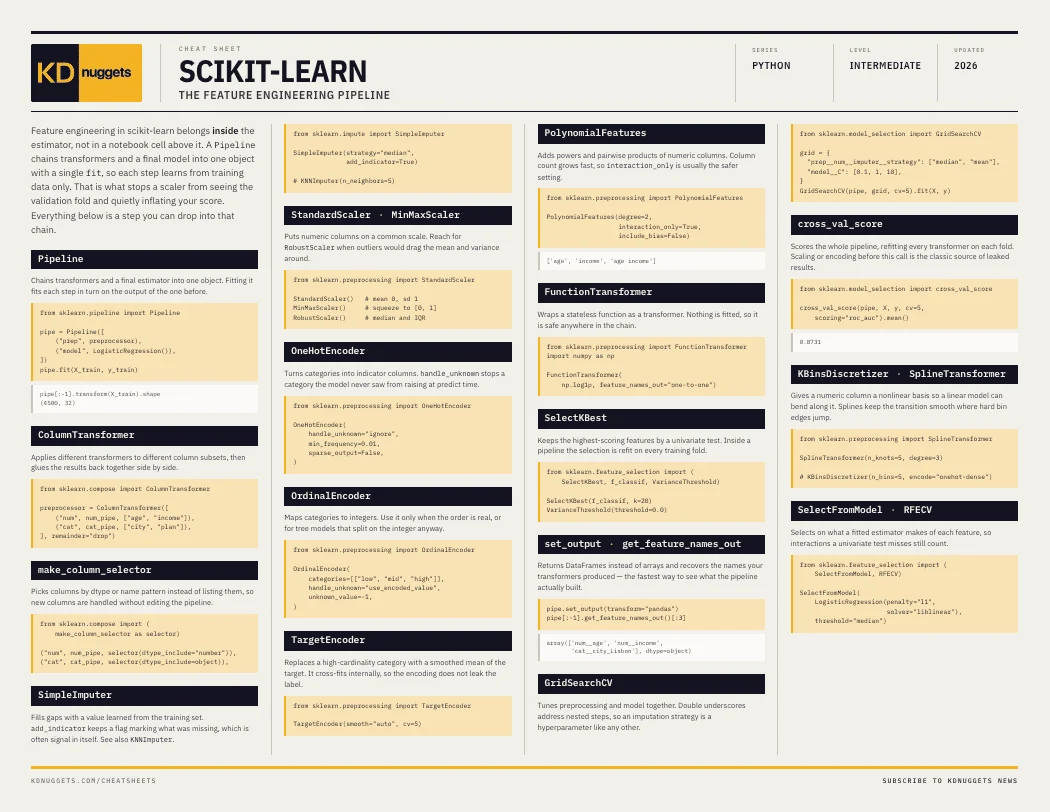
The trajectory of a machine learning model is rarely determined by the sophistication of the estimator itself, but rather by the rigor of the data preparation that precedes it. In data science workflows, early technical errors frequently stem from logistical missteps outside the model architecture rather than algorithmic deficiencies within it. Common pitfalls include scaling a continuous variable in one isolated notebook cell, encoding categorical attributes in another, and executing model fitting further down the script. While cross-validation scores in such disconnected environments often appear artificially inflated, these metrics routinely collapse upon encountering unseen production data. The underlying issue is rarely the mathematical formulation of the estimator; rather, it is data leakage, a phenomenon where preprocessing routines inadvertently expose validation folds to information from the training dataset prior to evaluation.
Addressing this vulnerability requires a structural shift in how data scientists organize their codebases, moving away from fragmented, ad-hoc transformations and toward integrated, reproducible workflows. By embedding feature engineering directly into Scikit-Learn pipelines, practitioners ensure that every transformation step is fitted exclusively on training subsets, preserving the integrity of validation and test splits. To support this industry-wide transition toward more robust modeling practices, technical education platforms have increasingly focused on consolidating these architectural patterns into accessible reference materials. A newly released resource, the Feature Engineering in Scikit-Learn cheat sheet published by KDnuggets, serves as a practical compendium for developers seeking to streamline their preprocessing chains without sacrificing statistical validity.
The Evolution of Data Preprocessing and Leakage Prevention
In the early years of applied machine learning, exploratory data analysis and model training were heavily intertwined. Practitioners relied on manual data manipulation—slicing dataframes, applying scaling functions independently, and merging arrays before passing them to modeling libraries. This unstructured approach created significant maintenance burdens and heightened the risk of data leakage, which occurs when information from outside the training dataset is used to create the model.
Data leakage can severely compromise predictive performance in real-world deployments. For instance, if normalization parameters such as mean and standard deviation are computed across an entire dataset before cross-validation splitting, information from the validation set leaks into the training phase. The model learns characteristics of the validation data it should not yet have access to, yielding overly optimistic performance metrics during development that fail to translate to operational environments.
Recognizing these systemic challenges, core developers of the Scikit-Learn library—originally launched in 2007 as a Google Summer of Code project by David Cournapeau—gradually introduced architectural components designed to enforce best practices. Tools such as the Pipeline class and various composite estimators were developed to encapsulate sequences of transformations and final estimators into a single object. Despite the availability of these tools, adoption rates varied. Many practitioners continued to rely on custom Python loops and manual transformations due to the perceived complexity of configuring multi-step pipelines.
Over the past decade, industry adoption of automated machine learning (AutoML) and MLOps has underscored the necessity of reproducible preprocessing. Regulatory demands in sectors such as finance and healthcare further necessitate audit trails that clearly define data transformations. Consequently, modern data science curricula emphasize pipeline-centric architectures from the outset, transforming what was once considered an advanced feature into a fundamental prerequisite for professional model development.
Core Architectural Components of Modern Pipelines
The utility of a standardized pipeline lies in its ability to orchestrate disparate preprocessing tasks cohesively. Among the most critical structural elements in modern Scikit-Learn workflows is the ColumnTransformer. This class enables data scientists to apply distinct transformation pipelines to different subsets of a dataframe simultaneously. Instead of manually splitting datasets into numerical and categorical components, dropping columns, and concatenating resulting arrays, the ColumnTransformer automates the routing of specific columns to designated transformers.
Complementing this component is the make_column_selector utility, which allows practitioners to target columns dynamically based on their data types rather than explicit string naming. This programmatic selection ensures that data pipelines remain resilient to schema changes. If an upstream data engineering pipeline introduces a new numerical feature, the pipeline adapts automatically without requiring manual updates to column lists.
Handling missing data and categorical variables presents another set of persistent challenges in tabular data modeling. The SimpleImputer class, particularly when configured with the add_indicator=True parameter, addresses missingness by not only imputing missing values with statistical estimates such as median or mean, but also appending binary indicator columns that explicitly flag where data was absent. In many real-world domains, the mere fact that a data point is missing carries significant predictive value; capturing this pattern explicitly often enhances model accuracy.
For categorical features, the OneHotEncoder remains a foundational tool, though improper handling of unseen categories during inference has historically caused runtime exceptions in production systems. Incorporating the handle_unknown="ignore" parameter ensures that unexpected categories encountered during model scoring are safely encoded as all-zeros rather than crashing the prediction service. Furthermore, for high-cardinality categorical variables—such as postal codes or detailed product categories—where one-hot encoding would introduce an intractable number of sparse dimensions, TargetEncoder provides a statistically grounded alternative by replacing categories with the expected value of the target variable, regularized to prevent overfitting.
Inspection, Transparency, and Hyperparameter Optimization
As pipelines grow in complexity, maintaining visibility into the data transformation process becomes increasingly difficult. Combining a ColumnTransformer with feature generation techniques, such as PolynomialFeatures, can rapidly expand a modest dataset of a dozen columns into an expansive feature space comprising hundreds or thousands of dimensions. To combat this opacity, recent enhancements to Scikit-Learn have introduced methods such as set_output(transform="pandas") and get_feature_names_out().
These inspection tools allow data scientists to trace the lineage of engineered features directly within pandas DataFrames. By preserving column names and metadata through transformation steps, developers can easily audit feature importance scores, debug unexpected outputs, and verify that transformations behave as intended before submitting data to downstream estimators.
The true operational payoff of pipeline integration, however, is realized during hyperparameter tuning. When preprocessing steps are decoupled from the model estimator, optimizing data preparation parameters—such as imputation strategies, scaling methods, or encoding techniques—requires separate, error-prone grid searches for each configuration. When preprocessing is fully encapsulated within a pipeline, these data preparation choices become hyperparameters just like any other.
Using utilities such as GridSearchCV or RandomizedSearchCV, practitioners can evaluate multiple imputation methods, feature selection thresholds, and regularization strengths simultaneously within a single cross-validated search. This unified approach eliminates the risk of evaluation bias and ensures that the entire modeling workflow is optimized globally rather than locally optimized at each isolated stage.
Industry Implications and Future Directions
The formalization of feature engineering cheat sheets and standardized architectural patterns reflects a broader maturation within the data science profession. As organizations move past the initial hype cycle of artificial intelligence, the primary bottleneck in machine learning has shifted from algorithmic innovation to data quality, reproducibility, and system reliability.
Industry analysts note that technical debt in machine learning systems frequently accumulates not from poor model choice, but from entangled glue code surrounding the model. By encapsulating data transformations within portable pipeline objects, organizations can serialize entire end-to-end workflows using serialization libraries like joblib or pickle. This capability simplifies deployment pipelines, ensuring that the exact sequence of feature transformations applied during training is identically replicated in production inference servers.
Educational resources that distill these architectural standards into concise references play a vital role in bridging the gap between theoretical knowledge and engineering best practices. As machine learning engineering continues to converge with traditional software engineering disciplines, the reliance on ad-hoc scripting is steadily giving way to modular, testable, and maintainable pipeline architectures. Through the adoption of structured preprocessing chains, data science teams can achieve greater consistency, reduce deployment friction, and build more resilient predictive systems capable of withstanding the complexities of real-world data environments.