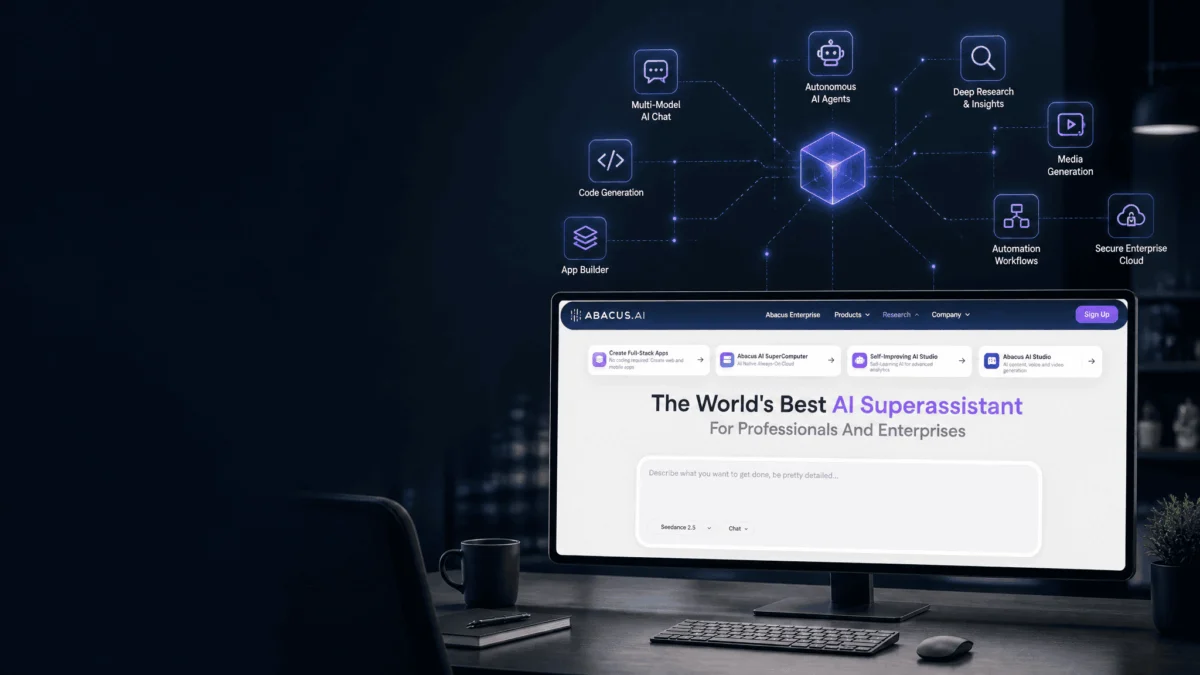
The landscape of generative artificial intelligence has grown increasingly fragmented over recent years, forcing modern professionals, developers, and enterprises to juggle an array of disparate subscriptions. Users frequently find themselves paying separate fees for a general-purpose conversational chatbot like OpenAI’s ChatGPT, a dedicated coding assistant like Anthropic’s Claude, a specialized visual generator for marketing assets, and a cloud hosting environment for application deployment. Into this crowded market steps Abacus AI, an ambitious platform founded in 2019 by former Google Brain researchers. Positioned as an AI super-assistant, the platform aims to consolidate multi-model chat, autonomous multi-step agents, local coding environments, creative studios, application builders, and persistent cloud workloads under a single roof.
This review examines the fundamental architecture, feature ecosystem, transparent pricing dynamics, data governance frameworks, and real-world performance metrics of Abacus AI. By synthesizing product documentation, platform capabilities, and independent user feedback from diverse technological forums, this analysis determines whether Abacus AI successfully reduces administrative overhead and subscription bloat or simply introduces an additional layer of workflow complexity.
Background Context and Market Evolution
The foundational strategy of Abacus AI reflects a broader industry shift away from single-vendor dependence toward unified orchestration layers. When the company launched approximately seven years ago, it operated primarily as an enterprise machine learning platform focused on structured predictive modeling, forecasting, and fraud detection. As generative AI captured global market share following the introduction of foundational large language models, the company expanded its commercial scope to encompass consumer-facing and professional tooling.
The core problem Abacus AI attempts to resolve is cognitive and financial fragmentation. Professionals often need to compare how different model families—such as OpenAI’s GPT series, Anthropic’s Claude, Google’s Gemini, xAI’s Grok, and DeepSeek—interpret the exact same complex document or codebase. Historically, this required opening multiple browser tabs, managing separate billing profiles, and manually transferring context between distinct interfaces.
To mitigate this friction, Abacus AI developed ChatLLM and RouteLLM, allowing users to access more than 100 language, image, and video models within a unified interface or via a single OpenAI-compatible API endpoint. However, market research highlights a persistent technical hurdle inherent in aggregation models: independent routing studies published in early 2026, which analyzed over 400,000 prompt instances across 21 datasets and 33 models, indicate a measurable performance gap between automated routing algorithms and ideal manual model selection. Consequently, while platforms like Abacus AI successfully eliminate tab-switching, they substitute first-party product simplicity for platform breadth and orchestration overhead.
Platform Architecture and Core Tooling Ecosystem
The Abacus AI ecosystem is expansive, spanning consumer-grade conversational tools, developer environments, creative workspaces, and managed infrastructure. Understanding the platform requires analyzing its distinct product pillars.
ChatLLM and Multi-Model Orchestration
ChatLLM serves as the primary conversational front door to the platform. It aggregates models from major providers into a single workspace supplemented by document analysis features, deep research modes, voice access, and project organization directories. The principal advantage lies in comparative workflows: users can upload a spreadsheet or PDF once and query multiple underlying model architectures consecutively without re-uploading files.
Despite its functional versatility, ChatLLM’s interface carries considerable cognitive load. The density of menus, routing settings, and integrated media tools makes it less efficient than single-purpose chatbots for quick, repetitive queries. Furthermore, ordinary text interactions incur minimal computational overhead, but deploying advanced features rapidly draws upon the user’s monthly credit allocation.
Autonomous Agents and Desktop Coding Workflows
The platform features Abacus AI Agent (formerly marketed as DeepAgent), designed for multi-step autonomous assignments such as automated research reports, code reviews, web-scraping workflows, and scheduled business processes. While vendor demonstrations highlight seamless execution, independent user reports reflect a bifurcated experience. Some professionals report receiving structured, highly usable research summaries, while others cite context loss, infinite execution loops, and premature credit exhaustion during failed runs.
For software developers, Abacus AI Desktop integrates a command-line interface, CoWork coding assistants, VS Code extensions, and live meeting transcription listeners. Operating locally on macOS, Windows, and Linux distributions, Desktop processes local documents and repositories without requiring cloud uploads, offering notable privacy benefits. Although promotional materials claim the coding agent outperforms established benchmarks like Claude Code and Codex, these assertions lack independently verified methodology, necessitating rigorous internal validation by technical teams before production deployment.
Application Building, Creative Studio, and Cloud Infrastructure
AppLLM provides a browser-based environment for generating full-stack applications from natural language prompts, complete with built-in databases, authentication flows, and one-click cloud deployment. While effective for rapid prototyping, generated code requires traditional engineering oversight regarding security, authorization, and error handling.
Concurrently, Abacus AI Studio gathers over 50 image, video, and audio models—including Seedance, Veo, and Kling—into a unified creative workspace. While ideal for marketing agencies testing multiple visual concepts simultaneously, video generation consumes platform credits at an accelerated rate. For persistent workloads, Abacus AI SuperComputer offers cloud-hosted environments, SSH access, and S3-style storage to keep applications and databases online outside active browser sessions.
Pricing Structure, Credit Economics, and Value Proposition
Abacus AI utilizes a tiered subscription model paired with a consumption-based credit system. Public marketing highlights an introductory rate of $7 for the first month, transitioning to a standard Basic tier priced at $10 monthly. The Pro tier, priced at $20 per month, expands monthly credit allowances and lifts functional restrictions on autonomous agents, coding tools, and cloud environments. At the enterprise level, dedicated organizational plans reportedly start at $5,000 monthly, incorporating custom machine learning workloads, specialized governance controls, and dedicated computing clusters.
+--------------------+-------------------------+-------------------------+-------------------------------------------------------+
| Plan               | Published Price         | Estimated Monthly Credits| Practical Scope and Feature Availability              |
+--------------------+-------------------------+-------------------------+-------------------------------------------------------+
| Basic              | $7 intro, then $10/mo   | ~20,000                 | ChatLLM, limited Agent access, restricted Desktop     |
| Pro                | $20/mo                  | ~30,000                 | Broader model access, unrestricted Agents, SuperComputer|
| Enterprise         | Starts at $5,000/mo     | Contract-specific       | Organizational integrations, SSO, dedicated support   |
+--------------------+-------------------------+-------------------------+-------------------------------------------------------+
The primary point of friction for subscribers involves credit mechanics. Credits do not equate to direct language-token counts; rather, they serve as a dynamic measure of computational resource consumption. High-complexity tasks—such as video rendering, deep research runs, autonomous agent debugging, and persistent cloud runtime—deplete monthly allocations rapidly. Independent reviews across platforms like G2 and Trustpilot generally praise the all-in-one model variety but frequently cite billing confusion, rapid credit depletion, and variable customer support responsiveness. Consequently, prospective users are advised to evaluate their operational volume against Pro tier allocations rather than relying solely on the low-cost Basic entry point.
Enterprise Security, Data Governance, and Privacy Compliance
For professional and organizational deployment, data security and governance represent critical evaluation criteria. Abacus AI maintains a comprehensive security architecture, documenting AES-256 encryption for data at rest and TLS 1.2 or higher for data in transit. Key management is handled via AWS KMS, complemented by least-privilege access controls, multi-factor authentication, regular vulnerability scanning, and third-party penetration testing.
The vendor formally asserts adherence to SOC 2 Type II, ISO/IEC 27001:2022, HIPAA, GDPR, and CCPA frameworks. Regarding data privacy, Abacus AI explicitly states that customer prompts and uploaded files are not utilized to train generalized or proprietary foundation models, and that user data is permanently deleted within 15 days following a formal account termination request.
However, security analysts emphasize that these corporate safeguards do not automatically eliminate operational risks introduced by user configuration choices. Granting an autonomous desktop agent screen access, integrating corporate email accounts, or establishing public app endpoints expands the organizational attack surface. Businesses handling highly regulated financial or healthcare data must verify contractual terms, demand dedicated tenant configurations, and enforce strict human-in-the-loop oversight before granting agents unmonitored execution authority.
Comparative Market Analysis: Abacus AI vs. First-Party Providers
Evaluating Abacus AI against leading first-party alternatives—such as OpenAI’s ChatGPT Plus, Anthropic’s Claude Pro, and Google Gemini Advanced—requires weighing breadth against specialization.
- Model Variety: Abacus AI provides centralized access to over 100 conversational and generative models, whereas first-party subscriptions restrict users to a single proprietary model family.
- Workflow Integration: Abacus AI bundles application builders, local coding workstations, and creative media suites into a single platform, features that require separate third-party services in traditional setups.
- User Experience and Simplicity: First-party platforms offer streamlined, polished user interfaces designed for immediate conversational utility, avoiding the navigation complexity inherent in Abacus AI’s multi-tool dashboard.
- Cost Efficiency: For professionals who actively utilize model comparison, coding tools, and automated research concurrently, Abacus AI consolidates multiple subscription expenses into a single $20 monthly fee. Conversely, users requiring a reliable, single-model chatbot will find first-party subscriptions more direct and predictable.
Strategic Implications and Final Evaluation
Abacus AI occupies a distinctive position in the generative software market. It is an expansive, highly capable orchestration platform that successfully addresses the administrative burden of subscription fragmentation for technical professionals, developers, and digital agencies. Earning an overall rating of 8 out of 10, the platform excels in model diversity, developer utility, and rapid prototyping capabilities.
However, its valuation is tempered by opaque credit consumption rates, occasional autonomous agent inconsistencies, and interface complexity. Basic tier limitations make the $20 Pro plan the realistic threshold for users seeking genuine workflow consolidation. Organizations and individuals whose daily operations rely on multi-model testing, document processing, and rapid application deployment will find exceptional utility in Abacus AI. Conversely, users requiring simple, predictable conversational interfaces or unmonitored high-stakes automation should approach the platform with measured caution, utilizing introductory billing cycles to rigorously test actual workflow compatibility before making long-term commitments.