The integration of artificial intelligence into business analytics workflows has fundamentally transformed how organizations process and interpret operational data. Standard conversational chatbots frequently fail to apply rigorous data science standards, often providing immediate, confident responses based on insufficient sample sizes. For instance, when queried about promotional performance, a typical language model might recommend a campaign boasting the highest average order volume, even if that average is derived from a single transaction. In contrast, human senior data analysts employ a methodical approach: they critically evaluate context, formulate hypotheses, write precise queries, and verify sample sizes before presenting actionable insights to corporate executives.
To bridge this operational gap, data scientists have engineered modular Python pipelines that embed critical analytical discipline directly into source code. By transitioning from single-prompt interactions to structured, multi-stage workflows, developers can compel artificial intelligence models to adhere to statistical best practices. This technical walkthrough examines the development of a comprehensive Python toolkit designed to process business queries through six distinct validation stages: business context understanding, hypothesis generation, SQL query planning, data validation, executive summarization, and strategic recommendation.
The Evolution of Automated Data Analysis
Early applications of large language models in data analytics relied heavily on prompt engineering, where users submitted raw datasets alongside natural language questions and expected comprehensive, accurate evaluations. While this approach lowered the barrier to entry for exploratory data analysis, it introduced significant vulnerabilities. Models frequently exhibited confirmation bias, hallucinated metrics, or overlooked fundamental statistical anomalies such as class imbalance, missing values, and insufficient statistical power.
Recognizing these limitations, software engineers began developing deterministic frameworks that treat language models as components within a larger, governed ecosystem rather than infallible oracles. By combining the natural language interpretation capabilities of models like Anthropic’s Claude or OpenAI’s GPT-4o with the deterministic execution power of database engines like DuckDB and Pandas, developers can enforce strict computational checks. This methodology ensures that exploratory findings undergo automated scrutiny before reaching executive stakeholders, thereby mitigating the financial and strategic risks associated with unvetted algorithmic recommendations.
Preparing the Analytical Environment and Source Data
To demonstrate the efficacy of a multi-stage analytical pipeline, practitioners utilize a standardized transaction dataset, such as online_orders.csv, which contains granular order-level information across multiple dimensions including product identifiers, promotion codes, unit costs, customer IDs, sale dates, and total units sold. Although compact—comprising merely 29 rows spanning three months, four promotional campaigns, and eleven products—such datasets present acute analytical hazards. Small sample sizes magnify the statistical distortion caused by outliers, making them an ideal proving ground for algorithmic guardrails.
Data ingestion typically begins within a Python notebook environment utilizing the Pandas library. Initial schema inspection reveals data types and missing values, establishing foundational metadata essential for downstream language model prompts. Crucially, before invoking any external application programming interface, analysts deploy DuckDB to perform deterministic SQL aggregations directly on the DataFrame. This local SQL execution exposes immediate statistical discrepancies. For example, grouping the dataset by promotion identifier and sorting by average units per order might initially highlight a specific promotion with an average of 8.0 units. However, inspecting the underlying row count reveals that this top-performing campaign is supported by only a single order, illustrating the exact analytical trap that automated validation pipelines must intercept.
Architecting the Unified LLM Wrapper and JSON Parser
Modern enterprise applications often require flexibility regarding underlying artificial intelligence service providers. To accommodate varying corporate preferences for Anthropic or OpenAI infrastructure, developers construct a unified wrapper class, designated as LLMClient. This architecture abstracts provider-specific communication protocols into a single, standardized complete() method.
The wrapper handles idiosyncrasies such as Anthropic’s multi-block content responses—which require programmatic scanning for text block types—while maintaining clean separation from the core analytical logic. Concurrently, because downstream pipeline stages depend on structured data interchange, developers implement a robust JSON parsing utility. Model outputs frequently include extraneous conversational prose or markdown formatting code fences. The parser systematically strips these artifacts, extracts valid JSON objects or arrays, and triggers explicit exceptions if structural compliance fails, ensuring that malformed model outputs never propagate silently through the workflow.

Executing the Six-Stage Analytical Pipeline
The core functionality of the senior analyst toolkit is encapsulated within a class structure that processes inquiries through six sequential phases.
Stage 1: Business Context Understanding
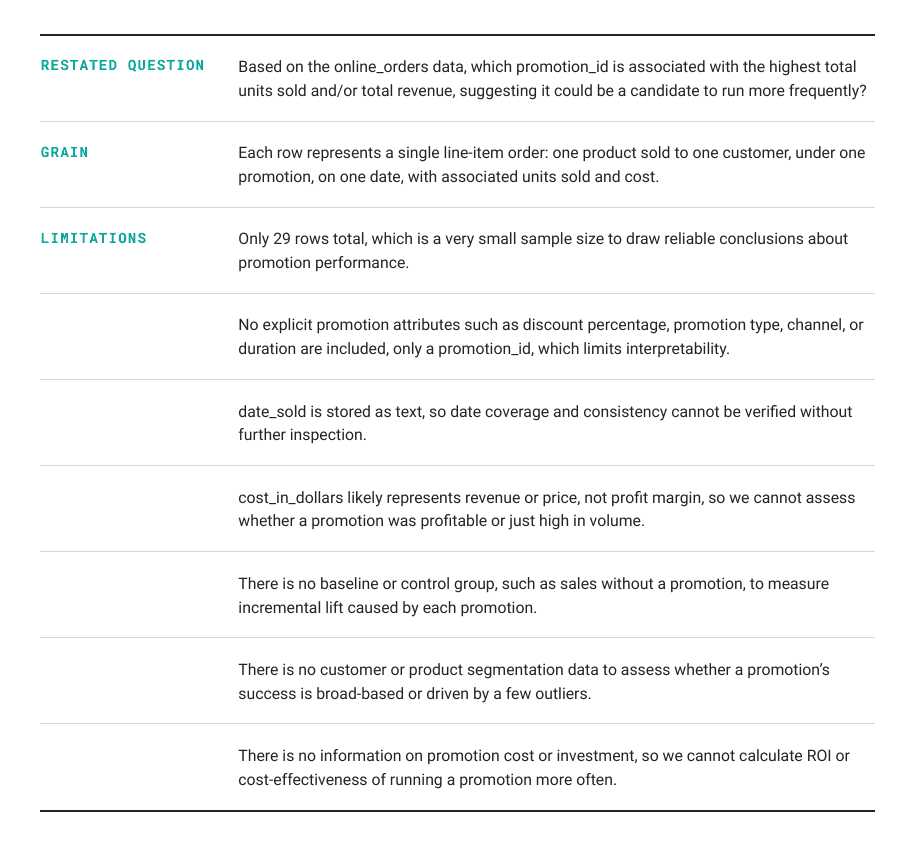
The pipeline initiates by examining the business question in relation to the target table schema and row count. Utilizing the language model, the system restates the stakeholder query into precise, answerable parameters, identifies the grain of the data, and explicitly catalogs known limitations such as restricted date coverage or sample size constraints.
Stage 2: Hypothesis Generation
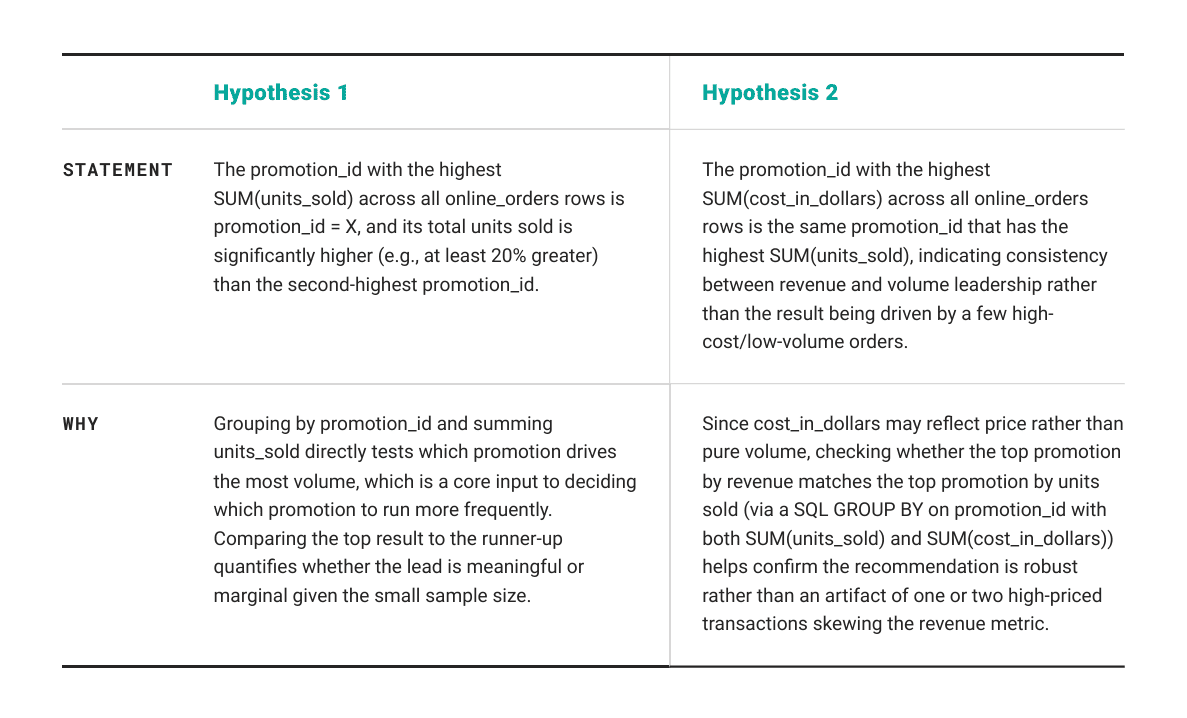
Rather than directly querying for descriptive statistics, the framework prompts the model to generate specific, testable hypotheses utilizing exclusively available table columns. These hypotheses frame analytical exploration around comparative performance rather than isolated maximums.
Stage 3: SQL Planning
The third stage translates the prioritized hypothesis into a robust SQL query executed via DuckDB. Crucially, the prompt instructs the model to incorporate order count metrics alongside aggregated values, ensuring that subsequent verification stages receive the necessary data points to evaluate statistical support.
Stage 4: Validation
Diverging from pure artificial intelligence generation, the validation stage operates entirely through deterministic Python code. The pipeline executes the generated SQL query and checks the resulting order counts against a predefined minimum support threshold, programmatically flagging low-confidence groups.
Stage 5: Executive Summary
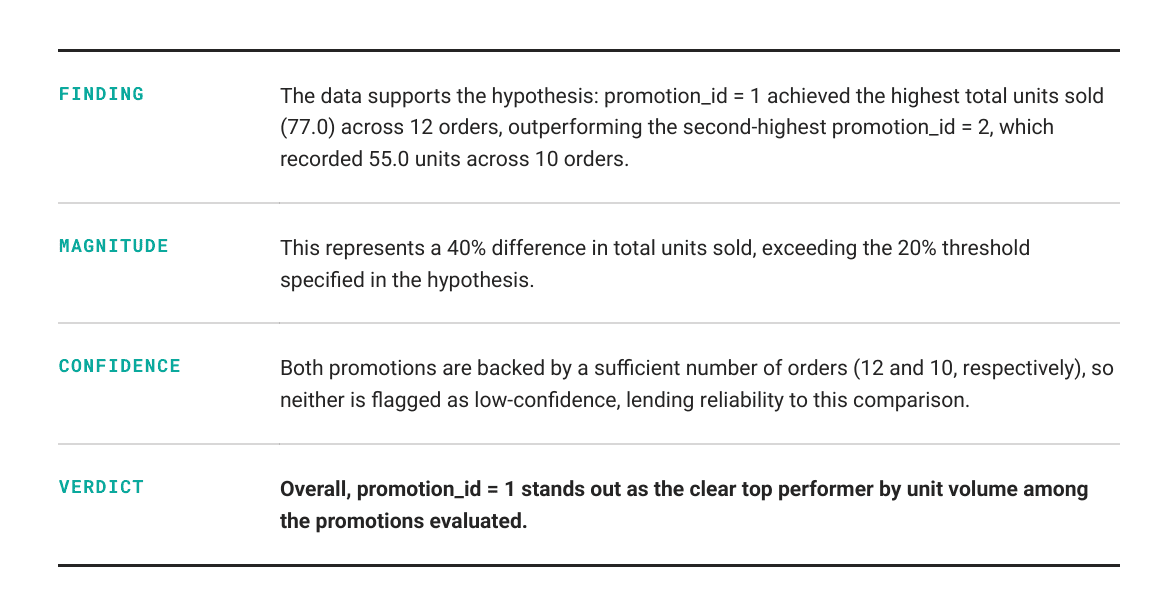
Armed with validated data, the fifth stage synthesizes the findings into a concise executive summary. The prompting instructions explicitly prohibit the model from anchoring headline conclusions on flagged, low-confidence rows, thereby enforcing data-driven objectivity.
Stage 6: Strategic Recommendations
The final stage translates the executive summary into actionable business recommendations. Governed by strict compliance rules, the system ensures that proposed strategies derive exclusively from supported evidence, defaulting to recommendations for further analysis if underlying data strength proves insufficient.
Technical Implementation and Code Architecture
Implementing the complete pipeline requires initializing the client infrastructure with valid authentication keys and instantiating the SeniorAnalyst class. The modular design ensures seamless interchangeability between different model architectures. Whether configured for Anthropic’s Claude Sonnet or OpenAI’s GPT-4o, the operational interface remains identical.
import pandas as pd
import duckdb
import json
import re

class LLMClient:
    def __init__(self, client, model, provider):
        self.client = client
        self.model = model
        self.provider = provider

    def complete(self, prompt):
        if self.provider == "anthropic":
            response = self.client.messages.create(
                model=self.model,
                max_tokens=1024,
                messages=["role": "user", "content": prompt],
            )
            for block in response.content:
                if block.type == "text":
                    return block.text
            raise ValueError("No text block found in Claude's response.")

        if self.provider == "openai":
            response = self.client.chat.completions.create(
                model=self.model,
                messages=["role": "user", "content": prompt],
            )
            return response.choices[0].message.content

        raise ValueError(f"Unsupported provider: self.provider")

def parse_json(text):
    text = text.strip()
    if text.startswith("```"):
        text = re.sub(r"^```(?:json)?s*", "", text, flags=re.IGNORECASE)
        text = re.sub(r"s*```$", "", text)
    try:
        return json.loads(text)
    except json.JSONDecodeError:
        pass

    candidates = []
    object_match = re.search(r".*", text, re.DOTALL)
    array_match = re.search(r"[.*]", text, re.DOTALL)
    if object_match:
        candidates.append(object_match)
    if array_match:
        candidates.append(array_match)
    candidates.sort(key=lambda match: match.start())

    for match in candidates:
        try:
            return json.loads(match.group(0))
        except json.JSONDecodeError:
            continue

    raise ValueError(f"No valid JSON found in model output:ntext")

class SeniorAnalyst:
    MIN_SUPPORT = 3

    def __init__(self, llm, table_name, dataframe):
        self.llm = llm
        self.table_name = table_name
        self.con = duckdb.connect()
        self.con.register(table_name, dataframe)
        self.schema = self.con.execute(f"DESCRIBE table_name").df()
        self.context = None

    def understand_business_context(self, question):
        row_count = self.con.execute(f"SELECT COUNT(*) FROM self.table_name").fetchone()[0]
        columns = self.schema[["column_name", "column_type"]].to_dict("records")
        prompt = f"""You are a senior data analyst. A stakeholder asked: "question"
Table: self.table_name
Columns: columns
Row count: row_count
Restate the stakeholder question in terms this table can actually answer. Also name the grain of the table, and list limitations: sample size, date coverage, missing dimensions.
Return JSON only: "restated_question": "...", "grain": "...", "limitations": ["...", "..."]"""
        self.context = parse_json(self.llm.complete(prompt))
        return self.context

    def generate_hypotheses(self, n=2):
        columns = list(self.schema["column_name"])
        prompt = f"""Business context: self.context
Propose n specific, testable hypotheses that would help answer the restated question, using only columns in: columns.
Return JSON only: ["hypothesis": "...", "why": "...", ...]"""
        return parse_json(self.llm.complete(prompt))

    def plan_sql(self, hypothesis):
        columns = list(self.schema["column_name"])
        prompt = f"""Table: self.table_name
Columns: columns
Hypothesis to test: hypothesis['hypothesis']
Write one DuckDB SQL query that tests this hypothesis. Include a COUNT(*) column named n_orders if grouping.
Return JSON only: "sql": "...", "purpose": "...""""
        return parse_json(self.llm.complete(prompt))

    def validate(self, sql_plan):
        result = self.con.execute(sql_plan["sql"]).df()
        if "n_orders" in result.columns:
            result["low_confidence"] = result["n_orders"] < self.MIN_SUPPORT
        else:
            result["low_confidence"] = False
        return result

    def summarize(self, hypothesis, validated_result):
        flagged = validated_result[validated_result["low_confidence"]] if "low_confidence" in validated_result.columns else pd.DataFrame()
        prompt = f"""Hypothesis: hypothesis['hypothesis']
Query result:
validated_result.to_string(index=False)
Rows marked low_confidence have fewer than self.MIN_SUPPORT orders and should not anchor a conclusion.
Write a concise 3 to 4 sentence executive summary based only on the data shown."""
        return self.llm.complete(prompt)

    def recommend(self, summary):
        prompt = f"""Executive summary: summary
Propose 2 to 3 specific business recommendations based only on what the summary supports. Avoid low-confidence data."""
        return self.llm.complete(prompt)

    def run(self, question):
        context = self.understand_business_context(question)
        hypotheses = self.generate_hypotheses()
        top_hypothesis = hypotheses[0]
        plan = self.plan_sql(top_hypothesis)
        validated = self.validate(plan)
        summary = self.summarize(top_hypothesis, validated)
        recommendation = self.recommend(summary)
        return
            "context": context,
            "hypotheses": hypotheses,
            "sql_plan": plan,
            "validated_result": validated,
            "summary": summary,
            "recommendation": recommendation,
Implications and Future Outlook for Automated Analytics
The implementation of structured, multi-stage analytical toolkits represents a significant maturation in enterprise artificial intelligence adoption. By embedding validation gates directly into computational pipelines, organizations reduce their exposure to algorithmic hallucinations and superficial data interpretations.
As enterprises increasingly migrate toward autonomous data infrastructure, the requirement for deterministic oversight will only intensify. Future iterations of automated analytical frameworks will likely incorporate advanced statistical testing libraries, automated anomaly detection algorithms, and real-time integration with enterprise data warehouses. Ultimately, transitioning artificial intelligence from an unconstrained conversational assistant to a disciplined analytical partner ensures that corporate decision-making remains rooted in verifiable statistical rigor.