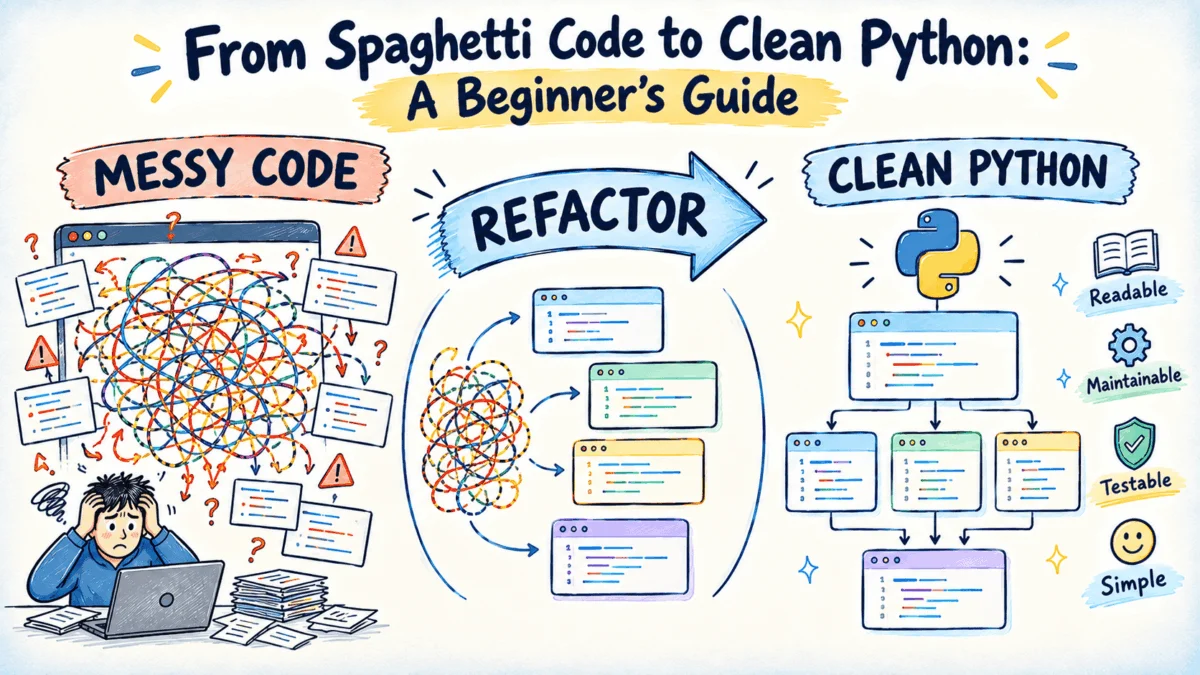
As software systems scale in complexity and modern development teams face mounting pressure to deliver features rapidly, the maintainability of underlying codebases has emerged as a central challenge in enterprise engineering. A primary architectural ailment plaguing legacy and fast-paced projects alike is "spaghetti code"—a pejorative term describing source code characterized by a complex and tangled web of control structures, tightly coupled business logic, and obscured data dependencies. In languages like Python, which prioritize flexibility and rapid prototyping, developers often find themselves writing monolithic functions that handle multiple disparate responsibilities simultaneously. This architectural debt leads to decreased developer velocity, elevated defect rates, and a steep learning curve for incoming engineers. Industry research consistently indicates that software engineering organizations spend up to 70 percent of their total lifecycle costs on maintenance, refactoring, and debugging rather than net-new feature development. Addressing code smells through systematic refactoring—such as decoupling responsibilities, leveraging static typing, adopting data classes, and hardening error handling—has consequently become an urgent priority across the technology sector.
To understand the mechanics of this transformation, it is instructive to examine the lifecycle of a typical monolithic Python script utilized in modern e-commerce or inventory management pipelines. In early-stage applications, developers frequently consolidate distinct business domains into single, expansive routines to accelerate initial deployment. Consider an order-processing function designed for an online retail platform. Within a single execution block, this legacy routine calculates item pricing, applies complex tiered discounts based on customer status, mutates a global inventory dictionary, determines shipping fees based on order thresholds, and simulates the dispatch of confirmation emails.
This tightly coupled paradigm introduces subtle, insidious bugs that are exceptionally difficult to isolate. For instance, in unrefactored scripts where discount logic is evaluated mid-loop against a running subtotal rather than a finalized aggregate sum, the ultimate financial outcome of an order can depend entirely on the arbitrary sequence in which items appear within the incoming data payload. When production outages or financial discrepancies occur, engineers are forced to trace through convoluted loops and side-effect-laden global state modifications, significantly increasing Mean Time to Resolution (MTTR). Code quality metrics tracked by automated static analysis tools routinely flag such patterns as high-risk vulnerabilities, noting that functions exceeding strict cognitive complexity thresholds correlate directly with higher rates of post-release defects.
The systematic remediation of monolithic Python scripts requires a disciplined, step-by-step refactoring methodology that aligns with established software engineering principles, notably the Single Responsibility Principle (SRP). Industry standard guidelines dictate that individual routines should possess a singular, well-defined purpose, accept explicit inputs, and return predictable outputs without inducing unintended side effects across external scopes.
The first phase of this architectural modernization involves disaggregating the monolithic block into specialized, highly focused functions. By separating calculation logic from state mutation and execution flows, developers eliminate order-dependent bugs. For example, isolating subtotal calculations, discount evaluations, and shipping fee determinations into pure functions ensures that each component can be analyzed, evaluated, and executed in complete isolation from the rest of the application.
def calculate_subtotal(items):
    return sum(item.unit_price * item.quantity for item in items)

def apply_discount(subtotal, customer_type):
    if customer_type == "vip":
        return subtotal * 0.85
    if customer_type == "regular" and subtotal > 100:
        return subtotal * 0.95
    return subtotal

def calculate_shipping(discounted_total):
    return 0.0 if discounted_total > 500 else 12.99
This functional decomposition transforms the codebase from an opaque procedure into a transparent, declarative pipeline where inputs map cleanly to outputs.
Beyond procedural decoupling, modern Python development increasingly relies on structured data modeling to eliminate the ambiguities inherent in passing primitive data structures, such as nested dictionaries with string keys, across system boundaries. Loose dictionaries offer no native guarantees regarding schema integrity, mandatory fields, or expected data types, leading to runtime KeyError exceptions and fragile code.
The integration of Python’s built-in dataclasses module addresses this systemic vulnerability by enforcing explicit type definitions and structural contracts. By defining clear data classes for domain entities such as individual order items and overarching transaction records, development teams establish a resilient data layer that can be validated at compile-time and runtime alike.
from dataclasses import dataclass

@dataclass
class OrderItem:
    sku: str
    unit_price: float
    quantity: int

@dataclass
class Order:
    customer_email: str
    customer_type: str
    items: list[OrderItem]
When core coordination logic is refactored to consume these structured dataclasses, functions transition from workers that manipulate arbitrary data to coordinators that orchestrate clean, typed pipelines. The primary processing routine simplifies dramatically:
def process_order(order: Order, inventory: dict) -> float:
    subtotal = calculate_subtotal(order.items)
    discounted = apply_discount(subtotal, order.customer_type)
    total = discounted + calculate_shipping(discounted)
    update_inventory(order.items, inventory)
    return total
This structural clarity significantly enhances readability, allowing engineers to comprehend the entire business transaction top-to-bottom in mere seconds.
Another critical pillar of clean code architecture involves robust error management. In legacy scripts, encountering anomalous states—such as an invalid Stock Keeping Unit (SKU) missing from warehouse inventory—is frequently handled by logging a non-blocking warning message to standard output while permitting execution to proceed unchecked. In enterprise production environments, silent failures of this nature can precipitate severe data corruption, resulting in oversold inventory, fulfillment failures, and compromised customer trust.
Modern software engineering standards mandate fail-fast error handling, wherein exceptions are raised explicitly at the exact locus of failure.
def update_inventory(items, inventory):
    for item in items:
        if item.sku not in inventory:
            raise ValueError(f"item.sku not found in inventory")
        inventory[item.sku] -= item.quantity
By halting execution and surfacing explicit exceptions—such as a ValueError—development teams ensure that anomalous conditions cannot propagate undetected through downstream systems. This practice drastically simplifies root-cause analysis during incident investigations and guarantees transactional integrity.
The ultimate validation of a refactored codebase lies in its testability. Monolithic scripts that entangle input processing, business logic, persistence, and external communication are notoriously difficult to subject to automated unit testing, often requiring exhaustive mocking of global state and environment variables. Conversely, code structured around pure functions, explicit data classes, and strict error boundaries lends itself naturally to comprehensive test coverage using frameworks like pytest.
def test_apply_discount_vip():
    assert apply_discount(200, "vip") == 170.0

def test_apply_discount_regular_under_threshold():
    assert apply_discount(80, "regular") == 80
Industry analysts and software quality benchmarks consistently highlight that high unit test coverage correlates directly with reduced defect density and faster release cycles. When individual business rules are isolated into discrete, testable units, automated test suites execute in milliseconds and point developers with surgical precision to the exact source of a regression. Furthermore, coupling these isolated functions with static type hinting enables advanced linters and Integrated Development Environments (IDEs) to catch type mismatches and interface violations before the code is ever committed to version control.
The economic and operational implications of transitioning from spaghetti code to clean Python extend far beyond immediate aesthetic improvements. Enterprise software organizations that mandate rigorous refactoring protocols report substantial gains in engineering productivity, reduced onboarding timelines for junior developers, and enhanced system resilience. As artificial intelligence and automated code-generation tools become ubiquitous in modern software development workflows, the cleanliness and modularity of underlying codebases have taken on renewed significance. Large language models and AI coding assistants perform exponentially better when processing modular, well-typed, and single-responsibility functions compared to sprawling, state-mutating monolithic scripts.
By systematically replacing loose dictionaries with dataclasses, decoupling calculations from execution sequence order, replacing silent print warnings with explicit exceptions, and establishing granular unit tests, engineering teams future-proof their software infrastructure. Embracing these disciplined refactoring practices transforms Python applications from brittle, high-risk liabilities into scalable, maintainable assets capable of supporting sustained enterprise growth.