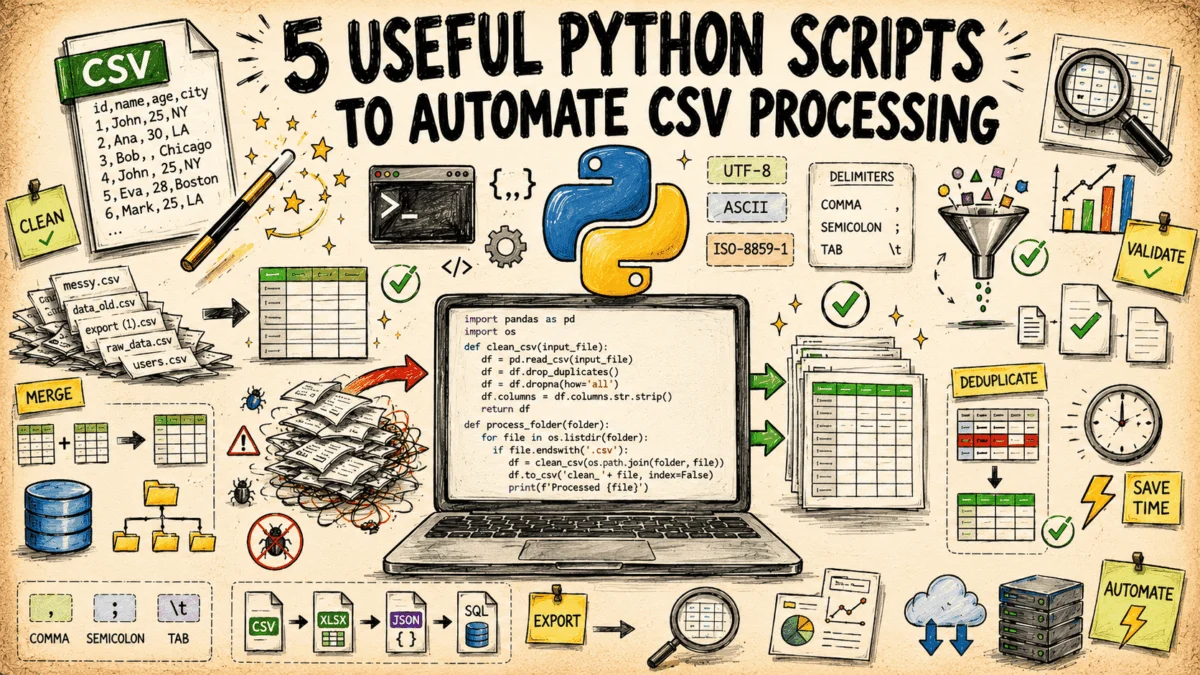
Comma-separated values, universally known as CSV files, remain a cornerstone of data exchange across modern enterprise systems, analytics pipelines, and database operations. Despite the rise of sophisticated data storage formats and cloud data warehouses, simple tabular text files continue to serve as the default output for legacy applications, SaaS exports, and batch processing jobs. However, the ubiquity of CSV files is frequently matched by the persistence of data quality friction. Developers, data engineers, and analysts routinely encounter inconsistent delimiters—ranging from semicolons to tabs—unexpected character encodings, shifting column schemas, and duplicate records.
While these anomalies are generally minor, the manual effort required to remediate them is repetitive, error-prone under tight deadlines, and rarely justifies the development of bespoke, heavyweight internal tools. To address this persistent operational bottleneck, a comprehensive suite of five self-contained Python scripts has been introduced. Designed exclusively around the Python standard library, these utilities eliminate the administrative and security overhead of managing third-party package dependencies or complex virtual environments, making them immediately deployable across virtually any server or local development machine.
The Mechanics of Modern Data Hygiene Challenges
The friction inherent in CSV processing rarely stems from catastrophic system failures; rather, it originates from the quiet degradation of data consistency at the point of ingestion. In enterprise environments where data flows continuously from disparate vendors, internal applications, and customer portals, upstream schema drift is a constant hazard. A routine database export that appears pristine within a spreadsheet application interface may silently harbor critical defects, such as a missing required column, text strings embedded within a strictly numeric field, or anomalous blank values.
Traditionally, these discrepancies are identified downstream after the data has been loaded into a centralized data warehouse or consumed by a machine learning model. Tracing the root cause of downstream pipeline failures back to an unannounced schema modification or encoding mismatch consumes valuable engineering hours. Organizations have long sought lightweight, programmatic guardrails that can inspect, normalize, and validate tabular data at the perimeter of their pipelines before corruption spreads to core analytical systems.
1. Automated Schema Validation and Perimeter Defenses
The first utility in the newly released suite functions as a programmatic schema validator, directly addressing the vulnerability of upstream data ingestion.
Operational Workflow and Architecture
The validator operates by cross-referencing an incoming CSV file against a declarative schema defined in a lightweight JSON configuration file. Administrators map expected column headers to explicit data types—such as integers, floats, dates, strings, and validated email formats—alongside optional regular expression patterns and nullability constraints.
To ensure optimal performance and scalability when handling multi-gigabyte datasets, the script utilizes Python’s csv.DictReader to stream the file row by row. This streaming architecture prevents memory exhaustion by avoiding the need to load the entire dataset into RAM simultaneously. Instead, the script evaluates each cell against its corresponding rule, compiling a granular, row-by-row error report that details exact line numbers and column identifiers. Upon completion, the script yields a non-zero exit code if validation failures are detected, transforming the utility into an effective pipeline gatekeeper that can halt automated workflows before corrupted data propagates further.
2. Row-Level Diffing for Audit Trails and Snapshot Comparisons
Tracking changes between consecutive data exports—such as comparing yesterday’s customer database extract with today’s iteration—has historically relied on manual visual inspection or cumbersome spreadsheet-based comparisons.
Mechanics of Field-Level Variance Detection
The second utility automates this comparative analysis by ingesting two distinct CSV snapshots and aligning them using one or more user-defined primary key columns. By leveraging internal set theory operations, the script rapidly isolates newly added keys, removed records, and surviving entities that have undergone internal modification.
Unchanged rows are systematically filtered out, focusing the output exclusively on actionable variances. For records present in both files, the script evaluates individual column values, recording field-level deltas that capture the transition from old to new values. The resulting audit report is output as a structured CSV detailing the change type, primary key, affected column name, and historical values, providing compliance teams and data engineers with a transparent, easily sortable change log.
3. Normalizing Legacy Formats: Encodings and Delimiters
Interoperability issues between global software systems frequently manifest as encoding corruption and non-standard delimiters. Files originating from regional European systems, for instance, frequently utilize semicolons instead of commas, while legacy enterprise resource planning tools may export files encoded in Latin-1 or featuring intrusive Byte Order Marks (BOM).
Detection and Remediation Protocols
The encoding and delimiter normalizer addresses this by programmatically inspecting the structural composition of an input file prior to parsing. The script reads a binary sample of the file, cycling through a curated shortlist of common character encodings and falling back to probabilistic byte-level heuristics if standard decoders fail.
Concurrently, Python’s built-in csv.Sniffer utility analyzes a sample of the decoded text to accurately determine whether the delimiter is a comma, semicolon, tab, or pipe character. Once the file’s native format is identified, the script streams the data and rewrites it into a pristine, standardized format adhering to modern conventions: UTF-8 encoding, standard comma delimiters, and Unix-style line endings (n). A console summary provides a complete audit trail of the original file parameters and the normalization actions performed.
4. Configurable Column Transformation and Reshaping
Data transformation tasks—such as renaming headers, dropping extraneous fields, reordering columns, and deriving new metrics from existing data points—are routinely performed on an ad-hoc basis. However, applying these transformations consistently across dozens of recurring batch files demands automation.
Safe Expression Parsing and Stream Processing
The column transformer script relies on a declarative JSON configuration file to execute sequential transformation steps, including renaming, dropping, reordering, and deriving columns. To mitigate security risks associated with arbitrary code execution, derived columns are constructed using a restricted, safe expression syntax rather than dynamic evaluation functions.
Users can define templates—such as combining first and last names or converting raw currency strings into floating-point numbers—by coupling template strings with registered conversion primitives like to_float, to_int, and strip_currency. Operating via csv.DictReader and csv.DictWriter, the script maintains a flat memory footprint while guaranteeing that output files mirror the exact column sequence defined in the configuration policy.
5. Reservoir Sampling and Privacy-Preserving Field Anonymization
Sharing production datasets with external collaborators, internal QA teams, or third-party developers for debugging purposes frequently introduces significant regulatory and security compliance risks, particularly under frameworks such as GDPR and CCPA. Manually redacting sensitive columns in spreadsheet software is both time-consuming and prone to human oversight.
Cryptographic Hashing and Memory-Efficient Sampling
The final script in the collection combines probabilistic random sampling with cryptographic anonymization. To handle massive production files without exceeding memory limits, the script implements reservoir sampling, a randomized algorithm that selects a uniform statistical sample of rows in a single pass without pre-loading the entire file into memory.
For columns designated as sensitive in the configuration file, the script applies a keyed cryptographic hash to the original values, truncating the output into consistent, pseudonymous tokens. Crucially, this deterministic hashing ensures that identical input values consistently produce the same masked output within a given processing run. This preserves essential referential integrity and relational mappings between rows while entirely obfuscating personally identifiable information (PII). A concluding execution summary documents the sample size and the specific fields subjected to anonymization.
Comparative Overview of Processing Utilities
| Script Name | Primary Purpose | Key Architectural Features | Optimal Enterprise Use Case |
|---|---|---|---|
| Schema Validator | Enforce structural and data-type compliance | Type checks, regular expression validation, row-level error logging | Automated pipeline ingestion gating |
| Row-Level Diff Tool | Compare sequential CSV snapshots | Key-based entity matching, field-level delta reporting | Automated daily export auditing |
| Encoding & Delimiter Normalizer | Standardize non-compliant tabular files | Automated encoding detection, delimiter sniffing, BOM stripping | Integrating legacy system outputs |
| Column Transformer | Reshape, rename, and derive attributes | Config-driven execution, secure expression parsing, stream processing | Standardizing recurring batch imports |
| Sampler & Anonymizer | Generate safe, reduced subsets of production data | Reservoir sampling, consistent keyed cryptographic hashing | Secure cross-team data sharing and testing |
Strategic Implications for Data Engineering Operations
The introduction of these standardized, dependency-free utilities highlights a broader operational shift within data engineering: the growing emphasis on lightweight, resilient edge tooling. While cloud-native orchestration platforms and heavy data transformation frameworks handle heavy enterprise lifting, micro-tasks associated with file intake and data hygiene remain a persistent source of friction.
By relying exclusively on the Python standard library, these scripts eliminate the vulnerabilities associated with dependency bloat, software supply chain risks, and version conflicts. Organizations adopting these modular utilities can significantly reduce the engineering hours spent troubleshooting routine data ingestion anomalies, thereby accelerating overall pipeline velocity and strengthening data governance standards at the earliest stages of the lifecycle. All scripts and accompanying documentation are publicly accessible via the author’s open-source repository on GitHub for community deployment and customization.