For over a century, the field of paleontology operated under a fundamental consensus: fossilization was a destructive process that effectively incinerated the biological blueprint of an organism. According to the prevailing dogma, the complex organic molecules—the proteins, lipids, and DNA that once animated a living creature—would inevitably degrade, dissolve, or be replaced by minerals within a relatively short geological window. In this view, any biological material recovered from specimens dating back tens of millions of years was considered either an anomaly or the result of modern contamination. However, a landmark study led by the University of Liverpool has provided empirical evidence that shatters this long-standing assumption, confirming that remnants of original protein structures can, in fact, survive the passage of the Mesozoic Era.
The Anatomy of a Discovery: Investigating the Edmontosaurus
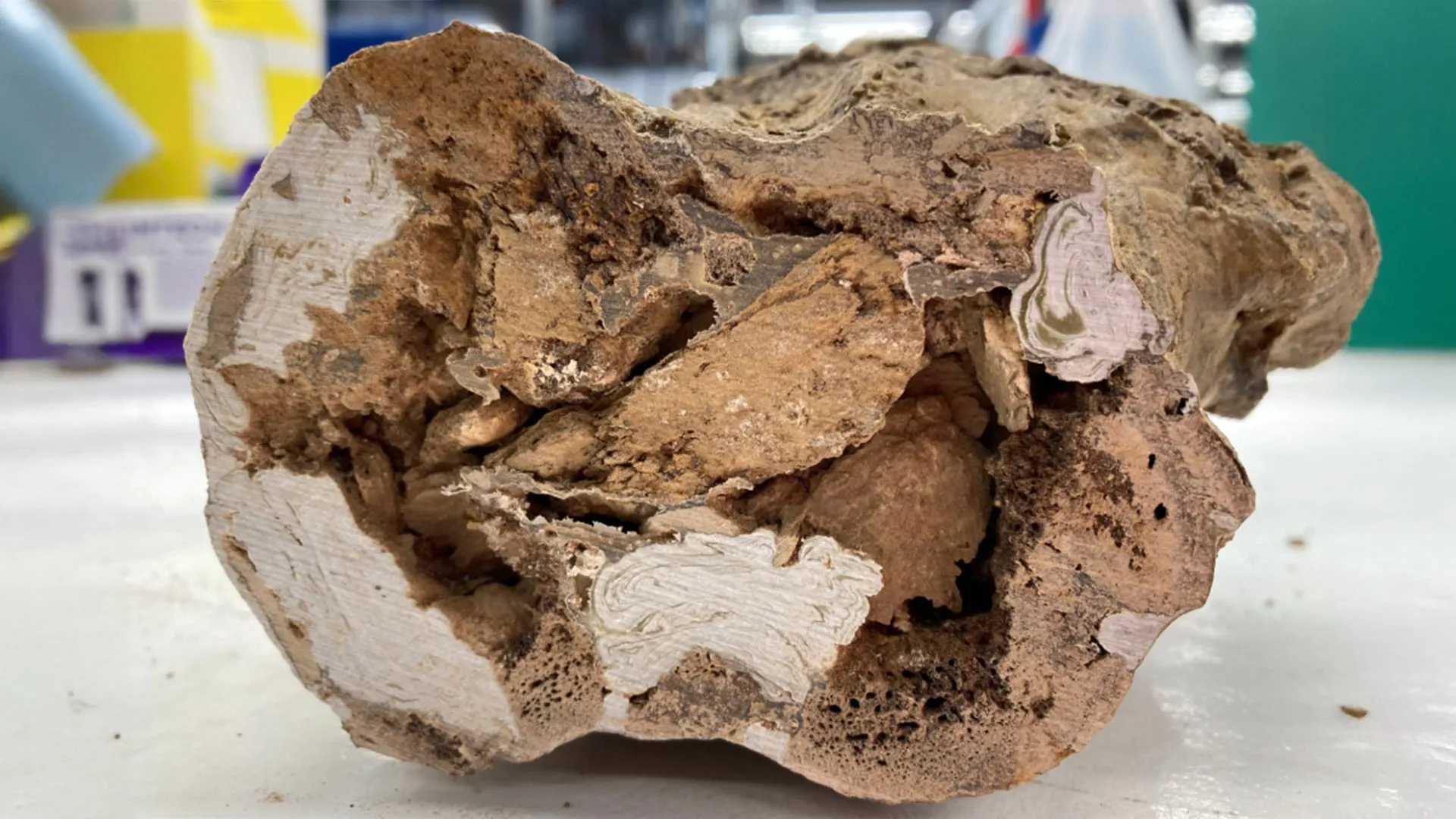
The study, published in the peer-reviewed journal Analytical Chemistry, centers on an exceptionally well-preserved sacrum—a robust structure of vertebrae fused to the pelvis—belonging to an Edmontosaurus, a genus of duck-billed hadrosaur. Excavated from the sedimentary layers of the Hell Creek Formation in South Dakota, this 22-kilogram specimen dates back to the Upper Cretaceous period, placing it near the final chapter of the dinosaur age, approximately 66 to 68 million years ago.
The researchers utilized a multi-institutional approach to interrogate the internal matrix of the bone. By applying advanced protein sequencing and high-resolution mass spectrometry, the team sought to identify molecular signatures that were unequivocally linked to collagen. Collagen, the primary structural protein in the vertebrate skeletal system, serves as the organic scaffold upon which minerals deposit to form bone. Finding remnants of this specific protein in a specimen that has spent tens of millions of years buried in the earth is a feat that was once considered chemically impossible.
A Three-Decade Scientific Impasse
The debate regarding "ancient organics" has simmered in the scientific community for roughly 30 years. The controversy began in earnest during the 1990s and early 2000s, when various research groups reported the detection of soft tissues and protein fragments in dinosaur fossils. Skeptics, however, were quick to point out that these findings could easily be explained by exogenous contamination—bacteria, fungal spores, modern human contact, or environmental leeching of organic matter from the surrounding soil into the porous structure of the fossilized bone.
Because the chemical signature of collagen is ubiquitous in the modern world, proving that detected fragments were "endogenous" (originating from the dinosaur itself) required an extraordinary burden of proof. The University of Liverpool team, working in collaboration with researchers from UCLA and the University’s Materials Innovation Factory, sought to bypass these criticisms by employing a battery of rigorous, redundant analytical techniques.
Methodology: Proving the Persistence of Proteins
To ensure the validity of their findings, the researchers did not rely on a single data point. The investigation was a concerted effort involving several specialized laboratories:
- Mass Spectrometry: The primary tool used to measure the mass-to-charge ratio of ions. By mapping the chemical properties of the fossil samples, researchers could isolate the specific molecular markers of collagen.
- Tandem Mass Spectrometry: Conducted by researchers at UCLA, this technique allowed for the detection and quantification of hydroxyproline. Hydroxyproline is a non-essential amino acid that is almost exclusively found in collagen. Its presence serves as a "molecular fingerprint" for the protein, providing a definitive chemical indicator that collagen—not a common environmental contaminant—was the target of the analysis.
- Proteome Research: The Centre for Proteome Research at the University of Liverpool successfully identified specific fragments of collagen alpha-1, the primary building block of bone tissue.
- Verification: The Materials Innovation Factory provided secondary analytical confirmation, ensuring that the results were reproducible across different testing platforms.
By identifying the specific amino acid sequences that define collagen alpha-1 and confirming the presence of hydroxyproline, the team effectively closed the loophole of "contamination." The findings suggest that while the proteins are significantly degraded—as one would expect after millions of years—they are not entirely replaced or destroyed.
The "Hidden Archive": Revisiting a Century of Microscopy
One of the most profound implications of this research involves the vast, existing archives of paleontology collections worldwide. For over 100 years, scientists have utilized cross-polarized light microscopy to examine thin sections of fossilized bone. This technique, which uses polarized light to reveal the crystalline structures of minerals and organic matrixes, has historically been used to describe the morphology of bone growth.
Professor Steve Taylor, chair of the Mass Spectrometry Research Group at the University of Liverpool, suggests that these legacy images may contain a wealth of untapped data. "Our results have far-reaching implications," Taylor noted. "Firstly, it refutes the hypothesis that any organics found in fossils must result from contamination. Secondly, it suggests that cross-polarized light microscopy images of fossil bones, collected for a century, should be revisited. These images may reveal intact patches of bone collagen, potentially offering a ready-made trove of fossil candidates for further protein analysis."
If specific optical signatures in these century-old images can be correlated with the presence of collagen, researchers may be able to identify "high-probability" fossils for molecular testing without having to subject the entire specimen to destructive sampling. This would effectively turn museums and university collections into a searchable database of ancient molecular information.
The Mystery of Preservation
Despite the breakthrough, the study leaves open one of the most intriguing questions in natural history: How do these molecules survive the entropic decay that should have erased them millions of years ago?
Proteins are inherently unstable. Over tens of millions of years, thermal fluctuations, radioactive decay, and chemical interactions with the surrounding sediment should break down the long peptide chains that make up collagen. The fact that they persist suggests that the environment within the Edmontosaurus sacrum acted as a sort of "molecular vault." Scientists are now theorizing that specific mineralization processes—perhaps the rapid encasement of the protein by iron oxides or other minerals—might shield the protein from the enzymes and water that usually trigger decomposition.
This discovery prompts a necessary re-evaluation of the fossilization process itself. It implies that fossilization is not a uniform, binary event where "organic" becomes "rock," but rather a complex, multi-stage transition that can occasionally trap and preserve the original biochemistry of the organism.
Future Implications for Evolutionary Biology
The ability to extract molecular data from fossils promises to revolutionize our understanding of evolutionary relationships. While DNA is significantly more fragile than protein and remains elusive in specimens of this age, collagen sequences provide a reliable proxy for phylogenetic analysis. By comparing the collagen sequences of different dinosaur species, scientists could potentially construct a more accurate "family tree" of the Mesozoic era, resolving debates about the relationships between various duck-billed dinosaurs or the evolutionary transitions between theropods and modern birds.
As the scientific community digests these findings, the University of Liverpool’s work stands as a testament to the power of modern analytical chemistry in resolving long-standing biological mysteries. The barrier that once separated paleontology from molecular biology has been breached. As researchers apply these new, high-precision tools to other specimens, we may find that the fossil record is far more informative than we ever dared to imagine—not just as a collection of shapes and sizes, but as a library of ancient life waiting to be decoded.