As enterprise adoption of generative artificial intelligence accelerates, organizations increasingly deploy autonomous AI agents capable of multi-step reasoning, dynamic tool selection, and long-horizon execution. However, this shift from simple single-turn prompts to complex agentic workflows has exposed a significant engineering bottleneck: performance regression. When an AI agent’s behavior degrades following a system prompt update, tool description modification, or underlying model swap, identifying the root cause has historically relied on subjective guesswork and manual re-testing.
To combat this opacity, software and machine learning engineering teams are turning toward structured evaluations—commonly known as "evals"—to systematically measure behavioral shifts. Rather than relying on broad, qualitative claims regarding an agent’s capability, modern evaluation frameworks provide a repeatable, metric-driven approach to isolate failures, assess functional improvements, and prevent regressions from reaching production environments.
The Evolution of Agent Testing: Moving Beyond Single-Turn Evals
Evaluating traditional large language model (LLM) outputs has historically been straightforward. Single-turn evaluations typically involve presenting a model with a single prompt, collecting a response, and running a deterministic grader against a known, expected answer. However, autonomous AI agents fundamentally break this linear model of evaluation.
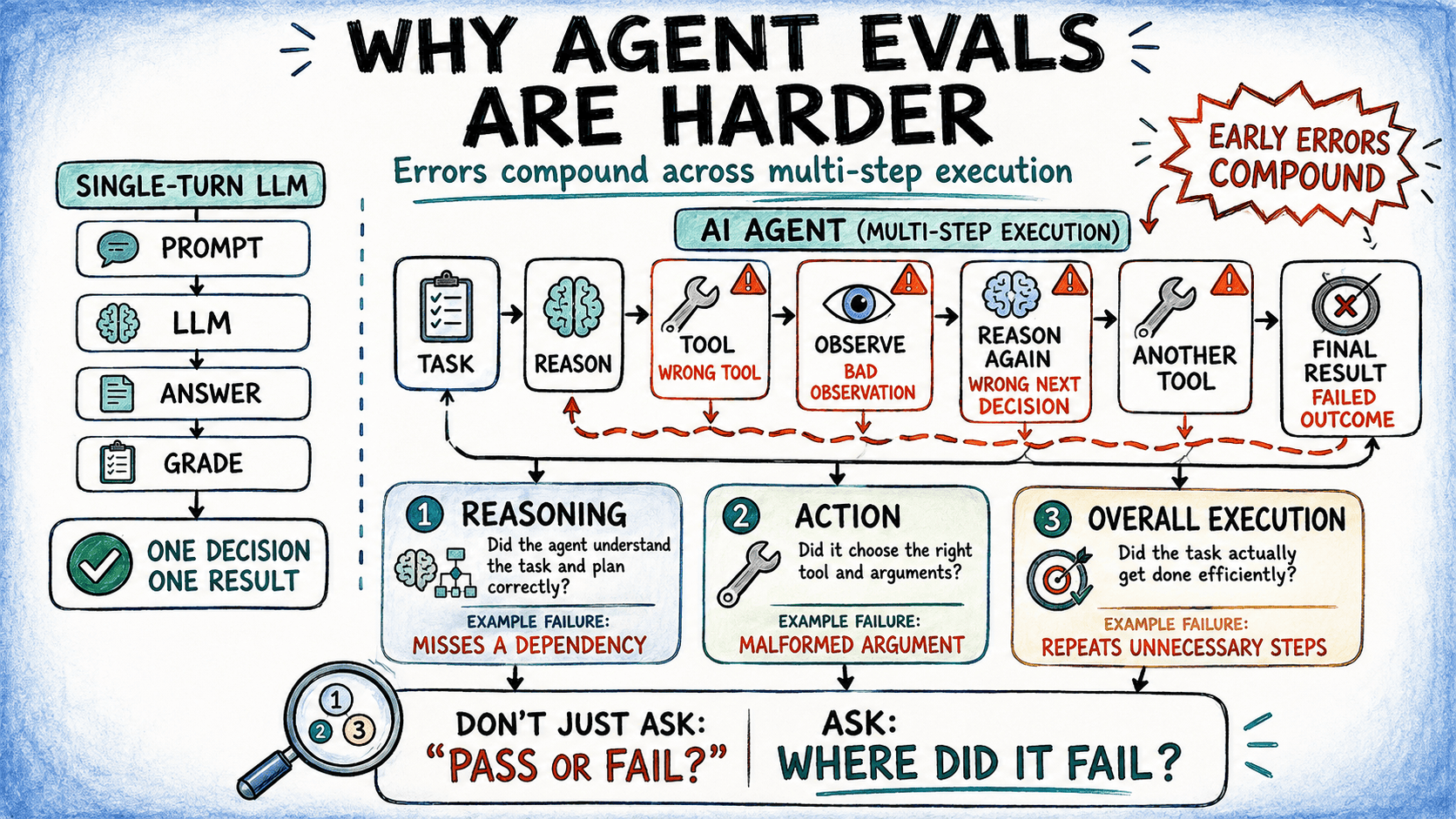
An agent may reason through a complex task, invoke an external API tool, observe the resulting payload, and iterate through this loop dozens of times before reaching a conclusion. Consequently, errors do not remain isolated; a single misstep during an early reasoning phase alters the operational state for every subsequent step, causing errors to compound exponentially over the course of execution.
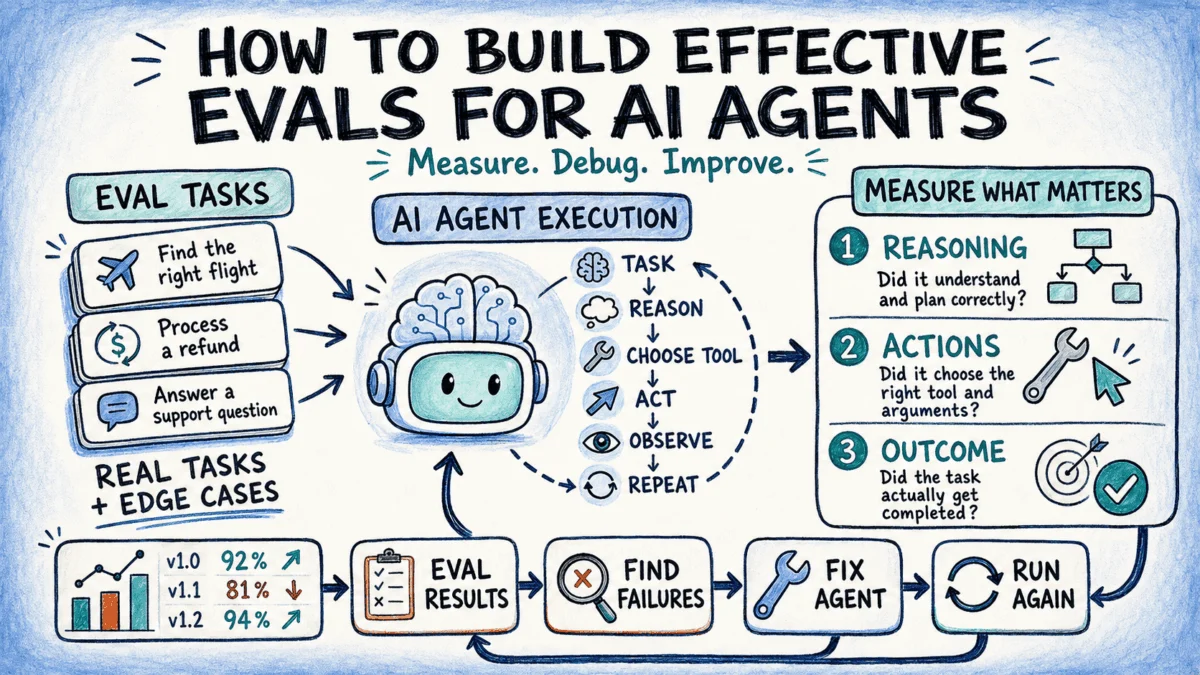
Recognizing this compounding vulnerability, artificial intelligence engineering teams at leading labs and enterprises have established a layered taxonomy for diagnosing agent failures. Rather than treating an agent run as a binary pass-or-fail event, robust evaluation architectures isolate failures into three distinct operational layers: reasoning, action, and overall execution.
The Reasoning Layer evaluates whether the agent understands the core directive, successfully decomposes the objective into logical sub-steps, and maintains an appropriate order of operations. For example, a travel-booking agent fails at the reasoning layer if it attempts to execute a flight reservation before verifying basic seat availability.
The Action Layer focuses on tool utilization. This involves selecting the correct API or database function, providing accurate arguments, and executing the call precisely when required within the workflow sequence. A typical failure at this layer occurs when an agent uses the correct flight-search tool but passes an unrecognized airport code or malformed JSON payload.
Finally, the Overall Execution Layer measures task completion and resource efficiency. An agent may technically achieve the user’s goal—such as successfully booking a flight—yet fail at the execution layer by redundantly querying the same search tool multiple times for information already present in its working context.
Sourcing Tasks and Establishing Robust Test Harnesses
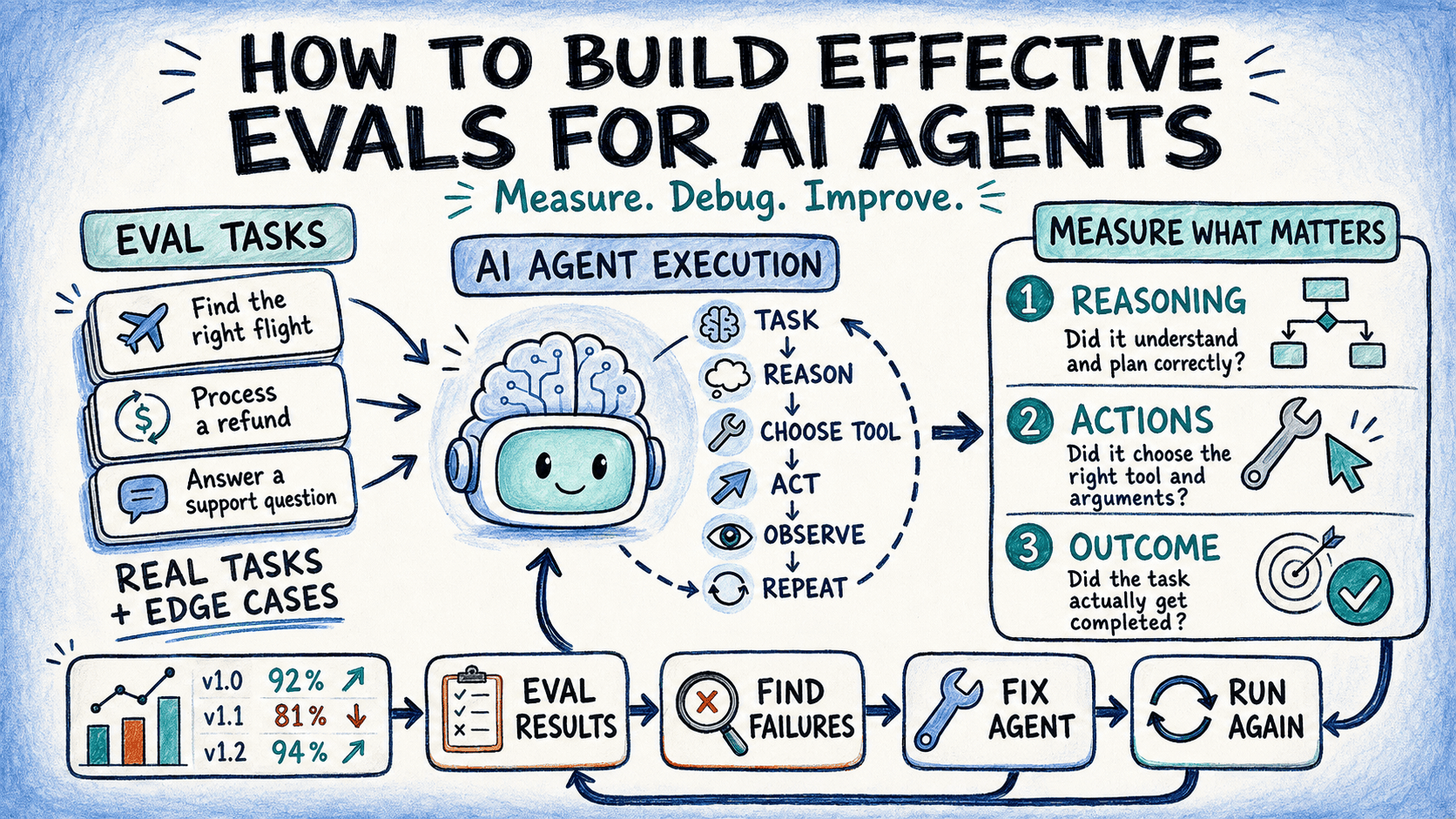
Industry best practices suggest that building an effective evaluation suite does not require hundreds of initial tasks. Instead, engineering teams can construct high-impact eval sets starting with a handful of focused, highly representative scenarios. The most efficient path to sourcing these initial test cases is to formalize the manual quality-assurance checks teams already perform prior to a software release: capturing common workflows, known edge cases, and historical user failures.
Furthermore, balanced task design is critical to prevent false confidence in an agent’s capabilities. Evaluation suites must include negative test cases—queries that should explicitly not trigger certain tools or behaviors—to measure decision-making accuracy rather than mere action repetition.
To ensure reproducibility, test harnesses must operate within strictly isolated, clean environments for every trial. Residual files, cached data, or shared execution histories can artificially skew performance metrics, presenting a misleading picture of agent reliability.
Furthermore, binary scoring mechanisms often obscure nuanced improvements or regressions. Transitioning to partial-credit scoring allows engineers to differentiate between an agent that completely misunderstands a customer support ticket and one that successfully diagnoses the issue and verifies identity, but fails to process an optional refund.
Accounting for Non-Determinism: Pass@k Versus Pass^k
Because frontier models and agentic workflows are inherently non-deterministic, running a single trial per task can yield misleading results. An agent might succeed on the first try due to stochastic variance, yet fail repeatedly under identical conditions. To accurately capture reliability, engineering organizations rely on probabilistic metrics rooted in software testing theory: pass@k and pass^k.
The pass@k metric calculates the probability that an agent achieves at least one successful outcome across k independent attempts. This metric is well-suited for exploratory tasks where finding a valid solution eventually satisfies the user requirement. Conversely, the pass^k metric measures the probability that all k attempts succeed consecutively. For customer-facing, high-stakes enterprise agents where operational consistency is paramount, tracking pass^k ensures that stochastic variance does not mask systemic instability.
Matching Graders to Operational Layers
Selecting the appropriate evaluation mechanism requires aligning the grader type with the specific layer of the agent’s behavior under review. Industry frameworks typically categorize graders into four distinct methodologies: deterministic, code-based, model-based, and human review.
Deterministic graders—such as exact string matching, static test suites, and database state verifications—offer fast, inexpensive, and unambiguous results for fixed outputs. However, they struggle to evaluate nuanced variations or novel problem-solving paths discovered autonomously by frontier models.
Code-based graders, utilizing assertions, API response validations, and custom integration scripts, excel at verifying functional behaviors, structured JSON outputs, and state transitions, provided the test environment remains rigidly controlled.
For subjective, open-ended tasks and freeform natural language generation, model-based graders employ a separate LLM to score the execution transcript against a defined rubric. To maintain integrity, model-based grading systems require regular calibration against human judgment.
Finally, human review remains the gold standard for high-stakes judgment calls that automated scripts or secondary models cannot reliably execute alone, though its cost and latency prevent it from scaling effectively.
Transcript Inspection and Preventing Evaluation Flaws
A high-level dashboard score alone is insufficient to validate an evaluation suite. Industry experts emphasize the necessity of regularly inspecting raw execution transcripts to evaluate the agent’s internal reasoning, intermediate tool calls, and final state transitions. Transcript reviews frequently expose fundamental flaws in the evaluation harness itself—such as overly rigid string-matching graders penalizing correct answers due to minor formatting discrepancies, or ambiguous task definitions that make successful completion nearly impossible.
In many development cycles, rectifying underlying grading bugs has produced dramatic improvements in benchmark scores without requiring any modifications to the underlying model weights. Additionally, engineering teams must guard against benchmark saturation. When an evaluation suite yields a pass rate approaching 98 percent, the suite loses its utility for identifying marginal improvements, functioning merely as a basic regression guard. Maintaining high velocity requires continuously supplementing legacy suites with increasingly complex tasks designed to probe emerging agent capabilities.
Integrating Evals Into the Continuous Development Lifecycle
The true utility of agent evaluations is realized when they are integrated directly into automated software development workflows. By treating agent traces and core functions as core components of a continuous integration and continuous deployment (CI/CD) pipeline, teams can execute eval suites automatically on every pull request. If an update degrades performance beyond established thresholds, the pipeline automatically blocks the merge, preventing regressions from reaching production environments.
Nevertheless, automated pre-production evals must be complemented by rigorous production monitoring. Combining automated unit-test evaluations with live user telemetry, real-time feedback loops, and periodic transcript audits ensures that engineering teams capture edge cases, environmental drift, and user-behavior shifts that fixed pre-release test suites inevitably miss.
Implications for the Future of Enterprise AI Engineering
The widespread adoption of structured evaluation frameworks marks a maturation point in the deployment of generative artificial intelligence. By shifting away from subjective observation and ad-hoc debugging, engineering organizations can treat AI agent development with the same rigorous, empirical discipline applied to traditional software engineering.
Through the systematic implementation of isolated test harnesses, layered grading mechanisms, probabilistic reliability metrics, and continuous workflow integration, developers can transform agent optimization from an exercise in unpredictable guesswork into a measurable, repeatable engineering discipline. Ultimately, establishing this continuous feedback loop—test, measure, diagnose, and improve—enables enterprises to deploy autonomous AI systems with unprecedented confidence, reliability, and scale.